


Commercial Bond Rates 2025: Top Trends & Crucial Insights
Commercial bond rates represent the cost businesses incur when securing surety bonds to ensure contractual or regulatory obligations. These rates fluctuate based on factors like the business’s creditworthiness, economic conditions, and bond market trends. Key aspects to consider include:
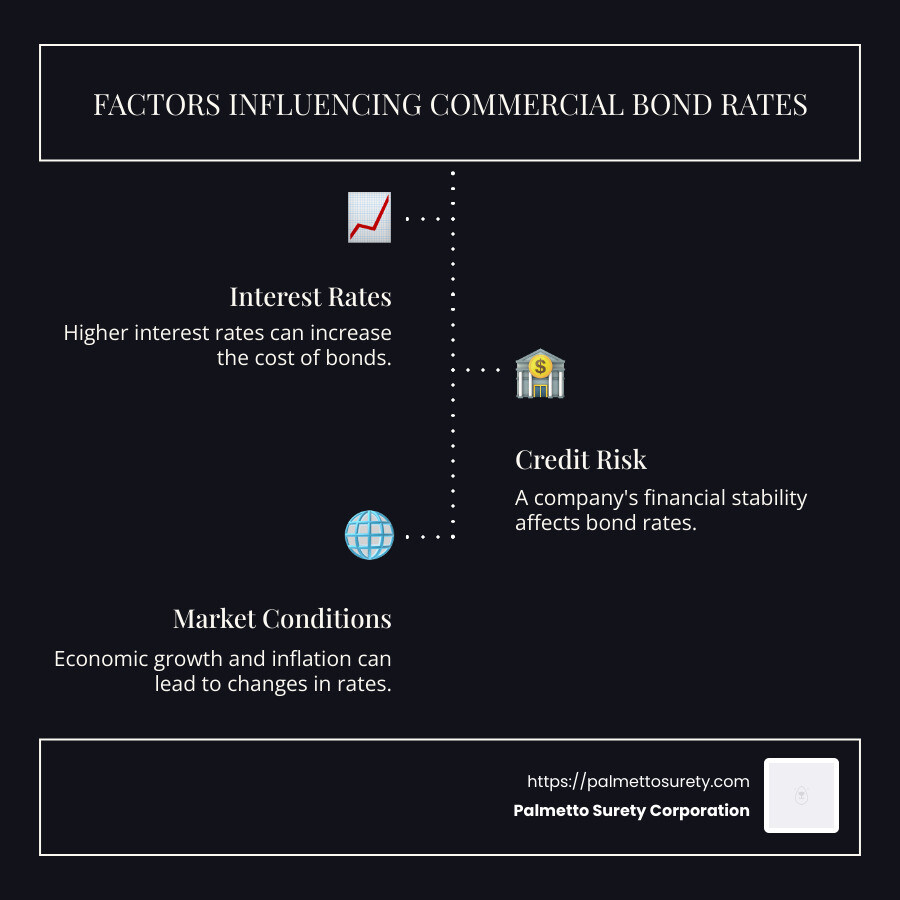
- Interest Rates: Higher rates can increase the cost of bonds.
- Credit Risk: A company’s financial stability affects bond rates.
- Market Conditions: Economic growth and inflation can lead to changes in rates.
Understanding commercial bond rates is crucial for businesses in construction, transportation, and healthcare, as it impacts their financial planning and ability to meet obligations.
As Haiko de Poel Jr, with experience in marketing and rebranding for the surety bond industry, I bring insights into navigating commercial bond rates effectively. With my background, I aim to simplify complex financial concepts for businesses seeking clarity on bond costs.
Understanding Commercial Bond Rates
When it comes to commercial bond rates, three main factors play a pivotal role: interest rates, inflation, and economic growth. Let’s break these down:
Interest Rates
Interest rates are like the heartbeat of the bond market. When they rise, borrowing money becomes more expensive. This means that businesses will pay more to secure bonds. Conversely, when interest rates fall, bonds become cheaper. The Federal Reserve’s decisions on interest rates have a direct impact on commercial bond rates.

Inflation
Inflation is the rate at which the general level of prices for goods and services rises, eroding purchasing power. High inflation can lead to higher bond rates because investors will demand more return to compensate for the decreased purchasing power of future cash flows. Conversely, low inflation often leads to lower bond rates.
Fact: Inflation can lead to increased costs for companies, which may affect their ability to meet bond obligations.

Economic Growth
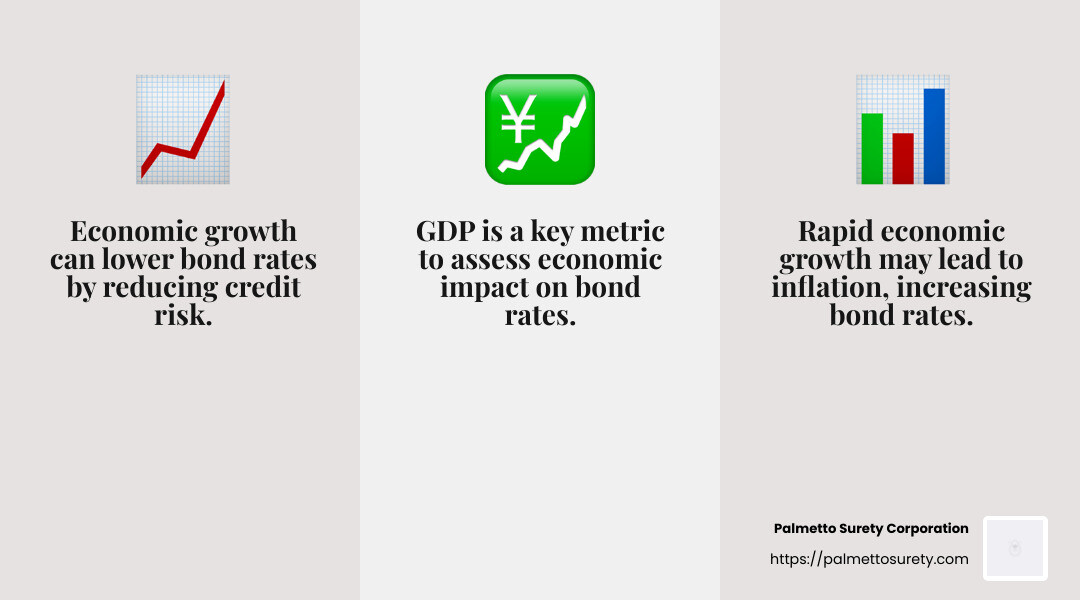
Economic growth, measured by metrics like GDP, can influence bond rates in several ways. During periods of strong economic growth, companies tend to perform better financially, which can lead to lower bond rates due to reduced credit risk. However, rapid growth can also trigger inflation, leading to higher rates as a countermeasure by central banks.
Understanding these factors is essential for businesses, especially those in industries like construction and transportation, where surety bonds are a key part of operations. By keeping an eye on interest rates, inflation, and economic growth, businesses can better anticipate changes in commercial bond rates and plan accordingly.
This knowledge helps businesses make informed decisions, ensuring they secure bonds at the most favorable rates possible.
Factors Influencing Commercial Bond Rates
When it comes to understanding commercial bond rates, it’s crucial to consider a few key factors: interest rates, inflation, the yield curve, and economic growth. Each plays a significant role in shaping the bond market landscape.
Interest Rates
Interest rates are the primary driver of bond rates. When the Federal Reserve adjusts interest rates, it influences the entire financial market. Higher interest rates mean higher borrowing costs, leading to increased bond rates. On the flip side, when interest rates drop, borrowing becomes cheaper, and bond rates usually follow suit.
Inflation
Inflation impacts how much return investors expect from bonds. If inflation is high, the value of future bond payments decreases, prompting investors to demand higher returns to offset this loss. This results in higher bond rates. Conversely, low inflation keeps bond rates lower as the purchasing power of future payments remains stable.
Yield Curve
The yield curve shows the relationship between interest rates and the maturity of debt. A normal yield curve, which slopes upward, suggests that longer-term bonds will have higher rates. This is because investors require more return for locking up their money longer. However, an inverted yield curve, where short-term rates are higher than long-term rates, can signal economic trouble ahead, impacting bond rates across the board.
Economic Growth
Economic growth, often measured by GDP, affects bond rates in multiple ways. In times of robust growth, businesses thrive, and default risk decreases, leading to lower bond rates. However, if growth is too rapid, it can spark inflation, which might push rates higher as central banks take action to control it.
Understanding these factors helps businesses and investors steer the bond market more effectively. By keeping an eye on changes in interest rates, inflation, yield curves, and economic growth, they can make informed decisions about when to secure bonds and at what rates.
This knowledge is especially valuable for industries reliant on surety bonds, allowing them to plan and budget more accurately.
Current Trends in Commercial Bond Rates
Commercial bond rates are influenced by many factors, and understanding their current trends can help businesses make better financial decisions. Let’s explore some of the key trends shaping the market today.
Moody’s Aaa Yield
Moody’s Aaa yield is a benchmark for the highest quality corporate bonds. This yield is often used as a reference point for other bond rates. As of January 2025, the yield was reported at 6.08%. This marks an increase from previous months, with December 2024 at 5.80% and November 2024 at 5.78%. This upward trend suggests a tightening in the bond market, possibly due to rising interest rates or increasing inflation expectations.
HQM Yield
The HQM (High Quality Market) yield curve is another important indicator. It provides spot rates for high-quality corporate bonds, helping investors gauge the market’s direction. Recent data shows that the HQM yield has been experiencing gradual increases, reflecting broader market trends. This increase is consistent with the rise in Moody’s Aaa yield, indicating a general shift towards higher bond rates.
Market Trends
Several market trends are currently influencing commercial bond rates:
-
Interest Rate Hikes: As central banks, like the Federal Reserve, adjust interest rates to manage inflation, bond rates often follow suit. The recent hikes have put upward pressure on yields, making borrowing more expensive.
-
Inflation Concerns: With inflation on the rise, investors demand higher yields to compensate for the decreasing purchasing power of future bond payments. This has led to an overall increase in bond rates.
-
Economic Growth: While economic growth is typically positive for businesses, rapid growth can lead to inflationary pressures. This necessitates rate hikes, further influencing bond yields.
-
Yield Curve Dynamics: The yield curve has been flattening, suggesting uncertainty about future economic growth. A flat or inverted yield curve can indicate potential economic slowdowns, impacting bond rates and investor sentiment.
Keeping an eye on these trends helps businesses and investors anticipate changes in the bond market. By understanding how factors like Moody’s Aaa yield and HQM yield interact with broader economic conditions, they can better steer the complexities of securing and managing commercial bonds.
By staying informed about these trends, businesses can make more strategic decisions about their financial operations, ensuring they remain competitive and resilient in the face of changing market conditions.
How to Analyze Commercial Bond Rates
Analyzing commercial bond rates involves understanding several key concepts: bond yield calculation, the bond yield curve, and investment strategies. Let’s break these down into simple terms.
Bond Yield Calculation
A bond’s yield is the return an investor earns from the bond’s interest payments. There are different ways to calculate this, but the most common methods include:
-
Coupon Yield: This is the bond’s annual interest payment divided by its par value. For example, a bond with a $1,000 par value and a 5% coupon rate pays $50 annually. So, its coupon yield is 5%.
-
Yield to Maturity (YTM): This is a more complex calculation that considers the bond’s current market price, its par value, coupon interest rate, and the time left to maturity. YTM provides a comprehensive view of the bond’s potential return if held to maturity.
Bond Yield Curve
The bond yield curve is a graph showing the yields of bonds with the same credit quality but different maturities. It helps investors see how yields change over time.
-
Normal Yield Curve: This slopes upward, indicating that longer-term bonds have higher yields than short-term ones. This is typical when the economy is growing steadily.
-
Inverted Yield Curve: This slopes downward, suggesting that short-term bonds offer higher yields than long-term ones. An inverted curve can signal economic trouble ahead.
-
Flat Yield Curve: This occurs when there is little difference between short-term and long-term yields, often signaling uncertainty about future economic growth.
Understanding the yield curve helps investors predict economic trends and make informed decisions about which bonds to buy or sell.
Investment Strategies
Investors use different strategies to manage their bond portfolios based on their goals and risk tolerance:
-
Laddering: This involves buying bonds with different maturities. As each bond matures, the proceeds are reinvested in a new bond with a longer maturity. This strategy helps manage interest rate risk.
-
Barbell Strategy: This involves investing in short-term and long-term bonds but avoiding intermediate maturities. It allows investors to benefit from high yields on long-term bonds while keeping some assets liquid with short-term bonds.
-
Bullet Strategy: This focuses on bonds with the same maturity date. It is often used when investors have a specific future financial need.
By understanding these concepts, investors can better analyze commercial bond rates and make strategic decisions that align with their financial goals. This knowledge is crucial for navigating the bond market’s complexities and optimizing investment returns.
Frequently Asked Questions about Commercial Bond Rates
What are the current corporate bond rates?
Corporate bond rates fluctuate based on various economic factors. As of February 24, 2025, Moody’s Seasoned Aaa Corporate Bond Yield stands at 5.29%. This rate is a measure of the yield on corporate bonds with the highest credit rating, indicating low risk. It’s slightly lower than the long-term average of 6.43%.
The HQM Yield Curve also provides insights into corporate bond rates, offering a snapshot of yields across different maturities. These rates are crucial for investors looking to assess the risk and return of investing in high-quality corporate bonds.
What is the 5-year corporate bond rate?
The 5-year corporate bond rate is a key indicator for investors, reflecting the yield of bonds maturing in five years. This rate can vary based on market conditions, including interest rates and economic growth expectations.
Currently, the market trends show a slight decline in bond yields compared to the previous year. For example, a year ago, the Moody’s Aaa yield was at 5.01%, showing a modest increase to 5.29% in the current period. This highlights the dynamic nature of bond yields and the influence of broader economic factors.
How do economic factors influence bond yields?
Several economic factors impact commercial bond rates:
-
Interest Rates: When central banks raise interest rates, corporate bond yields typically rise to remain attractive to investors. Conversely, lower interest rates can lead to decreased yields.
-
Inflation: Rising inflation can erode the purchasing power of the fixed income from bonds, prompting higher yields to compensate investors for this risk.
-
Economic Growth: Strong economic growth can lead to higher corporate earnings, reducing the risk of default and potentially lowering yields. However, sustained growth might also trigger inflationary pressures, influencing yields upward.
Understanding these factors helps investors anticipate changes in bond yields and adjust their strategies accordingly. By staying informed about current rates and economic indicators, investors can make more informed decisions in the bond market.
Conclusion
At Palmetto Surety Corporation, we understand the complexities of commercial bond rates. With over 20 years of experience in the industry, our expertise spans various sectors including construction, manufacturing, transportation, and healthcare. Our deep understanding of market trends and economic factors allows us to offer custom advice and solutions.
One of our standout features is our quick service. We know that time is of the essence for our clients, so we strive to approve most applications within hours. This efficiency sets us apart and ensures that you can focus on what truly matters—running your business smoothly and effectively.
Our team is dedicated to providing you with the best service possible. Whether you’re a small business or a large corporation, we are here to help you steer the complexities of commercial surety bonds with confidence.
For more information, visit our commercial surety bonds page to see how we can assist you in meeting your bonding needs.


