


Florida Statute Performance Bonds: Top 5 Crucial Facts 2024
Understanding Florida’s Performance Bond Laws: A Detailed Guide
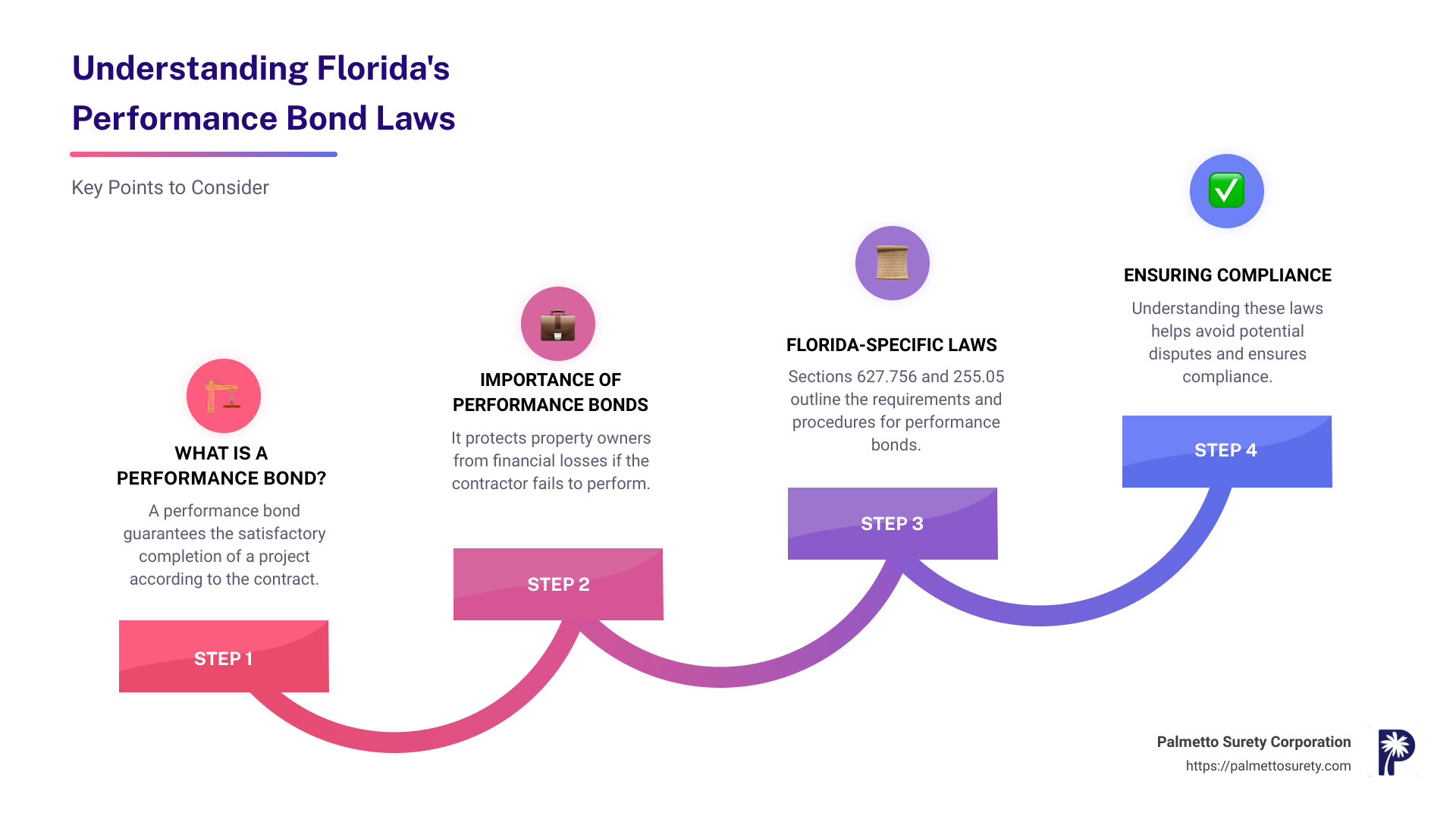
Florida statute performance bonds provide crucial protections in construction projects, ensuring contractors fulfill their contractual obligations. Here’s a quick rundown of what you need to know:
- What is a performance bond? A performance bond guarantees the satisfactory completion of a project as per the contract.
- Why is it important? It protects property owners from financial losses if the contractor fails to perform.
- Florida-specific laws: The state has specific statutes like Section 627.756 and Section 255.05, which outline the requirements and procedures for performance bonds.
Florida law requires performance bonds on public construction projects, though they may also be needed for private works. These bonds safeguard the project’s successful completion by holding sureties accountable if the contractor defaults. Understanding these laws ensures compliance and helps avoid potential disputes.
I’m Haiko de Poel Jr, with extensive experience at Palmetto Surety Corporation, specializing in florida statute performance bonds. I’ve helped numerous businesses steer the complexities of surety bonds to ensure compliance and successful project completion.
Glossary for florida statute performance bonds:
What is a Performance Bond?
A performance bond is a financial guarantee that ensures a contractor will complete a construction project according to the agreed-upon terms and conditions. This bond is a type of surety bond involving three parties: the principal (contractor), the obligee (project owner), and the surety (bonding company).
Purpose of Performance Bonds
The primary purpose of a performance bond is to protect the obligee from financial loss if the contractor fails to meet their obligations. This bond guarantees that the project will be completed as specified in the contract, covering any costs that arise from contractor defaults.
A performance bond acts as an insurance policy for the project owner, providing peace of mind that the project will be finished satisfactorily.
Construction Agreements and Contractor Obligations
In construction agreements, performance bonds are often required to ensure that contractors adhere to the project’s scope, timeline, and quality standards. Contractors must secure these bonds before starting work, demonstrating their commitment and financial stability.

Key contractor obligations under a performance bond include:
- Completing the project on time.
- Adhering to the project’s specifications and quality standards.
- Managing subcontractors and suppliers effectively.
Difference Between Performance Bonds and Payment Bonds
While performance bonds and payment bonds are both essential in construction, they serve different purposes.
Performance Bonds:
- Guarantee: Ensure the contractor completes the project as per the contract.
- Beneficiary: Protects the project owner from incomplete or defective work.
Payment Bonds:
- Guarantee: Ensure that subcontractors, suppliers, and laborers get paid for their services and materials.
- Beneficiary: Protects against claims from unpaid parties, preventing liens on the property.
Payment Bonds: Protecting Subcontractors and Suppliers
Payment bonds are crucial in construction projects as they safeguard subcontractors, suppliers, and laborers from non-payment. These bonds ensure that all parties providing labor and materials are compensated, even if the principal defaults.
Without a payment bond, unpaid subcontractors and suppliers might file liens against the property, leading to legal complications and potential project delays.
Guarantees and Financial Security
Both performance and payment bonds provide financial security and ensure that construction projects run smoothly. They mitigate risks for project owners and ensure that all parties involved are protected from financial loss due to contractor defaults or non-payment.
By understanding the roles and differences between performance bonds and payment bonds, project owners can make informed decisions that safeguard their investments and ensure project success.

Next, we’ll dig into the specifics of Florida Statute 337.18: Surety Bonds for Construction Contracts, outlining the statutory requirements and key provisions that contractors and project owners must follow.
Florida Statute 337.18: Surety Bonds for Construction Contracts
Key Provisions of Florida Statute 337.18
Florida Statute 337.18 outlines the requirements and conditions for surety bonds in construction contracts. This statute ensures that public construction projects are completed as promised and that all parties involved are protected financially.
Statute Requirements
The statute mandates that a surety bond is required for the successful bidder of a construction contract. This bond must be equal to the awarded contract price. However, for multiyear maintenance contracts, the department may allow incremental annual contract bonds that cumulatively total the full awarded price.
The department also has discretion in phased design-build contracts to permit multiple performance and payment bonds in succession, aligning with each contract phase.
Contract Award and Bond Requirements
When a contractor is awarded a contract, they must secure a surety bond. This bond guarantees the project’s prompt, faithful, and efficient performance according to the plans and specifications. It also ensures the prompt payment of all laborers, material suppliers, and equipment providers involved in the project.
In some cases, the department may waive the bond requirement:
- Contracts priced at $250,000 or less if the project is noncritical and nonperformance does not endanger public health, safety, or property.
- Prime contractors that are qualified nonprofit agencies for the blind or severely handicapped.
- Subcontractors that are qualified nonprofit agencies for the blind or severely handicapped, with waivers not exceeding the subcontract amount.
For high-value projects ($250 million or more), the department may reduce the bonding requirement and set a surety bond amount that is a portion of the total contract price. Alternative means of security, such as letters of credit or cash collateral, may be provided for the balance.
Defaults and Damage Assessments
If a contractor defaults, the surety is responsible for completing the contract work according to the original plans and specifications. The surety’s liability is limited to the penal sum of the bond and does not cover personal injury or property damage arising from the default.
Public Work
All bonds must be payable to the department and conditioned for the project’s faithful performance. For contracts priced at $25,000 or less, the security may be a cashier’s check or money order instead of a surety bond.
The department has rules to refuse bonds from sureties that fail to settle or defend claims on previous contracts.
Summary of Key Provisions
- Surety Bond Requirement: Equal to the awarded contract price.
- Waivers: Available for noncritical projects under $250,000 or for qualified nonprofit agencies.
- Reduced Bonding: For projects $250 million or more, with alternative security options.
- Defaults: Surety completes the contract work, limited to the bond amount.
- Security for Small Contracts: Cashier’s check or money order for contracts $25,000 or less.
By understanding these key provisions, contractors and project owners can ensure compliance with Florida’s performance bond laws and safeguard their construction projects.
Next, we’ll explore the requirements for performance bonds in Florida, detailing contractor obligations and the process for securing these bonds.
Requirements for Performance Bonds in Florida
Exemptions and Special Conditions
Contractor Obligations
In Florida, contractors are required to secure performance bonds to guarantee the satisfactory completion of construction projects. These bonds ensure that contractors fulfill their contractual obligations, protecting project owners from financial loss if the contractor fails to perform. This is crucial for both public and private construction projects.
Public Records and Surety Insurer
Performance bonds must be issued by a surety insurer authorized to do business in Florida. The bond becomes a public record, accessible for verification. Contractors need to provide a certified copy of the bond to the project owner, ensuring transparency and compliance with legal requirements.
Contract Value Thresholds
Not all contracts require performance bonds. Florida statutes have specific thresholds:
- Contracts priced at $250,000 or less may have the bond requirement waived if the project is deemed noncritical and nonperformance poses no risk to public health, safety, or property.
- High-value projects ($250 million or more) may have reduced bonding requirements. The department can set a surety bond amount that covers a portion of the contract price, with alternative security like letters of credit or cash collateral for the remaining balance.
State Contracts
For state contracts, performance bonds are typically mandatory. The Florida Department of Transportation (FDOT) often requires these bonds to ensure project completion and payment to subcontractors, suppliers, and laborers. The bond amount is usually equal to the awarded contract price unless specific exemptions apply.
County and City Contracts
Local government contracts may also require performance bonds. Counties and cities in Florida follow similar guidelines, ensuring that public projects are protected. However, there may be flexibility based on the project’s scope and criticality.
Exemptions
Certain conditions allow for exemptions from the performance bond requirement:
- Nonprofit Agencies: Prime contractors or subcontractors that are qualified nonprofit agencies for the blind or severely handicapped can receive waivers. However, the waiver amount for subcontractors cannot exceed the subcontract value.
- Small Contracts: For projects priced at $25,000 or less, contractors can opt to provide a cashier’s check or money order instead of a performance bond.
By understanding these exemptions and special conditions, contractors can steer Florida’s performance bond laws more effectively, ensuring compliance and protecting their interests.
Next, we’ll discuss The Surety’s Options for Default Under a Florida Performance Bond, outlining the steps sureties can take when a contractor defaults.
The Surety’s Options for Default Under a Florida Performance Bond
Surety Actions Post-Default
When a contractor defaults on a performance bond in Florida, the surety has several options to address the situation. These options are designed to ensure that the project is completed to the satisfaction of the property owner, while also protecting the financial interests of the surety.
1. Paying the Bond Amount
The surety can choose to pay the amount of the bond directly to the project owner. This payment covers the losses incurred due to the contractor’s failure to perform. The amount paid will be up to the limit specified in the performance bond.
2. Financing the Contractor
If the project is near completion, the surety might opt to finance the current contractor to finish the work. This option is often used to avoid further delays and additional costs associated with bringing in a new contractor. The surety provides the necessary funds to ensure the project is completed according to the contract terms.
3. Negotiating Completion
In some cases, the surety and the contractor may negotiate a plan to complete the project. This could involve revising the project timeline, adjusting the scope of work, or other modifications that satisfy the property owner. The goal is to reach an agreement that allows the contractor to finish the job while meeting the owner’s expectations.
4. Replacing the Contractor
The surety might decide to take over the project and arrange for a replacement contractor to complete the remaining work. This involves selecting a new contractor who can meet the project specifications and deadlines. The surety oversees the transition to ensure minimal disruption and timely completion.
Legal Remedies and Performance Bond Terms
The surety’s actions are guided by the terms of the performance bond and relevant Florida statutes. The bond outlines the surety’s obligations and the contractor’s financial responsibilities. If the contractor defaults, they are required to reimburse the surety for any costs incurred in fulfilling the bond terms.
Example Case Study: Palm Beach County v. Trinity Industries, Inc.
In the case of Palm Beach County v. Trinity Industries, Inc., the court highlighted the importance of performance bonds in public projects. The case demonstrated how a surety could be held accountable for ensuring project completion, emphasizing the legal backing provided by Florida statutes.
By understanding these options, contractors and property owners can better steer the complexities of performance bond defaults. The surety’s role is crucial in maintaining project integrity and financial stability.
Next, we’ll explore the Statute of Limitations for Performance Bonds in Florida, detailing the timeframes and legal actions involved.
Statute of Limitations for Performance Bonds in Florida
Understanding the statute of limitations for performance bonds in Florida is crucial for contractors, property owners, and surety companies. This section outlines the specific performance requirements, timeframes for legal actions, and enforcement of contracts under Florida law.
Specific Performance
Specific performance is a legal remedy where a court orders a party to fulfill their contractual obligations. This remedy is often used when monetary damages are insufficient to resolve the breach. For example, if a contractor fails to complete a unique construction project, the court may order them to finish the work rather than pay damages.
To pursue specific performance, the plaintiff must show:
- A valid and enforceable contract exists.
- A breach of the contract occurred.
- The contract terms are clear enough for the court to enforce.
- The plaintiff is ready and able to perform their remaining obligations.
- The defendant can perform but refuses to do so.
- No adequate remedy at law exists.
Statute of Limitations
In Florida, the statute of limitations for actions related to performance bonds is generally one year. According to Florida Statute 627.756, actions must be initiated within one year after the completion of labor or delivery of materials. However, there are some exceptions:
- Recovery of Retainage: Actions for recovery of retainage must also be filed within one year, but certain conditions must be met, such as the public entity paying out the retainage to the contractor.
- Extensions: If the specified conditions are not met within the one-year period, the limitation period extends until 120 days after one of the conditions is satisfied.
Contract Enforcement
To enforce a performance bond contract, parties must adhere to the terms outlined in the bond and relevant statutes. The surety, contractor, and property owner must understand their rights and obligations to avoid disputes and ensure timely project completion.
Legal Actions
Legal actions involving performance bonds can include:
- Suing for Specific Performance: If a contractor fails to perform, the property owner can sue to compel them to complete the project.
- Claiming Damages: If specific performance is not feasible, the property owner may seek monetary damages for the breach.
- Surety Intervention: The surety can step in to fulfill the contractor’s obligations, either by paying the bond amount, financing the current contractor, negotiating completion, or replacing the contractor.
Practical Considerations
When dealing with performance bonds, be aware of the legal timeframes and requirements. Missing the statute of limitations can result in losing the right to pursue legal remedies. Always consult with a legal expert to steer these complexities.
Example Case Study: Palm Beach County v. Trinity Industries, Inc.
In Palm Beach County v. Trinity Industries, Inc., the court underscored the significance of adhering to performance bond statutes. The case demonstrated the importance of timely legal action and the role of the surety in ensuring project completion.
By understanding the statute of limitations and specific performance requirements, parties involved in construction projects can better manage their obligations and protect their interests.
Next, we’ll address some frequently asked questions about Florida Statute Performance Bonds, providing clear answers to common concerns.
Frequently Asked Questions about Florida Statute Performance Bonds
What is a performance bond in Florida?
A performance bond in Florida is a type of surety bond that guarantees a contractor will complete a construction project according to the terms and specifications of the contract. If the contractor fails to meet these obligations, the surety company steps in to cover the losses or ensure the project is completed.
Performance bonds are essential for protecting property owners from financial loss due to contractor defaults. They are required for most public construction projects and may also be mandated for private works.
What is the statute 337.18 in Florida?
Florida Statute 337.18 outlines the requirements for surety bonds on construction contracts. This statute mandates that contractors awarded public work contracts must provide a performance bond. The bond ensures the contractor will perform the work according to the contract terms and within the specified timeframe.
Key provisions of this statute include:
- Surety Bond Requirement: Successful bidders must furnish a performance bond for the awarded contract price.
- Public Work: The statute applies to public construction projects, ensuring these projects are completed as planned.
- Damage Assessments: The statute provides guidelines for assessing damages if the contractor defaults.
For more detailed information, you can refer to the Florida Statutes.
What is the statute of limitations for specific performance in Florida?
In Florida, the statute of limitations for actions related to performance bonds is generally one year. According to Florida Statute 627.756, actions must be initiated within one year after the completion of labor or delivery of materials.
However, there are exceptions:
- Recovery of Retainage: Actions for recovery of retainage must be filed within one year, but certain conditions must be met, such as the public entity paying out the retainage to the contractor.
- Extensions: If the specified conditions are not met within the one-year period, the limitation period extends until 120 days after one of the conditions is satisfied.
Understanding these timeframes is crucial for enforcing performance bond contracts and pursuing legal remedies.
Example Case Study: Palm Beach County v. Trinity Industries, Inc.
In Palm Beach County v. Trinity Industries, Inc., the court highlighted the importance of adhering to performance bond statutes. The case demonstrated the need for timely legal action and the role of the surety in ensuring project completion.
By familiarizing yourself with these statutes and their requirements, you can better steer the complexities of performance bonds in Florida and protect your interests in construction projects.
Next, we’ll dive into the surety’s options for default under a Florida performance bond, exploring the various actions they can take to address contractor defaults.
Conclusion
At Palmetto Surety Corporation, we understand the complexities of Florida’s performance bond laws and are here to make the process as smooth as possible. With over two decades of experience in the industry, our team is dedicated to offering quick approval and efficient service to meet your surety bond needs.
Quick Approval and Efficient Service
We pride ourselves on our streamlined process, allowing you to secure your performance bond with minimal hassle. Our cutting-edge technology enables you to purchase, print, and manage your surety bonds effortlessly. This efficiency is crucial in the world of construction, where time is often of the essence.
Charleston SC: Our Home Base
Based in Charleston, SC, Palmetto Surety Corporation extends its services across multiple states, including Florida. Our expertise in Florida statute performance bonds ensures that you receive the guidance and support you need to comply with state requirements and protect your construction projects.
Why Choose Palmetto Surety Corporation?
- Exemplary Customer Support: Our dedicated team is available 24/7 to assist with any questions or concerns you may have.
- Technical Expertise: With years of experience, we offer valuable insights and solutions custom to your specific needs.
- Reliable and Transparent: We uphold traditional business values like accountability and integrity, ensuring a trustworthy partnership.
For more information or to get started with your performance bond, visit our Palmetto Surety Corporation service page. Our team is ready to help you steer the intricacies of performance bonds and ensure your project’s success.
By choosing Palmetto Surety Corporation, you’re not just getting a bond; you’re gaining a partner committed to your project’s success. Reach out to us today to experience the best in surety bond services.


