


Florida Contractor License Bond: Top 2024 Guide for Success
Introduction
If you need a Florida Contractor License Bond, you’ve come to the right place. This guide will help you understand everything about obtaining and maintaining this essential bond.
Key Highlights:
- A Florida Contractor License Bond is required to legally operate as a contractor in Florida.
- It ensures compliance with state regulations and protects consumers from financial loss due to contractor errors.
- Contractors must navigate specific requirements, including credit checks and bonding amounts, to secure their licenses and renewals.
A Florida Contractor License Bond is critical not just for meeting legal obligations but also for building consumer trust. When you’re bonded, it assures your clients that you are dependable and financially stable. This bond acts as a safety net, ensuring that any damages or breaches of contract are covered, providing peace of mind for both you and your clients.
My name is Haiko de Poel Jr., and I have experience in everything related to the Florida Contractor License Bond. As a fractional Chief Marketing Officer with a strong focus on digital transformation, I’ve worked closely with several firms to help them navigate intricate licensing and bonding processes. My expertise ensures that you’re getting reliable and straightforward information.
What is a Florida Contractor License Bond?
A Florida Contractor License Bond is a type of surety bond required for contractors to legally operate in Florida. This bond serves as a financial guarantee that contractors will adhere to state laws and regulations while performing their work.
Definition
A Florida Contractor License Bond is a three-party agreement involving:
- The Principal (the contractor)
- The Obligee (the state of Florida or local licensing authority)
- The Surety (the bond provider)
The bond ensures that the contractor will fulfill their obligations and comply with all relevant laws and regulations. If the contractor fails to meet these obligations, the bond provides financial compensation to the harmed party.

Purpose
The primary purpose of a Florida Contractor License Bond is to protect the public from financial loss due to a contractor’s unethical or incompetent behavior. It ensures that contractors operate their businesses legally and ethically. Here are some key points:
-
Consumer Protection: The bond provides a safety net for consumers. If a contractor fails to complete a project, uses substandard materials, or violates local building codes, the bond can cover the financial damages.
-
Legal Compliance: The bond ensures that contractors adhere to state and local regulations. This includes following building codes, obtaining necessary permits, and fulfilling contractual obligations.
-
Professional Credibility: Holding a bond can enhance a contractor’s credibility. It shows clients that the contractor is financially responsible and committed to ethical business practices.
Legal Requirement
Florida law mandates contractors to obtain a license bond before they can get their contractor’s license. The requirements vary based on the contractor’s credit score and the type of license they are applying for.
- Credit Score Requirements: Contractors with a credit score below 660 must obtain a bond. The bond amount can vary:
- $5,000 for Division II contractors who have completed a financial responsibility course.
- $10,000 for Division II contractors who haven’t completed the course and Division I contractors who have completed it.
-
$20,000 for Division I contractors who haven’t completed the course.
-
Financially Responsible Officer Bond: If the contractor’s qualifying agent is not an owner of the company, the company must designate a Financially Responsible Officer (FRO) who will need to purchase and maintain a $100,000 surety bond.
-
Renewal: The bond must be renewed annually to ensure continuous compliance with licensing requirements.
By securing a Florida Contractor License Bond, contractors not only comply with legal requirements but also build trust with their clients, showing that they are committed to professional and ethical standards.

Next, we’ll delve into the different types of contractor license bonds in Florida, categorizing them into Division I and Division II bonds.
Types of Contractor License Bonds in Florida
In Florida, contractor license bonds are categorized into two main divisions: Division I and Division II. Each has specific bond amounts and requirements, which we’ll break down below.
Division I Contractor License Bond
Division I contractors include those who engage in the construction of commercial or residential buildings. This category encompasses:
- Building Contractors: Focus on commercial or residential buildings.
- General Contractors: Can perform any type of contract work.
- Residential Contractors: Specialize in residential buildings only.
To meet the financial responsibility requirements, Division I contractors typically need a $20,000 bond. However, this amount can be reduced to $10,000 if the contractor completes a board-approved financial responsibility course.
Division II Contractor License Bond
Division II contractors cover a variety of specialized trades. These include:
- Air Conditioning Contractors: Work on HVAC systems.
- Glass and Glazing Contractors: Install windows and glass.
- Mechanical Contractors: Handle HVAC and additional tasks like gas piping.
- Plumbing Contractors: Perform plumbing-related work.
- Pollutant Storage System Contractors: Work on pollution storage tanks.
- Pool/Spa Contractors: Construct and service pools and spas.
- Roofing Contractors: Focus on roofing projects.
- Sheet Metal Contractors: Work with sheet metals.
- Solar Contractors: Install solar panels.
- Specialty Contractors: Handle specific phases of construction.
- Underground Utility and Excavation Contractors: Perform underground utility and excavation services.
For Division II contractors, the bond amount is typically $10,000. However, this amount can be reduced to $5,000 if the contractor completes a board-approved financial responsibility course.
Understanding these bond types and amounts is crucial for contractors aiming to secure their licenses and operate legally in Florida. Next, we’ll guide you through the process of obtaining a Florida Contractor License Bond, including the application steps and required documents.
How to Obtain a Florida Contractor License Bond
Application Process
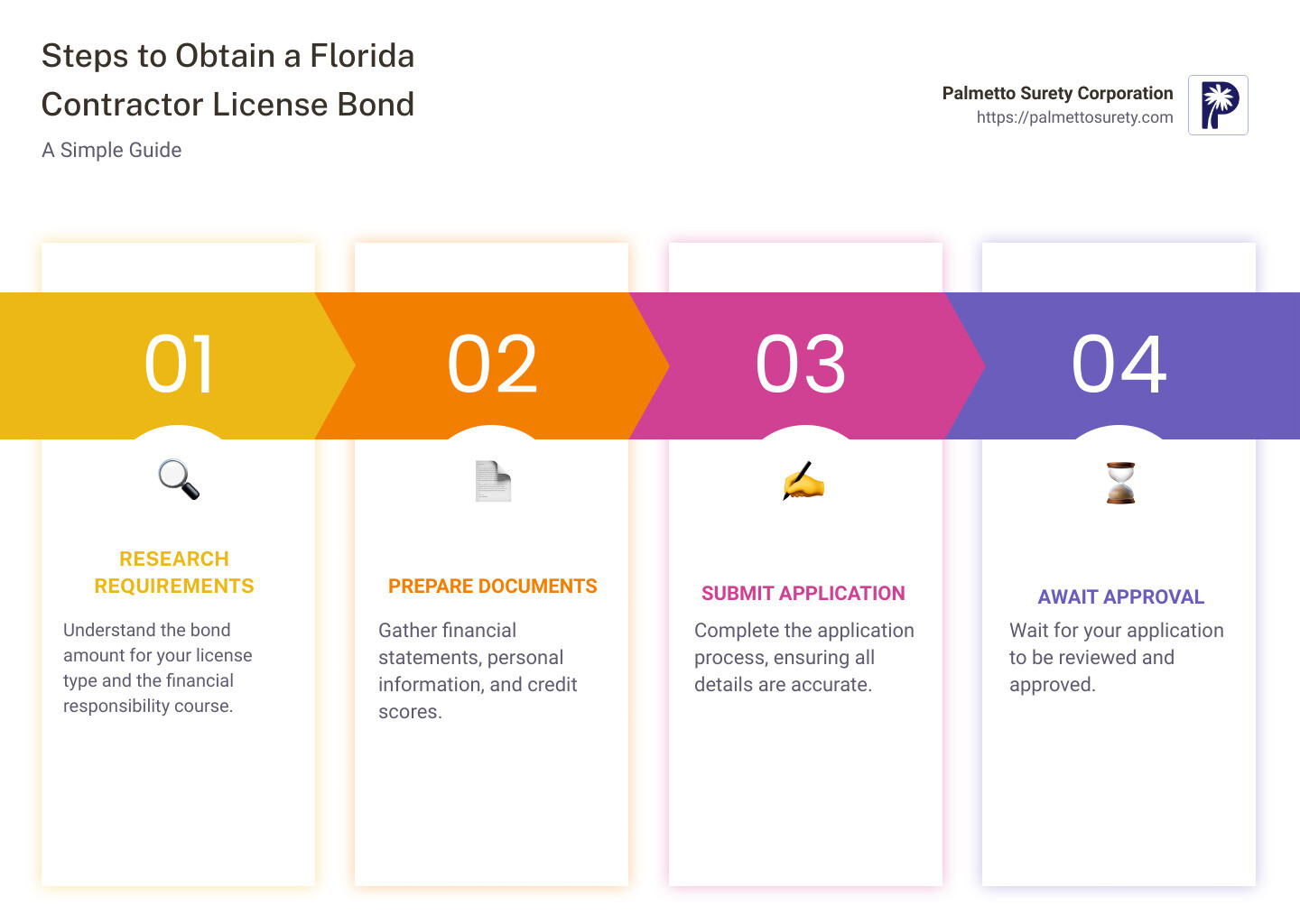
Getting a Florida Contractor License Bond involves several steps. Here’s a simple breakdown:
-
Determine Your Bond Type and Amount: First, you need to know whether you’re a Division I or Division II contractor. Division I contractors usually need a $20,000 bond, which can be reduced to $10,000 with a financial responsibility course. Division II contractors need a $10,000 bond, reducible to $5,000 with the same course.
-
Choose a Surety Company: Select a reputable surety company like Palmetto Surety Corporation to issue your bond. Ensure they offer competitive rates and excellent customer service.
-
Complete the Application: Fill out the bond application form provided by the surety company. This typically includes personal information, business details, and financial data.
-
Submit Required Documents: Send in all necessary documents with your application (more on this below).
-
Approval and Issuance: Once your application is reviewed and approved, the surety company will issue your bond. You’ll receive the bond form and power of attorney to file with the Florida Construction Industry Licensing Board (CILB).
Required Documents
To complete your bond application, you’ll need to gather and submit several key documents:
-
Financial Statements: Provide detailed financial statements of your business. This helps the surety company assess your financial stability.
-
Credit Report: A personal credit report is required. Contractors with a credit score below 660 may need to provide additional financial assurances.
-
Personal Information: Include personal details such as your name, address, and Social Security number.
-
Business Information: Supply your business name, address, and employer identification number (EIN).
Financial Responsibility
Meeting the financial responsibility requirements is crucial for obtaining your bond:
-
Credit Score Requirements: A credit score of 660 or higher is typically needed. If your score is below this threshold, you must either post a cash deposit or secure a surety bond or irrevocable letter of credit.
-
Bond or Letter of Credit: Contractors with lower credit scores must maintain a surety bond or letter of credit until their credit score improves. The bond amount varies based on your license type and whether you complete a financial responsibility course.
By following these steps and providing the necessary documents, you can successfully obtain your Florida Contractor License Bond. This ensures you meet state requirements and can operate legally as a contractor in Florida. Next, we’ll discuss the costs associated with these bonds, including premiums and renewal fees.
Costs Associated with Florida Contractor License Bonds
Understanding the costs associated with a Florida Contractor License Bond is vital for contractors. Let’s break down what you need to know about bond premiums, factors affecting costs, and renewal fees.
Bond Premiums
The cost of a Florida Contractor License Bond, also known as the bond premium, typically ranges from 1% to 1.8% of the bond amount annually. For example, if you’re required to obtain a $10,000 bond, you can expect to pay between $100 and $180 per year.
Here’s a quick reference:
| Bond Amount | Annual Premium (1%-1.8%) |
|---|---|
| $5,000 | $50 – $90 |
| $10,000 | $100 – $180 |
| $20,000 | $200 – $360 |
Factors Affecting Cost
Several factors influence the cost of your bond premium:
-
Credit Score: A higher credit score can significantly reduce your bond premium. Contractors with excellent credit (650 and above) often get the best rates.
-
Financial Stability: Surety companies assess your financial statements to gauge stability. Strong financial health can lead to lower premiums.
-
Bond Amount: The required bond amount directly affects the premium. Higher bond amounts result in higher premiums.
Renewal Fees
Florida Contractor License Bonds typically require annual or biennial renewal:
-
Annual Renewal: Most bonds need to be renewed every year. The renewal fee is generally the same as the initial premium.
-
Biennial Renewal: Some bonds, depending on the issuing surety company, might offer two-year terms. This can sometimes result in a slight discount on the annual rate.
-
Cancellation Policy: Bonds can be canceled with written notice from the surety to the obligee (the city or county requiring the bond) and the principal (the contractor). Notice periods range from 15 to 90 days before the cancellation takes effect.
Understanding these costs ensures that you budget appropriately and maintain compliance with Florida’s licensing requirements. Next, we’ll guide you through the process of filing a bond claim in Florida.
How to File a Bond Claim in Florida
Filing a bond claim in Florida can be straightforward if you follow the proper steps and understand the required notices and enforcement procedures. Here’s a simple guide to help you through the process.
Steps to File a Claim
- Obtain a Copy of the Bond
-
Before you can file a claim, get a copy of the bond. This document will contain essential details such as the bond number, the parties involved, and the bond terms.
-
Send Notice to the Contractor
-
Notify the contractor about the issues that may lead to a claim. This notice should be in writing and outline the specific problems, such as incomplete work or unpaid suppliers.
-
File a Notice of Nonpayment
- If the contractor does not resolve the issues after receiving your notice, the next step is to file a Notice of Nonpayment. This formal document states that you have not received payment for services or materials provided.
Required Notices
- Notice to Contractor
-
This initial notice informs the contractor of the issue. It’s a critical step as it offers the contractor a chance to address the problem before a claim is officially filed.
-
Notice of Nonpayment
- If the contractor fails to address the issue, you must file a Notice of Nonpayment. This notice is essential for moving forward with the claim process. It must be filed within a specific timeframe to be valid, so check local regulations for deadlines.
Enforcement
- Legal Action
-
If the contractor does not respond to the Notice of Nonpayment, you may need to take legal action. This involves filing a lawsuit to enforce the bond’s terms. The court will then determine the validity of the claim.
-
Claim Resolution
- Once legal action is taken, the court will review the evidence and decide. If the claim is valid, the surety company will compensate for the damages up to the bond amount. The contractor is then responsible for reimbursing the surety company.
By following these steps and understanding the required notices and enforcement procedures, you can effectively file a bond claim in Florida. This ensures that you are protected if a contractor fails to meet their obligations. Next, we’ll address some frequently asked questions about Florida Contractor License Bonds.
Frequently Asked Questions about Florida Contractor License Bonds
What is the bond amount for a contractor’s license in Florida?
The bond amount for a contractor’s license in Florida depends on the contractor’s division and whether they have completed a financial responsibility course.
- Division I Contractors: Typically, the bond amount is $20,000. However, if they complete a financial responsibility course, the bond amount is reduced to $10,000.
- Division II Contractors: The bond amount is $10,000. If they complete a financial responsibility course, it is reduced to $5,000.
These bonds ensure that contractors comply with state regulations and protect the public from any financial harm due to non-compliance.
How much does it cost to get licensed and bonded in Florida?
The cost of getting licensed and bonded in Florida includes several components:
- Bond Premiums: Typically, the premium for a Florida Contractor License Bond ranges from 1% to 1.8% of the bond amount. For example, a $10,000 bond may cost between $100 and $180 annually.
- Application Fees: Contractors need to pay a fee when applying for their license. For instance, the fee for registering for the licensure exam is $215.
- Renewal Costs: Florida Contractor License Bonds must be renewed annually. The renewal fees are similar to the initial bond premiums and depend on the contractor’s credit score and financial stability.
What are the types of bonds required from a contractor?
Contractors in Florida may need various types of bonds depending on their specific projects and licensing requirements:
- Bid Bonds: Ensure that the contractor will enter into the contract if they win the bid.
- Performance Bonds: Guarantee that the contractor will complete the project according to the contract terms.
- Payment Bonds: Ensure that the contractor will pay all laborers, suppliers, and subcontractors.
- Maintenance Bonds: Cover any defects in workmanship or materials for a specified period after project completion.
These bonds provide financial protection and assure that contractors meet their obligations, enhancing trust and reliability in the construction industry.
For more detailed information on Florida Contractor License Bonds and other related requirements, visit the Florida Construction Industry Licensing Board (CILB).
Conclusion
Palmetto Surety Corporation
In summary, obtaining a Florida Contractor License Bond is not just a legal requirement; it’s a crucial step in ensuring your construction business operates smoothly and builds trust with clients. These bonds protect the public by guaranteeing that contractors adhere to all relevant laws, rules, and regulations, and they provide financial security in case of faulty workmanship or materials.
Compliance with bond requirements is essential for maintaining your license and reputation. Failure to comply can result in severe penalties, including license suspension or revocation, and can damage your business’s credibility.
At Palmetto Surety Corporation, we understand the intricacies of obtaining a Florida Contractor License Bond. With over 20 years of experience, we’ve helped thousands of contractors secure the bonds they need quickly and efficiently. Our partnerships with over 30 surety companies allow us to offer the best terms and competitive pricing in the market.
Why Choose Palmetto Surety Corporation?
- Quick Approval: Our streamlined application process ensures fast approval, so you can focus on your projects.
- Efficient Service: Our dedicated support team is available 24/7 to assist you with any questions or concerns.
- Expertise: With more than two decades of experience, we have the knowledge and resources to guide you through the bonding process.
Trust Palmetto Surety Corporation to handle your bonding needs with professionalism and care. Secure your business’s future and ensure compliance with all necessary regulations by obtaining your Florida Contractor License Bond with us today.
For more information or to get started on your bond application, visit Palmetto Surety Corporation.


