


Public Adjuster Bond Guide: Top Tips for 2024 Success
Introduction
To operate as a public adjuster, you must understand the Public Adjuster Bond requirements. This bond ensures that adjusters adhere to laws and regulations and look out for their client’s best interests.
Quick Info:
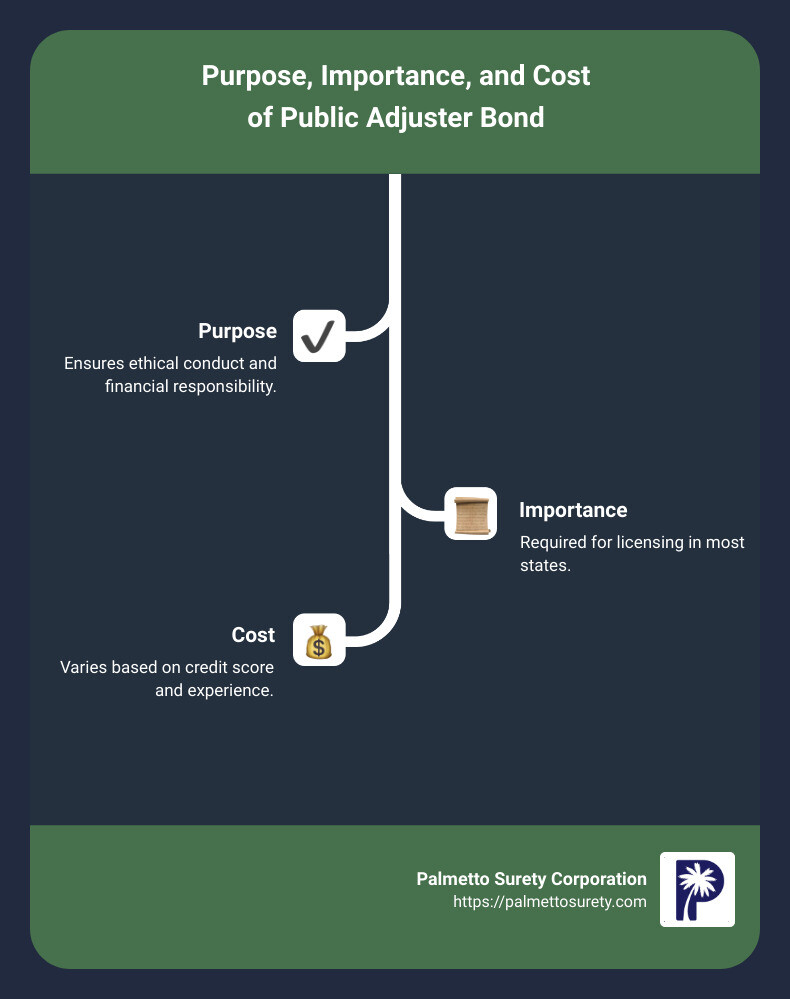
– Purpose: Ensures ethical conduct and financial responsibility.
– Importance: Required for licensing in most states.
– Cost: Varies based on credit score and experience.
Public Adjuster Bonds play a crucial role in the insurance claim process. By guaranteeing that claims are handled ethically and legally, these bonds protect consumers from potential misconduct and ensure that adjusters remain accountable. They act as a safety net for clients seeking fair settlements, reinforcing trust in the adjusting profession.
For those new to the field or seeking to expand their knowledge, understanding the bond requirements and regulations is essential.
What is a Public Adjuster Bond?
A Public Adjuster Bond is a type of surety bond that public adjusters must obtain to legally operate in most states. This bond ensures that the adjuster will follow all applicable laws and regulations, acting in the best interest of their clients. Essentially, it serves as a financial guarantee for ethical behavior and compliance with industry standards.
Purpose
The primary purpose of a Public Adjuster Bond is to protect consumers. It provides a safety net for clients who may suffer financial harm due to the adjuster’s misconduct, such as fraud or negligence. The bond holds the adjuster accountable and offers a means of compensation for damages.
Legal Contract
A Public Adjuster Bond is a legal contract involving three parties:

- Principal: The public adjuster who is required to obtain the bond.
- Obligee: The state or regulatory body that mandates the bond.
- Surety: The insurance company that issues the bond and guarantees the adjuster’s obligations.
In this agreement, the surety backs the principal’s promise to adhere to the law. If the adjuster fails to meet their obligations, the surety will cover any valid claims up to the bond amount. The adjuster must then repay the surety for any claims paid out, along with interest and fees.
Three Parties Involved
- Principal: You, the public adjuster, who needs the bond to get licensed.
- Obligee: The state regulatory agency, such as the Ohio Department of Insurance, that requires the bond.
- Surety: The company that issues the bond and pays claims if you fail to comply with legal requirements.

Real-World Example
Imagine you’re a public adjuster in Ohio. To get your license, you need to file a $1,000 surety bond with the Ohio Department of Insurance. This bond ensures that you will follow Ohio Revised Code sections 3951.01 to 3951.10. If you fail to comply, the surety company will pay any valid claims up to the bond amount, and you must reimburse them.
Understanding the basics of a Public Adjuster Bond is crucial for anyone entering the field. It not only helps you meet licensing requirements but also builds trust with your clients by ensuring ethical and legal conduct.
Next, let’s dive into why these bonds are essential and how they protect both the public and the industry.
Why Public Adjuster Bonds are Necessary
Public Adjuster Bonds are essential for several reasons. They ensure ethical conduct, provide financial protection, and comply with state regulations.
Ensuring Ethical Conduct
Public adjusters handle sensitive and significant financial matters for their clients. To ensure they act in the best interests of their clients, Public Adjuster Bonds hold them accountable. These bonds act as a deterrent against unethical behavior. If a public adjuster engages in misconduct, the bond provides a financial incentive to adhere to industry laws, regulations, and standards.
Example: If a public adjuster inflates a claim dishonestly, a client can file a claim against the bond. The surety company investigates and, if the claim is valid, compensates the client. This system promotes honesty and integrity in the profession.
Providing Financial Protection
Public Adjuster Bonds protect clients financially. If a public adjuster fails to fulfill their duties, clients can suffer financial losses. The bond ensures that clients can seek compensation for these losses.
Case Study: Imagine a public adjuster who misappropriates funds meant for a client’s claim settlement. The affected client can file a claim against the bond to recover the lost amount. The surety company pays the client and then seeks reimbursement from the public adjuster.
Complying with State Regulations
Most states require public adjusters to obtain a bond before they can be licensed to operate. This requirement ensures that all practicing public adjusters are financially responsible and adhere to state laws.
Fact: As of now, 46 states and the District of Columbia require public adjusters to have a bond. This requirement is part of the licensing process and helps maintain high standards across the industry.
Promoting Industry Standards
By requiring bonds, states encourage public adjusters to maintain high professional standards. Bonds ensure that public adjusters are not only financially accountable but also committed to ethical practices.
Quote: “Public Adjuster Bonds promote upstanding behavior throughout the industry by holding adjusters accountable for their misconduct.” This statement underscores the bond’s role in maintaining industry integrity.
In summary, Public Adjuster Bonds are necessary to ensure ethical conduct, provide financial protection, and comply with state regulations. These bonds play a crucial role in maintaining the integrity and trustworthiness of the public adjusting profession.
Next, let’s explore how to obtain a Public Adjuster Bond and what documents you’ll need for the application process.
How to Obtain a Public Adjuster Bond
Getting a Public Adjuster Bond is a straightforward process, but it requires attention to detail. Here’s a step-by-step guide to help you navigate through it.
Application Process
-
Find a Surety Company: Start by choosing a reputable surety company like Palmetto Surety Corporation. They specialize in surety bonds and can offer the expertise you need.
-
Complete the Application: Most surety companies provide an online application form. You’ll need to fill in details such as your legal name, address, and contact information.
-
Underwriting: The surety company will assess your application. They will review your credit score, business experience, and financial stability. This process helps them determine the risk involved in issuing the bond to you.
-
Get a Quote: After evaluation, the surety company will provide you with a quote. This quote outlines the premium you need to pay to activate the bond.
-
Pay the Premium: Once you agree to the terms and pay the premium, the surety company will issue the bond.
Required Documents
To complete the application, you will need to provide several key documents:
- Public Adjuster License Application: This is typically required by your state’s Department of Insurance.
- Proof of Identity: A copy of your driver’s license or passport.
- Financial Statements: These may include bank statements or tax returns to prove your financial stability.
- Credit Report: Some surety companies will pull this directly, but it’s good to have a recent copy.
- Business Information: If you operate under a business name (DBA), include your business license and any relevant documents.
Cost Factors
The cost of a Public Adjuster Bond varies based on several factors:
- Bond Amount: Different states require different bond amounts. For example, Ohio requires a $1,000 bond, while other states may require more.
- Credit Score: Your credit score significantly impacts the premium. A higher credit score typically results in a lower premium. For instance, a $50,000 bond could cost $375 annually for a credit score of 720+, but up to $3,500 for a score between 500-549.
- Business Experience: More experienced public adjusters might get better rates as they are considered lower risk.
- State Regulations: Some states have specific requirements that could affect the cost and process.
Table: $50,000 Public Adjuster Bond Cost by Credit Score
| Credit Score | Bond Cost (1 Year) | Bond Cost (1 Month) |
|---|---|---|
| 720+ | $375 | $38 |
| 625 – 719 | $500 | $50 |
| 600 – 624 | $1,250 | $125 |
| 575 – 599 | $1,500 | $150 |
| 550 – 574 | $2,500 | $250 |
| 500 – 549 | $3,500 | $350 |
Note: The credit score ranges do not include other factors that may result in a change to the annual premium.
Final Steps
Once you have your bond, you’ll need to file it with the appropriate state agency, usually as part of your public adjuster license application. Make sure to keep a copy of the bond for your records.
Next, let’s delve into the specific bond requirements for different states such as Ohio, Florida, California, New York, and Texas. This will help you understand the unique regulations and amounts required in each jurisdiction.
State-Specific Public Adjuster Bond Requirements
Ohio
In Ohio, you need to provide a $1,000 surety bond as part of your public adjuster license application. This bond ensures you will adhere to Ohio’s insurance laws and regulations. To apply, submit a notarized Individual Public Insurance Adjuster Certificate of Authority License Application along with a $100 non-refundable fee payable to the “State of Ohio Treasurer.” Don’t forget to include a copy of your public insurance adjuster contract form.
Florida
Florida requires public adjusters to post a $50,000 surety bond. This bond helps protect consumers from any unethical or fraudulent actions by the adjuster. The application process involves passing the Florida Adjuster Examination and completing 24 hours of continuing education every two years to maintain your license. This ensures that public adjusters are always up-to-date on best practices and legal requirements.
California
In California, public adjusters must also secure a $20,000 surety bond. This bond is mandatory for obtaining your public adjuster license and serves as a financial guarantee that you will comply with state regulations. Applicants must complete 24 hours of continuing education per every two-year license term to keep their license active.
New York
New York mandates a $1,000 surety bond for public adjusters. This bond protects policyholders and ensures that adjusters follow state laws and ethical guidelines. The bond must be filed with the New York Department of Financial Services as part of the licensing process. Additionally, adjusters need to renew their bond annually to keep their license in good standing.
Texas
In Texas, public insurance adjusters are required to post a $10,000 surety bond. This bond is a prerequisite for obtaining a public insurance adjuster license and ensures adherence to state regulations. Texas also requires public adjusters to complete continuing education to maintain their licenses, similar to other states.
These state-specific requirements help ensure that public adjusters operate ethically and responsibly, providing a layer of protection for consumers.
Next, we’ll explore the costs involved in obtaining a Public Adjuster Bond and how factors like credit score can impact the price.
How Much Does a Public Adjuster Bond Cost?
The cost of a Public Adjuster Bond varies based on several factors. Understanding these can help you estimate the expense and potentially save money.
Cost Factors
Credit Score: One of the primary factors affecting the cost of a Public Adjuster Bond is your credit score. Surety companies use your credit score to assess the risk of issuing a bond. Here’s a quick look at how credit scores impact bond costs for a $50,000 bond:
| Credit Score | Bond Cost (1 Year) | Bond Cost (1 Month) |
|---|---|---|
| 720+ | $375 | $38 |
| 625 – 719 | $500 | $50 |
| 600 – 624 | $1,250 | $125 |
| 575 – 599 | $1,500 | $150 |
| 550 – 574 | $2,500 | $250 |
| 500 – 549 | $3,500 | $350 |
As you can see, higher credit scores result in lower bond costs. If your credit score is below 600, expect to pay significantly more for your bond.
Business Experience: The number of years you’ve been in business can also affect bond costs. Experienced adjusters are often seen as lower risk, which can lead to lower premiums.
State Requirements: Some states have specific bond amounts and requirements that can influence the cost. Always check your state’s regulations to understand what is required.
Multi-Year Discounts
Many surety companies offer discounts if you purchase a bond for multiple years. This can be a cost-effective option if you plan to stay in business for an extended period. For example, a two-year bond might be cheaper than buying two separate one-year bonds.
Credit Score Impact
Your credit score plays a crucial role in determining the cost of your Public Adjuster Bond. Surety companies view your credit score as an indicator of financial responsibility. A higher credit score generally means a lower risk for the surety company, which translates to lower bond premiums for you.
If your credit score isn’t ideal, don’t worry. There are still options available. Some companies offer bad credit surety bond programs designed to help those with lower credit scores get bonded at a reasonable rate.
Next, we’ll discuss how to maintain and renew your Public Adjuster Bond to ensure continuous compliance with state regulations.
How to Maintain and Renew Your Public Adjuster Bond
Maintaining and renewing your Public Adjuster Bond is essential to stay compliant with state regulations and keep your license active. Here’s a straightforward guide on how to do it:
Renewal Process
Renewing your Public Adjuster Bond is a yearly requirement. Here’s how to ensure a smooth renewal:
- Mark Your Calendar: Keep track of your bond’s expiration date to avoid lapses. Bond terms typically last one year.
- Receive Renewal Notice: Your surety provider will send you a renewal invoice before your bond expires.
- Pay the Invoice: Once you pay the renewal fee, your bond will be renewed for another term. SuretyBonds.com, for example, will send renewal instructions upon payment.
- Receive Updated Bond: After payment, you will receive updated bond documentation to submit to the relevant state department.
Updating Bond Information
If you need to update your bond information, such as changing your public adjuster agent name to match your license application, follow these steps:
- Contact Your Surety Provider: Explain the needed change. If you purchased your bond from SuretyBonds.com, email [email protected].
- Submit Documentation: Provide any necessary supporting documents to process the update.
- Receive Updated Bond: Once processed, you will receive the updated bond form to submit to the Ohio Department of Insurance or the relevant agency in your state.
Compliance
Staying compliant with state regulations is crucial to avoiding claims against your bond. Here’s how to do it:
- Follow All Laws: Adhere to all applicable laws and regulations governing public adjusters in your state.
- Ethical Conduct: Avoid engaging in fraud or unfair business practices.
- Timely Payments: Ensure all claims and settlement funds owed to insureds are paid promptly.
By following these guidelines, you can maintain your Public Adjuster Bond without any issues, ensuring continuous compliance and protecting your professional reputation.
Next, we’ll answer some frequently asked questions about Public Adjuster Bonds to help you understand more about their benefits and potential drawbacks.
Frequently Asked Questions about Public Adjuster Bonds
What are the negatives for using a public adjuster?
While public adjusters can help you get a higher settlement, there are some drawbacks:
- Fees: Public adjusters typically charge a percentage of the settlement amount, which can sometimes be as high as 20%.
- Conflict of Interest: Although they represent you, some adjusters may prioritize their commission over your best interests.
- Delays: The involvement of a public adjuster can sometimes slow down the claims process, especially if there are disputes.
Who pays for a public adjuster in Florida?
In Florida, the policyholder is responsible for paying the public adjuster’s fees. These fees are usually a percentage of the insurance payout. It’s important to discuss and agree on these fees upfront to avoid any surprises later.
How can a public adjuster save you money?
Public adjusters can save you money in several ways:
- Higher Settlements: They are skilled negotiators who can often secure higher settlements than you might achieve on your own.
- Expertise: They know the ins and outs of insurance policies and can identify coverages you might miss.
- Time Savings: Handling a claim can be time-consuming. A public adjuster takes over this task, allowing you to focus on other things.
Understanding these aspects can help you make an informed decision about whether to hire a public adjuster.
Next, we’ll delve into the specifics of obtaining and maintaining your Public Adjuster Bond to ensure you stay compliant and protect your business.
Conclusion
At Palmetto Surety Corporation, we understand the importance of having the right Public Adjuster Bond to ensure your business runs smoothly and ethically. Our goal is to provide quick approval and efficient service, making the bonding process as stress-free as possible.
Quick Approval
We know that time is of the essence. That’s why we’ve streamlined our application process to get you bonded quickly. Simply complete our online application, and our team will provide you with a competitive quote ASAP. We’re here to help you meet your state’s requirements without unnecessary delays.
Efficient Service
Our commitment to efficiency doesn’t stop at quick approvals. We offer personalized support to guide you through every step of the bonding process. Whether you need help with your application, have questions about state-specific requirements, or need to renew your bond, our dedicated team is here to assist you.
Why Choose Palmetto Surety Corporation?
- Expertise: With over twenty years of experience in the surety bond industry, we have the knowledge and expertise to handle all your bonding needs.
- Customer Support: Our 24/7 support team ensures you receive the best possible service at all times.
- Technology: Our cutting-edge technology allows you to purchase, print, and manage your surety bond with ease.
Ready to get started? Contact us today to secure your Public Adjuster Bond and protect your business. With Palmetto Surety Corporation, you’re in good hands.


