


Surety bond for auto title: 3 Easy Steps
Navigating Auto Title Challenges with a Surety Bond

A surety bond for auto title is a legal guarantee that verifies vehicle ownership when the original title is missing or defective, allowing you to legally register, insure, and sell your vehicle.
- What it is: A financial guarantee that you are the rightful owner of a vehicle.
- Why you need it: To get a “bonded title” from your state’s Department of Motor Vehicles (DMV) when the original title is lost, stolen, or unobtainable.
- Purpose: It protects previous owners, lienholders, and the state from financial loss or claims against the vehicle’s ownership.
- Outcome: It grants you the same legal ownership rights as a standard vehicle title.
If you’ve lost a car title, inherited a vehicle with missing paperwork, or bought a car without receiving a proper title, you know the frustration. A surety bond for auto title is the crucial safety net that resolves these ownership challenges. It’s your path to establishing legal ownership and moving forward with peace of mind.
My name is Haiko de Poel Jr. As a fractional Chief Marketing Officer, I’ve helped one of the fastest-growing US surety bond companies make complex solutions like the surety bond for auto title process accessible for all vehicle owners.
What is a Surety Bond for an Auto Title and Why Do You Need One?
A surety bond for an auto title—also known as a certificate of title bond, lost title bond, or defective title bond—is a legal and financial guarantee. It helps you obtain a clear auto title from your state’s Department of Motor Vehicles (DMV) when the original proof of ownership is missing.

The bond’s purpose is to protect the DMV, you, and any future owner from financial loss due to ownership claims. It verifies your rightful ownership, allowing you to legally register, insure, and sell your vehicle.
Common Scenarios Requiring a Bonded Title
A surety bond for auto title is the essential solution in many common situations:

- Lost or Stolen Title: The most frequent reason. You’ve misplaced the original title or it was stolen, leaving you unable to prove ownership.
- Never Received Title from Seller: You paid for a vehicle, but the seller never provided a properly assigned title. This can happen with uncooperative private sellers or dealerships that go out of business.
- Defective or Improperly Assigned Title: The title is damaged, illegible, contains errors, or wasn’t correctly signed over to you.
- Inherited Vehicle without Paperwork: The original title was lost during the handling of estate affairs.
- No Proof of Ownership for Older or Custom Vehicles: For antique or custom-built cars where an original title is impossible to obtain, a bonded title establishes legal ownership.
- Moving from Out-of-State: Your out-of-state title is missing or has issues, preventing you from registering the vehicle in your new home state.
In these cases, a bonded title provides the same rights as a standard title, letting you prove ownership, register, insure, and sell your vehicle.
The Three-Party Agreement Explained
A surety bond for auto title is a three-party agreement:
- The Principal (You, the Vehicle Owner): You seek the bonded title and promise the state you are the rightful owner. You are responsible for reimbursing the surety for any valid claims paid out.
- The Obligee (Your State’s Department of Motor Vehicles (DMV)): The DMV requires the bond to protect itself and other legitimate claimants from financial loss if an ownership issue arises.
- The Surety (The Insurance Company Guaranteeing the Bond): We, Palmetto Surety Corporation, act as the surety. We issue the bond and provide a financial guarantee to the DMV. If a valid claim is filed, we pay it, and you are legally bound by an indemnity agreement to reimburse us.
This structure ensures ownership is verified and all parties are protected, even without the original title.
The Step-by-Step Guide to Obtaining a Bonded Title
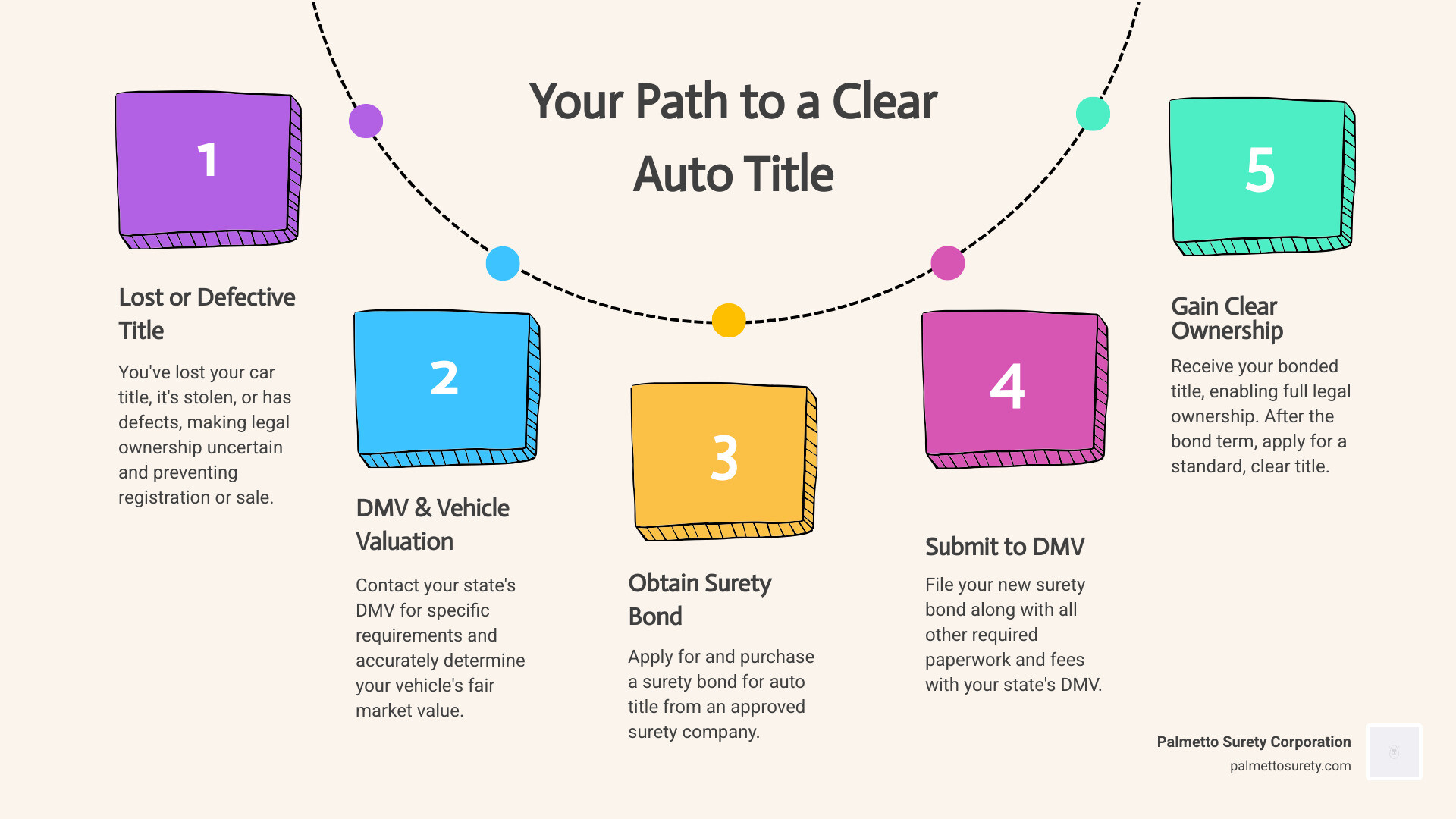
Obtaining a bonded title involves careful coordination with your state’s DMV and a surety provider. While requirements vary by state, the general process is consistent. The DMV’s approval can take 4-5 weeks, so it’s wise to start early.

Step 1: Contact Your State’s DMV and Gather Paperwork
Your first and most crucial step is contacting your state’s DMV. They will determine if you’re eligible for a bonded title and set the required bond amount. You will likely need to:
- Complete an “Application for Bonded Title.”
- Fill out a “Statement of Facts” form explaining how you acquired the vehicle and why the title is missing.
- Provide proof of ownership, such as a Bill of Sale, a canceled check, or a notarized statement from the previous owner.
- Provide the Vehicle Identification Number (VIN) and a valid government-issued ID.
- Submit any state-specific forms, like California’s Application for Replacement or Transfer of Title (REG 227).
Always check with the DMV before applying for the bond, as only they can provide the accurate bond amount for your vehicle.
Step 2: Determine Your Vehicle’s Value
The DMV will instruct you on how to determine your vehicle’s value, which is crucial for setting the required bond amount. This may involve:
- A value determined by the DMV itself.
- A written appraisal from a licensed auto dealer.
- Using a recognized valuation guide like Kelley Blue Book or NADA guides.
- A state-specific system, like Texas’s Standard Presumptive Value (SPV).
The bond amount is typically set at 1.5 times the vehicle’s value, though this can range from 1 to 3 times the value depending on the state.
Step 3: Apply for and Purchase Your Surety Bond for Auto Title
With the required bond amount from the DMV, you can apply for and purchase your surety bond for auto title from a licensed provider like us. We make this step quick and efficient.
- Application: Complete our online application with your name, address, vehicle details (year/make/model, VIN), and the value determined by the DMV.
- Payment: You’ll receive a free, no-obligation quote. Once you pay the premium, your bond is issued.
- Delivery: Most bonds are issued within 24 hours. If your order is received by 4 p.m. CST on a weekday, it’s often emailed the same day, with physical forms mailed shortly after.
- Forms: We provide access to the necessary surety bond forms to ensure they are properly executed.
We approve most applications within hours, offering quick and efficient service.
Step 4: Submit Your Bond and Finalize Your Bonded Title
Once you receive your surety bond for auto title, you’ll return to the DMV to finalize the process.
- File the Bond: Take the original, signed, and notarized bond document to your local DMV office.
- Pay Fees: Pay any additional state filing fees, which are typically between $15 and $25.
- Receive Title: After processing your paperwork, the DMV will issue a bonded title, granting you full legal ownership rights.
While getting the bond is fast, the DMV’s final processing can take 4-5 weeks.
Explaining the Costs and Terms of a Surety Bond for Auto Title
Understanding the cost and duration of a surety bond for auto title is straightforward. The premium is a small fraction of the bond amount, and the term is fixed, providing an affordable path to a clear title.

How is the Bond Amount Determined?
The bond amount is tied to your vehicle’s value and state regulations. It represents the maximum financial guarantee the surety provides. Most states require the bond amount to be 1.5 to 2 times the vehicle’s value, though some may require up to 3 times the value. For high-value vehicles (often over $25,000), the application may require more underwriting and additional financial documentation due to the higher risk.
What is the Cost of a Surety Bond for Auto Title?
The cost you pay, the premium, is a small, one-time percentage of the total bond amount.
- For bond amounts of $6,000 or less, many title bonds cost a flat rate of just $100.
- For amounts from $6,001 to $25,000, the cost is often around $10 for every $1,000 of coverage, starting at $100.
- For amounts from $25,001 to $50,000, it might be $15 for every $1,000 of coverage, starting at $375.
- For bonds over $50,000, pricing typically starts at $500 and requires underwriter review.
Overall, the cost to secure an auto title bond typically ranges from $100 to $300 or more, making it an affordable solution. You can learn more about the cost of surety bonds on our site.
How Long is the Bond Valid and What Happens Next?
A surety bond for auto title is a temporary step. Most bonds are issued for a 3-year bond period. After this term, the bond expires and does not renew.
Once the bond term ends without any claims filed against it, you can convert your bonded title into a standard, clear vehicle title. The three-year term acts as a “claim period,” giving any potential previous owners a window to come forward. If no claims arise, your ownership is solidified.
Advantages, Disadvantages, and Your Liabilities
Like any powerful tool, a surety bond for auto title comes with clear advantages and responsibilities. Understanding both helps you steer the process with confidence and ensures financial responsibility for all parties.
The Advantages of a Bonded Title
Securing a bonded title open ups your vehicle’s full potential and provides significant benefits:
- Path to Legal Ownership: It gives you “the same rights as a standard vehicle title,” and the state officially recognizes you as the owner.
- Ability to Register and Insure: A bonded title allows you to legally register your car and get the insurance coverage you need.
- Right to Sell the Vehicle: You gain the legal authority to sell or transfer ownership of the vehicle.
- Peace of Mind and Compliance: It provides legal proof of ownership and ensures you comply with state law, avoiding potential fines.
Potential Liabilities and Credit Score Impact
While a bond provides a solution, you have important responsibilities as the principal.
When you get a bond, you sign an indemnification agreement. This means if a valid claim is made and the surety (us) pays it, “you, the bond holder, are responsible for reimbursing the surety company for that payout.” The bond is a guarantee for the state and claimants, backed by your promise to reimburse us. Failure to do so can lead to serious financial consequences.
Purchasing a bond usually involves a “soft credit inquiry” and typically doesn’t impact your credit score. However, if a claim is paid and you fail to reimburse the surety, this could lead to collection action and negatively affect your credit score.
That while getting the bond is quick, the DMV’s application process can take 4-5 weeks. Additionally, a bonded title is not a solution for all situations, such as for stolen vehicles, and existing liens must be satisfied first.
For further reading on related topics, you might explore What is a fidelity bond?.
Frequently Asked Questions about Auto Title Bonds
It’s normal to have questions when navigating the auto title bond process. Here are answers to some of the most common ones.
How long does the entire bonded title process take?
The timeline has two main parts. Getting the bond from us is fast—our bond issuance is typically 24 hours or less. The longest part is DMV processing. After you submit your bond and other documents, the DMV’s approval for a bonded title can take 4 to 5 weeks, depending on your state.
What happens if someone makes a claim against my bond?
If someone files a valid ownership claim with the DMV, it will be investigated. If the claim is found to be legitimate, we, as your surety provider, will pay the claim up to the bond amount. However, as the principal, you are legally obligated to reimburse us for any amount we pay out on a valid claim. In rare cases where a legitimate prior owner proves their claim, your bonded title could be overturned within the three-year bond period.
Can I get a bonded title for an abandoned vehicle or a vehicle with a lien?
This depends on the situation:
- Abandoned Vehicles: Generally, no. Most states have specific legal procedures for abandoned vehicles that don’t involve a bonded title. The process is for situations where you legitimately acquired a vehicle, but the paperwork is missing.
- Vehicles with a Lien: You typically cannot get a clear bonded title until any active lien is satisfied and officially released. The DMV will require proof of lien release before issuing the title.
A Bill of Sale is always a crucial document. It’s also important to know that a bonded title is not a way to legitimize ownership of a stolen vehicle.
Conclusion
Navigating vehicle ownership without a clear title is daunting, but a surety bond for auto title offers a clear, legal, and efficient path forward. It transforms uncertainty into verified ownership, allowing you to register, insure, and sell your vehicle with confidence.

By securing this bond, you gain peace of mind and ensure compliance with the law. It’s a testament to the robust legal frameworks designed to protect all parties while enabling legitimate ownership.
At Palmetto Surety Corporation, we understand the importance of clear ownership. With over 20 years of experience, we specialize in making these processes understandable and accessible. Our commitment to quick service means we can approve most applications within hours, helping you get on the road to a clear title faster.
Don’t let a missing or defective title keep you from enjoying your vehicle. Let us help you steer the process with confidence. Get your commercial surety bond quote today, and take the first step towards clear ownership.
Get your commercial surety bond quote today


