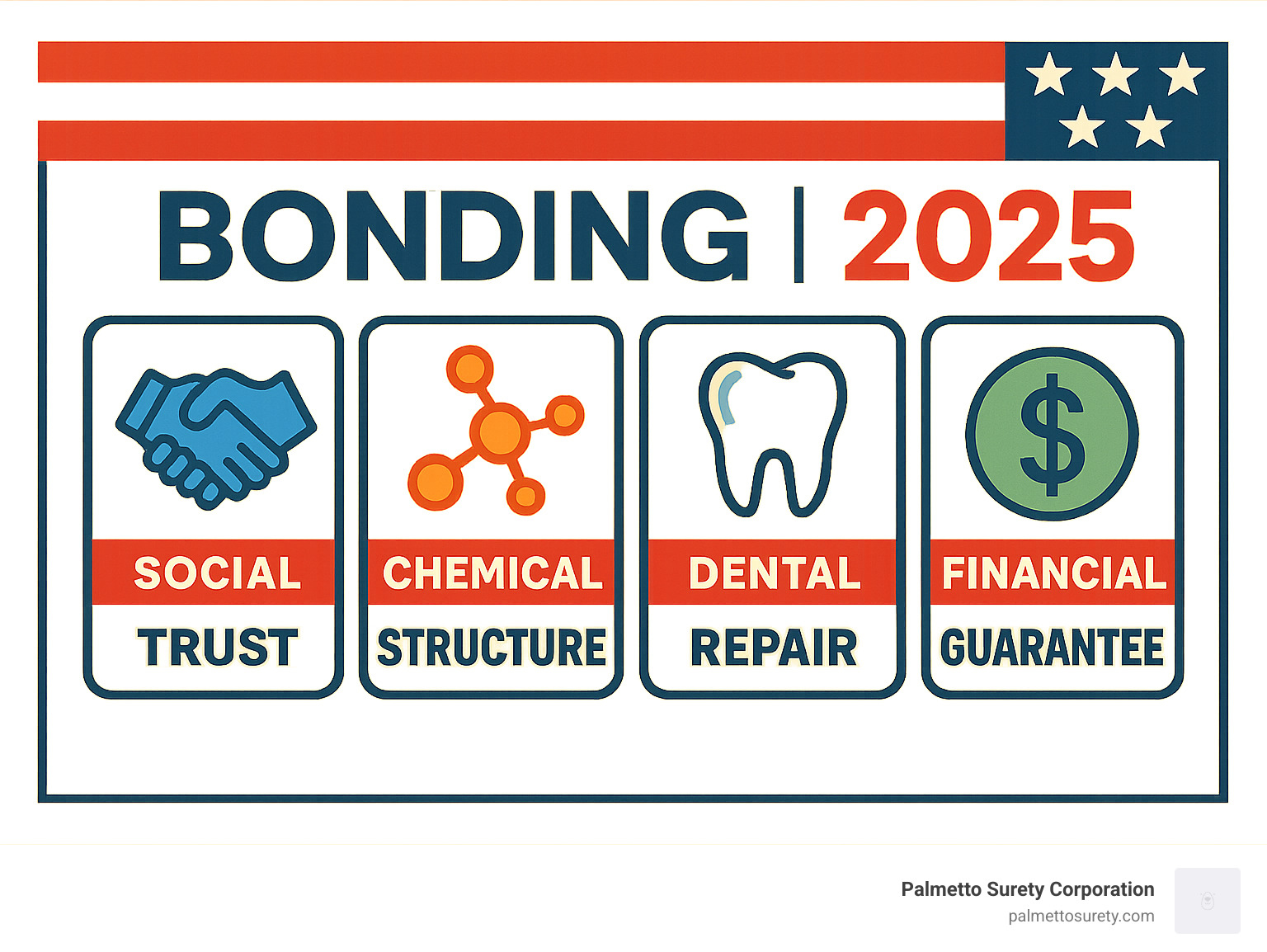
Bonding: 4 Essential Types Explained
Exploring the Many Facets of Bonding
The word bonding might seem simple, but it describes a wide range of connections across different parts of our lives. From deep personal relationships to important financial agreements, “bonding” is everywhere.
To truly understand it, let’s break down its key meanings:
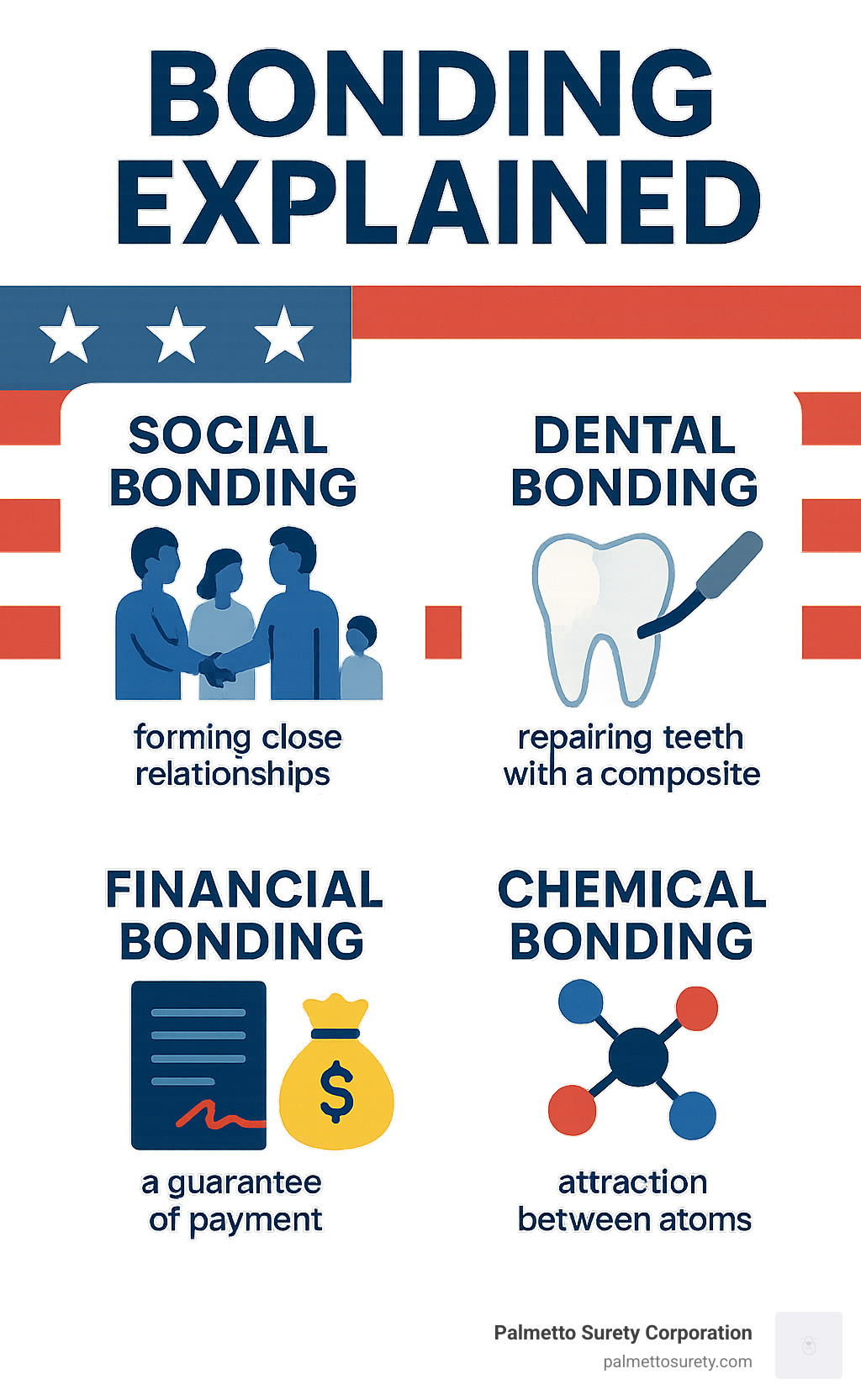
- Emotional or Social Bonding: This is about forming close relationships, whether with family, friends, or even pets. It’s the feeling of attachment and connection we share with others.
- Dental Bonding: A common cosmetic procedure where a dentist applies a tooth-colored material to fix chips, gaps, or discoloration in teeth.
- Financial Bonding: In business and legal terms, this often means a financial guarantee that promises certain obligations will be met, like a surety bond.
- Material Bonding: This refers to the process of attaching materials together, whether through chemical forces or adhesives.
I’m Haiko de Poel Jr. My work in marketing and digital change, especially at Palmetto Surety Corporation, involves understanding and leveraging various forms of bonding to drive growth and build trust.
The Science of Connection: Chemical and Material Bonds
When we talk about bonding in its most fundamental sense, we often dive into the amazing worlds of chemistry and material science. Here, bonding isn’t just a concept; it’s the very force that holds everything together! We’re talking about the incredible power that connects things at an atomic and molecular level, or the way one material strongly adheres to another. It’s the invisible glue that forms the very fabric of our world, from the air we breathe to the devices we use every day.
Chemical Bonding: The Building Blocks of Matter
At the heart of all matter, chemical bonding explains how tiny atoms link up to form molecules and the countless compounds we see around us. Think of it like nature’s own super-strong construction set, where each atom is a unique building block. The “snap” or connection that happens between them? That’s a chemical bond! This process is all about atoms finding stability, usually by getting a full outer shell of electrons. It’s their way of feeling complete and balanced.
There are a few main types of chemical bonds, each with its own special way of connecting atoms:
-
Ionic Bonds: Imagine a powerful tug-of-war where one atom is so strong, it completely pulls electrons away from another. This transfer of electrons creates two oppositely charged particles, called ions – one positive and one negative. These ions then attract each other, much like tiny magnets. Ionic bonds are generally very strong and are found in many everyday materials, like the table salt you sprinkle on your food (which is sodium chloride!). Materials with ionic bonds are often hard and can be brittle.

-
Covalent Bonds: In this type of bonding, atoms prefer to share electrons to achieve that stable, complete feeling. It’s like two friends sharing a favorite toy, both benefiting from its presence. Covalent bonds are very common and are responsible for forming many of the substances in our bodies and in nature. Because they share electrons in specific ways, atoms bonded covalently arrange themselves in particular shapes. Materials formed with strong covalent bonds, like diamonds, can be incredibly strong and have super high melting points.
-
Metallic Bonds: Found, as the name suggests, in metals and alloys, this is a truly unique type of bonding. Here, the outer electrons of the atoms aren’t tied to any single atom. Instead, they roam freely throughout the entire material, like a vast “sea of electrons.” This freedom of movement is exactly why metals are such excellent conductors of electricity and heat, and why they can be shaped and molded without breaking. The strength of these bonds can vary a lot, from the fluid mercury you might remember from old thermometers to the super tough tungsten found in light bulb filaments.
Beyond these main types, there are also weaker forces, like van der Waals forces and hydrogen bonding. While not as strong, these subtle molecular forces are incredibly important for many biological processes and give materials their unique properties. Understanding these fundamental connections helps us make sense of everything around us, from the strongest steel beams to the softest cotton fabrics. If you’re curious to dig deeper into this fascinating science, you can explore this Encyclopedia article about chemical bonding.

A Closer Look at Dental Bonding
Moving from the tiny, invisible world of atoms to something we can all see and appreciate, let’s talk about dental bonding! This is a fantastic example of material bonding in a very practical, everyday application – our smiles! It’s a popular and cost-effective cosmetic dentistry procedure that can work wonders.
Dental bonding involves a dentist carefully applying a tooth-colored composite resin to one or more of your teeth. Think of your dentist as a skilled artist, carefully adding and shaping material to perfect a piece of art, but in this case, the masterpiece is your tooth! The process is usually quite straightforward, often taking only about 30 to 60 minutes per tooth. First, the tooth surface might be gently prepared to help the resin stick better. Then, the composite resin, which can be custom-matched to your natural tooth shade, is applied, molded, and smoothed into just the right shape. A special ultraviolet light is then used to harden the resin, creating a strong bond with your tooth. Finally, the dentist trims, shapes, and polishes the bonded material so it looks completely natural and fits perfectly with your bite.
Dentists use dental bonding for a variety of reasons to improve smiles and fix tooth repair issues. It’s commonly used for repairing chipped or cracked teeth, for closing small gaps between teeth, or to conceal discoloration and stubborn stains that even bleaching can’t remove. It can also change the shape or length of a tooth to create a more uniform smile or even protect exposed tooth roots due to receding gums.
One of the big advantages of dental bonding is how minimally invasive it is compared to other options like veneers or crowns. It typically removes the least amount of your natural tooth enamel. Plus, it’s generally more affordable. However, it’s good to know that while the composite resin is strong, it’s not quite as strong as natural tooth enamel. It can also be prone to chipping or staining over time, especially if you enjoy lots of coffee, tea, or red wine. But don’t worry, touch-ups and replacements are always an option!

Curious to learn more about how this cosmetic wizardry works? Check out this helpful resource on What Is Tooth Bonding?.
The Heart of the Matter: Social and Emotional Bonds
Beyond molecules and dental work, the idea of bonding takes on a truly human meaning. Social and emotional bonding is all about the deep connections we form with others—those invisible ties that link us to our families, friends, communities, and even our beloved pets. These bonds aren’t just nice to have; they’re vital for our well-being and growth, shaping who we are and how we experience the world.
Think about it: from the moment we’re born, we’re wired for connection. Psychology teaches us that humans have a natural need for emotional attachments. These relationships, built on trust, affection, and mutual support, give us a sense of security and belonging. They’re the sturdy foundation upon which we build our lives, offering comfort when things are tough and boosting our joy during good times.

The Parent-Child Bond: A Lifelong Connection
Perhaps the most fundamental of all social bonds is the one between a parent and child. This powerful connection, often starting even before a baby is born, inspires parents to shower their little ones with love, affection, and protection. It truly is a beautiful thing to witness!
This early bonding isn’t just heartwarming; it’s absolutely crucial for a child’s healthy development. Research, even studies with newborn monkeys, shows how important it is for babies to interact with a caring, responsive adult for better social skills and to avoid feelings of sadness. For human babies, the strong ties they form with their parents give them their very first model for close relationships. This helps them feel secure, builds their self-esteem, and greatly impacts how they learn and grow socially.
While we often hear about the maternal bond (thanks to pregnancy and breastfeeding), the paternal bond is just as important and develops through its own unique interactions. Both parents bring special qualities to a child’s development. Bonding is a process, not something that happens instantly, and it can take time. Things like hormonal changes, postpartum depression, or a baby’s health issues might affect how quickly it forms, but a strong bond will still develop. Adoptive parents, for example, form bonds with their children just as effectively as biological parents.
We can actively strengthen these precious parent-child bonds through simple, loving activities. These include skin-to-skin contact, especially wonderful for newborns to promote warmth and closeness. Gentle actions like cradling, rocking, or stroking offer immense comfort and love. Infant massage, when done right, can be a fantastic way to connect. Engaging during feeding times, whether nursing or bottle-feeding, provides perfect chances for eye contact and interaction. Even if they don’t understand the words, babies adore the sound of your voice and rhythm when you’re reading and singing to them. And of course, playing together—from a game of peek-a-boo to building towers with blocks—is a universal language of connection. Finally, mirroring their expressions and vocalizations helps your baby feel truly seen and understood.
As children grow into their teenage years, these strong bonds continue to act as a protective shield against developmental challenges, supporting their mental health and offering crucial guidance. To dive deeper into how this plays a role in youth development, explore this article: Bonding as a Positive Youth Development Construct.
Bonds of Friendship and Community
Beyond our immediate family, our lives are truly enriched by platonic relationships—the wonderful bonds of friendship and community. These connections, often formed through shared experiences and common interests, add so much to our sense of belonging and overall happiness.
Think about the casual “male bonding” that happens when guys get together for a weekend, or how “gal pals” share deep conversations over coffee or cocktails. These informal get-togethers, filled with shared laughter, support, and sometimes even vulnerability, really solidify friendships. In social science, “bonding social capital” refers to connections within a similar group (great for “getting by”), while “bridging social capital” refers to connections between different groups (helpful for “getting ahead”). Both are incredibly important for a healthy society.
Our relationships with animals also fit perfectly into this picture. The human-animal bond, a concept that really gained traction in the late 1970s, recognizes the deep emotional connection between people and their furry (or feathered, or scaled!) companions. It’s why so many of us consider our pets part of the family! These bonds offer amazing health benefits, like reducing stress, lowering blood pressure, and providing constant companionship.
On a broader scale, community bonding helps create strong teams and effective group dynamics. Whether it’s a neighborhood association, a sports team, or a volunteer group, working towards shared goals and experiencing things together builds a powerful sense of solidarity and collective identity. These bonds provide vital social support, make it easier to work together, and can even help people overcome tough economic times by offering a network of mutual help and trust.
The World of Financial Bonding: Surety and Bail
Now, let’s pivot to a very different, yet equally critical, form of bonding: the financial kind. In the business and legal worlds, bonding is not about emotional ties or chemical reactions. Instead, it’s about guarantees, financial protection, and keeping promises. Think of it as a strong safety net designed to lower risks and make sure that agreements are honored, even when things get tough.
And this is exactly where we, at Palmetto Surety Corporation, come in. For over 20 years, we’ve focused on providing this important layer of security. We specialize in commercial surety bonds and court surety (often called bail bonds). Our goal is to make getting a bond as easy and clear as possible. This helps our clients move forward with their projects and legal matters with real confidence.

What is a Surety Bond? A Three-Party Guarantee
At its heart, a surety bond is a financial promise that someone will keep their end of a deal. It’s a formal agreement that gives assurance to one party (we call them the “obligee”) that another party (the “principal”) will do what they’ve promised. If the principal somehow fails to keep their promise, the surety (the company that issues the bond, like Palmetto Surety Corporation) steps in. We make sure the obligee gets compensated for any damages.
This kind of bonding involves a special three-way agreement:
- The Principal: This is the person or business that needs the bond. They’re the one making a promise, like a builder promising to finish a construction job, or a business promising to follow certain rules.
- The Obligee: This is the party that needs the promise. It’s often a government office, a client, or a licensing group that wants to be sure the principal will do what they agreed to.
- The Surety: This is the company that issues the bond and financially stands behind the principal’s promise. Here at Palmetto Surety Corporation, we act as the surety, offering that crucial layer of protection.
It’s important to know that a surety bond is not like regular insurance. Insurance usually protects the person or business who bought the policy from financial loss. But a surety bond protects the obligee (that’s the customer or the public). If we have to pay out on a surety bond, the principal is legally required to pay us back for those damages. This setup encourages the principal to always do their best and fulfill their obligations carefully.
Surety bonds are super important across many different fields. They build trust and help keep everyone accountable. We help a wide range of businesses and organizations. For example, in construction, performance bonds make sure a builder finishes a project, and payment bonds ensure workers and suppliers get paid. In transportation, bonds help guarantee ethical business practices for things like car dealerships or freight brokers. And even in healthcare, bonds can protect patients and make sure medical suppliers follow the rules. These bonds are really about protecting people and government groups from problems like bad work, mistakes, or even fraud.
If you’re wondering how this differs from traditional insurance, we have a detailed explanation in What is Surety Bond Insurance?.
Understanding Bail Bonds in the Justice System
Another critical area of financial bonding is within the justice system: bail bonds. When someone is arrested, they are often given the chance to be released from jail before their court date. They can do this by paying “bail”—a sum of money meant to ensure they show up in court later. If they can’t afford the full bail amount, a bail bond agency, working through a network of local bail bondsmen (or bail agents), can step in to help.
A bail bond is simply a financial promise to the court that the defendant will appear for all their scheduled court dates. In exchange for a small percentage of the total bail amount (usually 10-15%), the bail bond agency posts the full bail amount for the defendant. This allows the defendant to go home and wait for their trial, instead of staying in jail.
The process usually involves the defendant, or a co-signer (someone who agrees to be responsible), making an agreement with the bail agent. This agreement often requires “collateral,” which is something valuable that secures the bond. If the defendant doesn’t show up in court, the bail bond is forfeited. Then, the bail agency has the right to find the defendant and get the full bail amount back from the collateral or the co-signer.
Our network of bail bondsmen across the southeastern United States understands how urgent and sensitive these situations can be. We work hard to provide quick and efficient service. Our goal is to help individuals steer the legal process and get back with their families. Understanding the role of bail is crucial, and you can learn more in What is Bail?. For those needing immediate help, we even offer options on How to Buy Bail Bonds Online.
Frequently Asked Questions about Bonding
We’ve covered a lot of ground, from the invisible forces that hold atoms together to the very visible contracts that underpin our financial system. Let’s tackle some common questions that often arise when discussing the multifaceted concept of bonding.
How long does cosmetic dental bonding last?
Good news! The longevity of cosmetic dental bonding is pretty impressive. While it can vary a bit, the material used typically lasts anywhere from 3 to 10 years before you might need a touch-up or replacement. If the bonding is on your front teeth, where less chewing happens, you can often expect it to last a solid 4 to 8 years.
A few things can influence how long your dental bonding stays looking great:
- Where it’s located: Bonds on your front teeth, which don’t face as much chewing pressure, tend to last longer than those on your back teeth.
- Your bite: If you have an uneven bite or tend to grind your teeth (that’s called bruxism), it can put extra stress on the bonded material.
- Your eating habits: Be gentle! Avoiding super hard foods, ice, or sticky candies can really extend your bond’s life. And yes, chewing on pencils or biting your fingernails are big no-nos for your dental bond!
- Your daily care: Keeping up with excellent oral hygiene – brushing twice a day, flossing daily, and regular dental check-ups – is super important. It helps maintain the bond’s strength and keeps it from staining.
If you ever notice sharp edges, changes in your bite, or if your bonding chips or breaks, don’t hesitate to give your dentist a call. They’re there to help!
What are some synonyms for “bonding”?
Given how many different contexts the word “bonding” appears in, it’s no surprise that it has a rich vocabulary of synonyms! Depending on the specific meaning you’re trying to convey, you might use several other words.
For instance, when talking about materials sticking together, you might use adherence or adhesion. Think of glue’s adherence to a surface. If you’re talking about a strong, close attachment, especially physical, you could say cling.
For broader connections, whether physical or emotional, attachment is a great general term. When describing a relationship or link between people or things, connection works beautifully. A more formal or informal link, often between groups or ideas, could be an association. And of course, for how two or more people or things are linked, or the state of being linked, we often use relationship.
So, while “bonding” is a wonderfully versatile word, these synonyms can help you be even more precise in your descriptions!
Who needs a surety bond?
The need for a surety bond is quite widespread, touching many parts of our business and legal world. Generally, if you need to provide a financial guarantee to someone (the “obligee”) that you’ll fulfill a specific obligation, you might need a surety bond.
Let’s look at some common folks and businesses who often find themselves needing a surety bond:
- Contractors: Especially in the construction world, contractors often need bonds like bid bonds (to guarantee they’ll take the job if they win the bid), performance bonds (to guarantee they’ll complete the project), and payment bonds (to ensure subcontractors and suppliers get paid). This is especially true for government projects or large corporations.
- Business Owners: Many states and cities require certain businesses to be bonded just to get or keep their licenses. This protects their customers. Think of folks like auto dealers, mortgage professionals, insurance brokers, cleaning services, or even travel agencies. The specific type of business that needs a bond can vary a lot by location and industry.
- Fiduciaries: These are individuals appointed to manage money or assets for others, like guardians, trustees, or executors of estates. They often need probate bonds or fiduciary bonds to ensure they handle those assets responsibly and honestly.
- License Holders and Permit Applicants: Before many professions and activities can legally operate, they need a license or permit bond. These bonds act as a promise to follow specific laws and regulations.
- Government Requirements: Our federal, state, and local governments often mandate bonds. This helps protect the public, making sure businesses operate ethically and deliver on their promises.
- Court Proceedings: Beyond the bail bonds we discussed earlier, individuals might need other court bonds for various legal situations, such as appealing a judgment or specific legal actions.
At Palmetto Surety Corporation, we work with a vast network of bond agents and bail bondsmen across the southeastern United States. Our goal is to help individuals and businesses figure out their specific bonding needs and get the right bond quickly. Our ability to approve most applications within hours means we can provide efficient service right when you need it most.
To dive deeper into specific requirements, you can explore resources like Who Needs License and Permit Surety Bonds? and learn about the diverse Types of Surety Bonds available.
Conclusion
Wow, what a journey we’ve been on! From the tiny, invisible forces that hold atoms together in chemical bonding, to the heartwarming accept shared between a parent and child, we’ve explored just how fundamental bonding is to our world. We’ve seen its precision in dental procedures, fixing smiles, and its vital role in underpinning financial agreements, building security and trust.
It’s truly amazing how one simple word, “bonding,” can describe such a vast array of connections. Whether we’re talking about the deep personal relationships that enrich our lives, the structural integrity of the materials around us, or the steadfast guarantees that drive our economy, the core idea remains the same: it’s all about establishing reliable connections. These connections bring stability and peace of mind, from the most intimate moments to the most professional contracts.
Here at Palmetto Surety Corporation, we live and breathe the concept of bonding every single day. Our focus is squarely on the financial guarantees that empower businesses and individuals to move forward with confidence. We pride ourselves on providing quick, efficient, and reliable commercial surety bonds and court surety (bail bonds) through our dedicated network across the southeastern United States. Our mission is to help you build and maintain the secure connections you need to thrive, ensuring promises are kept and obligations are met.
Ready to secure your next project or steer a legal challenge with absolute confidence? Let us help you find the right bonding solution for your unique needs.
Find the right surety bond for your needs