


Florida Law on Recorded Performance Bonds: Key 2024 Insights
Understanding Florida’s Requirements for Recording Performance Bonds
Florida law on recorded performance bonds is essential knowledge for contractors, subcontractors, and project owners involved in public works or building projects. This law ensures that projects are completed on time and that subcontractors and suppliers are paid.
Here’s a quick summary:
-
Mandatory for public projects over $100,000: Bonds are required before commencing work.
-
Information Required: Bond must display contractor, surety, and project details.
-
Recording Obligation: Contractors must provide a recorded bond before starting work. Payment is withheld until the public entity receives this.
Florida’s stringent recording requirements protect the state and stakeholders from financial risk and ensure timely project completion.
I’m Haiko de Poel Jr., a marketing and digital change expert with a deep understanding of florida law on recorded performance bonds. My experience includes rebranding and relaunching major surety bond companies, ensuring compliance and efficiency in the bonding process.
Common florida law on recorded performance bonds vocab:
– florida statute of limitations on performance bond
– performance bond florida
– performance bonds florida

A performance bond is a type of surety bond used in the construction industry to guarantee the completion of a project according to the terms of the contract. It involves three parties:
- Principal: The contractor who needs the bond.
- Obligee: The project owner who requires the bond.
- Surety: The company that issues the bond, promising to pay the obligee if the principal fails to meet their obligations.
Purpose of a Performance Bond
The primary purpose of a performance bond is to protect the project owner from financial loss if the contractor fails to complete the project or performs defective work. This ensures that the project is completed as per the agreed terms, even if the contractor defaults.
Financial Guarantee
A performance bond serves as a financial guarantee. If the contractor does not fulfill their contractual duties, the surety company steps in to either complete the project or compensate the project owner for the financial loss up to the bond’s value.
Surety Bond
Unlike traditional insurance, a surety bond involves a rigorous underwriting process. The surety company assesses the contractor’s financial health, project history, and ability to complete the project. This process helps assure the project owner of the contractor’s reliability.
Key Takeaways
- Definition: A performance bond is a surety bond ensuring contract completion.
- Purpose: Protects the project owner from contractor default.
- Financial Guarantee: Ensures project completion or compensates for losses.
Performance bonds are essential in the construction industry, providing peace of mind to project owners and ensuring that projects are completed as planned.

Next, we’ll dive into the specific requirements for recording performance bonds in Florida, including the relevant statutes and procedures.
Florida Law on Recorded Performance Bonds
Key Requirements for Recording Performance Bonds
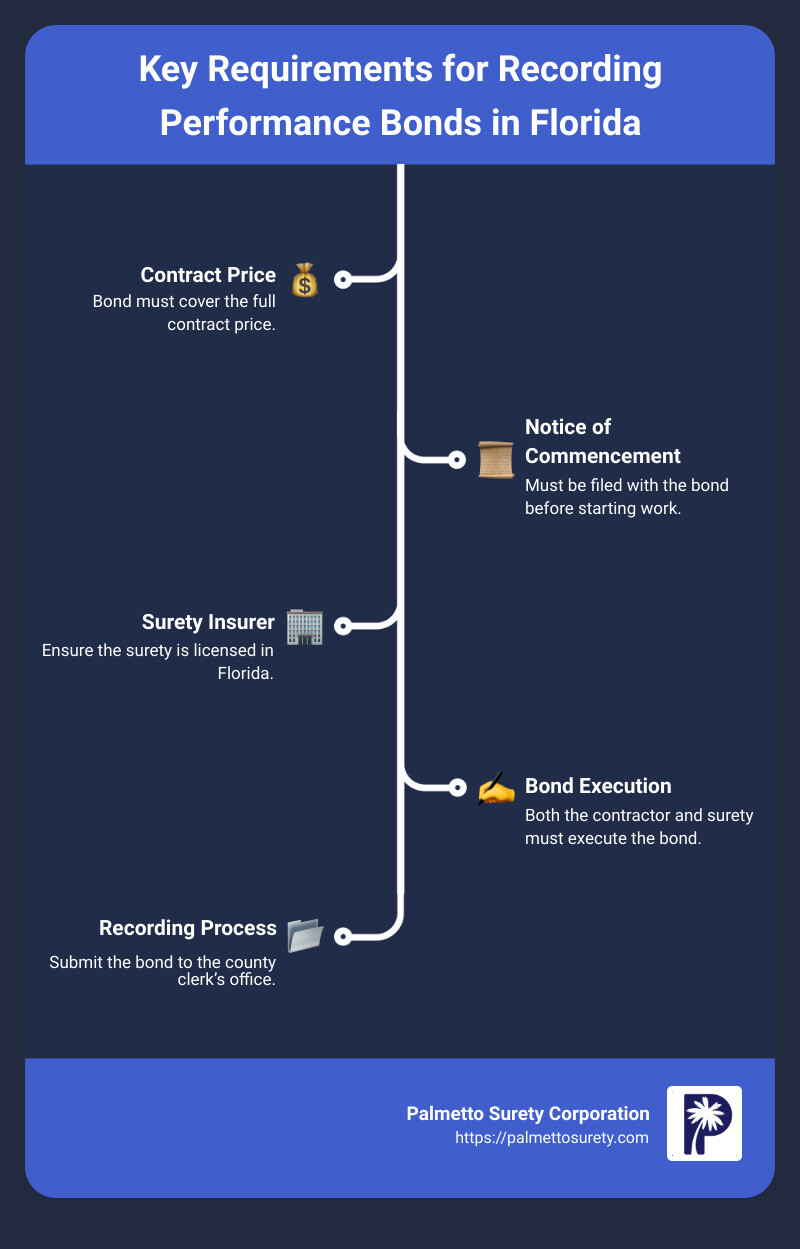
In Florida, recording a performance bond is a crucial step in ensuring legal protection for public and private construction projects. The Florida Statutes outline specific requirements and procedures for this process, primarily under Sections 713.23, 713.245, and 255.05.
Section 255.05 is especially significant for public projects. It mandates that any person entering into a contract with a state, county, city, or political subdivision for the construction or repair of a public building or public work must execute and record a payment and performance bond before starting work. This bond must include:
- Contractor’s Information: Name, principal business address, and phone number.
- Surety Information: Name and contact details of the surety company.
- Owner Information: Details of the property owner being improved.
- Project Description: Legal or street address and a general description of the improvement.
- Contract and Bond Numbers: Assigned by the contracting public entity and the surety, respectively.
For private projects, Sections 713.23 and 713.245 govern the requirements. These sections detail the necessity of attaching the payment bond to the notice of commencement and the conditions under which conditional payment bonds are applicable.
Key Points:
- Public Projects: Bond requirement for contracts over $100,000. For contracts between $100,000 and $200,000, the bond can be waived at the discretion of the public entity.
- Private Projects: Bonds should be attached to the notice of commencement if required by the contract.
Steps to Record a Performance Bond in Florida
Recording a performance bond involves several steps to ensure compliance with Florida law. Here’s a simplified guide:
-
Execution of Bond: Before starting the project, the contractor must execute a payment and performance bond, ensuring it contains all required information as stipulated by Section 255.05.
-
Notice of Commencement: For private projects, the contractor must attach the bond to the notice of commencement. This notice is a critical document that officially marks the beginning of the project and must be recorded with the local clerk’s office.
-
Recording Process: The contractor must record the bond with the clerk’s office in the county where the project is located. This step is vital as it provides public notice of the bond and its terms, protecting all parties involved.
-
Providing Recorded Copy: Before receiving any payment from the public entity, the contractor must provide a recorded copy of the bond to the public entity. Failure to do so can delay payments and potentially lead to legal complications.
-
Notice of Bond: If a lien is filed, the contractor or any interested party must record a notice of bond with the bond attached, informing the lienor that their lien is secured by the bond.
Example Form:
“`plaintext
NOTICE OF BOND
To: (Name and Address of Lienor)
You are notified that the claim of lien filed by you on [Date], and recorded in Official Records Book [Number] at page [Number] of the public records of [County], Florida, is secured by a bond, a copy being attached.
Signed: (Name of person recording notice)
“`
This notice must be verified, served to the lienor, and recorded with the clerk’s office.
Recording a performance bond correctly ensures that all parties are protected and that the project proceeds smoothly. It is essential for contractors to understand and follow these steps carefully to avoid any legal issues.
Next, we will explore the differences between payment bonds and performance bonds and how they protect various stakeholders in a construction project.
Differences Between Payment Bonds and Performance Bonds
When engaging in a construction project, understanding the differences between payment bonds and performance bonds is crucial. Both types of bonds play essential roles, but they serve different purposes and protect different parties.
What is a Payment Bond?
A payment bond guarantees that subcontractors, laborers, and suppliers will be paid for their work and materials. This bond ensures that everyone involved in the project gets paid, even if the contractor fails to do so.
Key Points:
- Protection for Subcontractors and Suppliers: Ensures payment for labor and materials.
- Prevents Liens: Protects the property from liens by unpaid parties.
- Three-Way Contract: Involves the owner, contractor, and surety.
What is a Performance Bond?
A performance bond ensures that the contractor completes the project according to the contract terms. If the contractor fails to deliver, the surety company steps in to either complete the project or compensate the owner.
Key Points:
- Protection for the Owner: Ensures project completion.
- Covers Defective Work: Protects against incomplete or substandard work.
- Obligation Fulfillment: Ensures the contractor meets all contract terms.
Protection Provided by Each Bond
Both bonds provide crucial protections, but they target different risks:
-
Payment Bonds: Protect subcontractors, laborers, and suppliers from non-payment. This is vital because unpaid parties can file liens against the property. A payment bond removes this risk by ensuring payment.
-
Performance Bonds: Protect the project owner from incomplete or defective work. If the contractor defaults, the surety company either completes the project or compensates the owner for any losses.
Case Study: Florida Construction Project
Imagine a large construction project in Florida. The contractor is required to post both a payment bond and a performance bond. Midway through the project, the contractor faces financial difficulties and cannot pay the subcontractors.
Without a Payment Bond:
Subcontractors file liens against the property. The project owner must deal with these legal issues, potentially causing delays and additional costs.
With a Payment Bond:
The surety company pays the subcontractors, preventing liens and keeping the project on track.
Later, suppose the contractor abandons the project, leaving it incomplete.
Without a Performance Bond:
The project owner must find a new contractor and may incur significant costs to complete the project.
With a Performance Bond:
The surety company steps in, either completing the project or compensating the owner for the additional costs.
Conclusion
In summary, payment bonds and performance bonds both play essential roles in protecting different stakeholders in a construction project. Payment bonds ensure that subcontractors and suppliers are paid, preventing liens on the property. Performance bonds ensure that the project is completed according to the contract, protecting the owner from defective or incomplete work.
Understanding these differences is crucial for anyone involved in construction projects, ensuring all parties are protected and the project proceeds smoothly.
Next, we will explore The Little Miller Act in Florida and how it provides additional protections for subcontractors, suppliers, and laborers on government projects.
The Little Miller Act in Florida
The Little Miller Act is a state law that provides essential protections for subcontractors, suppliers, and laborers involved in public construction projects. This law mirrors the federal Miller Act and ensures that everyone working on government projects gets paid, even if the main contractor fails to do so.
Protection for Subcontractors, Suppliers, and Laborers
Florida’s Little Miller Act is codified in Florida Statute §255.05. It mandates that any contractor entering into a contract with a state, county, city, or political subdivision for construction, completion, or repair of a public building or work must provide a payment and performance bond. This bond ensures that:
- Subcontractors: Get paid for their labor and materials.
- Suppliers: Receive payment for the materials they provide.
- Laborers: Are compensated for their work on the project.
Government Projects
The Little Miller Act specifically applies to public works and building projects. This means any construction project funded by government entities must adhere to these bonding requirements.
Key Requirements
- Contracts Over $100,000: Contractors must provide a payment and performance bond.
- Contracts Between $100,000 and $200,000: The bond requirement can be waived at the discretion of the awarding official.
- Contracts Under $100,000: No bond is required.
Steps to Ensure Compliance
- Execute the Bond: Before starting any work, contractors must execute a payment and performance bond.
- Record the Bond: The bond must be recorded with the public entity awarding the contract.
- Provide a Copy: Contractors must provide a recorded copy of the bond to the public entity before they can receive any payment.
Case Study: Impact of the Little Miller Act
Consider a scenario where a subcontractor is hired to install electrical wiring in a new public school building. Halfway through the project, the main contractor faces financial issues and cannot pay the subcontractor.
Without the Little Miller Act:
The subcontractor might not get paid, leading to financial strain and potential legal battles to recover the owed money.
With the Little Miller Act:
The payment bond ensures the subcontractor gets paid, as the surety company steps in to cover the costs. This protection allows the subcontractor to continue their work without financial disruption.
Conclusion
The Little Miller Act in Florida provides crucial protections for subcontractors, suppliers, and laborers working on government projects. By ensuring payment through mandated bonds, the act safeguards the interests of those who contribute to public construction projects. In the next section, we will address frequently asked questions about Florida’s requirements for recording performance bonds.
Frequently Asked Questions about Florida Law on Recorded Performance Bonds
What is the Payment Bond Law in Florida?
Florida law requires contractors to furnish a payment bond for public and private construction projects to protect subcontractors, suppliers, and laborers from non-payment. Under Florida Statute § 713.23, a payment bond must be provided by the contractor before starting construction. This bond ensures that anyone providing labor, materials, or services gets paid even if the general contractor fails to fulfill their payment obligations.
Key Points:
– Section 713.23: Requires a payment bond for private projects.
– Section 255.05: Mandates payment bonds for public projects over $100,000.
– Notice Requirements: Subcontractors must provide a Notice to Contractor within 45 days of starting work and a Notice of Nonpayment within 90 days after completing their work.
Is a Performance Bond a Requirement within the Contract Documents?
Yes, a performance bond is often a requirement in the contract documents for construction projects. This bond acts as a financial guarantee that the contractor will complete the project according to the terms specified in the contract.
Why It’s Important:
– Financial Guarantee: Protects the project owner from incomplete or defective work.
– Contract Terms: Ensures all contractual obligations are met.
– Compensation: Provides a mechanism for the owner to recover costs if the contractor defaults.
Under Florida Statute § 255.05, any contractor working on public projects over $100,000 must provide a performance bond. For private projects, performance bonds are typically required as specified in the contract documents.
What is the Standard for a Performance Bond?
A performance bond is a type of surety bond that guarantees the contractor will complete the project as per the contract. The bond amount is usually equal to the contract value, ensuring full coverage in case of a breach.
Key Elements:
– Surety Bond: Involves three parties – the obligee (project owner), the principal (contractor), and the surety (bonding company).
– Contract Value: The bond amount typically matches the total contract value.
– Breach of Contract: If the contractor fails to meet the contract terms, the surety company steps in to complete the project or compensate the owner.
For example, if a contractor is hired to build a library for $500,000 and fails to complete the work, the surety company will either hire another contractor to finish the job or pay the project owner up to $500,000 to cover the costs.
By understanding these key aspects of the florida law on recorded performance bonds, contractors, subcontractors, and project owners can better steer the complexities of Florida’s construction industry, ensuring compliance and financial protection.
In the next section, we will conclude our discussion with a summary and provide information on how Palmetto Surety Corporation can assist you with your bonding needs.
Conclusion
Navigating the complexities of Florida’s requirements for recording performance bonds can be challenging. However, understanding the key elements—such as the importance of a performance bond, the specific statutes involved, and the steps required for proper recording—ensures compliance and financial protection for all parties involved.
At Palmetto Surety Corporation, we simplify this process for you. With over twenty years of experience, we offer quick and efficient services custom to meet your bonding needs. Our state-of-the-art technology allows you to purchase, print, and manage any surety bond with ease, ensuring a hassle-free experience.
Why Choose Us?
- Quick Service: We streamline the process, reducing underwriting times so you can focus on your project.
- Efficient Approval: Our team works tirelessly to provide fast and reliable bond approvals, ensuring you meet all legal requirements without delay.
- Expert Support: Our dedicated support team is available 24/7 to answer any questions and guide you through the process.
For more information on how we can assist you with your performance bond needs in Florida, visit our service page.
By choosing Palmetto Surety Corporation, you’re not just getting a bond—you’re getting peace of mind.


