


What is a Cash Bond in Court? Top 5 Benefits in 2024
Understanding Cash Bonds in Court
What is a cash bond in court? It’s essentially money paid to secure the temporary release of someone accused of a crime while they await trial. This bond guarantees that the person will appear in court when required. If they don’t show up, the court keeps the money.
Here are key points for a quick understanding:
- Definition: A cash bond is a direct payment to release a defendant from jail.
- Purpose: Ensures the defendant appears at their court date.
- Process: Paid in full with cash, debit, or credit card and directly to the court.
Why is this important? Posting a cash bond can get someone out of jail quickly, giving them the opportunity to prepare for their defense while living their ordinary life. Unlike other bond forms, a cash bond eliminates the need for a third party like a bail bondsman.
My name is Haiko de Poel Jr., and I specialize in simplifying complex topics like “what is a cash bond in court” for everyone to understand. With years of experience in the surety bond industry, I’ve seen how these bonds work and why they’re crucial for those navigating the legal system.
Ready to dive deeper? Let’s break down how cash bonds function and their benefits in detail.
What is a Cash Bond in Court?
When someone is arrested and charged with a crime, one of the ways to secure their release from custody is through a cash bond. But what exactly is a cash bond in court, and how does it work?
How Does a Cash Bond Work?
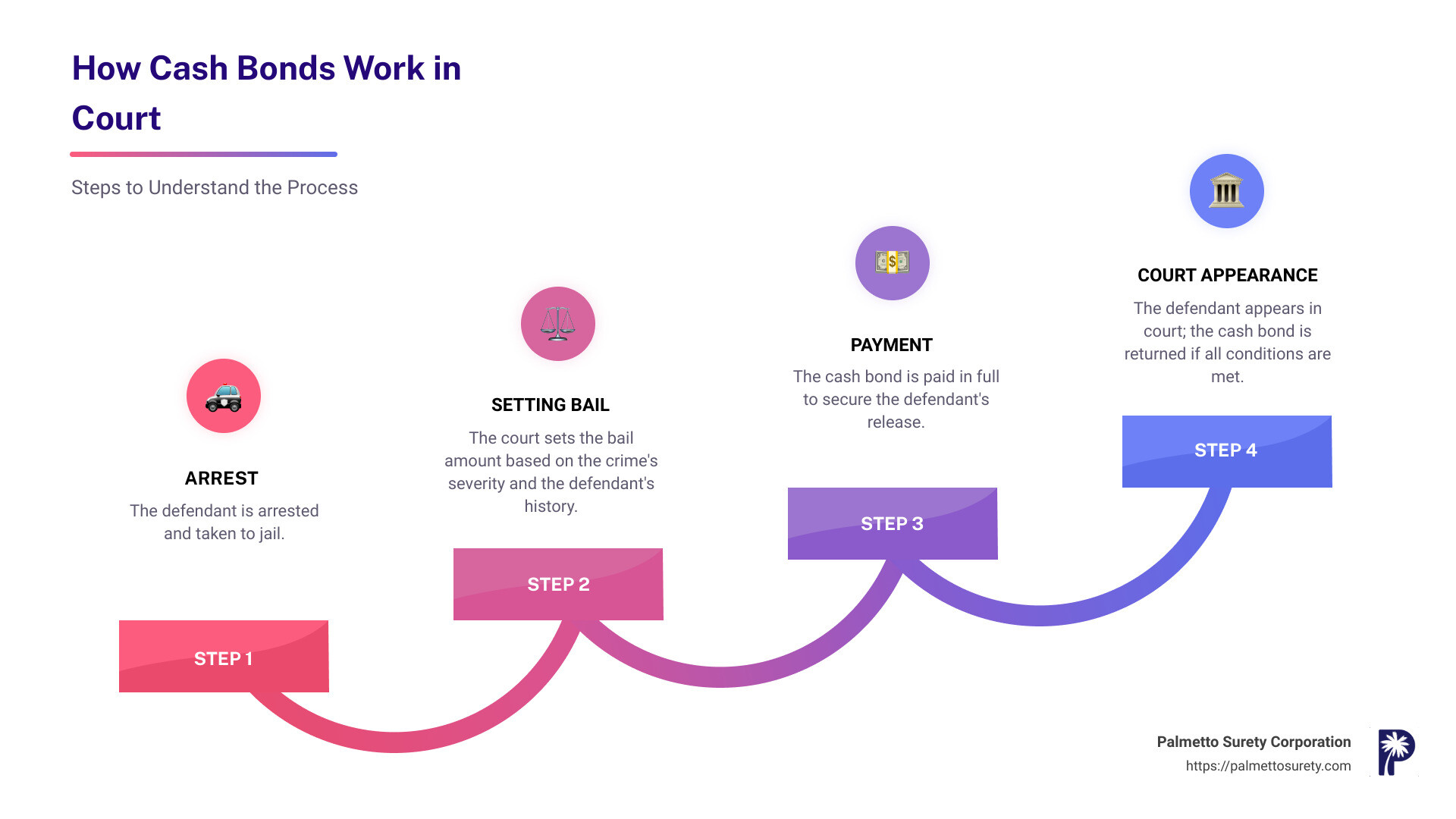
A cash bond is a type of bail that requires the full bail amount to be paid in cash. This payment guarantees that the defendant will appear for all court proceedings. Here’s a simple breakdown of the process:
- Arrest and Booking: After an arrest, the defendant goes through the booking process at the police station or detention facility.
- Bail Determination: A judge sets the bail amount based on factors like the severity of the crime, the defendant’s criminal history, and their flight risk.
- Payment: The full bail amount is paid in cash, cashier’s check, or money order to the court. This can be done by the defendant or a third party like a family member or friend.
- Release: Once the payment is made, the defendant is released from custody with the understanding that they must appear for all scheduled court dates.
- Compliance and Refund: If the defendant complies with all court orders and appears for all court dates, the cash bond is typically refunded at the end of the case, minus any court fees.
Benefits of Cash Bonds
Cash bonds offer several benefits, making them a preferred choice for many:

Immediate Payment: Since cash bonds don’t involve third parties, the release process can be expedited. This means the defendant can get out of jail faster once the cash bond is posted.
Full Return: Upon the defendant’s compliance with court conditions, the full bail amount is usually returned. This is a significant advantage over other types of bonds where fees are non-refundable.
For example, let’s say John is arrested for a minor offense, and the judge sets his bail at $5,000. John’s family decides to post a cash bond. They gather the $5,000 and pay it directly to the court. John is then released from custody. He attends all his court dates, and at the end of his case, his family receives the $5,000 back, minus any court fees.
Cash bonds are straightforward and can be a quick way to ensure a defendant’s release from jail, provided the full bail amount is available. They also reduce financial risk since the full amount is refundable if the defendant meets all court obligations.
Understanding how cash bonds work and their benefits can help you make informed decisions if you or a loved one ever face legal trouble.

Next, we’ll explore the differences between cash bonds and surety bonds, helping you understand when one might be more beneficial than the other.
Differences Between Cash Bonds and Surety Bonds
When it comes to posting bail, understanding the differences between cash bonds and surety bonds is crucial. Both serve the same purpose: securing a defendant’s release from jail. However, they operate differently and involve different levels of financial risk.
Cash Bond
A cash bond is straightforward. You pay the full bail amount in cash directly to the court.
Definition: A cash bond requires the defendant or a third party to pay the entire bail amount in cash to the court. This ensures the defendant will appear for all court proceedings.
Process:
1. Arrest and Booking: The defendant is arrested and booked.
2. Bail Amount Set: A judge sets the bail amount.
3. Payment: The full bail amount is paid in cash, cashier’s check, or money order to the court.
4. Release: The defendant is released from custody.
5. Court Appearances: The defendant must attend all required court dates.
6. Refund: If the defendant meets all court obligations, the cash bond is refunded.
Financial Risk: The primary risk is the loss of the entire bail amount if the defendant fails to appear in court. However, if all conditions are met, the full amount is refunded, minus any court fees.
Surety Bond
A surety bond is more complex and involves a third party.
Definition: A surety bond involves three parties: the principal (defendant), the obligee (court), and the surety (bail bond company). The surety guarantees the full bail amount to the court if the defendant fails to appear.
Process:
1. Arrest and Booking: The defendant is arrested and booked.
2. Bail Amount Set: A judge sets the bail amount.
3. Contact Bail Bond Company: The defendant or a loved one contacts a bail bond company.
4. Payment: A fee, usually 10% of the bail amount, is paid to the bail bond company. Collateral may also be required.
5. Surety Bond Issued: The bail bond company issues a bond to the court, guaranteeing the full bail amount.
6. Release: The defendant is released from custody.
7. Court Appearances: The defendant must attend all required court dates.
8. Consequences of Non-Appearance: If the defendant fails to appear, the bail bond company is responsible for the full bail amount. They may use the collateral to cover this cost.
Financial Risk: The fee paid to the bail bond company is non-refundable. If the defendant fails to appear, the collateral may be forfeited. This adds an extra layer of financial risk compared to a cash bond.
Comparison of Cash Bonds and Surety Bonds
| Aspect | Cash Bond | Surety Bond |
|---|---|---|
| Parties Involved | Defendant and Court | Defendant, Court, Bail Bond Company |
| Payment | Full bail amount in cash | Fee (typically 10% of bail) to bail bond company |
| Refund | Full amount refunded if conditions met | Fee is non-refundable |
| Collateral | Not required | May be required |
| Risk | Loss of full amount if conditions not met | Loss of fee and collateral if conditions not met |
Both cash bonds and surety bonds have their pros and cons. Your choice will depend on your financial situation and the specific circumstances of the case.
Next, we’ll look at the factors that determine bail amounts, helping you understand how judges decide how much bail to set.
Factors Determining Bail Amounts
When a judge sets bail, it’s not an arbitrary decision. Several factors influence how much bail will be. Understanding these factors can help you steer the bail process better.
Severity of the Crime
The seriousness of the crime plays a huge role. For minor offenses, bail might be lower. For severe crimes, like violent felonies, bail amounts can be extremely high. The idea is to ensure that those accused of serious crimes have a lower likelihood of bonding out quickly.
Criminal History
A defendant’s past criminal record is also considered. If someone has a history of not showing up for court or committing multiple offenses, the judge may set a higher bail. This helps ensure that repeat offenders are less likely to skip their court dates.
Flight Risk
Judges assess whether the defendant is likely to flee before the trial. Factors like having strong community ties or a stable job can lower flight risk. On the other hand, if someone has a history of skipping court dates or has no fixed address, bail will likely be higher to discourage fleeing.
Risk to Public Safety
Public safety is another critical factor. If the defendant is considered a danger to the community, the judge may set a higher bail or even deny bail altogether. This is common in cases involving violent crimes or threats to public safety.
Probation or Parole Status
If the defendant is already on probation or parole, this can lead to a higher bail amount. Being on probation or parole means the person has already been convicted of a crime and is under court supervision. Violating these terms can result in stricter bail conditions.
Amount of Evidence Against the Defendant
The strength of the evidence also matters. If the case against the defendant is strong, the judge may set a higher bail. This is because a strong case increases the likelihood of conviction, which might motivate the defendant to flee.
By considering these factors, judges aim to set a bail amount that balances the need for public safety with the defendant’s right to freedom before trial.
Next, we’ll explore the different types of bail bonds available, helping you understand your options for securing release from custody.
Types of Bail Bonds Available
When someone is arrested, there are several types of bail bonds available to secure their release from custody. These bonds serve different purposes and come with unique processes. Let’s break down the most common types:
Cash Bond
A cash bond is the simplest form of bail. It involves paying the full bail amount in cash to the court. This ensures the defendant’s release from jail. If the defendant appears at all required court dates, the cash is refunded, minus any fees or fines.
Process:
- The court sets a bail amount.
- The defendant or a third party pays the full amount in cash.
- The defendant is released from custody.
- Upon completion of the trial, the cash is returned, less any court fees.
Example:
Imagine John is arrested, and his bail is set at $5,000. His family pays the full amount in cash. John is released and attends all his court dates. After the trial, the court returns the $5,000, minus any administrative fees.
Surety Bond
A surety bond involves a bail bond company acting as a guarantor. Instead of paying the full bail amount, the defendant or a third party pays a percentage (usually 10%) to the bail bond company. The company then posts the full bail amount on behalf of the defendant.
Process:
- The court sets a bail amount.
- The defendant contacts a bail bond company.
- The defendant pays a fee (typically 10% of the bail amount) to the company.
- The bail bond company posts the full bail amount.
- The defendant is released from custody.
- If the defendant appears in court, the bail bond is dissolved. If not, the company may use collateral to cover the bail.
Example:
Sarah’s bail is set at $10,000. She doesn’t have the full amount, so she contacts a bail bond company. She pays $1,000 (10% of the bail) and provides her car as collateral. The company posts the full $10,000, and Sarah is released. If she attends all court dates, the bond is resolved, and she gets her car back.
Property Bond
A property bond uses real estate as collateral to secure the defendant’s release. The court places a lien on the property, which must be worth at least the bail amount.
Process:
- The court sets a bail amount.
- The defendant or a third party offers property as collateral.
- The court assesses the property’s value.
- If approved, the court places a lien on the property.
- The defendant is released from custody.
- If the defendant appears in court, the lien is removed. If not, the court can foreclose on the property.
Example:
Mike’s bail is set at $50,000. His family offers their home, worth $100,000, as collateral. The court places a lien on the home. Mike is released and attends all court dates. After the trial, the lien is removed from the property.
Personal Recognizance (PR) Bond
A personal recognizance (PR) bond allows the defendant to be released without paying bail. Instead, they sign a written agreement to appear in court. This type of bond is typically granted to those with minimal flight risk and a strong community presence.
Process:
- The court assesses the defendant’s risk factors.
- The defendant signs an agreement to appear in court.
- The defendant is released from custody.
- If the defendant appears in court, the bond is resolved. If not, they may face additional charges.
Example:
Jane is arrested for a minor offense, and the judge determines she is not a flight risk. Jane signs a PR bond, promising to attend all court dates. She is released without paying any bail. Jane attends all her court dates, and the bond is resolved.
These bail bond options provide various ways to secure release from custody, each with its own benefits and risks. Next, we’ll dive into some frequently asked questions about cash bonds in court.
Frequently Asked Questions about Cash Bonds in Court
What does a cash bond mean?
A cash bond is a type of bail that requires the full bail amount to be paid in cash to the court. This ensures that the defendant will appear for all court proceedings. If the defendant meets all the bail conditions, the money is refunded at the end of the case, regardless of the verdict.
Does a bond need to be in cash?
Not necessarily. While a cash bond specifically requires payment in cash, cashier’s check, or money order, there are other forms of bail bonds. For example, a surety bond involves a bail bondsman who posts the bail for a fee, usually a percentage of the bail amount. This means you don’t need to have the full amount of money on hand.
What happens if the defendant doesn’t appear in court?
Failing to appear in court can have serious consequences. The court may forfeit the cash bond, meaning the money paid is not refunded. Additionally, the court may issue a warrant for the defendant’s arrest. If a surety bond was used, the bondsman may employ a bounty hunter to locate and arrest the defendant.
These FAQs cover some of the most common questions about cash bonds in court. Understanding these aspects can help you steer the bail process more effectively.
Conclusion
Understanding what is a cash bond in court and how it works is crucial for anyone navigating the legal system. Cash bonds serve as a financial guarantee that the defendant will appear for their court date. By paying the full bail amount in cash, either the defendant or a third party ensures immediate release from custody. If the defendant meets all court obligations, the money is typically returned.
Why Choose Palmetto Surety Corporation?
At Palmetto Surety Corporation, we specialize in simplifying the bail bond process. With over twenty years of experience, we offer a range of surety and bail bond services custom to meet your needs. Our dedicated team is here to provide you with the support and expertise required to make informed decisions.
Whether you need a cash bond or a surety bond, we can guide you through each step, ensuring a smooth and hassle-free experience. Our court bonds page provides detailed information and easy access to our services.
Contact Us
For more information or to get started with our services, visit our website at Palmetto Surety Corporation.
We are committed to offering exemplary customer support and ensuring that you have all the resources you need to steer the bail bond process effectively.
Feel free to visit our website anytime. We’re here to help you every step of the way.


