


How Do You Become a Notary Public: 7 Easy Steps (2024)
Why Becoming a Notary Public is Essential
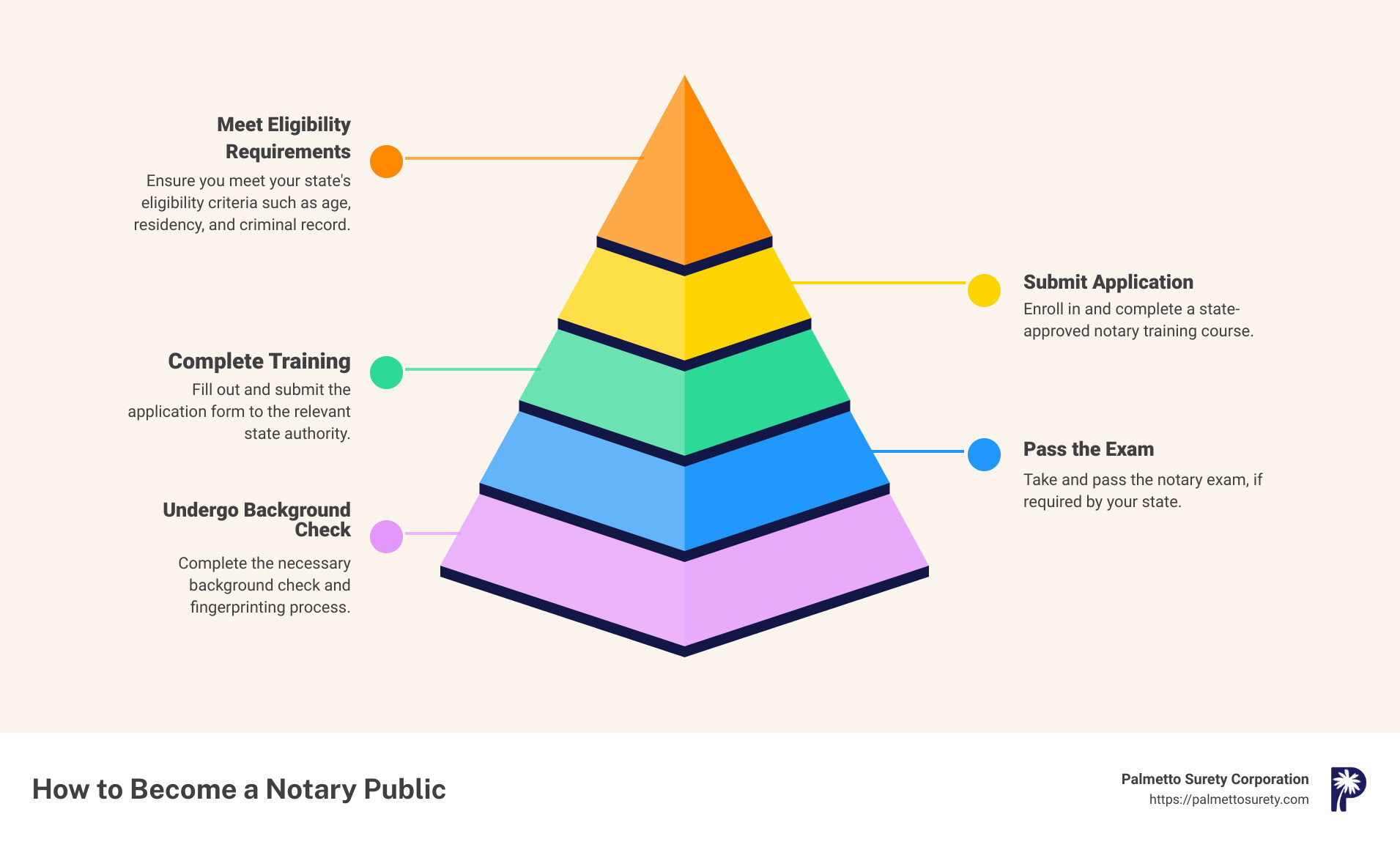
How do you become a notary public? Here’s a quick breakdown to get you started:
1. Meet your state’s eligibility requirements.
2. Submit an application.
3. Complete required training (if applicable).
4. Pass the notary exam.
5. Undergo a background check.
Becoming a notary public is more than just obtaining a title—it’s about serving your community and enhancing your career. As a notary, you play a critical role in preventing fraud, ensuring the legitimacy of signatures, and administering oaths. This makes you a valuable resource in legal and business transactions.
Benefits
- Serve Your Community: Help businesses and individuals with important documents.
- Expand Your Skill Set: Gain valuable knowledge of legal procedures and practices.
- Generate Additional Income: Work part-time, full-time, or on an as-needed basis.
- Improve Professional Opportunities: Stand out in fields like real estate and finance.
- Flexibility and Independence: Set your own working hours and conditions.
I’m Haiko de Poel Jr, a seasoned expert in the field of marketing and digital change. My experience in guiding individuals through their professional journey makes me uniquely qualified to help you understand how do you become a notary public. Join me as we dig deeper into each step of the process.
Qualifications to Become a Notary Public
Becoming a notary public can open up new professional opportunities and allow you to serve your community. But first, you need to meet certain qualifications. Let’s break down the key requirements:
Age Requirement
To become a notary public, you must be at least 18 years old. This is a standard requirement across all states. Being of legal age ensures that you are mature enough to handle the responsibilities that come with the role.
Residency
You must be a legal resident of the state where you plan to serve as a notary. Some states also allow residents from neighboring states to become notaries. For instance, if you live near a state border and work in the adjacent state, you might still be eligible to apply.
Criminal Record
Having a clean criminal record is crucial. Most states disqualify individuals with felony convictions from becoming notaries. Some states may also scrutinize misdemeanors, especially those involving fraud or dishonesty. A background check is often part of the application process to ensure you meet this criterion.

Education
While not all states require formal education or training, many recommend or mandate it. For example, Louisiana requires prospective notaries to complete a state-approved notary education course. This course covers notary laws, duties, and ethical practices.
In states where training is not mandatory, it’s still a good idea to take a course. Training can help you pass any required exams and ensure you understand your responsibilities.
Meeting these qualifications is the first step in your journey to becoming a notary public. Next, we’ll explore the detailed application process, including the necessary forms, fees, and steps to get your commission.
How Do You Become a Notary Public?
Application Process
The journey to becoming a notary public starts with the application process. Each state has specific requirements, but the general steps are similar.
-
Application Form: First, you’ll need to fill out an application form. This form usually asks for basic information such as your name, address, and background details. You can typically find this form on your state’s Secretary of State website.
-
Submission Details: Once you complete the form, you’ll need to submit it along with any required documentation. This could include proof of residency, a copy of your ID, and possibly your voter registration card.
-
Filing Fee: Most states require a filing fee when you submit your application. This fee can range from less than $100 to several hundred dollars, depending on your state. For example, in Louisiana, you must submit an Application to Qualify and pay a filing fee.
Training and Exam
In some states, notary applicants must complete a training course and pass an exam.
-
Training Courses: States like California and New York require applicants to complete a state-approved notary education course. Even if your state doesn’t require it, taking a course can be beneficial. Courses cover essential topics like notary laws, ethical practices, and duties.
-
Exam Details: After training, you may need to pass a state-administered exam. The exam tests your knowledge of notary laws and procedures. For instance, Louisiana requires non-attorney applicants to pass a state notary exam, which is held at least twice a year.
-
Study Guide: To prepare for the exam, states often provide an official study guide. Louisiana offers the “Fundamentals of Louisiana Notarial Law and Practice” as a comprehensive resource.
Background Check and Fingerprinting
Some states require a background check and fingerprinting as part of the application process.
-
Requirements: States like Florida and Texas mandate background checks to ensure applicants have no disqualifying criminal history. This step is crucial for maintaining the integrity of the notary public office.
-
Process: The process usually involves submitting your fingerprints and undergoing a criminal background check. For example, in California, you must complete a Live Scan fingerprinting and submit the results to the state.
Receiving Your Commission Certificate
Once you’ve completed the application, training, exam, and background check, you’re almost there.
-
Notification: After your application is approved, you’ll receive a notification. This could be an email or a letter, depending on how you submitted your application.
-
Documentation: You will then receive your commission certificate. This document officially authorizes you to act as a notary public. In Louisiana, after passing the exam, you must submit your commission documents, including an Oath of Office and a Signature form.
Required Supplies for Notaries
To perform your notarial duties effectively, you’ll need some essential supplies. Let’s break down the three main items: the notary seal, notary journal, and certificates.
Notary Seal
Types: The notary seal is a critical tool for any notary public. It comes in two main types: the traditional rubber stamp and the modern embosser. Both types are widely accepted, but the choice depends on your preference and state regulations.
Quality and Durability: When selecting a notary seal, quality and durability are paramount. A high-quality seal ensures clear, legible imprints every time, which is crucial for the legal acceptance of documents. Look for seals made from durable materials that can withstand frequent use.
Notary Journal
Importance: While not all states require notaries to maintain a journal, it is highly recommended. A notary journal serves as a detailed record of all notarial acts performed, providing a paper trail that can protect you in case of disputes or legal questions.
Features: A good notary journal should include:
- Date and time of the notarial act
- Type of document notarized
- Signer’s name and address
- Type of identification presented
- Signer’s signature
- Notary fee charged, if any
A well-structured journal helps ensure that you capture all the necessary details for each notarization.
Certificates
Types: Certificates are perhaps the most challenging type of “supply” because different types of notarizations require different certificates. Common types include:
- Acknowledgments
- Jurat certificates
- Copy certifications
Availability: Many state Notary-regulating sites provide basic certificates, but these may not always make the best professional impression. Some suppliers offer downloadable certificates online, allowing you to print the specific type you need as required. This flexibility can save you from keeping a stock of various paper certificates.
Quality: Just like with your seal, the quality of your certificates matters. High-quality paper and clear, professional templates can improve your credibility and professionalism.
With these essential supplies in hand, you’re well-equipped to perform your notarial duties effectively and professionally. Next, let’s look at the costs involved in becoming a notary.
Costs Involved in Becoming a Notary
Becoming a notary public involves several costs, which can vary depending on your state. Here’s a breakdown of the typical expenses:
Application and Exam Fees
The first step to becoming a notary is submitting an application. Application fees can range from less than $100 to several hundred dollars, depending on your state. For example, in Louisiana, the application fee is $35.
Next, you may need to pay for an exam fee if your state requires a notary exam. Notary exams can cost around $30 to $100. In Louisiana, the state notary exam costs $100.
Training costs can also add to your expenses. While not all states require training, it’s highly recommended. Training can range from $50 to $200, depending on whether you choose online courses or in-person seminars.
Surety Bond and Insurance
A surety bond is often required to become a notary. This bond protects the public from any mistakes you might make. The amount of the bond varies by state. For example, Louisiana requires a $10,000 bond for first-time notaries. The cost of obtaining a surety bond can range from $50 to $150, depending on the bond amount and your creditworthiness.
Some notaries opt for Errors and Omissions (E&O) insurance instead of or in addition to a surety bond. E&O insurance covers legal fees and damages if you make an unintentional mistake. This insurance is optional but highly recommended for added protection. The cost of E&O insurance varies based on the coverage amount you choose.
Additional Costs
Don’t forget about additional supplies you’ll need, such as a notary seal, journal, and certificates. A notary seal can cost between $15 and $50. A notary journal might cost around $10 to $30. Certificates, if not provided by your state, can be downloaded or purchased for a small fee.
Fingerprinting and background checks may also be required in some states. These can add another $20 to $50 to your total costs.
Overall, the total cost to become a notary can range from a few hundred to several hundred dollars, depending on your state’s specific requirements and the options you choose.
Duration and Renewal of Notary Commission
Commission Term
The length of a notary commission varies by state. Most states offer a term of 4 years, but this can range from 5 to 10 years in some states. For example, a notary in California is commissioned for 4 years, while in Pennsylvania, the term is 4 years as well.
In Louisiana, the commission is unique because it lasts for life. This means once you’re commissioned, you do not have to renew, although you must keep your bond or insurance up-to-date.
Renewal Process
When your commission term is about to expire, you’ll need to renew it to continue performing notarial acts. The renewal process involves several steps and varies by state.
-
Application Submission: You must submit a renewal application, often available on your state’s Secretary of State website.
-
Training and Exam (if required): Some states require you to complete additional training or pass an exam to renew your commission.
-
Background Check and Fingerprinting: If your state requires it, you may need to undergo a background check and fingerprinting again.
-
Bond Renewal: You will need to renew your notary bond or errors and omissions insurance. This is crucial as it protects the public from any mistakes you might make. The cost of the bond is typically based on state requirements and can range from $5,000 to $25,000.
-
Fees: Renewal fees vary by state. For example, the state application fee might be around $35. Additional costs for training, exams, and background checks can add up, so budget accordingly.
-
Documentation: Submit all required documents, including proof of bond renewal, training certificates, and your renewal application.
-
Notification: Once your renewal is processed, you will receive a new commission certificate. This document officially allows you to continue your duties as a notary.
Renewing your commission on time is essential to avoid any lapse in your ability to notarize documents. Always check your state’s specific requirements and deadlines to ensure a smooth renewal process.
Next, let’s answer some frequently asked questions about becoming a notary public.
Frequently Asked Questions about Becoming a Notary Public
How much does it cost to become a notary?
The cost to become a notary varies widely depending on your state. Here are the general expenses you might encounter:
- Application Fee: This can range from $35 to $100.
- Training Costs: Some states require training courses, which can cost between $30 and $200.
- Exam Fee: If your state requires an exam, expect to pay around $100.
- Surety Bond: Most states require a surety bond, which can cost from $50 to $150 for a $10,000 bond.
- Notary Supplies: A notary seal, journal, and certificate can cost between $50 and $100.
In total, becoming a notary could cost anywhere from $100 to several hundred dollars, depending on your state’s requirements.
How hard is the notary exam?
The difficulty of the notary exam varies by state. Some states, like California and New York, have more challenging exams, while others have simpler tests. Here are some key points to consider:
- Preparation: Taking a training course can significantly improve your chances of passing. Many states offer courses that cover notarial laws and procedures.
- Content: The exam generally includes questions on state-specific notary laws, ethics, and procedures.
- Pass Rate: States with more difficult exams often have lower pass rates. For instance, California’s pass rate is around 40%.
If you study and prepare well, you can pass the exam. Many notary associations offer study guides and practice tests to help you succeed.
What are the rules for notaries?
Notaries must follow specific rules and guidelines to ensure the integrity of their work. Here are some general rules that apply in most states:
- Impartiality: Notaries must remain impartial and cannot notarize documents in which they have a personal interest.
- Identification: Notaries must verify the identity of all signers using government-issued ID.
- Record Keeping: Most states require notaries to keep a journal of all notarial acts.
- Oaths and Affirmations: Notaries may need to administer oaths or affirmations in certain situations.
- Seal or Stamp: While not always required, many states mandate the use of a notary seal or stamp.
Each state has its own set of rules, so familiarize yourself with your state’s specific requirements. For more detailed information, consult your state’s notary handbook or the Secretary of State’s website.
Next, let’s look at the required supplies for notaries.
Conclusion
Becoming a Notary Public is a rewarding journey that opens doors to new career opportunities and allows you to serve your community. The process involves several steps, including meeting qualifications, submitting an application, completing training, and passing an exam if required. Additionally, securing a surety bond and purchasing necessary supplies like a notary seal and journal are essential parts of the process.
At Palmetto Surety Corporation, we understand the complexities of becoming a Notary Public. We are here to support you every step of the way, from obtaining your Tennessee Notary Bond to providing expert guidance on the application process.
Feel free to reach out to us for any questions or assistance you may need. Our dedicated support team is available to ensure you have all the information and resources required to succeed as a Notary Public.
Contact Information
- Email: [email protected]
- Website: Palmetto Surety Corporation
We look forward to helping you on your path to becoming a Notary Public.


