Adjuster Bond Guide: Top 7 Insights for 2024 Success
Introduction
An adjuster bond is a type of surety bond required for insurance adjusters to ensure they adhere to legal and ethical standards while handling claims. This bond is crucial as it protects the public from any fraudulent or dishonest practices by the adjuster.
Here’s what you need to know about an adjuster bond:
- What is it? It’s a three-party agreement between the adjuster (principal), the state agency (obligee), and the surety company (guarantor).
- Why is it important? It ensures adjusters comply with state regulations and protects clients against any potential misconduct.
- Who needs it? Depending on the state, all public adjusters and sometimes independent adjusters may need this bond to get licensed.
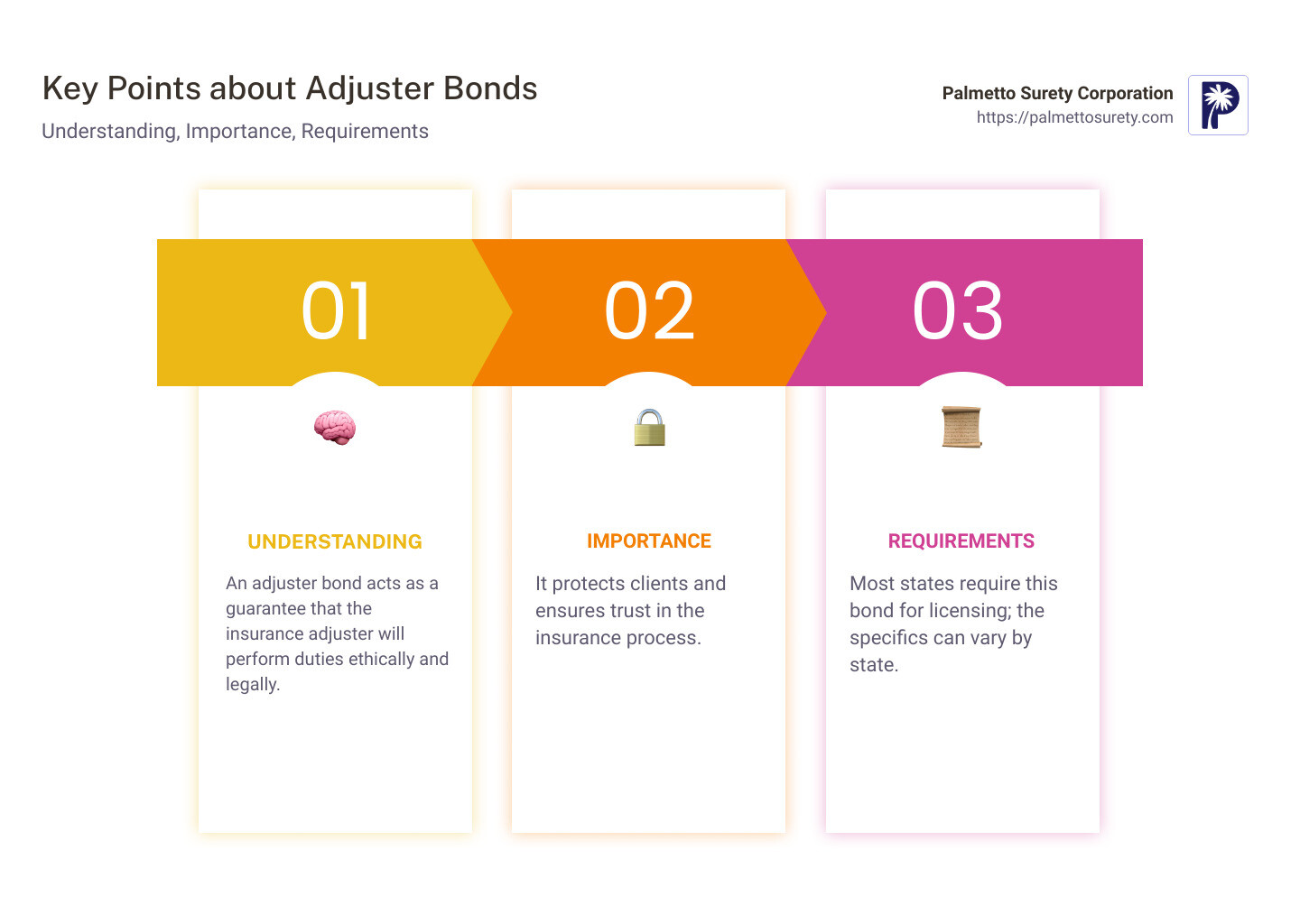
Key Points to Understand:
- Understanding: An adjuster bond acts as a guarantee that the insurance adjuster will perform duties ethically and legally.
- Importance: It protects clients and ensures trust in the insurance process.
- Requirements: Most states require this bond for licensing; the specifics can vary by state.
What is an Adjuster Bond?
An adjuster bond is a type of surety bond that insurance adjusters must obtain to get licensed in many states. This bond ensures that adjusters adhere to industry laws and regulations, protecting both the state and individuals filing insurance claims from illegal and unethical practices.
Definition
An adjuster bond acts as a legal contract among three parties:
- Principal: The insurance adjuster who purchases the bond.
- Obligee: The state agency that requires the bond for licensing.
- Surety: The company that issues the bond and guarantees payment if the principal fails to meet their obligations.
Surety Bond
Unlike traditional insurance, a surety bond does not protect the adjuster. Instead, it safeguards the public and the state. If an adjuster fails to comply with the law, the state can make a claim against the bond. The surety company will then compensate the state up to the bond’s limit and seek reimbursement from the adjuster.
Legal Requirement
Most states require insurance adjusters to obtain a surety bond before they can receive their license. This bond ensures that adjusters:
- Follow state regulations.
- Operate ethically.
- Protect clients from fraud and misconduct.
For example, Georgia mandates a $5,000 surety bond for public adjusters, ensuring they act in good faith and comply with state laws.

Why It Matters
An adjuster bond is crucial for maintaining trust in the insurance industry. It provides a financial safety net for clients and states, ensuring that adjusters fulfill their duties responsibly. If an adjuster engages in unethical behavior, the bond offers a way for affected parties to seek compensation.
In summary, an adjuster bond is a critical component of the licensing process for insurance adjusters, ensuring they operate within the bounds of the law and protect the interests of their clients and the state.
Types of Adjuster Bonds
Public Adjuster Bonds
A Public Adjuster Bond is a surety bond required for public adjusters. Public adjusters work on behalf of policyholders, helping them file claims and negotiate settlements with insurance companies. They are the only type of adjuster legally allowed to advocate for the insured in claim negotiations.
For example, if a homeowner’s property is damaged in a storm, a public adjuster can help the homeowner receive the maximum payout from their insurance policy. The Public Adjuster Bond ensures that the adjuster will adhere to legal and ethical standards. If the adjuster fails to do so, the bond provides financial protection to the policyholder.
Independent Adjuster Bonds
An Independent Adjuster Bond is for adjusters who work independently but are hired by insurance companies to handle claims. Unlike public adjusters, independent adjusters aim to minimize the payout for the insurance company.
Consider an independent adjuster working for multiple insurance companies to assess damage after a natural disaster. The Independent Adjuster Bond ensures they follow state laws and ethical guidelines. This bond protects the insurance companies and policyholders from any unethical behavior by the adjuster.
State Variations
Adjuster bond requirements vary significantly by state.
- California requires an Insurance Adjuster Bond for both public and independent adjusters.
- Georgia mandates a Public Adjuster Bond.
- Nebraska and New Hampshire require either a Public or Independent Adjuster Bond, depending on the adjuster’s role.
- Nevada has a unique requirement with a Motor Vehicle Damage Appraiser Bond.
Each state has specific regulations governing the bond amounts and the licensing process. For instance, some states like Florida require public adjusters to post a bond before they can be licensed. Other states, such as Wisconsin, have different rules for public and independent adjusters.
Understanding these state variations is essential for adjusters to ensure compliance and maintain their licenses. You can find detailed information on state-specific requirements by visiting the Palmetto Surety Corporation website.
In the next section, we will discuss how to obtain an adjuster bond, including the application process and required documents.
How to Obtain an Adjuster Bond
Application Process
Getting an adjuster bond is a straightforward process if you know the steps. Here’s a simple guide to help you through:
-
Complete Pre-Licensing Requirements: Before applying for the bond, ensure you meet all pre-licensing requirements. For example, in Georgia, you need to pass a pre-licensing course and exam unless you have a certified designation that allows you to waive the exam.
-
Apply Online: Most states, including Georgia, require you to apply for your adjuster license online through the National Insurance Producer Registry (NIPR).
-
Submit Fingerprints and Background Check: You’ll need to submit your fingerprints and pass a criminal background check. This is a standard requirement to ensure the integrity of adjusters.
-
Obtain a Surety Bond: You can get your surety bond from a reputable provider like Palmetto Surety Corporation. The bond ensures you will act in good faith and adhere to state laws and regulations.
-
Pay the Application Fee: There is an application fee that varies by state. For example, Georgia requires a fee when you submit your application through NIPR.
Required Documents
When applying for an adjuster bond, you’ll need to prepare and submit several key documents:
- Completed Application Form: Available on the NIPR website.
- Proof of Pre-Licensing Course Completion: If applicable.
- Fingerprint Submission: For the background check.
- Citizenship Affidavit: This must be notarized.
- Surety Bond: Typically, a $5,000 bond for Georgia.
- Experience Documentation: Some states, like Georgia, require proof of five continuous years of relevant insurance experience.
Palmetto Surety Corporation
Palmetto Surety Corporation makes obtaining an adjuster bond easy and efficient. Here’s why you should consider them:
- Competitive Rates: With rates starting as low as $100 for those with good credit.
- Quick Approvals: Most bonds are approved and delivered within 24 hours.
- Experienced Agents: Benefit from a team of highly experienced surety agents with in-house underwriting authority.
- Comprehensive Support: Their 24/7 support team ensures you get the help you need at any time.
You can start your application process by visiting the Palmetto Surety Corporation website and accessing their resources and forms.
Next, we will look into the costs and fees associated with adjuster bonds, including bond amounts, premium rates, and renewal fees.
Costs and Fees Associated with Adjuster Bonds
When it comes to costs and fees for adjuster bonds, there are a few key factors to consider: bond amounts, premium rates, and renewal fees.
Bond Amounts
The required bond amount varies by state. For example, in Georgia, a public adjuster must file a $5,000 surety bond as part of the licensing process. Different states have different requirements, so it’s crucial to check the specific bond amount needed in your state.
Premium Rates
The premium rate is the percentage of the bond amount you pay as a fee. Premiums for adjuster bonds typically range from 1% to 7.5% of the bond amount. Your credit profile and company strength can significantly affect this rate. For instance:
- Good Credit: If you have a strong credit score, you might pay closer to 1% of the bond amount.
- Bad Credit: Those with financial hardships or lower credit scores may pay higher premiums, sometimes up to 7.5%.
For example, if you need a $5,000 bond in Georgia, your premium could range from $50 to $375 depending on your credit profile.
Renewal Fees
Adjuster bonds must be renewed periodically, typically annually. Renewal fees depend on the bond amount and your credit profile. For instance, in Georgia, a public adjuster bond can be renewed for:
- $100 for 1 year of coverage
- $175 for 2 years of coverage
- $250 for 3 years of coverage
Opting for a longer-term bond can save you money in the long run, as you pay 25% less per year and avoid the hassle of annual renewals.
Additional Costs
If a claim is made against your bond and found valid, you will need to repay the surety for the claim amount plus any associated fees. This can be costly and may affect your future premium rates.
It’s essential to resolve any disputes with customers quickly to avoid claims on your bond. Repeated claims can lead to higher premiums or even being dropped by your surety provider, making it difficult to get bonded in the future.
For more detailed information on costs and to get an accurate quote, visit the Palmetto Surety Corporation website.
Next, we will explore state-specific requirements for adjuster bonds, focusing on Georgia, Texas, and California.
State-Specific Requirements
Georgia
In Georgia, public adjusters must apply for a resident insurance license and obtain a $5,000 surety bond. The bond ensures that the adjuster will act in good faith and adhere to state laws. The application process involves several steps:
- Pre-Licensing Course and Exam: Applicants must pass a pre-licensing course and exam unless they have a certified designation that allows for a waiver.
- Application: Submit the application online through the National Insurance Producer Registry (NIPR) and pay the application fee.
- Fingerprinting and Background Check: Submit fingerprints and pass a criminal background check.
- Experience: Have at least five continuous years of experience in insurance roles such as subagent, agent, or adjuster.
- Citizenship Affidavit: Provide a notarized Citizenship Affidavit as part of the application.
For more information, visit the Georgia Office of Commissioner of Insurance and Safety Fire.
Texas
Texas also requires public adjusters to obtain a license and surety bond. Here’s a quick guide to the process:
- Pre-Licensing Course and Exam: Complete a pre-licensing course and pass the state exam.
- Application: Submit the application via the Texas Department of Insurance (TDI) website.
- Fingerprinting and Background Check: Undergo fingerprinting and a background check.
- Surety Bond: Obtain a $10,000 surety bond.
- Continuing Education: Complete continuing education courses to maintain the license.
For detailed steps, check the Texas Department of Insurance website.
California
California has specific requirements for adjusters, including a surety bond and licensing process:
- Education and Exam: Complete required pre-licensing education and pass the state exam.
- Application: Apply through the California Department of Insurance (CDI) and pay the necessary fees.
- Fingerprinting and Background Check: Submit fingerprints and pass a criminal background check.
- Surety Bond: Obtain a $20,000 surety bond.
- Exemptions: Certain exemptions to the surety bond requirement took effect on January 1, 2022. Check the CDI website for details.
Licensing Process
The licensing process generally involves the following steps, regardless of the state:
- Education and Exam: Complete a pre-licensing course and pass the state exam.
- Application: Apply online through the appropriate state department or registry.
- Fingerprinting and Background Check: Submit fingerprints and pass a background check.
- Surety Bond: Obtain the required surety bond amount.
- Experience: Meet any state-specific experience requirements.
- Continuing Education: Fulfill ongoing education requirements to maintain the license.
State Regulations
State regulations vary and can impact the type of bond required and the licensing process. It’s crucial to:
- Stay Updated: Regulations can change, so regularly check your state’s insurance department website.
- Understand Reciprocity: Some states have reciprocity agreements, which might affect your bonding requirements if you are licensed in multiple states.
- Emergency Adjusters: During disasters, out-of-state adjusters may need to register as emergency adjusters. Policies vary by state, so consult the state’s insurance department for specifics.
For more detailed state-specific requirements, visit the Palmetto Surety Corporation website.
Next, we will address some frequently asked questions about adjuster bonds.
Frequently Asked Questions about Adjuster Bonds
What is the purpose of an adjuster bond?
An adjuster bond serves as a safeguard for consumers and the state. It ensures that insurance adjusters adhere to industry regulations and ethical standards. If an adjuster engages in illegal or unethical practices, the bond provides financial protection to those affected. Essentially, it holds adjusters accountable and helps maintain trust in the insurance industry.
How much does an adjuster bond cost?
The cost of an adjuster bond varies depending on several factors:
- Bond Amount: Typically set by state regulations.
- Premium Rates: Usually range from 1% to 7.5% of the bond amount.
For instance, in Georgia, a public adjuster bond costs $100 for one year of coverage, $175 for two years, or $250 for three years. Most bonds can be purchased instantly online and often do not require a credit check.
Can an adjuster bond be cancelled?
Yes, an adjuster bond can be cancelled. The surety company can cancel the bond by providing at least a 60-day written notice to the state agency. However, the adjuster must ensure compliance with all regulations and settle any claims before cancellation to avoid penalties or legal issues.
For more information or to get started with your adjuster bond, visit Palmetto Surety Corporation.
Conclusion
When it comes to securing an adjuster bond, trust and reliability are paramount. At Palmetto Surety Corporation, we pride ourselves on being a dependable partner in the complex world of surety bonds. Our extensive experience and commitment to excellence ensure that you receive the best service possible.
Trust is the foundation of any good relationship, especially in the insurance industry. With over 35 years in the business, we have built a reputation for being a trustworthy provider of surety bonds. Our clients know they can rely on us to provide accurate information, competitive rates, and fast approvals.
Reliability is equally important. Our state-of-the-art underwriting platform ensures that the process of obtaining an adjuster bond is quick and hassle-free. We understand the urgency that often accompanies these needs, and we strive to deliver bonds within 24 hours after application. This reliability extends to our customer support, available 24/7 to answer any questions or concerns you may have.
Choosing Palmetto Surety Corporation means choosing a partner who understands the intricacies of the insurance industry and is committed to helping you navigate them with ease. Whether you need a public adjuster bond, an independent adjuster bond, or any other type of surety bond, we are here to assist you every step of the way.
For more information or to get started with your adjuster bond, visit Palmetto Surety Corporation. We look forward to helping you secure your bond and build a successful career as an insurance adjuster.