


Do you receive bail money back: Your 1st Key Guide
Understanding When and How You Get Your Bail Money Back
Do you receive bail money back? The answer depends entirely on how you paid bail and whether you met all court requirements. Here’s what you need to know:
Cash Bail (Paid Directly to Court):
- ✅ Refundable – You get your money back after the case ends
- ⚠️ Deductions apply – Court fees, fines, or restitution may be subtracted
- 📅 Timeline – Typically 2-12 weeks after case conclusion
Bail Bonds (Paid to Bondsman):
- ❌ Non-refundable – The 10-15% premium you paid is a service fee
- 🔄 Collateral returned – Any property used as collateral comes back
- ⏰ No waiting – Nothing to refund since it was a fee
Key Requirement for Any Refund:
You must attend all court dates and follow all bail conditions, regardless of whether you’re found guilty or innocent.
When someone is arrested in the United States, bail serves as a financial guarantee that allows temporary release from jail while awaiting trial. Think of it as a deposit – if you show up to court as promised, you get it back. If you don’t, the court keeps it.
The confusion around bail refunds often stems from not understanding the difference between paying bail directly to the court versus hiring a bail bondsman. With cash bail, you’re essentially lending money to the court. With bail bonds, you’re paying for a service – and services aren’t refundable.
I’m Haiko de Poel Jr., and through my work with Palmetto Surety Corporation and other companies in the bail and surety industry, I’ve helped thousands of people understand exactly when do you receive bail money back and when you don’t. This guide will walk you through every scenario so you know exactly what to expect with your money.
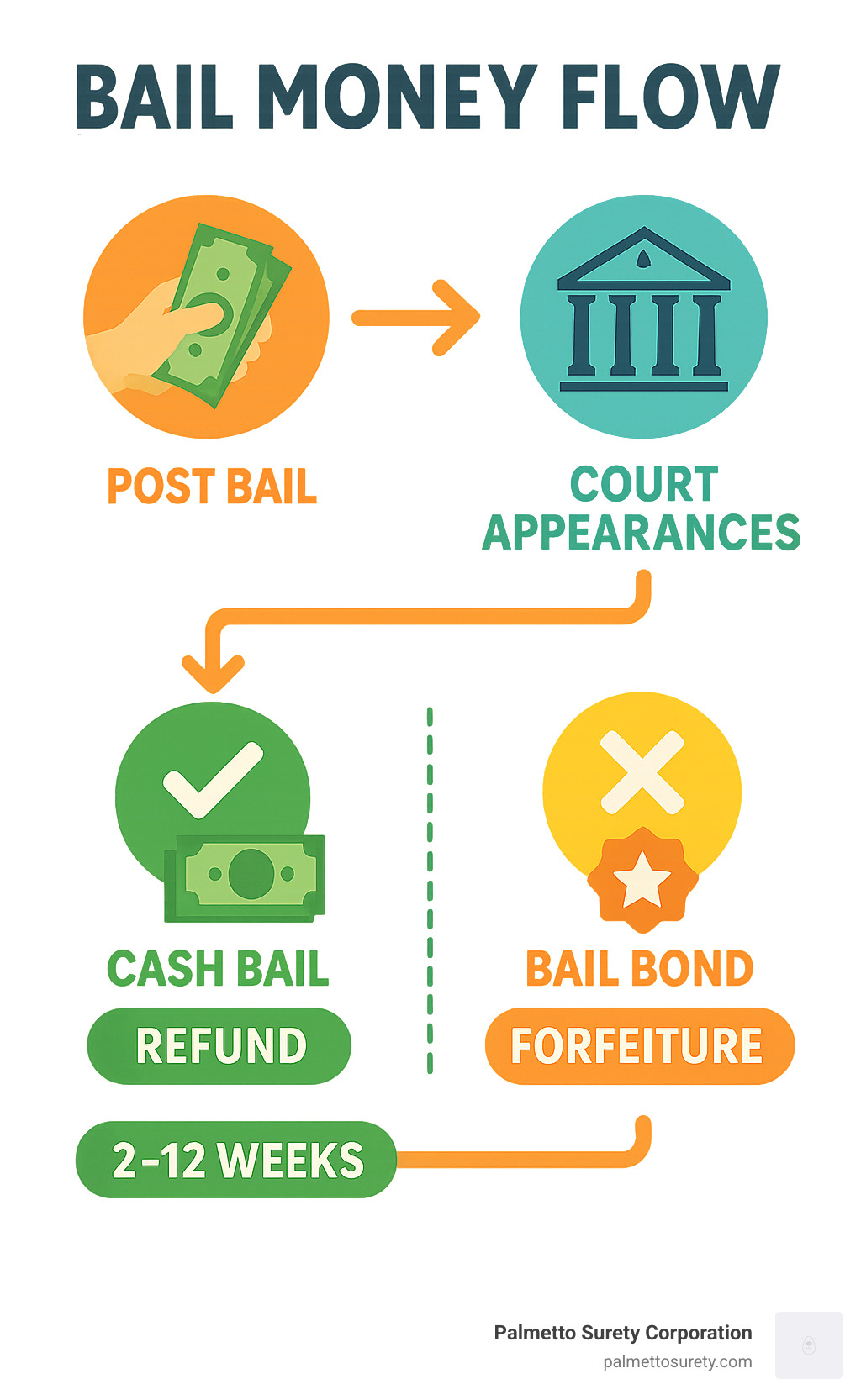
Understanding Your Bail Options and Their Refund Rules
When someone you care about gets arrested, understanding your bail options becomes crucial – especially since each choice has completely different rules about do you receive bail money back. The good news? Once you understand the basics, it’s actually pretty straightforward.

Think of bail as the court’s way of saying “we trust you’ll come back if you put some skin in the game.” It’s a financial commitment that secures the defendant’s release from custody while they prepare for their case. But here’s where it gets interesting – not all bail payments work the same way.
The U.S. justice system offers several paths to freedom, and each one handles your money differently. You’ve got cash bail (where you pay the court directly), bail bonds (where you hire a professional), and a few other options we’ll cover. The key to knowing do you receive bail money back lies in understanding exactly which path you’re taking.

For Cash Bail: How Do You Receive Bail Money Back?
When you pay cash bail, you’re essentially making a refundable deposit directly to the court. You pay the full bail amount upfront – let’s say $5,000 – and the court holds onto it like a security deposit on an apartment.
Here’s the beautiful simplicity of cash bail: if you show up to all your court dates and follow the rules, you get your money back. It doesn’t matter if you’re found guilty, not guilty, or if charges get dropped. The case outcome isn’t what determines your refund – it’s whether you kept your promise to appear in court.
But there’s a small catch (isn’t there always?). While the court will return your bail money, they might make some deductions first. Think of it like getting your apartment deposit back, but they take out money for that hole you accidentally put in the wall.
The court can subtract court fees, fines, or restitution from your bail before sending you the refund. So if you paid $5,000 in cash bail but owe $200 in court fees, you’d get back $4,800. You’re still getting the vast majority of your money back – just not every penny if you have outstanding obligations.
The payer of bail (whoever actually wrote the check or handed over the cash) is the one who receives the refund when the case concludes. This matters if a family member or friend posted bail on someone’s behalf.
For Bail Bonds: Why Don’t You Receive Bail Money Back?
This is where most people get confused, and honestly, I don’t blame them. If you use a bail bondsman, the money you paid them is gone forever – and that’s actually how it’s supposed to work.
Here’s why: when you hire a bail bondsman, you’re not making a deposit. You’re paying for a service. The bondsman posts the full bail amount to the court (using what’s called a surety bond), and you pay them a non-refundable premium – typically 10-15% of the total bail amount.
Let’s break this down with real numbers. Say bail is set at $10,000. Instead of paying the full $10,000 to the court, you pay a bail bondsman $1,000-$1,500 (their 10-15% service fee). The bondsman then guarantees the full $10,000 to the court on your behalf.
That $1,000-$1,500 you paid? It’s the cost of the bondsman taking on the risk of guaranteeing your $10,000 bail. Think of it like paying an insurance premium – you don’t get that money back because you were paying for protection and service.
Sometimes a bondsman will also ask for collateral (like putting a lien on your car or house) to secure the bond. The good news is that while you’ll never see that premium again, any collateral gets returned once the case ends and all court appearances are made.
For more details on how these financial guarantees work in practice, you can learn more about bail surety bonds and the risk mitigation strategies bondsmen use.
Other Avenues: Property Bonds and Release on Own Recognizance (O.R.)
The bail system offers a couple of other paths that work differently from cash bail and bail bonds.
Property bonds let you use real estate or other valuable property as collateral instead of cash. The court places a lien on your property, which means they have a legal claim to it if the defendant doesn’t show up. When all court obligations are met, the lien gets released and your property is free and clear. Since no money changes hands, there’s no cash refund to worry about – just the release of the court’s claim on your property.
For certain low-level offenses or defendants who aren’t considered flight risks, judges sometimes grant Release on Own Recognizance (O.R.). This is basically the court saying “we trust you” and releasing the defendant based solely on their promise to appear in court.
With O.R. release, there’s no financial commitment at all – no cash, no bondsman, no property liens. Since you didn’t pay anything, the question of do you receive bail money back doesn’t even come up. It’s simply a written promise to show up when required.
The Step-by-Step Process for Recovering Bail Funds
Getting your bail money back might seem complicated, but it’s actually pretty straightforward once you know the steps. Think of it like returning a rental car – there’s a process to follow, paperwork to complete, and then you get your deposit back. The key difference? Courts move at their own pace, so patience is definitely required.
The good news is that if you paid cash bail directly to the court and followed all the rules, do you receive bail money back is almost always a yes. Let’s walk through exactly how this works.
The Cash Bail Refund Procedure
If you paid cash bail directly to the court, you’re entitled to get that money back once the case wraps up. Here’s how the process typically unfolds:
First, your case needs to officially end. This could happen through a verdict, a plea deal, or even if the charges get dropped entirely. Once that happens, the court issues what’s called an “exoneration of bail” or “order to release bail.” This is basically the court’s way of saying “okay, we don’t need to hold onto this money anymore.”
Next, you’ll need to contact the court clerk’s office where the bail was originally posted. Don’t worry – they deal with this all the time and can walk you through their specific process. Each court has slightly different procedures, but the basics are the same everywhere.

The paperwork part is where having your original bail receipt becomes crucial. Seriously, guard this document like it’s cash – because it basically is. You’ll also need your photo ID, a completed refund request form from the court, the court order showing your case is closed, your Social Security number for tax purposes, and sometimes proof of your current address.
Here’s what you’ll typically need to bring:
- Original Bail Receipt (absolutely essential!)
- Valid Photo ID (driver’s license or passport work great)
- Court Order showing bail exoneration
- Completed refund request form from the court
- Proof of current address
- Social Security Number
How Long Does a Bail Refund Take?
Here’s where that patience I mentioned earlier really comes in handy. Do you receive bail money back quickly? Well, that depends on where you are and how backed up the court system is.
Most bail refunds take somewhere between 2 to 12 weeks after your case ends. I know that’s a pretty wide range, but court systems vary dramatically from place to place. Some are super efficient, others… not so much.
If you’re in California, you’re looking at about 30 days typically. New York City tells people to expect around 8 weeks, and they’ve got pretty good systems in place. You can check their official process at New York City’s official guidance on bail refunds if you’re dealing with a NYC case.
The reality is that courts handle thousands of cases, and processing refunds isn’t always their top priority. Don’t be surprised if there are administrative delays – it’s frustrating, but it’s normal. If you haven’t heard anything after the expected timeframe, a polite call to the court clerk usually helps move things along.
Does the Case Outcome Affect the Refund?
This is probably the biggest misconception people have about bail refunds. Here’s the truth: whether you’re found guilty or not guilty doesn’t change whether you get your bail money back.
The whole point of bail is to make sure you show up to court, not to punish you or act as a down payment on potential fines. So if you paid cash bail and attended all your court dates, you’re getting that money back regardless of what the judge or jury decides.
Found guilty? Your bail money still comes back, though the court might subtract any fines, court fees, or restitution you owe from the refund amount. Found not guilty? You get the full amount back, minus maybe some small administrative fees. Charges dropped? Same deal – your money comes back.
The only thing that really matters for getting your refund is that you showed up to court when you were supposed to and followed all the conditions of your release. Skip court or violate your bail conditions? That’s when you lose the money entirely.
It’s actually pretty fair when you think about it – the court held up their end of the bargain by letting you out of jail, and as long as you held up yours by showing up to court, everyone’s square.
Do You Receive Bail Money Back if Conditions Are Broken?
Here’s where things get serious. While we’ve established that cash bail is generally refundable, there are critical situations where you can kiss that money goodbye. Breaking bail conditions doesn’t just mean a slap on the wrist – it means losing your financial guarantee entirely.
The bail system operates on trust. When you post bail, you’re essentially making a promise to the court: “I’ll show up, and I’ll follow your rules.” Break that promise, and the consequences are swift and expensive.
Forfeiture: The Primary Reason Bail Isn’t Returned
Failure to appear in court is the number one reason people lose their bail money. It’s that simple and that devastating. When you skip your court date, the judge doesn’t send out a search party – they issue a bench warrant for your arrest and declare your bail forfeited.
This means the court keeps every penny, whether you paid cash bail directly or a bondsman guaranteed the amount. There’s no negotiation, no second chances, and no partial refunds. Do you receive bail money back after skipping bail? Absolutely not.
The moment you fail to appear, you’ve broken the fundamental agreement that bail represents. The court views this as you voluntarily giving up your right to that money. It’s their way of saying, “You didn’t hold up your end of the bargain, so we’re keeping the deposit.”

Other Violations of Release Conditions
Missing court isn’t the only way to lose your bail money. Judges often set specific conditions when they grant bail, and violating any of these can put your money at risk.
Travel restrictions are common – leaving the state or country without permission can trigger forfeiture. We’ve seen cases where someone took a “quick trip” to visit family and returned to find their bail revoked and their money gone.
No-contact orders are another frequent condition. If you’re charged with domestic violence or harassment, attempting to contact the alleged victim or witnesses can immediately jeopardize your bail. The court takes these violations seriously because they suggest you might intimidate witnesses or escalate the situation.
Committing new crimes while out on bail is perhaps the most serious violation. Getting arrested for any new offense signals to the court that you’re a danger to the community and can’t be trusted with freedom. This almost always results in bail revocation and forfeiture.
Failing drug tests is another way people lose their bail money. If substance abuse was part of your original charges, the court might require regular testing. Missing a test or testing positive can mean immediate forfeiture.
Legal Consequences of Skipping Bail
The financial loss from forfeiture is just the beginning. Skipping bail creates a cascade of legal problems that can haunt you for years.
Bail jumping is a separate criminal offense in most states. This means you’re not just facing your original charges – you now have additional charges that can result in more fines, longer sentences, and a permanent mark on your criminal record. California’s legal system specifically addresses this in CALCRIM No. 3001. Failure to Appear While on Bail.
Your original case will also suffer. Judges remember defendants who skip bail, and this negative case impact can influence everything from plea negotiations to final sentencing. You’ve essentially told the court that you don’t respect the legal process, which rarely works in your favor.
If you used a bail bondsman, you’ll also have bounty hunters to worry about. These bail enforcement agents have broad powers to track you down and bring you back to face the music. They can cross state lines, enter properties, and arrest you – all because you decided to skip your court date.
The bottom line? Following bail conditions isn’t just about getting your money back – it’s about avoiding a legal nightmare that can follow you for the rest of your life.
Frequently Asked Questions about Bail Refunds
Over the years, I’ve fielded thousands of questions about bail refunds from worried families and defendants. These are the questions that come up most often, and I want to make sure you have clear answers.
How do court fees and fines affect my cash bail refund?
Here’s where things can get a bit tricky, even when you’ve done everything right. Do you receive bail money back in full when you paid cash bail? Not always – the court can make deductions before sending you the refund.
When you paid cash bail directly to the court, you’re entitled to get that money back. But the court treats your bail money like a convenient source to pay off any financial obligations from your case. Administrative fees are almost always deducted – these cover the court’s processing costs. Court costs, which vary by state, are another common deduction.
If you’re convicted, the deductions can be more substantial. The court will subtract any fines imposed during final sentencing. They’ll also deduct restitution payments if you’re ordered to compensate victims. These deductions are completely legal and happen automatically.
Let me give you a real example: Say you posted $2,000 in cash bail, but the court orders $300 in fines and $150 in court costs after conviction. Your refund check will be for $1,550. The specific amounts depend on your state laws and what the judge orders, but the process works the same way everywhere.
What happens to the bail money if someone else pays it?
This situation comes up all the time – a parent, spouse, or friend steps up to post bail for someone they care about. The good news is that the refund goes to whoever actually paid the bail, not the defendant.
The court keeps careful records of who the “payer of record” or “surety” is. When it’s time for the refund, the check gets made out to that person. So if your mom paid your $5,000 cash bail, she’s the one who gets the refund check when your case is over.
Sometimes families want to redirect that refund to someone else – maybe the defendant needs the money for legal fees, or there’s been a change in family circumstances. Most courts allow this, but you’ll need paperwork. The original payer typically has to sign a notarized authorization or complete what’s called an “assignment of bail” form. Check with your court clerk about their specific requirements, because the rules vary by jurisdiction.
Can you bail yourself out of jail?
Absolutely, and it happens more often than you might think. If you have the full cash bail amount available when you’re arrested, you can pay your own way out. This means you’re paying the court directly, which puts you in the best position to get your money back later.
The self-bail process varies by location, but it typically involves going to the jail’s bond window or courthouse finance office. You’ll need to bring acceptable payment – most places take cash, money orders, cashier’s checks, or traveler’s checks. Some modern jail facilities even accept credit card payments, though this is still pretty rare for large amounts.
Florida law, for example, specifically allows defendants to post their own bail if they have the funds available. The key is having the money on hand and understanding the specific payment procedures for your county. Some jails have 24-hour bond windows, while others only process payments during business hours.
The advantage of bailing yourself out is straightforward – you maintain complete control over your money and the refund process. You don’t have to coordinate with family members or friends, and you don’t have to pay a bail bondsman’s non-refundable fee.
Conclusion: Navigating the Bail System with Confidence
Understanding the bail system doesn’t have to feel overwhelming. Now that you know the answer to “do you receive bail money back,” you can make informed decisions during what’s already a stressful time.
The bottom line is straightforward: cash bail paid directly to the court is refundable, while bail bond premiums are service fees that you won’t get back. It’s really that simple once you understand the difference between lending money to the court versus paying for a bondsman’s services.
The most important thing to remember? Show up to every single court date. Whether you’re facing serious charges or minor infractions, whether you paid $500 or $50,000 in bail – none of that matters if you don’t appear when the judge expects you. Missing court is the fastest way to lose your bail money and create much bigger problems for yourself.
We’ve seen families lose thousands of dollars simply because they misunderstood a court date or forgot about a hearing. Don’t let that be you. Mark every date on your calendar, set multiple reminders, and treat each court appearance as the most important appointment of your life.
At Palmetto Surety Corporation, we’ve been helping people steer these exact situations for over 20 years. Through our network of experienced bail agents across Georgia, Florida, Mississippi, South Carolina, and Tennessee, we’ve guided countless families through the bail process. We know how confusing it can be, and we’re here to make it clearer.
Whether you paid cash bail and are waiting for your refund, or you used a bail bond and want to understand what happens next, knowledge is power. Understanding your specific bail agreement – whether it’s cash, a bond, or property – helps you know exactly what to expect and when.
The criminal justice system can feel intimidating, but you don’t have to face it alone. If you’re someone who enjoys helping others through difficult times and has a strong understanding of the legal system, you might find a rewarding career as a bail agent. We’re always looking for dedicated professionals to join our team. Learn more about how you can Become an agent with us.
Every case is different, and every jurisdiction has its own procedures. When in doubt, ask questions. Court clerks, attorneys, and experienced bail agents are there to help you understand the process. The more you know, the more confident you’ll feel navigating this challenging time.
🏗️ Need a Surety Bond? Get Approved Today!
Get bonded quickly and easily to meet your licensing requirements.
We offer instant approvals and
competitive rates for contractors and businesses.
⚡ Popular Bonds – Quick Approval:
✅ Same-Day Approval Available! Most bonds approved in minutes.
Bad credit? No problem. We have options for all credit situations.
🏗️ Need a Surety Bond? Get Approved Today!
Get bonded quickly and easily to meet your licensing requirements.
We offer instant approvals and
competitive rates for contractors and businesses.
⚡ Popular Bonds – Quick Approval:
✅ Same-Day Approval Available! Most bonds are auto approved within minutes.
Bad credit? No problem. We have options for all credit situations.
⏱️ Call Now For An Instant Surety Bond Quote →
Fast approval • Competitive rates • Over 22 years of experience • No hidden fees


