


Lost Vehicle Title Bond: 3 Easy Steps to Peace of Mind
Understanding Your Options When Your Vehicle Title Disappears
A lost vehicle title bond is a type of surety bond that serves as a legal guarantee of your ownership when a vehicle’s original title is missing or defective. This bond protects the state DMV, previous owners, and future buyers from financial loss if ownership disputes arise.
Quick Answer: What You Need to Know About Lost Vehicle Title Bonds
- Purpose: Establishes legal proof of vehicle ownership when the original title is unavailable.
- Cost: Typically $100 for vehicles valued under $6,000, or 1-3% of the bond amount for higher values.
- Bond Amount: Usually 1.5 to 2 times your vehicle’s current market value.
- Duration: Generally valid for 3-5 years before converting to a regular title.
- Requirements: Vehicle identification, proof of value, and a surety bond application.
- Not Available In: Some states, including Delaware, Kansas, Kentucky, and Oregon, don’t allow bonded titles.
Common Situations Requiring a Title Bond:
- You never received the title when purchasing the vehicle.
- The title was lost, stolen, or destroyed.
- You received an improperly assigned or damaged title.
- The vehicle was inherited without a proper title transfer.
- You bought from someone who couldn’t locate their title.
When you need to register, insure, or sell your car but can’t find the title, it can be a frustrating roadblock. I’m Haiko de Poel Jr, and at Palmetto Surety Corporation, I’ve helped many clients steer the complexities of surety bonds, including state-specific lost vehicle title bond requirements. Understanding this process can save you significant time, money, and stress.
What is a Lost Vehicle Title Bond and Why is it Necessary?
A lost vehicle title bond is a financial safety net that proves you’re the rightful owner of a vehicle when the original title is missing. Also known as a “certificate of title bond” or “defective title bond,” it serves as a legal promise that you own the vehicle. When the original title is gone, the state’s Department of Motor Vehicles (DMV) needs assurance that you aren’t trying to claim someone else’s car. The bond provides this guarantee, ensuring that if another person makes a legitimate claim, funds are available to resolve the issue.
This process protects everyone involved: the DMV is shielded from fraud, future buyers can trust the vehicle’s legitimacy, and you can register, insure, and sell your car. To learn more about how surety bonds work, check out What is Surety Bond Insurance?.
Understanding the Purpose of a Title Bond
A title bond fills the gap left by missing paperwork, allowing you to move forward when you can’t register, insure, or transfer ownership of your vehicle.

- Financial Protection: The bond’s primary role is to provide funds if someone later proves a legitimate claim to your vehicle. This protects the state and prior owners from financial loss.
- Fraud Prevention: Requiring a bond makes it costly and risky to file false ownership claims, promoting honesty.
- Legal Ownership: A bonded title grants you the same legal rights as any other vehicle owner, including the ability to drive, insure, and register it.
- Vehicle Transfers: The bonded title provides the legal framework to sell, gift, or otherwise transfer your vehicle.
The Three Parties in a Title Bond Agreement
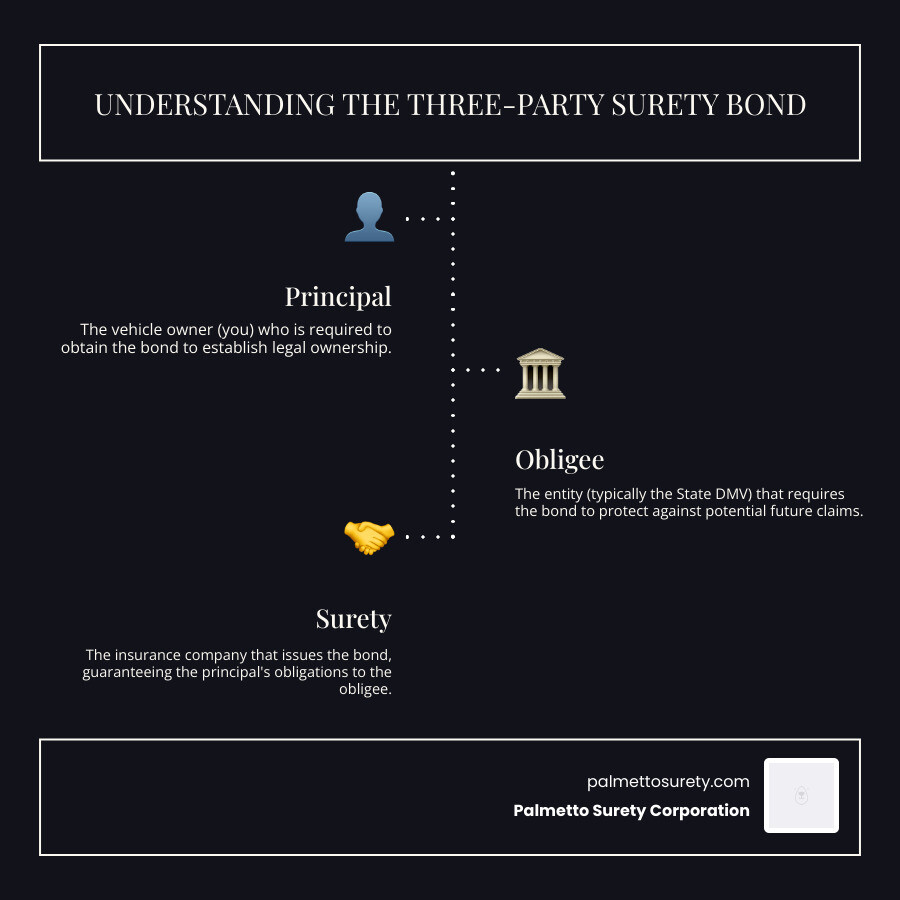
Every lost vehicle title bond is a three-party contract:
- The Principal: This is you, the vehicle owner needing the bond. You claim ownership and accept financial responsibility for any future claims.
- The Obligee: This is the state DMV, which requires the bond for protection before issuing a new title.
- The Surety: This is the insurance company, like Palmetto Surety Corporation, that issues the bond. The surety guarantees payment to the DMV for valid claims but will seek reimbursement from you, the principal.
This agreement protects all parties, allowing the DMV to issue your new title with confidence.
When is a Bonded Title Required?
The need for a lost vehicle title bond arises when a vehicle transaction becomes complicated due to missing paperwork. Many ownership situations don’t follow a simple path, such as buying a classic car where the seller can’t find the title or inheriting a family vehicle with no documents.

Common Scenarios That Demand a Lost Vehicle Title Bond
A bonded title is necessary when you have legitimate ownership of a vehicle but lack the traditional paperwork to prove it. Common situations include:
- Title Never Received: The seller lost the title or forgot to provide it, a common issue in private sales.
- Lost, Stolen, or Destroyed Title: The document was lost due to a move, fire, theft, or other unforeseen event.
- Improperly Assigned or Damaged Title: The title was filled out incorrectly, is illegible, or was signed by the wrong person, rendering it invalid.
- Inherited Vehicles: The title was lost during estate settlement, or the transfer was never completed.
- Auction or Custom-Built Vehicles: Purchases from salvage yards, impound lots, or custom builds often come with only a bill of sale.
- Abandoned Vehicles: A vehicle left on your property may require a bonded title to establish your formal ownership after following legal procedures.
States With Different Title Recovery Processes
Not every state handles missing titles the same way, and some don’t permit bonded titles at all. It’s crucial to understand your state’s specific regulations.
Your first step should always be checking with your DMV to confirm their requirements.
- States Not Allowing Bonded Titles: These include Delaware, Kansas, Kentucky, Louisiana, Maryland, New Jersey, North Dakota, Oklahoma, Oregon, Pennsylvania, South Carolina, South Dakota, and Virginia. These states have alternative processes for establishing ownership.
- States Preferring Court-Ordered Titles: In places like Indiana and Ohio, you may need to go through the court system instead of getting a surety bond.
- State-Specific Requirements: Among states that do allow bonded titles, rules can vary significantly. Requirements may include certified letters to previous owners, vehicle inspections, or different bond amount calculations and durations.
Your local DMV is the best resource for navigating these state-specific rules and ensuring you follow the correct process.
The Step-by-Step Process to Obtain a Bonded Title
Obtaining a bonded title is a manageable, three-step process. While it involves paperwork, breaking it down makes it approachable. The timeline can range from a few days to several weeks, depending on your state’s processing times and how quickly you gather documents.

Step 1: Contact Your Local DMV and Verify Eligibility
Your first and most essential step is to contact your local DMV. State requirements for lost vehicle title bonds vary, so you must confirm their specific process. Explain that you own a vehicle without a proper title and ask about their bonded title procedure.
During this initial inquiry, confirm that your state allows bonded titles and ask for the necessary forms and supporting documents. Most states require a Vehicle Identification Number (VIN) inspection, where an authorized official verifies your vehicle’s VIN to prevent fraud. Get a clear list of all requirements from the DMV before proceeding.
Step 2: Determine Your Vehicle’s Value and Required Bond Amount
Your state’s DMV determines the required value for your lost vehicle title bond, based on the vehicle’s current market value. The bond amount calculation is typically 1.5 to 2 times the vehicle’s fair market value. For example, a car worth $8,000 might require a bond of $12,000 to $16,000. This is the bond’s coverage amount, not the price you pay.
To determine the fair market value, most states use resources like Kelley Blue Book or NADA guides. You can check your vehicle’s value using Kelley Blue Book ahead of time. Some states have a state-set bond amount or special rules for certain vehicles. Always use the amount specified by your DMV, as they are the final authority.
Step 3: Apply for and Purchase Your Lost Vehicle Title Bond
With your DMV requirements in hand, you can apply for your bond. Working with an experienced surety provider like Palmetto Surety Corporation simplifies this step. You will need to provide application information, including your name, address, and vehicle details (year, make, model, VIN, and appraised value). For high-value bonds (over $10,000), a Personal Financial Statement may be required.
Even with minimal documentation, a written explanation of how you acquired the vehicle is often sufficient. Most applications involve a credit check, which can affect your premium rate. Once approved, you’ll pay the premium payment, a small percentage of the total bond amount. After payment, your bond can be issued immediately. The final step is filing the bond with your DMV. You’ll sign the original bond documents and submit them to the DMV, which will then issue your bonded title.
Understanding the Costs, Claims, and Validity of a Title Bond
Understanding the financial and legal aspects of a lost vehicle title bond is crucial. It’s important to distinguish between the “bond amount” (the total coverage) and the “premium” (the price you pay). For a $10,000 bond, you don’t pay $10,000; you pay a much smaller premium to secure that coverage.
How Much Does a Lost Title Bond Cost?
Lost vehicle title bonds are generally affordable. The cost depends on the bond amount required by the DMV.
- For bond amounts up to $6,000, there is often a flat rate of around $100.
- For higher bond amounts, the cost is a percentage, typically 1% to 3% of the total bond amount. A $15,000 bond might cost between $150 and $450.
Your credit score is a significant factor in determining your rate. Good credit usually results in lower premiums. The vehicle’s value is the primary driver of the bond amount and, therefore, the cost. For more details on bond pricing, explore The Cost of Surety Bonds.
What Happens if a Claim is Made?
A title bond is not insurance for you; it’s a guarantee of your ownership to protect others. If someone files a legitimate claim against your bond, the surety company will investigate. If the claim is valid, the surety pays the claimant, and you must then reimburse the surety.
This is a key difference from insurance. The indemnity agreement you sign makes you financially responsible for repaying any claims paid out, plus potential fees. This system ensures the integrity of the bonded title process. Fortunately, claims are rare when applicants are honest about their ownership.
Bond Validity and Selling Your Vehicle
Bonded titles are designed to become regular titles over time. Most bonds are valid for 3 to 5 years, depending on state law. During this period, the title will be marked as “bonded,” but this does not limit your ownership rights. You can sell a car with a bonded title, as it provides the same legal authority as a standard title.
When the bond period expires without any claims, you can apply to have the “bonded” brand removed, resulting in a clean title. When selling a vehicle with a bonded title, it is best practice to be transparent with the buyer about its status. The bond does not transfer to the new owner, but the bonded title does, and your original bond remains in effect for its term.
Frequently Asked Questions about Lost Title Bonds
Here are answers to the most common questions about lost vehicle title bonds.
Can I sell a car that has a bonded title?
Yes. A bonded title provides the same legal rights as a standard title, including the right to sell, gift, or trade in the vehicle. The purpose of a lost vehicle title bond is to establish your legitimate ownership. While not always legally required, it is good practice to inform potential buyers of the bonded status. This transparency is often appreciated, as the bond also protects the new owner from potential claims.
How is the bond amount for a title bond determined?
The bond amount is not chosen by you; it is set by your state’s DMV based on the vehicle’s current market value. The standard formula is 1.5 to 2 times the vehicle’s appraised value. For instance, a car valued at $8,000 may require a bond for $12,000 to $16,000. The DMV uses recognized sources like Kelley Blue Book or NADA guides for appraisal. Because the DMV has the final say, you should always confirm the required amount with them before purchasing a bond.
What is the difference between a bonded title and a duplicate title?
These two options solve different problems.
- A duplicate title is a replacement for a lost or damaged title when you are already the registered owner in the DMV’s system. The process is simple because your ownership is already on record.
- A bonded title is necessary when there is no clear proof of your ownership with the DMV. This occurs if you bought a car and never got the title, or if the title was lost before being transferred to you. The lost vehicle title bond acts as a financial guarantee of your ownership claim, allowing the DMV to issue a new title.
In short, a duplicate title replaces existing proof of ownership, while a bonded title creates it.
Your Clear Path to Vehicle Ownership
A missing vehicle title can feel like a major roadblock, but a lost vehicle title bond is a smart, straightforward solution. It protects all parties and gets you back on the road legally, changing uncertainty into confidence.

With a bonded title, you gain all the rights of a legal owner. You can register your vehicle, obtain proper insurance, and sell it with a clear title to transfer. After the bond period of 3-5 years expires without a claim, the “bonded” status is removed, leaving you with a clean title.
At Palmetto Surety Corporation, we have over two decades of experience turning frustrating title problems into simple paths to legal ownership. We’ve helped countless clients in situations just like yours, whether it involves a private sale, an inherited vehicle, or an auction purchase.
Navigating surety bonds can be unfamiliar, which is why we focus on making the process simple and approachable. When you contact us for a lost vehicle title bond, you’re getting more than just paperwork—you’re getting an efficient solution to get your life back to normal.
With the right guidance from a reliable surety provider, establishing your rightful ownership is clearer than you might think. If you’re ready to move forward or have questions, explore our Commercial Surety Bonds services. We are here to help you turn a missing title problem into a success story.


