


How Do You Get a Bonded Title in Texas: 5 Easy Steps
Why Understanding the Texas Bonded Title Process Matters
How do you get a bonded title in texas when you own a vehicle but can’t prove it with a regular title? This common issue affects Texans who’ve lost their original title, bought a car without proper documents, or inherited a vehicle with missing paperwork.
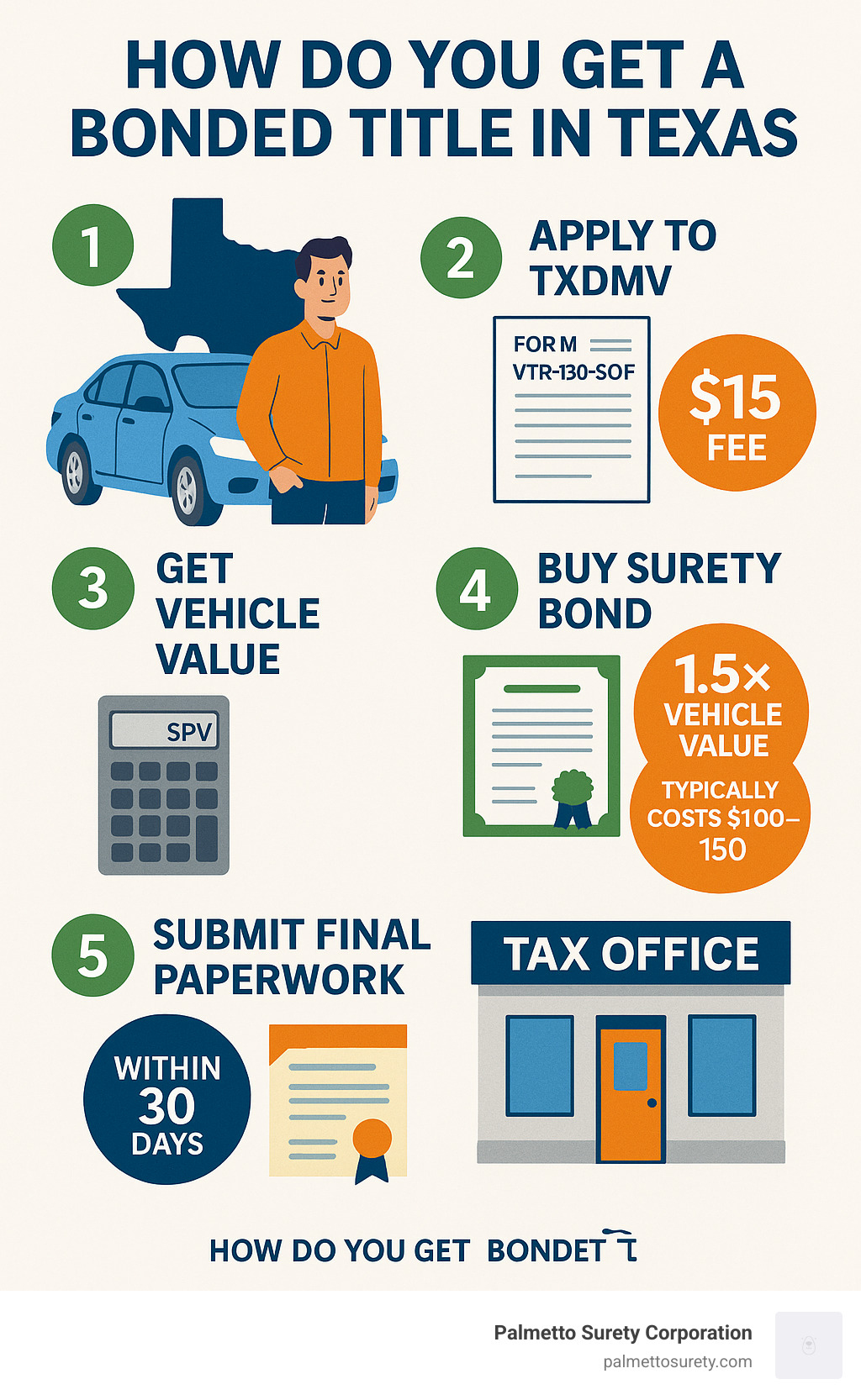
Quick Answer: Getting a Texas Bonded Title in 5 Steps
- Check Eligibility – Must be Texas resident with complete vehicle in your possession
- Apply to TxDMV – Submit Form VTR-130-SOF with $15 fee and supporting documents
- Get Vehicle Appraised – TxDMV determines value using SPV calculator or NADA guide
- Purchase Surety Bond – Buy bond worth 1.5x vehicle value (typically costs $100-150)
- Submit Final Paperwork – Take all documents to County Tax Office within 30 days
A bonded title serves as legal proof of ownership when your original title is missing or defective. The process involves purchasing a surety bond that protects any previous owners with a legitimate claim to your vehicle. While it takes 4-6 weeks, a bonded title gives you the same rights as a regular title and becomes a clean title after three years with no claims.
Whether you’re dealing with a lost title, incomplete paperwork from a private sale, or an inherited vehicle, the bonded title process provides a clear path to establishing legal ownership. The key is understanding the requirements and following each step carefully to avoid delays.
I’m Haiko de Poel Jr. Through my work at Palmetto Surety Corporation, I’ve helped countless Texans steer the bonded title process and secure the surety bonds they need. My experience shows that most title issues can be resolved efficiently when you understand the process and have the right guidance.
What is a Texas Bonded Title and Who Needs One?
When you have a car but no title to prove ownership, a Texas bonded title is your solution. It’s the state’s way of saying, “We believe you own this vehicle, but let’s put some insurance behind that claim just in case.”


A bonded title is a regular vehicle title with a financial safety net attached. The Texas Department of Motor Vehicles (TxDMV) issues this document when your original title is missing, damaged, or can’t be legally transferred. The “bonded” part comes from a surety bond you purchase—this acts as proof of ownership while protecting anyone who might have a legitimate claim to your vehicle.
Once you have a bonded title, you get the same rights as someone with a standard title. You can register your vehicle, drive it legally, and sell it. The Official TxDMV page on missing titles has the technical details if you want to dive deeper into the official requirements.
When You Might Need a Bonded Title
Life can complicate car ownership. You might have lost your original title in a move or had it stolen. These common situations are why the bonded title process exists.
Sometimes the problem originates with the seller. They may have failed to complete the title transfer correctly or never provided a title at all. Many buyers have trusted a seller’s promise that “the title is in the mail,” only to find it never arrives.
Inherited vehicles create their own unique challenges. When a family member passes away and leaves you their car, the title situation can become surprisingly complex, especially if important documents went missing over the years.
Other situations that commonly require a bonded title include purchasing vehicles from defunct dealerships or lenders, buying custom-built or assembled vehicles, and dealing with very old vehicles where the paper trail has vanished over decades.
Eligibility Requirements
Before you wonder how do you get a bonded title in texas, let’s ensure you and your vehicle qualify. The state has specific rules for this process.
First, you must be a Texas resident or military personnel stationed in Texas. The vehicle must be physically in your possession—this isn’t a process for claiming abandoned cars you found somewhere.
Your vehicle needs to be complete, meaning it has all its essential parts like the frame, body, and motor. If it looks like a car and could potentially run, it probably qualifies.
However, certain vehicles are automatically ineligible for bonded titles. If your vehicle has been declared a junked vehicle or marked as non-repairable, you’re out of luck. The same goes for vehicles that are abandoned, stolen, or involved in legal disputes. You can check your vehicle’s status using the NMVTIS database to make sure there aren’t any hidden issues.
The good news? Most legitimate vehicle ownership situations involving missing paperwork can be resolved through the bonded title process. It’s designed to help honest people in frustrating situations, not to circumvent proper ownership laws.
How Do You Get a Bonded Title in Texas? A Step-by-Step Guide
Obtaining a bonded title in Texas involves several steps with the TxDMV Regional Service Center and your local County Tax Assessor-Collector’s office. We’ll guide you through the process.

There’s an administrative fee of $15.00 for processing your initial bonded title application, so have that ready!
Step 1: Complete the Initial Application
Your journey begins with the Bonded Title Application or Tax Collector Hearing Statement of Fact (VTR-130-SOF). On this form, tell the TxDMV your story as thoroughly and honestly as possible.
On this form, you’ll need to provide:
- Your personal information (as the applicant).
- Detailed vehicle information, including the VIN, make, model, year, odometer reading, and purchase price.
- A clear and concise explanation for why you don’t have a traditional title. This “affidavit of fact” is crucial; explain what happened to the original title or why it wasn’t provided.
- Any supporting evidence you have of ownership. This is incredibly important! Examples include a bill of sale, a canceled check, an invoice, or any other document that proves you purchased or legally acquired the vehicle. The more evidence, the better.
- A copy of your acceptable photo ID.
Once completed, you’ll submit this form along with the $15.00 administrative fee to a TxDMV Regional Service Center. You can find the Form VTR-130-SOF here.
Step 2: What Documents Do You Need to Get a Bonded Title in Texas?
To ensure a smooth application process, gather these documents before you begin:
- Bonded Title Application or Tax Collector Hearing Statement of Fact (VTR-130-SOF): As mentioned above, this is your primary application form.
- Statement of Physical Inspection (VTR-270): This form verifies the physical characteristics of your vehicle.
- Acceptable Photo ID: A current government-issued photo identification.
- Supporting Evidence of Ownership: This could be a bill of sale, canceled check, invoice, or any other document proving your legal acquisition of the vehicle.
- Administrative Fee: $15.00 (payable to TxDMV, typically by check or money order).
Special Considerations for Out-of-State Vehicles:
If your vehicle was last titled out-of-state, or if it has never been titled in Texas, there are additional requirements:
- Vehicle Identification Report (VIR): The vehicle identification number (VIN) must be verified by a Texas certified Safety Inspection Station. This is done through a Vehicle Inspection Report (VIR).
- Law Enforcement Identification Number Inspection (Form VTR-68-A): If the vehicle has never been titled in Texas, you’ll need a VIN inspection completed by a law enforcement officer on this specific form.
- Release of Lien/Letter of No Interest: If the vehicle has an existing lien, especially if it’s from out-of-state, you’ll need an original release of lien or a letter of no interest from the lienholder. We’ll discuss liens in more detail later.
For those interested in understanding more about the various types of bonds, including those related to vehicle titles, we have More info about surety bonds available on our website.
Step 3: Determine the Vehicle’s Value and Bond Amount
Once your initial application (VTR-130-SOF) is submitted to the TxDMV Regional Service Center, they will review it. If your application is approved, you’ll receive a Notice of Determination for a Bonded Title or Tax Assessor-Collector Hearing (Form VTR-130-ND).
This notice will include an appraisal of your vehicle’s value and, crucially, the required bond amount. In Texas, the bond amount is set at 1 ½ times the value of the vehicle. So, if your car is appraised at $10,000, your bond amount will be $15,000.
The TxDMV determines your vehicle’s value using a few methods:
- Standard Presumptive Value (SPV): They will first attempt to use the TxDMV’s SPV Calculator. You can even try this yourself beforehand to get an estimate!
- NADA Guide: If an SPV cannot be determined, they will refer to the National Auto Dealers Association (NADA) reference guide.
- Professional Appraisal: If neither SPV nor NADA provides a value, you may be required to get an appraisal from a licensed dealer or insurance adjuster.
A special note for classic cars: For vehicles 25 years old or older, if the appraisal comes in under $4,000, the value will automatically be set at $4,000 for bonding purposes. This means the minimum bond amount for such vehicles would be $6,000 (1.5 x $4,000).
Step 4: How Do You Get a Surety Bond for a Bonded Title in Texas?
This is where we at Palmetto Surety Corporation come into the picture! After receiving your Notice of Determination (VTR-130-ND) from the TxDMV, you’ll need to purchase a surety bond. You have one year from the date of this notice to purchase your Surety Bond.
A surety bond for a bonded title is a type of commercial surety bond. It’s a three-party agreement:
- Principal: That’s you, the vehicle owner, who needs the bond.
- Obligee: This is the TxDMV, the entity requiring the bond to protect potential claimants.
- Surety: This is the bond company (like us!) that issues the bond and guarantees to pay out if a valid claim is made against it.
How much does a surety bond for a bonded title cost in Texas?
While the bond amount is 1.5 times your vehicle’s value, the actual cost you pay for the bond (your premium) is only a small percentage of that amount. Most surety bonds for bonded titles in Texas cost around $100-$150 to purchase, especially for lower value vehicles. For example, title bonds covering $6,000 or less typically cost a flat rate of $100. The cost can increase with higher bond amounts or if your credit history is less than stellar, though it’s often still possible to get bonded even with bad credit.
You can get a surety bond from licensed auto insurance agencies or agencies specifically licensed to sell vehicle surety bonds in Texas. As a licensed insurance company, Palmetto Surety Corporation offers commercial surety bonds across Texas. We pride ourselves on quick approvals and efficient service, helping you get bonded in minutes, not days. If you’d like to Learn about commercial surety bonds in general, our resources can help.
Step 5: Submit Your Final Application Packet
Once you have your original surety bond, you have a crucial deadline. Take all your documents to your nearest County Tax Office within 30 days of the bond’s issuance date. This is a tight window, so don’t delay.
Here’s what your final application packet should include:
- The original Notice of Determination for a Bonded Title or Tax Assessor-Collector Hearing (VTR-130-ND) that you received from the TxDMV.
- The original surety bond (VTR-130-SB) that you just purchased.
- A completed Application for Texas Title and/or Registration (Form 130-U). Make sure this form is filled out accurately and completely. You can find the Application for Texas Title (Form 130-U) here.
- Your photo ID.
- Any supporting evidence of ownership that you initially submitted.
- Proof of financial responsibility (liability insurance) for the vehicle.
- Any additional documents required based on your vehicle’s history (e.g., VTR-68-A for out-of-state VIN inspection, VIR for safety inspection, weight certificate for commercial vehicles, customs documents for imported vehicles).
The County Tax Office will review all these documents. If everything is in order, they will process your application and issue your bonded title.
Costs, Timelines, and What Happens Next
Now that you know how do you get a bonded title in texas, let’s discuss costs and timelines. The process is more affordable than many expect, and the timeline is predictable.

The administrative fee to TxDMV is just $15 when you submit your initial application. Your surety bond premium typically runs between $100-$150 for most vehicles, regardless of whether your car is worth $4,000 or $10,000. While the bond amount itself is 1.5 times your vehicle’s value, what you actually pay is just a small percentage of that amount.
If your vehicle needs a professional appraisal because TxDMV can’t determine its value through their standard methods, expect to pay around $50-$100 for that service. Out-of-state vehicles or those never titled in Texas might need a VIN inspection, which usually costs $20-$40. Finally, you’ll pay the standard Texas title and registration fees when you submit your final paperwork to the County Tax Office.
The processing time averages 4-6 weeks from start to finish, though this can vary. The biggest factor affecting your timeline is paperwork accuracy. Get everything right the first time to avoid delays. Incomplete forms or missing documents will send you back to square one.
TxDMV processing volume also plays a role – just like any government office, they have busy periods and slower times. If you need external services like appraisals or inspections, their turnaround times will add to your overall timeline. The key is staying organized and responding quickly when they need additional information.
Understanding the Validity of a Bonded Title
Your bonded title has a three-year validity period during which the surety bond is active. This serves as a protection period for anyone who might have a legitimate claim to your vehicle.
During these three years, if someone comes forward with proof they’re the rightful owner, the surety bond provides financial protection for them. The surety company would compensate them for their loss, and you’d be responsible for reimbursing the surety company. In practice, claims are rare if you’ve legitimately acquired your vehicle.
After those three years pass with no claims? Your bonded title automatically converts to a standard, clean title. The bond expires, the “bonded” designation disappears, and your vehicle has the same clear ownership status as any other car on the road.
Can You Get a Bonded Title if the Vehicle Has a Lien?
This question comes up frequently, and the answer depends on your specific situation. If your vehicle has an existing lien, you’ll need to provide an original lien release or a letter of no interest from the lienholder before you can proceed with the bonded title process.
For liens less than 10 years old, you’re responsible for tracking down this documentation. Sometimes this means contacting banks that may have been bought out, finance companies that changed names, or dealers who’ve gone out of business. It can be frustrating, but it’s necessary.
Liens older than 10 years might be considered too old to require a release in some cases, though you should always verify with TxDMV first. If you absolutely cannot obtain a lien release and the debt was legitimately paid, you might need legal counsel to pursue a court order clearing the lien.
The bottom line? Vehicles with active, unresolved liens generally aren’t eligible for bonded titles. The process is designed to clear up ownership issues, not create new ones.
[TABLE] Comparing a Bonded Title vs. a Regular Title
Understanding the differences between these two types of titles helps you know what you’re getting into:
| Feature | Regular Title | Bonded Title |
|---|---|---|
| Ownership History | Clear, undisputed paper trail | Established through surety bond; addresses missing documentation |
| Cost | Standard title/registration fees only | Standard fees plus $15 admin fee and $100-$150+ bond premium |
| Application Process | Simple transfer or duplicate request | Multi-step process with TxDMV, surety company, and County Tax Office |
| Transferability | Easy to transfer or sell | Transferable but requires disclosure; may affect resale value initially |
| Potential Claims | Minimal risk, clear ownership | Bond protects against claims for three years |
| “Clean” Status | Always considered clean | Becomes clean after three years with no claims |
The key takeaway? A bonded title gets you where you need to go, but it starts as a different type of ownership document than a regular title. After three years, though, they’re essentially identical.
Frequently Asked Questions about Texas Bonded Titles
After helping many Texans with the bonded title process, I’ve noticed common questions. Here are answers to the most frequent concerns about how do you get a bonded title in texas.
Can you sell a car in Texas with a bonded title?
Absolutely! You can legally sell a vehicle with a bonded title in Texas just like any other titled vehicle. The bonded title serves as legitimate proof of ownership, giving you full rights to transfer that ownership to someone else.
However, the key is that you must disclose to the buyer that the vehicle has a bonded title. This transparency is about ethics and legal protection. The buyer needs to know, as it could affect their financing or purchase decision.
When transferring a bonded title, the new owner receives the same bonded title status. They’ll benefit from the remaining time left on the three-year bond period, and if no claims arise, they’ll eventually receive a clean title just like you would have.
Is a bonded title in Texas considered a “clean” title?
Initially, no—a bonded title is not considered a clean title. This distinction affects how lenders, insurers, and future buyers view your vehicle.
A clean title indicates an unbroken chain of ownership with no questions or disputes about the vehicle’s history. Since you needed a bonded title in the first place because of missing or problematic documentation, it can’t be considered “clean” from the start.
The good news is that after three years with no claims against the bond, your bonded title automatically becomes a clean title. After this probationary period passes without claims, the state considers the matter settled, and you’ll have a regular, clean title.
How long does it take to get a bonded title in Texas?
Most people can expect the entire process to take 4 to 6 weeks from start to finish. This timeline covers everything from submitting your initial application to walking out of the County Tax Office with your bonded title in hand.
Several factors can influence how quickly your application moves through the system. Paperwork accuracy is probably the biggest factor under your control. Complete, accurate forms with all supporting documentation will sail through much faster than applications that require follow-up or corrections.
The TxDMV’s current processing volume also plays a role. Like any government agency, they sometimes experience busy periods that can slow things down. Vehicle appraisals and inspections, if required, add their own timeline considerations since you’re dependent on third-party services.
I always tell clients that being thorough and responsive on the front end pays dividends in processing speed. Double-check your forms, gather all your supporting documents, and respond quickly if the TxDMV requests additional information. This approach typically keeps you within that 4-6 week window and gets you back on the road with proper documentation as quickly as possible.
Secure Your Title and Drive with Confidence
The journey of how do you get a bonded title in texas might seem daunting, but it’s a straightforward path to reclaiming what’s rightfully yours. Each correct form and document brings you closer to legally driving your vehicle without worry.

Establishing clear ownership isn’t just about following the rules—it’s about protecting your investment and your peace of mind. Whether you bought that classic pickup truck from a neighbor who couldn’t find the title, inherited your grandmother’s car without the paperwork, or simply lost your title in a move, the bonded title process gives you a legitimate way forward.
We’ve walked through every step, from checking eligibility and gathering documents to determining vehicle value and purchasing your surety bond. The final submission to your County Tax Office marks the end of the paperwork and the beginning of worry-free driving.
At Palmetto Surety Corporation, we’ve helped people in these situations for over 20 years. We know you need a surety bond for your bonded title quickly and efficiently. Our streamlined process means most applications are approved within hours, not days.
The beauty of the bonded title system is that it acknowledges life’s messiness while providing a clean solution. After three years with no claims against your bond, you’ll have a regular, clean title—just like everyone else. Until then, you can drive, sell, and enjoy your vehicle knowing you’ve done everything by the book.
Ready to move forward with confidence? We’re here to make the surety bond part of your journey as smooth as possible. Get help with your Texas surety bond needs and let’s get you back on the road where you belong.


