


Florida Lost Title Bond: Your 2025 Guide
Why Florida Title Issues Don’t Have to Stop You
A florida lost title bond is your path to legal vehicle ownership when you can’t provide a traditional title certificate. Here’s what you need to know:
Quick Answer for Florida Lost Title Bonds:
- Bond amount: Twice your vehicle’s Kelly Blue Book value
- Cost: Starting at $100 for bonds up to $6,000
- Duration: 3 years from effective date
- Eligibility: Vehicles 10-25 years old, no liens or security interests
- Required forms: HSMV 82033 (bond), HSMV 82026 (affidavit), HSMV 82040 (title application)
Whether you bought a car from someone who lost the title, inherited a vehicle without proper paperwork, or received a defective title with errors, Florida Statute 319.23 provides a legal solution. The Florida Department of Highway Safety and Motor Vehicles (FLHSMV) allows you to obtain a bonded title by purchasing a surety bond that acts as financial protection for previous owners and lienholders.
The process involves three parties: you (the principal), the FLHSMV (the obligee), and a licensed surety company (the surety). The bond guarantees that if someone with a legitimate claim to the vehicle comes forward within three years, they’ll be compensated for any financial loss.
I’m Haiko de Poel Jr, and through my work at Palmetto Surety Corporation, I’ve helped countless Florida residents steer the florida lost title bond process to regain legal ownership of their vehicles. My experience in surety bonds and understanding of Florida’s specific requirements ensures you get accurate, actionable guidance for resolving your title issues.
What is a Florida Lost Title Bond and Who Needs One?
Think of a florida lost title bond as your financial safety net when you need to prove vehicle ownership but can’t produce the original title. This special type of surety bond, officially called a Certificate of Title Surety Bond, gives the Florida Department of Highway Safety and Motor Vehicles (FLHSMV) the confidence they need to issue you a new title.
Here’s how it works: Florida Statute 319.23 requires this bond to protect everyone involved in the transaction. If someone later proves they had a legitimate claim to your vehicle, the bond ensures they won’t lose money because of your new title. It’s like an insurance policy that protects previous owners, lienholders, and future buyers from financial harm.

The bond acts as your promise that you’re the rightful owner. If that promise turns out to be wrong, the bond covers any expenses, losses, or damages (including attorney fees) that result from issuing your title. This financial protection gives the state peace of mind when they can’t verify ownership through normal channels.
If you’re curious about how surety bonds work in general, our guide on what is a surety bond explains the basics in simple terms.

When You Might Need a Bond
Life happens, and sometimes vehicle titles go missing or become problematic. A florida lost title bond becomes your solution in several common situations.
The seller never gave you the title – maybe they promised to mail it but never did, or they simply vanished after the sale. You lost or had the title stolen before you could transfer it into your name. The title has errors like misspelled names, wrong VIN numbers, or improper signatures that make it impossible to use.
Inherited vehicles often come without titles, especially if they’ve been sitting in a garage for years. Sometimes you might acquire an abandoned vehicle legally but have no paperwork to prove ownership. In rare cases, older vehicles were never properly titled in the first place, leaving you with a car but no legal documentation.
Each of these situations leaves you in the same frustrating spot: you have a vehicle you rightfully own, but you can’t register it, insure it, or sell it legally without proper title documentation.
Who is NOT Eligible?
Before you get excited about the bonded title solution, let’s talk about when it won’t work for you. Florida has specific rules about which vehicles qualify for bonded titles.
Vehicles with existing liens are automatically disqualified. The state’s computer system will catch these during your application, so you’ll need to clear any outstanding loans or security interests first. Certain vehicle types like boats, mobile homes, RVs, and off-highway vehicles follow different titling rules and can’t use the bonded title process.
Age matters too. Florida typically only approves bonded titles for vehicles between 10 and 25 years old. Newer vehicles (usually 2011 and later) with electronic titles aren’t eligible, and vehicles older than 29 years also don’t qualify. This sweet spot exists because newer vehicles have better tracking systems, while very old vehicles often fall under different registration rules.
Out-of-state registrations create complications too. If your vehicle’s last registration was in another state, Florida generally won’t approve a bonded title. The same goes for vehicles received as gifts – these require different paperwork to establish ownership.
Understanding these limitations upfront saves you time and frustration in the application process.
Step-by-Step Guide to Obtaining Your Florida Bonded Title
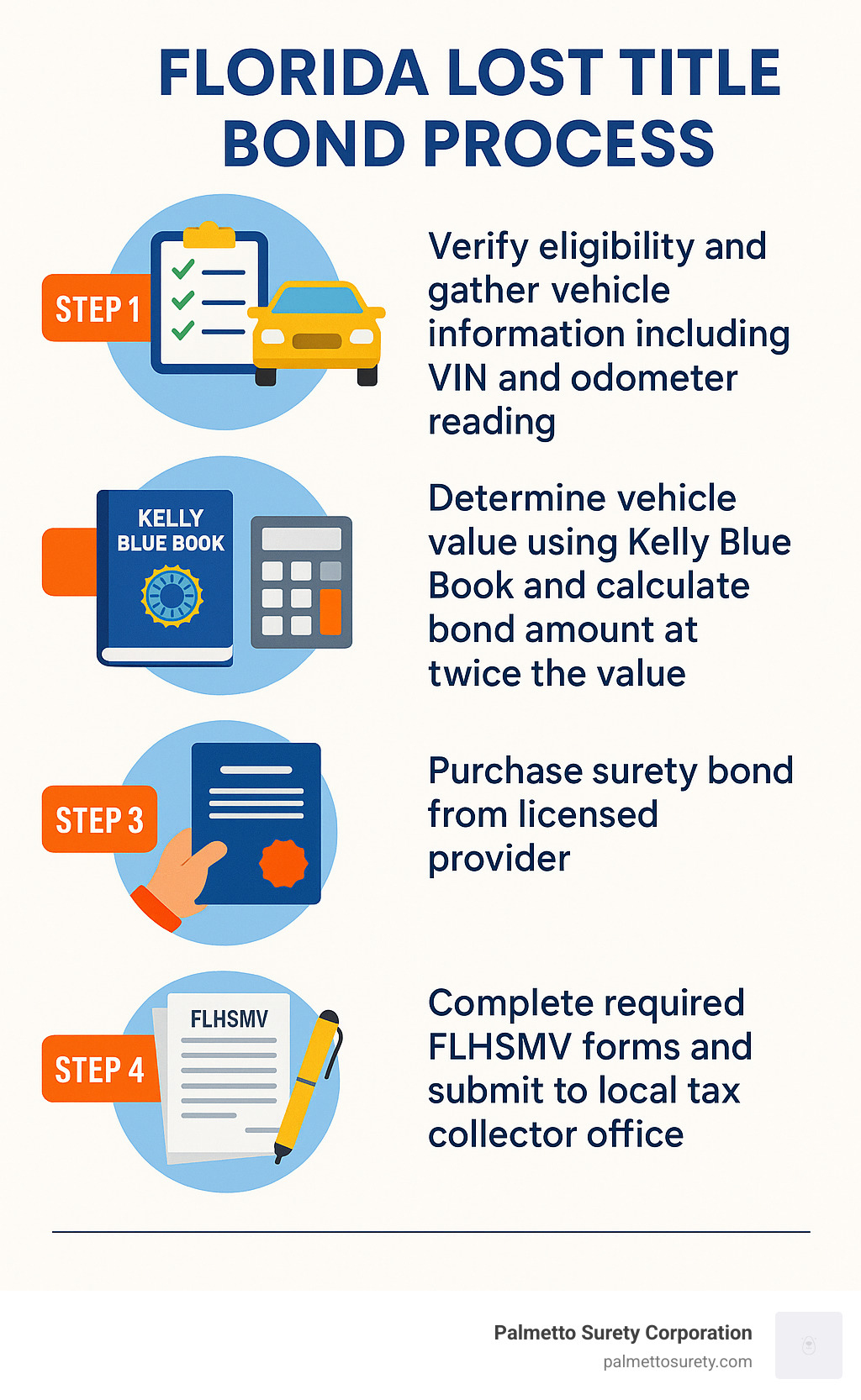
Getting your florida lost title bond and bonded title doesn’t have to feel overwhelming. Think of it like following a recipe – each step builds on the last, and before you know it, you’ll have that legal title in your hands. The Florida Department of Highway Safety and Motor Vehicles (FLHSMV) Division of Motorist Services handles these applications, and they’ve designed the process to be straightforward once you know what to expect.
Step 1: Verify Eligibility and Gather Vehicle Information
Before diving into paperwork, let’s make sure you’re on the right track. Your first stop should be your local tax collector’s office. These folks are your best friends in this process – they handle bonded title applications every day and know the current requirements for your specific county.
Once you’ve confirmed your vehicle qualifies, it’s time to become a detective about your own car. You’ll need to gather some key details that might seem obvious but are absolutely critical for the application.
The Vehicle Identification Number (VIN) is your vehicle’s unique fingerprint – that 17-character code that tells the whole story of your car. You’ll also need the current odometer reading and basic information like the vehicle make, model, and year.
Here’s where things get a bit more official: you’ll need to complete the Vehicle Identification Number and Odometer Verification form (HSMV 82042). Don’t worry – Part A is just basic information you can fill out yourself. Part B requires an authorized person to verify everything, such as a Florida law enforcement officer, a Florida dealer, or even a notary public. This step ensures there’s no confusion about which vehicle you’re claiming ownership of.
Step 2: Determine Vehicle Value and Bond Amount
This step is where math meets reality, and it’s probably the most important calculation you’ll make in this entire process. Your florida lost title bond must equal exactly twice your vehicle’s current retail value. No shortcuts, no approximations – the state wants precision here.
Florida primarily relies on Kelly Blue Book for vehicle valuations, though sometimes the NADA Guide comes into play. When you look up your vehicle’s value, be as accurate as possible. Include the exact year, make, model, body type, current mileage, any special options, and condition. Most applications use “good” condition as the standard baseline.
Let’s say your trusty Honda Civic shows a Kelly Blue Book value of $8,000. Your required bond amount would be $16,000. That $16,000 becomes what’s called the “penal sum” on your bond form – essentially the maximum amount the bond would pay out if someone with a legitimate claim comes forward.
Step 3: Purchase Your Florida Lost Title Bond
Now comes the part where you actually get your hands on that all-important florida lost title bond. You’ll need to work with a licensed surety company, and that’s exactly where we come in at Palmetto Surety Corporation.
The good news? You don’t pay the full bond amount – just a small percentage called the premium. We’ve built our reputation on approving most applications within hours, not days, which means you won’t be sitting around wondering if your paperwork made it through.
We make sure your bond gets issued on the correct Florida form, which is HSMV 82033 (the Title Surety Bond for a Motor Vehicle). This isn’t just any generic bond – it needs specific details like your legal name, our surety company information, the exact bond amount, your vehicle’s information including the VIN, year, make, and body type, plus the effective date. We handle all these details so you don’t have to worry about getting something wrong. You can explore more about our bond offerings on our Commercial Surety Bonds page.
Step 4: Complete and Submit Your Application
With your surety bond ready to go, it’s time to tackle the remaining paperwork. Think of this as gathering all the pieces of a puzzle – each document plays a specific role in proving your case to the state.
The Application for Certificate of Title (HSMV 82040) is your standard title application form. Nothing too complicated here – it’s the same form anyone would use when applying for a Florida vehicle title.
The Affidavit for a Bonded Title (HSMV 82026) is where you tell your story. This affidavit asks you to explain exactly how you came to own the vehicle, why the original title is missing, and most importantly, to confirm under oath that there are no existing liens or security interests on the vehicle. Be thorough and honest – this document is your sworn statement about the situation.
You’ll also need proof of identity (your Florida driver’s license or state ID works perfectly), and be prepared to pay sales tax if applicable. The tax calculation usually follows your bill of sale price, but here’s something to keep in mind: if your bill of sale shows a price significantly lower than the Kelly Blue Book value (less than 80%), the state might calculate tax based on the KBB value instead.
Don’t forget about the standard title and registration fees – these are the same fees anyone pays when getting a Florida title and registration.
Once you’ve double-checked everything, take your complete package to your nearest Florida tax collector’s office. They’ll review everything for completeness and accuracy before processing your application. Pro tip: make copies of everything before you submit it. You’ll thank yourself later if any questions come up.
Understanding the Bond’s Cost, Duration, and Conditions
When you’re considering a florida lost title bond, understanding the financial commitment and legal protections involved is crucial. Think of it as entering into a three-year agreement that protects everyone involved while you establish clear ownership of your vehicle.

How Much Does a Florida Lost Title Bond Cost?
The good news is that florida lost title bond costs are quite reasonable compared to the bond amounts required. While your bond amount equals twice your vehicle’s Kelly Blue Book value, you don’t pay that full amount – you only pay a small premium.
Most Florida residents pay a $100 minimum premium for bonds up to $6,000. This covers the majority of everyday vehicles. If your vehicle requires a higher bond amount, the pricing follows a tiered structure where you’ll pay approximately $15 for every $1,000 of coverage beyond that initial $6,000.
For example, if your vehicle’s Kelly Blue Book value is $5,000, you’d need a $10,000 bond and pay around $150 total. A vehicle valued at $10,000 would require a $20,000 bond, costing approximately $300.
When bond amounts exceed $50,000 for high-value vehicles, our underwriters review each application individually. These larger bonds typically start at $750, and we’ll consider factors like your credit history to determine the final premium. At Palmetto Surety Corporation, we’ve streamlined this process to provide approvals within hours rather than days. You can learn more about general pricing factors on our page about The Cost of Surety Bonds.
Bond Duration and What Happens Next
Your florida lost title bond serves as a three-year safety net, and understanding this timeline helps you plan ahead. During this period, your vehicle title will carry a “BT” (Bonded Title) brand, which simply indicates the title was issued with bond backing.
The three-year term isn’t arbitrary – it provides a reasonable window for any legitimate previous owners or lienholders to find the title change and come forward if necessary. Most people never encounter any issues during this period, especially when they’ve been honest about their vehicle acquisition.
Here’s what makes the process rewarding: after three years with no claims, the FLHSMV automatically removes the “BT” brand from your vehicle’s record. At that point, you can obtain a completely clear, standard title with no special notations. Your ownership becomes fully established, and the bond expires naturally without any renewal requirements.
What if a Claim is Filed Against the Bond?
While claims against florida lost title bonds are relatively uncommon, understanding the process gives you peace of mind. The bond exists to protect previous owners and lienholders who might have a legitimate financial interest in your vehicle.
If someone files a claim, we investigate thoroughly to determine its validity. Legitimate claims might come from someone who can prove they were the rightful owner or held a valid lien that wasn’t properly disclosed. Protecting prior owners and lienholders is the bond’s primary purpose, ensuring they’re compensated for any financial loss caused by the new title issuance.
Here’s the important part: if we pay out on a valid claim, you’re responsible for reimbursing us for that amount. The bond acts as a financial guarantee, not insurance for you personally. This indemnification structure means you should only apply for a bonded title when you’re confident about your legitimate ownership and have disclosed all known information about the vehicle’s history.
Most applicants never face this situation because they’re honest about their circumstances and truly are the rightful owners. The claim investigation process is thorough, and frivolous claims are rejected. Your principal’s responsibility to repay only applies to valid, proven claims – another reason why working with experienced professionals like our team at Palmetto Surety Corporation ensures you understand exactly what you’re agreeing to before moving forward.
Frequently Asked Questions about Florida Lost Title Bonds
We get a lot of questions from folks trying to figure out the florida lost title bond process. It’s understandable – dealing with title issues can feel overwhelming when you just want to legally drive your vehicle. Let me address the most common concerns we hear from our clients.
Can I get a bonded title for a vehicle that has a lien on it?
This is probably our most frequently asked question, and the answer is straightforward: no, you cannot get a bonded title for a vehicle with any existing liens or security interests. Florida law is crystal clear on this requirement – the vehicle must be completely free and clear of all encumbrances before you can even start the bonded title application process.
Here’s what happens if there’s a lien: the FLHSMV system will automatically flag it during your application review, and your request will be rejected immediately. There’s no way around this requirement, so you’ll need to resolve any outstanding liens first. This means paying off the loan completely and obtaining proper lien satisfaction documentation from the lienholder before you can proceed with your florida lost title bond application.
I know this can be frustrating, especially if you’re dealing with a lien from a previous owner or a situation where the lienholder is difficult to reach. But this requirement exists to protect everyone involved – including you – from potential legal complications down the road.
How long is the Florida lost title bond valid?
Your florida lost title bond has a specific lifespan that’s important to understand. The bond must remain active for exactly three years from its effective date – no more, no less. This isn’t a renewable bond; it simply expires after those three years.
During this three-year period, the bond serves as a safety net for anyone who might have a legitimate claim to your vehicle. If someone comes forward with proof that they’re the rightful owner or had a valid lien, they can file a claim against the bond during this window.
Here’s the good news: if nobody files a claim during those three years, the FLHSMV automatically removes the “BT” (Bonded Title) brand from your vehicle’s record. Once that happens, you can obtain a standard, clear title that looks just like any other vehicle title – no special notations or restrictions. It’s like the bonded title process never happened, and your ownership is fully established in the eyes of the law.
What are the penalties for driving without a proper title in Florida?
This question usually comes from people who are wondering if they really need to go through the bonded title process or if they can just keep driving their vehicle as-is. Let me be clear: driving without proper title and registration can create serious legal and financial problems.
If you’re pulled over or involved in an accident while driving an unregistered vehicle or one without a valid title, you’re looking at potential fines and penalties that can add up quickly. Even worse, law enforcement can impound your vehicle, which means you’ll be dealing with towing fees, daily storage costs, and the hassle of getting your car back – all while still needing to resolve the title issue.
But the problems go beyond just traffic stops. Without a valid title, you can’t legally sell the vehicle, and you’ll have serious difficulties getting proper insurance coverage. If something happens – whether it’s an accident, theft, or damage – proving ownership becomes a nightmare when you don’t have the right paperwork.
The florida lost title bond process exists specifically to help you avoid these headaches. It allows you to legally register, insure, and operate your vehicle while establishing clear ownership, even when the original title is missing. Trust me, it’s much easier to handle the bonded title process upfront than to deal with the complications of driving without proper documentation.
Get Your Florida Title Issues Resolved
You’ve made it through the entire florida lost title bond journey, and honestly, that’s something to celebrate! What might have seemed like an impossible maze of paperwork and requirements is actually a straightforward process that thousands of Florida residents successfully steer every year.

The key to success lies in working with a licensed surety provider who understands Florida’s specific requirements inside and out. At Palmetto Surety Corporation, we’ve been helping folks resolve their title issues for over 20 years, and we’ve seen just about every situation you can imagine. From inherited vehicles with missing paperwork to cars bought from sellers who “promised” to mail the title but never did – we get it, and we’re here to help.
Regaining legal ownership of your vehicle through the bonded title process isn’t just about getting a piece of paper. It’s about peace of mind. It’s about being able to register your car, get proper insurance, and drive without worrying about being pulled over for an unregistered vehicle. It’s about finally being able to sell that car if you need to, or simply knowing that your investment is protected.
The entire process – from verifying your eligibility to holding that new title in your hands – typically takes just a few weeks when you have all your paperwork in order. And with our ability to approve most bond applications within hours, not days, we help keep things moving smoothly on your end.
The florida lost title bond serves as your financial guarantee to the state that you’re the rightful owner. After three years without any claims, that bond expires and you’ll have a completely clear title – as if the whole missing title situation never happened in the first place.
If you’re dealing with a particularly valuable vehicle that requires a larger bond amount, don’t worry. We handle those situations regularly. For complex cases or high-value bonds, you can get help with your large bond request through our specialized portal, where our underwriters can provide personalized assistance.
Don’t let title issues keep your vehicle parked in the driveway any longer. Take that first step, verify your eligibility with your local tax collector’s office, and let us help you get back on the road legally and confidently.


