


Fidelity Bond vs Crime Policy: Smart Security 2024
Why Understanding the Fidelity Bond vs Crime Policy Decision Matters for Your Business
Fidelity Bond vs Crime Policy represents one of the most important insurance decisions business owners face when protecting their companies from financial crimes. While both provide crucial protection against theft and fraud, they serve different purposes and offer varying levels of coverage.
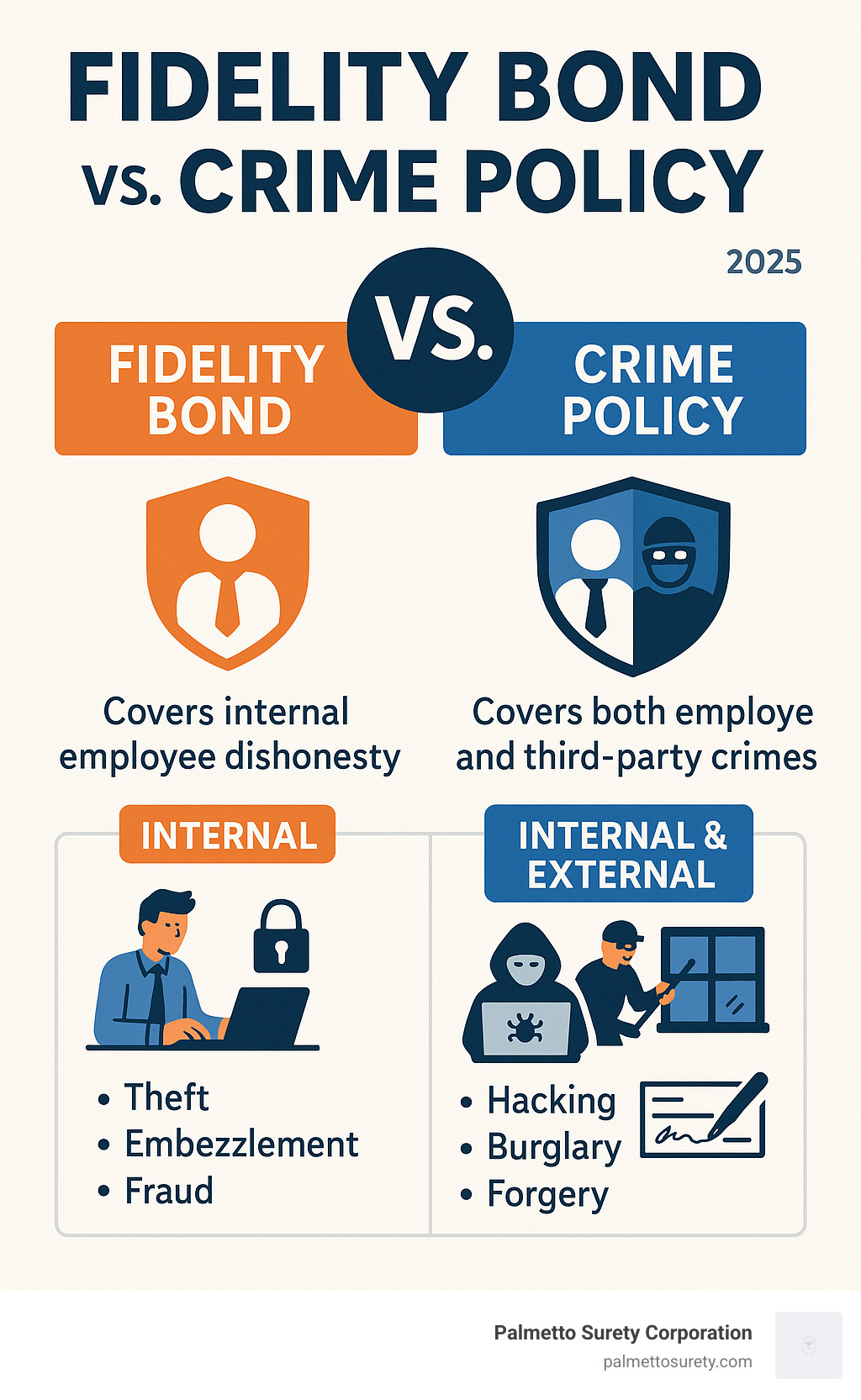
Here’s the key difference at a glance:
- Fidelity Bond: Protects against dishonest acts by your employees only (internal threats)
- Crime Policy: Protects against criminal acts by both employees and third parties (internal and external threats)
- Coverage Scope: Fidelity bonds focus on employee theft, embezzlement, and fraud; Crime policies include additional coverage for burglary, computer fraud, forgery, and social engineering
- Requirements: Some fidelity bonds (like ERISA bonds) are legally mandated; Crime policies are typically voluntary business decisions
The stakes are higher than you might think. Nearly 70% of employee theft cases occur in small or midsize companies, with individual losses reaching millions of dollars. Consider this sobering example from recent cases: an employee stole more than $3 million from a Texas employer over the course of a decade, forcing the company to cut bonuses and lay off workers.
Every business faces unique risks that require custom protection strategies. The choice between a fidelity bond, crime policy, or both depends on your industry, employee access levels, regulatory requirements, and overall risk tolerance.
I’m Haiko de Poel Jr., and through my work with Palmetto Surety Corporation and other financial services companies, I’ve helped hundreds of businesses steer the complex Fidelity Bond vs Crime Policy decision to find the right protection for their specific needs. My experience in risk management and business consulting has shown me that understanding these differences isn’t just about compliance—it’s about protecting your company’s future.
What is a Fidelity Bond? Your First Line of Defense Against Employee Dishonesty
Nobody likes to think about the possibility of employee theft, but the reality is that employee dishonesty represents one of the most significant risks businesses face today. When we examine the Fidelity Bond vs Crime Policy debate, understanding fidelity bonds becomes crucial for protecting your company’s financial stability.
A fidelity bond is like a safety net that protects your business from financial losses caused by dishonest acts committed by your own employees. Think of it as specialized insurance that covers the “what if” scenarios involving your trusted team members.


Unlike other types of insurance, a fidelity bond specifically covers financial losses from employee fraud and dishonesty. This includes forgery, embezzlement, theft of cash or property, illegal fund transfers, and even destruction of company assets. Fidelity bonds only protect against acts committed by your employees—not outside criminals or hackers.
The numbers tell a sobering story. The biggest claims in fidelity insurance typically involve monetary theft that happens over extended periods. For instance, an employee at a California Home Depot stole approximately $1.2 million by taking money from registers over time. In Georgia, a trusted employee embezzled more than $3.5 million between 2015 and 2020. These cases highlight why having proper protection isn’t just smart business—it’s essential. More info about what a fidelity bond is can help you understand the specifics.
Key Types of Fidelity Bonds Explained
Understanding the different types of fidelity bonds helps you choose the right protection for your specific situation. Each type serves a distinct purpose and protects different parties from employee dishonesty.
Employee Dishonesty Bonds are the most common type and what most people think of when they hear “fidelity bond.” These bonds protect your business directly from financial losses when employees commit dishonest acts like theft, embezzlement, or forgery. If an employee steals money from your company account or takes inventory, an employee dishonesty bond covers your losses.
Business Services Bonds work differently—they protect your clients rather than your business. Also called janitorial bonds, these are essential if your employees work on client premises or handle customer property. Cleaning services, home healthcare providers, and pet-sitting businesses often need these bonds. When your employee accidentally (or intentionally) damages or steals a client’s property, the business services bond ensures client protection and helps maintain your reputation.
ERISA Bonds represent a special category mandated by federal law. The Employee Retirement Income Security Act (ERISA) requires businesses offering employee retirement plans to carry fidelity bonds protecting those plans. These bonds safeguard retirement funds from misuse by plan trustees or administrators. Unlike other fidelity bonds where your business is the protected party, ERISA bonds protect the retirement plan itself and the employees who contribute to it.
Each type of fidelity bond serves as a crucial component in company asset protection, ensuring that both your business and your clients remain financially secure despite the unfortunate reality of potential employee dishonesty.
What is Commercial Crime Insurance? A Broader Shield for Your Assets
While fidelity bonds focus specifically on employee dishonesty, commercial crime insurance casts a much wider net of protection around your business. Think of it as upgrading from a basic home security system to a comprehensive protection package that guards against threats both inside and outside your organization.

Commercial crime insurance protects your business from a broad spectrum of criminal activities that can drain your finances, whether those crimes are committed by your own employees or by clever outsiders you’ve never met. This coverage recognizes that modern businesses face threats from every direction – from the trusted bookkeeper who’s been with you for years to sophisticated hackers operating from halfway around the world.
The beauty of a crime policy lies in its comprehensive approach. While understanding the Fidelity Bond vs Crime Policy distinction is important, crime insurance often includes fidelity coverage as just one piece of a larger protective puzzle. What is commercial crime insurance? It’s essentially your financial safety net against the full range of criminal threats that keep business owners awake at night.
Common Coverages in a Commercial Crime Policy
A well-rounded commercial crime policy reads like a detective novel’s table of contents, covering every scheme criminals have devised to separate you from your hard-earned money. Here’s what typically falls under this protective umbrella:
Employee Theft coverage protects against the dishonest acts of your own team members – the same protection you’d get from a fidelity bond, but integrated into your broader crime policy. Forgery or Alteration coverage steps in when someone creates fake checks or alters legitimate ones, turning your company signature into their personal ATM access.
Computer Fraud protection has become absolutely essential in our digital age, covering losses when criminals hack into your systems or trick your computers into transferring funds. Funds Transfer Fraud specifically targets those sophisticated schemes where criminals impersonate you to banks or trick your financial team into wiring money to fraudulent accounts.
Robbery and Burglary coverage protects your cash and securities when criminals use force or break into your premises – because sometimes old-fashioned crimes still happen alongside high-tech ones. Counterfeit Money protection saves you from losses when you unknowingly accept fake currency or money orders during normal business operations.
Perhaps most importantly for today’s businesses, Social Engineering Fraud coverage addresses the growing threat of criminals who manipulate your employees through fake emails, phone calls, or other deceptive communications. These smooth-talking fraudsters might impersonate your CEO, a trusted vendor, or even a client to trick your team into voluntarily sending money or sensitive information.
This comprehensive protection recognizes that criminals are creative, persistent, and always evolving their tactics. Commercial crime insurance evolves with them, offering your business a shield that’s as sophisticated as the threats you face.
The Core Comparison: Fidelity Bond vs Crime Policy
When you’re trying to understand the Fidelity Bond vs Crime Policy decision, it helps to think of it like choosing between a focused security guard and a comprehensive security system. Both protect your business, but they work in very different ways.
The biggest difference? A fidelity bond only protects you from your own employees’ dishonest acts, while a crime policy shields you from criminal acts by anyone – employees, hackers, burglars, and fraudsters alike.
| Feature | Fidelity Bond | Commercial Crime Policy |
|---|---|---|
| Perpetrator | Employees only | Employees AND third parties |
| Scope of Acts | Dishonesty, theft, fraud by employees | Broader range: employee theft, forgery, computer fraud, funds transfer fraud, robbery, burglary, counterfeit money, social engineering |
| Primary Purpose | Protect employer from employee dishonesty (sometimes client) | Protect business from a wide array of internal and external criminal acts |
| Typical Coverage Trigger | Finding of dishonest act by an employee, often requiring proof of intent | Finding of loss from any covered criminal act (internal or external) |
| Regulatory Impact | Often required by law or contract (e.g., ERISA bonds for retirement plans) | Generally voluntary, though highly recommended for comprehensive risk management |
Scope of Coverage: Internal vs. Internal & External Threats
Here’s where the Fidelity Bond vs Crime Policy comparison gets really interesting. Think of a fidelity bond as having tunnel vision – but in a good way. It’s laser-focused on one specific threat: your employees.
If your bookkeeper embezzles funds or your cashier steals from the register, a fidelity bond has you covered. It’s designed specifically for those uncomfortable moments when someone you trust breaks that trust.
A crime policy, on the other hand, is like having eyes in the back of your head. It covers employee theft just like a fidelity bond, but it also protects you from external threats that are becoming more common every day.
External threats covered by crime policies include sophisticated hacking attempts where criminals break into your computer systems, burglary where someone physically breaks in to steal your cash or securities, and forgery schemes where outsiders create fake checks or documents in your company’s name.
One of the fastest-growing threats is funds transfer fraud, where criminals impersonate vendors or executives to trick your finance team into wiring money to fraudulent accounts. This type of external threat isn’t covered by traditional fidelity bonds, but it’s a standard part of most crime policies.
Who is Protected and What are the Limits?
Both fidelity bonds and crime policies ultimately put money back in your business’s bank account when covered losses occur. But there’s an important twist with certain types of fidelity bonds that many business owners don’t realize.
Most coverage protects your business directly – you file a claim, and you get reimbursed for your loss. But Business Services Bonds work differently. These bonds primarily protect your clients when your employees commit dishonest acts on their premises.
If you run a cleaning service and your employee steals a client’s jewelry, a Business Services Bond reimburses the client directly. While this protects your reputation and keeps you from being sued, the primary protection flows to your customer, not to you.
Coverage limits are another key difference in the Fidelity Bond vs Crime Policy debate. Crime policies typically offer much higher coverage limits because they’re protecting against a wider range of potential losses. You might find fidelity bonds with limits of $50,000 to $500,000, while crime policies can easily extend into the millions.
Crime policies also offer more customizable limits, allowing you to adjust coverage based on your specific risks. If you handle large amounts of cash, you can increase your robbery coverage. If you’re worried about computer fraud, you can bump up those limits while keeping others lower.
Understanding Regulatory Mandates in the Fidelity Bond vs Crime Policy Debate
Here’s where things get legally serious. While most business insurance is a choice, certain fidelity bonds are absolutely required by law.
The big one is ERISA bonds. If your business offers retirement plans like 401(k)s, the Employee Retirement Income Security Act (ERISA) mandates that you carry fidelity bond coverage. This isn’t optional – it’s federal law.
ERISA bonds protect your employees’ retirement money from fiduciary responsibility violations. If someone managing the retirement plan steals or misuses those funds, the bond ensures your employees don’t lose their nest eggs.
But here’s the catch: not all fidelity bonds meet ERISA’s strict standards. The Department of Labor regularly audits companies and finds that many bonds don’t provide the specific “fraud and dishonesty” coverage that ERISA requires. Simply having “a fidelity bond” isn’t enough if it doesn’t specifically comply with ERISA’s detailed requirements.
Crime policies, while not legally mandated, are increasingly becoming contractual requirements. Many large clients now require their vendors to carry comprehensive crime coverage as part of doing business together. It’s their way of ensuring you’re financially responsible and prepared for various threats.
How to Choose the Right Protection for Your Company
Making the right choice in the Fidelity Bond vs Crime Policy decision doesn’t have to keep you up at night. Think of it like choosing the right security system for your home—you need to know what you’re protecting and what threats you’re most likely to face.

The key is understanding your business’s specific vulnerabilities before you start shopping for coverage. Every company faces different risks based on their industry, size, and daily operations.
Assessing Your Business’s Unique Risk Profile
Start by taking an honest look at your business operations. Cash handling procedures are often the biggest red flag—if your employees regularly handle cash or have easy access to company funds, you’re facing higher internal theft risks.
Consider your data access controls as well. Do employees have access to client financial information, bank accounts, or sensitive business data? The more access points you have, the greater your potential exposure to both internal and external threats.
Your internal controls matter tremendously in this assessment. Strong checks and balances, regular audits, and clear separation of duties can reduce your risk significantly. But even the best controls aren’t foolproof—that’s where proper coverage becomes essential.
Take a vulnerability analysis approach by asking yourself these tough questions: Where would it hurt most if something went wrong? What assets are most exposed? Are there gaps in your current security measures that criminals could exploit?
For businesses just starting this process, it’s helpful to learn about commercial surety bonds to understand the broader landscape of business protection options.
Industry-Specific Considerations and Scenarios
Your industry plays a huge role in determining which protection makes the most sense. Let’s walk through some real-world scenarios to help you see where your business might fit.
Financial services risks are particularly complex. If you’re handling client investments or managing financial accounts, you’re dealing with sophisticated threats. Computer fraud and funds transfer fraud are major concerns, making a comprehensive crime policy essential. You’ll also likely need ERISA bonds if you manage retirement plans.
Retail business threats center heavily around cash and inventory. High-volume cash handling makes employee theft a constant risk, while counterfeit money and external robbery are ongoing concerns. A crime policy with strong coverage for money and securities both inside and outside your premises typically makes the most sense.
Service-based business needs vary dramatically depending on where your employees work. If your team provides cleaning, home healthcare, or other services at client locations, a business services bond becomes crucial. Your reputation depends on protecting your clients from potential employee theft—even if you trust your team completely.
Non-profit organization risks often get overlooked, but they’re very real. Many nonprofits rely on volunteers who handle donations or event funds. Since standard employee dishonesty coverage usually excludes volunteers, you’ll need specialized fidelity bond coverage that includes non-salaried individuals.
Healthcare industry vulnerabilities go beyond just patient data. Medical practices often handle significant cash flows and are increasingly targeted by social engineering fraud schemes. A crime policy with specific coverage for these sophisticated attacks is becoming essential.
Construction contractor bonds typically focus on performance and payment guarantees, but don’t forget about internal risks. Equipment theft by employees or materials disappearing from job sites can be covered under crime policies, providing an extra layer of protection.
The reality is that many businesses find the best protection comes from having both types of coverage. A fidelity bond might be required for regulatory compliance or client contracts, while a crime policy provides broader protection against the full spectrum of threats your business faces.
Frequently Asked Questions
Is a crime policy the same as a fidelity bond?
No, they’re definitely not the same thing, though I understand why this confuses so many business owners. Think of it this way: fidelity bonds are a specific type of insurance that focuses like a laser on one particular problem – dishonest acts by your own employees.
A crime policy, on the other hand, is like having a much bigger umbrella. Crime insurance covers a wider range of criminal acts from both employees and third parties. While it often includes employee dishonesty coverage (similar to a fidelity bond), it also protects you from external threats like computer hackers, burglars, forgers, and even those sneaky social engineering scams where someone calls pretending to be your CEO.
So while every fidelity bond is essentially crime coverage, not every crime policy is limited to just employee dishonesty. The Fidelity Bond vs Crime Policy decision often comes down to whether you need focused protection or comprehensive coverage.
What is an ERISA bond and why is it important?
An ERISA bond is a specific type of fidelity bond required by federal law – specifically, The Employee Retirement Income Security Act of 1974. If your business offers retirement benefits like a 401(k) plan, this isn’t optional coverage you can skip.
It protects employee benefit and pension plans from losses due to fraud or dishonesty by plan fiduciaries. Essentially, it safeguards the retirement money that your employees are counting on for their future. The bond covers situations where someone who manages the plan might embezzle funds, misappropriate assets, or commit other fraudulent acts.
Here’s why it matters so much: the U.S. Department of Labor doesn’t mess around with ERISA compliance. They actively audit employee benefit plans, and if you don’t have proper ERISA bond coverage, your business could face serious penalties. Even worse, plan fiduciaries could be held personally liable for any losses. It’s basically the government’s way of making sure millions of American workers’ retirement savings stay safe.
Can my business have both a fidelity bond and a crime policy?
Absolutely! Yes, and it’s often recommended for businesses that want truly comprehensive protection. Many of my clients at Palmetto Surety Corporation find that this layered approach gives them the best of both worlds.
Here’s a common scenario: A business might have a standalone fidelity bond to meet a specific client or regulatory requirement (like an ERISA bond for their retirement plan or a business services bond because they clean offices), and also carry a comprehensive crime policy for broader protection against other threats like external fraud or burglary.
This makes perfect sense when you think about it. Your ERISA bond covers the specific legal requirement for your 401(k) plan. Your business services bond protects your clients when your employees work at their locations. But neither of these covers you if a hacker breaks into your computer system or someone robs your office.
The right coverage is often a combination that addresses your specific regulatory needs while also providing a safety net for the unexpected criminal acts that could come from any direction. It’s like having both a specialized tool for specific jobs and a Swiss Army knife for everything else.
Securing Your Business’s Future with the Right Coverage
Making the Fidelity Bond vs Crime Policy decision doesn’t have to keep you up at night. Think of it like choosing the right locks for your home—you want protection that fits your specific needs without breaking the bank.
Here’s what we’ve learned: fidelity bonds are your focused defense against the employee who might go rogue, while commercial crime policies cast a wider net to catch threats from all directions. Neither is inherently better than the other—they’re just different tools for different jobs.
The real magic happens when you take a step back and honestly assess your business. Are you handling lots of cash? Do employees have access to sensitive financial data? Are you required by law to have certain coverage? These aren’t just insurance questions—they’re business survival questions.
Proactive risk management means thinking ahead, not just reacting after something goes wrong. The construction company that waits until after an employee steals equipment to get coverage has already learned this lesson the hard way. The retail business that assumes “it won’t happen to us” might find out differently when facing a sophisticated social engineering scam.
The right coverage is a strategic investment in your company’s stability and future. It’s not just about checking boxes or meeting requirements—it’s about sleeping better at night knowing you’ve protected what you’ve worked so hard to build.
At Palmetto Surety Corporation, we’ve been helping businesses steer these decisions for over 20 years. We understand that every business is unique, and cookie-cutter solutions rarely work. Whether you need a simple fidelity bond to meet a client requirement or a comprehensive crime policy to protect against today’s evolving threats, we’re here to help you make the right choice.
Informed decision-making starts with understanding your options, but it ends with taking action. For expert guidance on securing the right surety bonds for your business needs, explore our commercial surety bond services.
Your business deserves protection that works as hard as you do. The question isn’t whether you can afford the right coverage—it’s whether you can afford to go without it.


