


Commercial Surety Bond Rates: 7 Powerful Savings Tips 2025
Understanding Commercial Surety Bond Pricing Made Simple
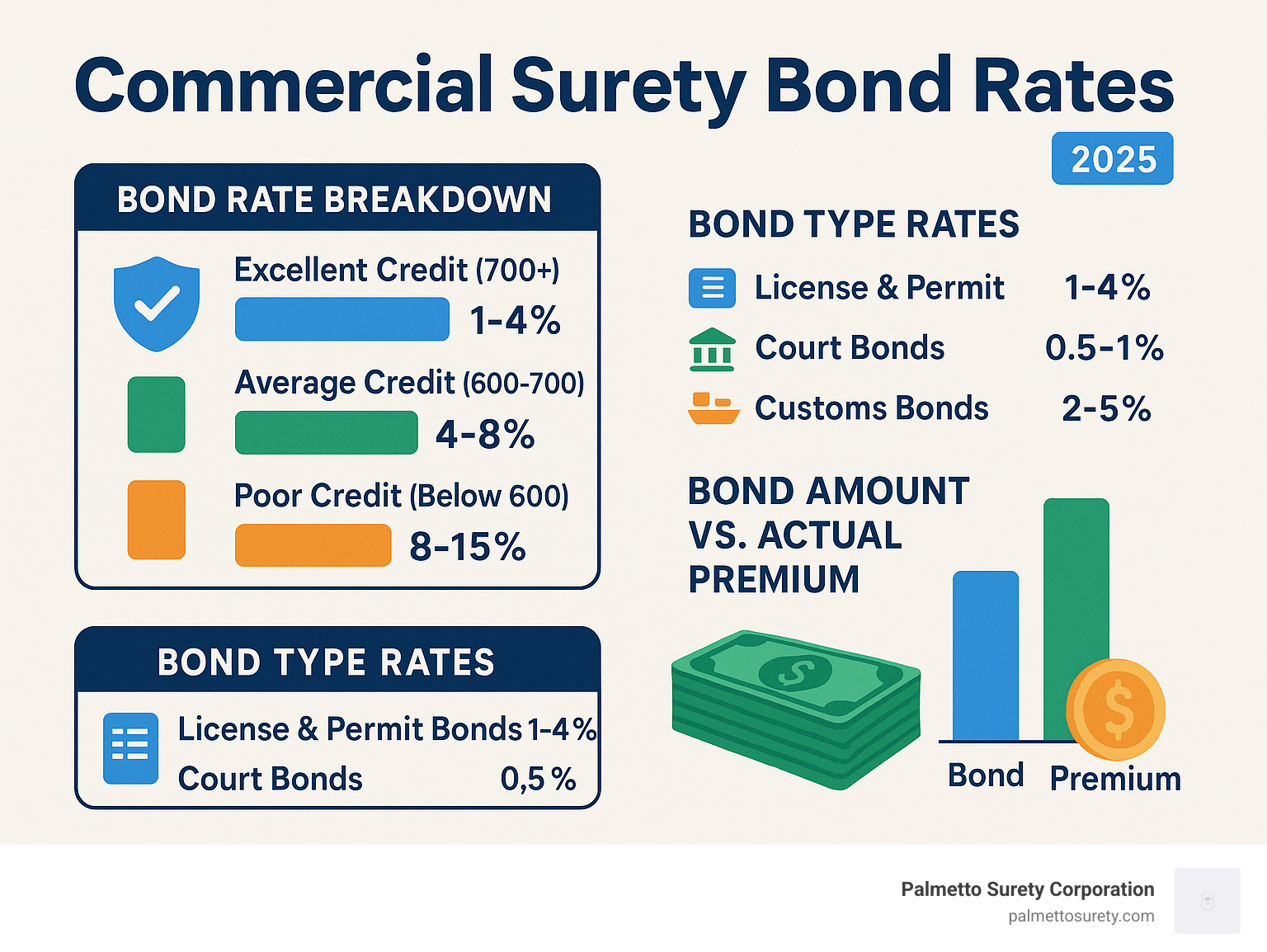
Commercial surety bond rates typically range from 0.5% to 15% of the total bond amount, with most businesses paying between 1% and 4% for standard license and permit bonds. The exact rate depends on your credit score, bond type, and industry risk factors.
Quick Rate Overview:
- Excellent Credit (700+): 1-4% of bond amount
- Average Credit (600-700): 4-8% of bond amount
- Poor Credit (Below 600): 8-15% of bond amount
- License & Permit Bonds: 1-4% annually
- Court Bonds: 0.5-1% annually
- Customs Bonds: 2-5% annually
If you’re a contractor, manufacturer, or business owner who needs a surety bond, understanding these rates can save you thousands of dollars. The difference between a 2% rate and a 5% rate on a $100,000 bond is $3,000 – money that stays in your pocket when you know how pricing works.
Commercial surety bonds serve as a financial guarantee that protects project owners, government agencies, and the public when businesses fail to meet their contractual obligations. Unlike insurance that protects the bonded party, surety bonds protect others from the bonded party.
The bond amount (also called the penal sum) is the maximum coverage provided, while the premium is the small percentage you actually pay. For example, a $50,000 bond at a 3% rate costs $1,500 annually – not $50,000.
I’m Haiko de Poel Jr, and I’ve helped redesign and relaunch one of America’s fastest-growing surety bond companies, working directly with commercial surety bond rates and underwriting processes. Through my experience at Palmetto Surety Corporation and other industry leaders, I’ve seen how proper rate education can save businesses significant money on their bonding costs.
Understanding Commercial Surety Bonds & Their Types


Think of a commercial surety bond as a three-way promise between you, the entity requiring the bond, and the surety company. It’s not insurance that protects you – it’s a financial guarantee that protects others from you if you don’t follow through on your commitments.
The relationship works through what’s called the obligee-principal-surety triangle. You’re the principal (the one who needs the bond), the obligee is whoever requires it (like a government agency or project owner), and the surety company backs your promise with their financial strength.
Here’s where it gets interesting: if something goes wrong and a claim is filed, the surety company will investigate and potentially pay the claim. But then they’ll come back to you for reimbursement – every penny, plus legal fees and investigation costs. This indemnity relationship is why your credit score and financial stability directly impact your commercial surety bond rates.
What Is a Commercial Surety Bond and How It Works
The beauty of this three-party contract lies in its simplicity. As the principal, you’re the business owner who needs the bond to operate legally or win contracts. The obligee is the government agency, court, or project owner who requires the bond for their protection. The surety is the insurance company that issues the bond and guarantees your performance.
When a claim happens, the surety steps in quickly to investigate and resolve the issue. They might pay damages, complete unfinished work, or compensate affected parties. However, this isn’t a free service – you’ll need to reimburse the surety for all costs through what’s called claim reimbursement.
This indemnity structure means the surety is essentially lending you their credit rating and financial backing. That’s why they’re so careful about who they bond and at what rates.
Main Categories of Commercial Surety Bonds
License and permit bonds are the bread and butter of commercial surety. These bonds ensure you’ll follow industry regulations and local laws. Whether you’re a contractor, auto dealer, or freight broker, chances are you need one of these bonds to operate legally.
Court and probate bonds protect beneficiaries and interested parties in legal proceedings. These bonds often carry lower rates because court supervision reduces risk, but they can require collateral for larger amounts.
Customs and excise bonds guarantee you’ll pay duties and taxes on imported goods. These bonds typically cost more because international trade involves complex regulations and potentially large financial exposures.
Lost instrument bonds replace valuable documents like stock certificates or bonds that have gone missing. Reclamation bonds ensure environmental cleanup, particularly in mining and construction projects where long-term environmental liabilities create higher risk.
Bond Amount vs Bond Cost/Premium
Here’s where many business owners get confused: the bond amount (also called the penal sum) isn’t what you pay – it’s the maximum coverage limit the surety will pay on a claim.
Your actual cost is the premium percentage of that bond amount. So if you need a $50,000 bond at a 2% rate, you pay $1,000 annually, not $50,000. The obligee sets the bond amount based on their risk assessment, while your rate depends on your creditworthiness and other underwriting factors.
Think of it like car insurance – you might have $100,000 in coverage, but you only pay a few hundred dollars in premiums. The difference is that with surety bonds, if there’s a claim, you’re ultimately responsible for paying it back.
Commercial Surety Bond Rates: Calculation & Cost Ranges
Understanding how commercial surety bond rates are calculated can feel like cracking a secret code, but it’s actually quite straightforward once you know what goes into the formula. The Surety & Fidelity Association of America (SFAA) provides the foundation that 98% of U.S. surety companies use when setting their rates through industry loss-cost filings.
Think of it like this: surety companies are essentially betting on your ability to fulfill your obligations. The riskier that bet seems, the higher your rate will be. Some companies use flat rates that stay the same regardless of bond size, while others offer sliding-scale rates that get better as your bond amount increases.
The beauty of sliding scales is that they reward larger bond purchases with better pricing. It’s like buying in bulk at the grocery store – the more you need, the better deal you get per unit.
How Commercial Surety Bond Rates Are Determined
The underwriting process might seem mysterious, but it follows a logical formula that weighs several key factors. Your credit score is the heavyweight champion here, especially for bonds under $50,000 where it’s often the only factor that matters.
Here’s how the major factors stack up: Bond amount plays a significant role because larger bonds trigger more thorough financial reviews, but they also qualify for better economies of scale. Industry risk varies dramatically – a notary public faces completely different risks than a construction contractor, and rates reflect that reality.
Your financial strength becomes crucial for larger bonds, where surety companies dig into your business financials looking for strong working capital, healthy profit margins, and reasonable debt levels. Project length can also impact your rate, with bonds covering projects longer than 12 months potentially facing time completion surcharges of 1% per month after the first year.
The credit tier system is particularly important to understand. Excellent credit (700+) opens the door to standard rates, while average credit (600-700) might face moderate surcharges. Poor credit (below 600) can trigger surcharges of 50-200%, but don’t worry – there are still options available.
Typical Commercial Surety Bond Rates by Bond Type
Commercial surety bond rates vary significantly by bond type, and knowing these ranges helps you budget accurately. License and permit bonds typically run 1-4% annually and represent the bread and butter of the commercial surety world.
For example, auto dealer bonds might cost $900-$7,500 annually for $50,000 in coverage, while contractor license bonds are much more affordable at $102-$450 annually for typical $15,000 coverage amounts.
Court bonds offer some of the most competitive rates at 0.5-1% annually. These bonds benefit from aggressive pricing competition, and larger amounts typically receive even better rates. However, appeal bonds and other high-value court bonds may require collateral.
Customs bonds command higher rates at 2-5% annually because they deal with complex federal regulations and potential for significant claims. The good news is that continuous customs bonds are often more cost-effective than purchasing multiple single-entry bonds throughout the year.
Forfeiture bonds sit at the top of the rate spectrum at 2-10% annually. These bonds carry the highest rates because they’re essentially direct financial guarantees, and they frequently require collateral or exceptionally strong financials to qualify.
| Bond Type | Rate Range | Typical Annual Cost |
|---|---|---|
| License & Permit | 1-4% | $102-$7,500 |
| Court Bonds | 0.5-1% | Varies by amount |
| Customs Bonds | 2-5% | Based on import volume |
| Forfeiture Bonds | 2-10% | Highest rates, often requires collateral |
U.S. vs Canada Commercial Surety Bond Rates
Canadian commercial surety bond rates operate on a completely different system than what we use in the United States. While we typically quote annual percentages, Canadian construction bonds are usually priced at $7-$10 per $1,000 of contract value for performance bonds and $3-$5 per $1,000 for labor and material bonds.
Canadian surety companies also charge annual administration fees ranging from $1,500-$2,500 just for bid bonds and bonding agreements. These fees exist before you even get a project, which can be a surprise for American contractors working north of the border.
Maintenance periods add another layer of complexity to Canadian pricing. A 24-month maintenance period typically adds $1.50 per $1,000 for 50% performance bonds and $2.00 per $1,000 for 100% performance bonds.
Exchange rates can significantly impact your costs when working across borders, and some Canadian projects specifically require bonds from Canadian-licensed sureties, which limits options for U.S. companies. According to recent research on credit impact, currency fluctuations can add an additional 5-15% to your effective bonding costs depending on market conditions.
Factors That Influence Rates & How to Apply at the Best Price

The difference between paying 2% and 8% on your surety bond often comes down to knowing what underwriters look for and how to present your application. I’ve seen identical businesses receive wildly different quotes simply because one understood the process better than the other.
Your commercial surety bond rates aren’t set in stone – they’re calculated based on specific factors you can often influence. Think of it like applying for a mortgage: the better your financial profile looks, the better your rate becomes.
The key factors that determine your rates include your credit score (the biggest factor for most bonds), your business history and financials, the bond amount you need, your industry classification, and any special circumstances like extended maintenance periods or change orders. Understanding these elements helps you position your application for success.
Credit Score Impact on Commercial Surety Bond Rates
Your credit score drives commercial surety bond rates more than any other single factor, especially for bonds under $50,000. Here’s the reality of how different FICO ranges translate to your wallet:
If you have excellent credit (720+), you’ll typically see license bond rates between 1-2% annually. You’ll also qualify for instant-issue programs that skip the paperwork hassle entirely. No financial statements, no waiting – just quick approval based on your strong credit history.
With good credit (680-719), expect license bond rates in the 2-4% range. You’ll go through standard underwriting, which might require some basic financial information, but the process stays straightforward.
Fair credit (620-679) puts you in the 4-8% rate category. Underwriters will want to see more of your financial picture, including business statements and sometimes personal financial information. According to recent research on credit impact, this credit range affects all types of financial products.
For poor credit (below 620), rates jump to 8-15% annually. You’ll need detailed financial documentation, and you might need collateral or a cosigner to get approved. The good news? Bad credit programs exist specifically for these situations, and SBA guarantees can sometimes help reduce your rates.
The instant-issue programs available for higher credit scores can get you bonded in hours rather than days. However, if your credit is borderline, full underwriting might actually produce better rates than the automated system would offer.
Additional Fees, Surcharges & Refund Policies
Beyond your base rate, several additional costs can sneak into your total premium if you’re not prepared for them.
Extended maintenance periods add surcharges when your project requires warranty coverage beyond the standard 12-24 months. Most bonds include the first year of maintenance at no extra cost, but additional years get charged on a sliding scale.
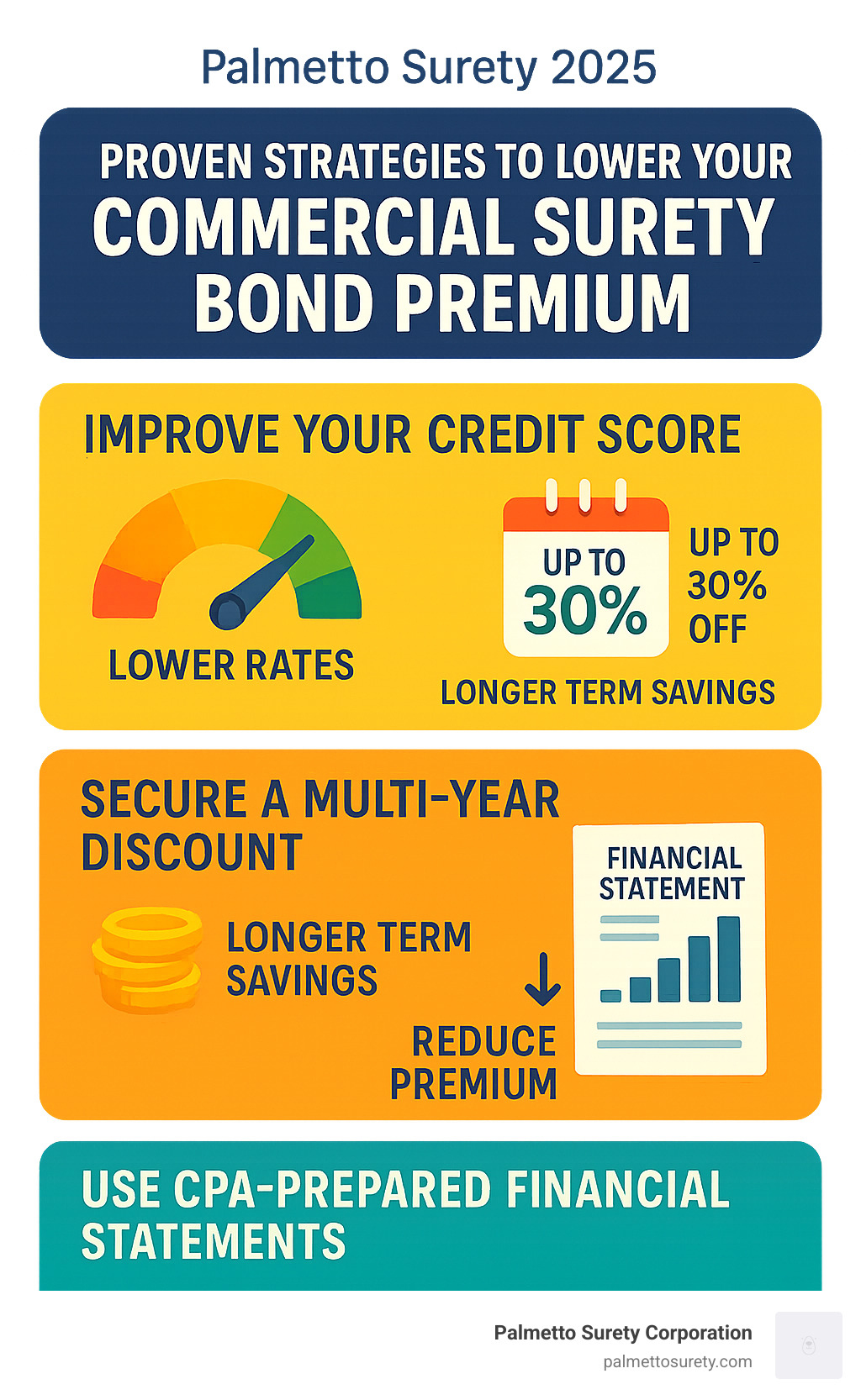
Multi-year purchasing can actually save you money – up to 30% in some cases. A three-year bond might cost 2.5 times the annual rate instead of three times, putting money back in your pocket.
Time completion surcharges hit construction projects that run longer than 12 months. You’ll face additional monthly charges of around 1% after that first year. Smart project scheduling can help you avoid these entirely.
Change orders trigger premium adjustments that settle at project completion. Increases mean additional charges, while decreases might generate refunds. The key is tracking these changes throughout your project.
Here’s something that catches many people off guard: surety bond premiums are generally non-refundable once issued. Unlike insurance, you can’t cancel mid-term and get money back. However, if the bond gets cancelled by law with no claims, you might qualify for a pro rata refund.
Proven Strategies to Lower Your Bond Premium & Speed Approval
After helping thousands of businesses get bonded over the years, I’ve seen which strategies consistently produce better rates and faster approvals.
Improving your credit score delivers the biggest bang for your buck. Even a 50-point improvement can cut your rates by 2-4 percentage points. Pay down those credit card balances and resolve any collections before you apply – the savings will more than cover the effort.
Using CPA-prepared financial statements carries serious weight with underwriters. Audited or reviewed statements trump compilations every time. Yes, it costs more upfront, but the investment often pays for itself through lower bond rates.
Adding a strong cosigner can transform your application if your credit or finances need help. The cosigner becomes equally liable for claims, so choose someone who understands the commitment. But their strong credentials can dramatically improve your rates.
Shopping multiple quotes makes perfect sense because different surety companies have different appetites. One company might specialize in your industry while another focuses on your credit profile. What gets rated at 8% with one surety might come in at 4% with another.
Applying online speeds everything up for standard bonds. Digital applications can process in hours, while paper applications sit in mail rooms and on desks for days or weeks.
Bundling multiple bonds with one surety company often produces volume discounts you won’t get by spreading your business around.
For more detailed information about our commercial surety bond options and how we can help you secure the best rates, visit our commercial surety bonds page.
Frequently Asked Questions About Commercial Surety Bond Rates
Are commercial surety bond premiums paid annually or one-time?
The payment schedule for your commercial surety bond rates depends entirely on what type of bond you need. Most business owners find this confusing at first, but it’s actually pretty straightforward once you understand the different categories.
License and permit bonds almost always require annual payments. Your contractor license bond, auto dealer bond, or freight broker bond will come due every year, and the good news is that your rate can actually improve if your credit score goes up or your business gets stronger financially.
Court bonds and project-specific bonds usually work as one-time payments. You pay once upfront and you’re covered for the entire period the bond needs to be active. This makes budgeting easier for specific legal cases or short-term projects.
Here’s where it gets interesting: many surety companies offer multi-year payment options that can save you serious money. Instead of paying $1,000 every year for three years, you might pay $2,500 upfront for a three-year term. That’s a $500 savings just for paying in advance.
Construction bonds are typically one-time premiums based on your original contract amount. However, don’t forget about change orders – they’ll adjust your final premium when the project wraps up.
Can I get bonded with bad credit, and what will it cost?
Absolutely – and this might surprise you. Most surety companies approve about 99% of applications, regardless of credit score. The difference is in what you’ll pay, not whether you’ll get approved.
If your credit score sits between 580 and 620, expect to pay roughly double or triple the standard rates. A bond that might cost someone with excellent credit $500 could run you $1,000 to $1,500. You’ll also likely need to provide personal financial statements and additional documentation.
Credit scores below 580 face the biggest challenges. Your commercial surety bond rates could be three to five times higher than standard pricing. Many surety companies will require collateral (like a certificate of deposit) or ask for a cosigner with stronger credit.
But here’s some good news: specialized bad credit programs exist specifically for people in your situation. These programs have higher rates but provide access when traditional underwriting might otherwise decline your application.
For construction contractors with credit challenges, the SBA Surety Bond Guarantee Program can be a lifesaver. The Small Business Administration backs up to 90% of the surety company’s risk, which encourages them to write bonds for contractors with weaker financials. You’ll pay an additional 0.6% guarantee fee to the SBA, but it often opens doors that would otherwise stay closed.
How do change orders affect my final premium?
Change orders can either cost you money or put money back in your pocket – it all depends on whether your project grows or shrinks during construction.
When your contract amount increases due to change orders, you’ll owe additional premium on the increased amount. Let’s say your original $500,000 contract grows to $600,000 through approved changes. You’ll pay premium on that extra $100,000 using the same rate structure from your original bond.
Contract decreases should generate refunds, though some surety companies charge small administrative fees to process them. Don’t assume this happens automatically – you may need to request the refund yourself when your project finishes smaller than originally planned.
Here’s something most contractors don’t realize: if your bond uses a sliding scale rate structure, change orders might actually move portions of your coverage into different rate tiers. Sometimes a contract increase pushes you into lower-rate brackets for the higher amounts, which partially offsets the additional premium you owe.
Most construction bonds go through a final premium adjustment when the project completes. Your surety company calculates the actual final contract amount (including all approved change orders) and either bills you for additional premium or issues a refund based on the difference.
The key is staying in communication with your bond agent throughout the project. They can help you understand how changes will impact your final costs and ensure you’re not hit with surprise bills at project completion.
Conclusion
Smart businesses know that understanding commercial surety bond rates isn’t just about compliance – it’s about protecting their bottom line. The difference between paying 2% and 8% on a $100,000 bond is $6,000 that could stay in your business instead of going to unnecessary premium costs.
The good news? You have more control over your bond rates than you might think. Your credit score remains the biggest factor, with excellent credit (720+) opening doors to rates as low as 1-2% for most license bonds. Even modest credit improvements can slash your premiums significantly.
Preparation pays off in the bonding world. Businesses that submit CPA-prepared financial statements consistently receive better rates than those using basic tax returns. Taking time to organize your application properly can save thousands over the life of your bond.
Don’t overlook multi-year discounts either. Many license bonds offer savings up to 30% when you pay for multiple years upfront. It’s like getting a bulk discount on something you’ll need anyway.
Shopping around makes sense too. Different surety companies have varying appetites for different industries and credit profiles. What one company quotes at 8% might cost you only 4% elsewhere.

At Palmetto Surety Corporation, we’ve spent over 20 years helping southeastern businesses steer the bonding process. We’ve seen too many companies overpay simply because they didn’t understand how rates work or rushed through their applications without proper preparation.
Our quick approval process doesn’t mean we cut corners on competitive pricing. Most of our commercial bonds get approved within hours because we’ve streamlined the underwriting process, not because we’re charging premium rates to speed things along.
Whether you’re dealing with excellent credit or facing some financial challenges, we work with businesses across the entire credit spectrum. Sometimes the solution is as simple as adding a cosigner or restructuring your application to highlight your strengths.
Ready to see what your actual bond costs should be? Our online application takes just minutes to complete, and you’ll have a real quote – not an estimate – faster than you’d expect.
Visit our commercial surety bonds page to start your application today. Because when it comes to commercial surety bond rates, knowing what you should pay is the first step to making sure you don’t overpay.


