


How Do Bondsman Make Money: 7 Powerful Facts in 2025
The Economics of Bail Bonds: A Quick Guide
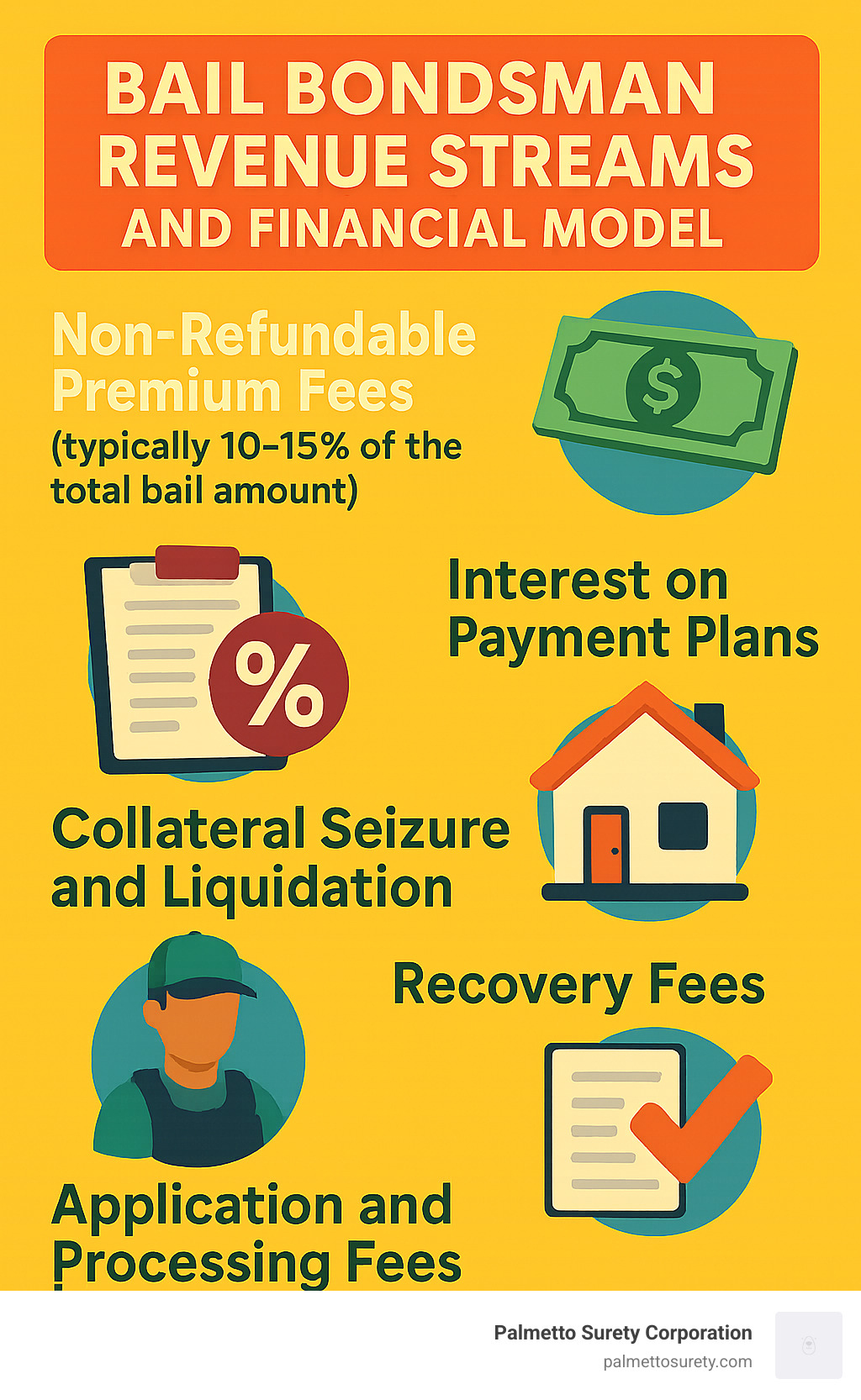
How do bondsman make money? Bail bondsmen primarily earn income through:
- Non-refundable premium fees (typically 10-15% of the total bail amount)
- Interest on payment plans when defendants can’t pay the full premium upfront
- Collateral seizure and liquidation when defendants skip court
- Recovery fees from bounty hunters who locate fugitives
- Application and processing fees for administrative costs
When someone is arrested and a judge sets bail at $10,000, few people have that kind of cash readily available. This is where bail bondsmen step in, offering to post the full amount to the court in exchange for a non-refundable fee – typically 10% of the bail amount.
The bail bonds industry operates at the intersection of the criminal justice system and financial services. Bondsmen essentially provide a form of insurance to the court, guaranteeing that defendants will appear for their scheduled hearings.
The business model is straightforward but carries significant risk. Bondsmen charge a premium that they keep regardless of case outcome, secure collateral to protect against defendants skipping court, and may employ bounty hunters to track down those who flee.
My name is Haiko de Poel Jr, and as a marketing expert who has worked extensively with Palmetto Surety Corporation, one of the fastest-growing surety bond companies in the US, I’ve gained insights into how do bondsman make money through my work developing business strategies for bail bond agencies across the southeastern United States.
Bail Bonds 101: Players, Process, Purpose
Let’s face it – the criminal justice system can be confusing and overwhelming, especially when you or a loved one is facing arrest. Bail bonds serve as a crucial financial lifeline, allowing defendants to maintain their freedom while awaiting their day in court. But who are the key players, and how does this whole process actually work?


The Arrest-to-Release Timeline
When someone gets arrested, they enter a process that can feel both frighteningly fast and painfully slow at the same time. Here’s what typically happens:
First comes the booking process – those tense hours after arrest where fingerprints are taken, mugshots are snapped, and personal information is recorded. It’s the official entry into the system.
Next, a judge determines how much money stands between the defendant and freedom until trial. This bail setting considers several factors: how serious was the alleged crime? Does the person have prior convictions? Are they likely to flee? Do they have strong community ties? Some jurisdictions simplify this with standard bail schedules for common offenses.
When that bail amount exceeds what’s in the checking account (and it often does), that’s when families reach out to a bail bondsman. After a quick assessment, the defendant or a family member pays the non-refundable premium – typically 10% of the total bail amount.
With premium in hand, the bondsman springs into action, posting the full bail amount to the court as a guarantee that the defendant will show up for all scheduled court dates. Once this bond is processed, the jail releases the defendant.
From handcuffs to home can take anywhere from a few hours to a full day, depending on how busy the jail is and the time of arrest. Experienced bondsmen often know how to steer the system efficiently, helping to reunite families faster.
What Is a Bail Bondsman?
A bail bondsman isn’t just a financial middleman – they’re a licensed professional who serves as a guarantor between the court and the defendant. When you break it down, they’re essentially saying to the court: “I vouch for this person. They’ll show up for their court dates, and I’m putting my money on it.”
These professionals wear many hats in our justice system:
They provide financial assistance to defendants who would otherwise sit in jail simply because they lack funds. They help ensure court appearances by staying in contact with defendants and sometimes providing reminders of court dates. They contribute to jail population management by facilitating pretrial release, which helps reduce overcrowding. And they often serve as informal guides through a complex legal landscape that few civilians understand well.
Becoming a bail bondsman isn’t as simple as hanging out a shingle. States require proper licensing, which typically involves:
Completing specialized education, passing state examinations, submitting to thorough background checks, establishing a relationship with a surety insurance company like Palmetto Surety Corporation, and committing to ongoing education to maintain their professional standing.
At their core, bail bondsmen are small business owners providing a vital service within our justice system. They take significant financial risks with each bond they write – which is precisely why understanding how do bondsman make money is so important. Their business model requires multiple revenue streams to remain sustainable while serving their communities effectively.
How Do Bondsman Make Money?
When people ask how do bondsman make money, they’re often surprised to learn there’s more to the business than just collecting fees. The bail bond industry operates on a fascinating business model that balances risk and reward.
Premium Fees: The 10% Rule
The bread and butter of a bail bondsman’s income comes from the non-refundable premium fee. Think of it as the price tag for freedom while awaiting trial.
Most states set this fee at around 10% of the total bail amount. So if a judge sets bail at $10,000, you’ll pay the bondsman $1,000 to post the full amount. For a $50,000 bail, that premium jumps to $5,000, and at $100,000, you’re looking at a $10,000 fee.
This premium compensates the bondsman for several services: shouldering the risk of the full bail amount, handling all the paperwork, monitoring you until your case concludes, and being available 24/7 (because arrests don’t just happen during business hours).
One important thing to remember – this fee stays with the bondsman regardless of your case outcome. Even if charges are dropped the next day or you’re found not guilty after a trial, that premium is earned and gone.
Different states have different rules about how much bondsmen can charge:
– California strictly caps premiums at 10%
– Colorado allows up to 15%
– Some states permit rates as low as 8%
For clients with a history of skipping court or extensive criminal records, some jurisdictions allow bondsmen to charge higher rates – sometimes 15-20% – because these clients represent a bigger financial risk.
Collateral: Safety Net for Skip Risk
Beyond the premium, bondsmen often require collateral as a financial safety net, especially for higher bail amounts or riskier clients.

Bondsmen accept various forms of collateral:
Property deeds are the gold standard, as real estate typically holds significant value. Vehicle titles, valuable jewelry, stocks and bonds, and even high-end electronics can also serve as collateral for smaller bail amounts. Sometimes, a trusted cosigner with strong credit and assets can provide a personal guarantee instead.
Collateral itself doesn’t generate direct revenue unless someone skips court. However, it provides the security that allows bondsmen to take on clients they might otherwise consider too risky.
When you fulfill all your court obligations, your collateral comes back to you – guilty verdict or not. The premium, however, stays with the bondsman.
Beyond the Premium: Additional Revenue Streams
While premium fees form the foundation of a bondsman’s income, several other revenue sources help keep the business profitable:
Payment plans and financing offer flexibility to clients who can’t pay the full premium upfront. Many bondsmen allow an initial down payment of 1-3% of the bail amount, with the remainder paid in monthly installments – plus interest rates that typically range from 10-20%. This creates an additional income stream similar to a small loan business.
Application and processing fees cover administrative costs like paperwork, credit checks, and background investigations. These typically range from $25-$100 per application and help offset operational expenses.
When defendants skip court, bondsmen may hire bounty hunters to track them down. While this is an expense, bondsmen often pass these costs (plus a markup) to the defendant or cosigner as recovery fees.
If a defendant disappears and can’t be located, bondsmen can legally seize and liquidate the collateral. After covering the forfeited bail amount, any excess funds may be returned to the client, though practices vary by company and jurisdiction.
When a defendant misses court but later appears, courts sometimes allow the bond to be reinstated. Bondsmen typically charge reinstatement fees ranging from $50-$500 to cover the administrative work involved.
Industry data suggests that while premium fees account for 70-80% of a bondsman’s revenue, these additional income sources significantly boost overall profitability.
Risk vs. Reward: How Do Bondsman Make Money Sustainably
The bail bond business is fundamentally about managing risk. For every bond written, the bondsman potentially risks the full bail amount if a defendant skips town.
So how do bondsman make money sustainably in this high-stakes environment? Through careful risk assessment and management.
Before posting a bond, experienced bondsmen like those working with Palmetto Surety Corporation conduct thorough evaluations of potential clients. They consider criminal history, previous bail compliance, employment stability, family ties, and other factors that might indicate flight risk.
Many develop scoring systems to categorize clients as low, medium, or high risk. This assessment directly impacts whether they accept the client, what premium they charge, collateral requirements, and how closely they’ll monitor the defendant.
When defendants do skip bail, bondsmen often employ bounty hunters to locate and return them to custody. This recovery system is remarkably effective – bounty hunters successfully apprehend approximately 90% of bail jumpers. While they typically charge 10-20% of the bail amount for their services, this high recovery rate is crucial to maintaining profitability.
To prevent skips in the first place, many bondsmen implement monitoring programs including regular check-ins, in-person visits, and reminder calls before court dates. These preventative measures significantly reduce the frequency of bail jumping.
The most successful bail bondsmen strike a careful balance – accepting enough clients to generate healthy revenue while being selective enough to minimize losses from bail jumpers. This delicate equilibrium is the secret to long-term profitability in the bail bond industry.
For more detailed information about the financial aspects of bail bonds, you can check out Investopedia’s guide to bail bonds.
Risk, Regulation & Recovery
The bail bond industry isn’t just about collecting premiums and posting bonds. It’s a business built on navigating risks, following strict regulations, and sometimes, chasing down defendants who decide to skip town. Understanding these challenges helps explain how do bondsman make money while walking this high-stakes tightrope.
Managing Skipped Bail
When a defendant ghosts their court date, the bail bond becomes “forfeited,” and suddenly, the bondsman is on the hook for the full bail amount. This is when the real work begins:

Most courts offer a grace period of 90-180 days where bondsmen can locate their missing client. During this time, bondsmen turn into part-detective, using skip tracing techniques to track down the fugitive. They’ll comb through databases, monitor social media, contact family members, and sometimes stake out known hangouts.
When these methods don’t pan out, many bondsmen call in the professionals – bail enforcement agents, better known as bounty hunters. Operating under legal authority established nearly 150 years ago in Taylor v. Taintor, these agents can legally apprehend fugitives, often entering their property without a warrant in many states. They typically charge 10-20% of the bail amount for a successful capture.
“Most people don’t realize that about 18-20% of defendants miss at least one court date,” explains a veteran bondsman with Palmetto Surety Corporation. “But the good news is only about 3-5% become long-term fugitives, and bounty hunters recover about 90% of those folks.”
If the defendant remains in the wind after the grace period expires, the bondsman must pay the court the full bail amount. That’s when the collateral gets liquidated to cover the loss, and any remaining balance might be pursued through civil litigation against the cosigner.
State-by-State Rules
If you’re wondering how do bondsman make money in different states, the answer varies widely because bail bond regulations are primarily handled at the state level.
In California, bondsmen are strictly limited to charging a 10% premium under Penal Code 1270, while Florida allows 10% for smaller bonds but 15% for larger amounts. Texas sets a minimum fee of 10% but gives bondsmen flexibility for high-risk cases. Georgia permits charges between 10-15% depending on the bail amount. And in 2021, Illinois eliminated commercial bail bonds entirely.
Licensing requirements show similar variety. Some states require as little as 8 hours of pre-licensing education, while others demand 40 hours or more. Most require state exams, background checks, and proof of financial stability. Continuing education requirements typically range from 8-24 hours annually.
Even bounty hunter regulations swing wildly from state to state. Kentucky, Illinois, Oregon, and Wisconsin have banned them outright. California, Nevada, and Connecticut require licensing and training. Meanwhile, Texas and Florida have minimal regulations beyond basic registration.
These regulatory differences dramatically impact business operations, fee structures, and recovery options for bondsmen across the country.
Legal & Financial Exposure
Being a bail bondsman means carrying significant legal and financial risks on your shoulders every day.
When a bond is forfeited and the defendant vanishes, the bondsman must pay the full bail amount to the court. This often triggers a claim against their surety insurance policy, which can damage their relationship with their surety company and increase premium costs down the road.
Bondsmen also face potential civil lawsuits from all directions – improper seizure of collateral, excessive force during apprehension, negligent hiring of bounty hunters, or breach of contract claims. One wrong move can lead to costly litigation.
Regulatory violations can hit hard too, with fines, license suspension or revocation, and even criminal charges in severe cases. And converting collateral to cash isn’t always straightforward – properties may be difficult to sell quickly, market values can disappoint, indemnitors might challenge the process legally, and there are always costs associated with maintaining and selling assets.
That’s why many successful bondsmen partner with established surety companies like Palmetto Surety Corporation. These partnerships provide crucial financial backing, legal guidance, standardized procedures, and risk management expertise.
“In this business, you’re only as good as your surety company,” notes a long-time bail agent. “Having Palmetto behind me means I can focus on writing bonds and helping clients, knowing I have solid backup if things go sideways.”
This delicate balance of risk and reward, coupled with navigating complex regulations, is the true answer to how do bondsman make money in this challenging industry.
Cash Bail, Own Recognizance & Other Alternatives
When exploring how do bondsman make money, it’s helpful to understand the alternatives to commercial bail bonds. These options not only impact defendants but also shape the bail bond industry’s business landscape.
Cash Bail vs. Bail Bonds vs. Release on Own Recognizance
Let’s look at the full spectrum of release options available in our justice system:
| Release Method | How It Works | Cost to Defendant | Pros | Cons |
|---|---|---|---|---|
| Cash Bail | Defendant pays full bail amount directly to court | 100% of bail (refundable if compliant) | Full refund after case conclusion; no bondsman fees | Requires full amount upfront; ties up funds for months/years |
| Bail Bond | Bondsman posts bail for a fee | 10-15% of bail (non-refundable) | Requires only a fraction of bail upfront; payment plans available | Premium never returned; collateral requirements |
| Own Recognizance (OR) | Court releases defendant on promise to return | $0 | No cost; no collateral | Only available for low-risk defendants and minor charges |
| Pretrial Services | Court-supervised release with monitoring | Varies by jurisdiction | Lower cost than bail bonds; no collateral | Not available in all jurisdictions; may include restrictions |
When someone has the financial means to pay their entire bail amount directly to the court, they can choose cash bail. This option means getting the full amount back after the case concludes (minus any court fees), but it requires having substantial funds available immediately. About 23% of defendants go this route, essentially tying up their money for what can sometimes be years as their case moves through the system.
For those facing minor charges who have strong community ties and no history of missed court dates, release on own recognizance (ROR) might be an option. The court essentially takes the defendant at their word that they’ll return for all hearings. Approximately 30% of defendants qualify for this no-cost option, though it’s typically reserved for low-level offenses.
Many jurisdictions now offer pretrial services programs as an alternative path to release. These taxpayer-funded programs may include regular check-ins, drug testing, or electronic monitoring. About 15% of defendants participate in these increasingly popular programs, which shift costs away from defendants to the public.
In recent years, charitable bail funds have emerged to help those who cannot afford even a bondsman’s premium. These non-profit organizations focus on lower bail amounts (typically under $5,000) and recycle their funds when cases conclude. Currently, they serve a small but growing segment—about 2% of defendants.
Pros and Cons for Defendants & Bondsmen
For someone facing arrest, each release option comes with distinct trade-offs.
Working with a bail bondsman means quick release with just 10-15% of the bail amount needed upfront. Many bondsmen offer payment plans for those who can’t manage even that reduced amount all at once. Defendants also benefit from having an experienced guide through the complex justice system. The downside? That premium fee is never returned, regardless of case outcome. Plus, most bondsmen require collateral, and additional fees may apply in certain situations.
Choosing cash bail means no third-party involvement and a full refund when the case ends. However, it requires having 100% of the bail amount available immediately, which can be a substantial financial burden. Those funds remain unavailable throughout what might be a lengthy case, and even after conclusion, refunds can take months to process.
Release on recognizance is clearly the most affordable option with no financial component at all. The catch? It’s simply not available for most serious charges or for defendants with any kind of problematic history.
For bail bondsmen, these alternatives represent varying levels of competition:
Cash bail primarily affects potential clients with substantial financial resources—not typically the core customer base for most bondsmen. Its impact is felt most with lower bail amounts, where more defendants might scrape together the full sum.
The growing bail reform movement presents a more significant challenge. Several states have implemented reforms limiting or eliminating cash bail entirely, while others have expanded pretrial services as alternatives. These changes directly reduce the market for bail bond services.
In response to these shifts, many bondsmen have wisely diversified their business models. Some have expanded into related services like process serving or fugitive recovery. Others have widened their geographic coverage to include multiple jurisdictions where bail is still common. Many focus increasingly on higher bail amounts where alternatives are less likely to be available.
Despite these alternatives and ongoing reforms, commercial bail bonds remain the predominant method of pretrial release nationwide. Approximately 49% of all defendants secure their freedom through a bail bondsman, demonstrating the continued relevance of this service in our justice system.
At Palmetto Surety Corporation, we’re proud to support our network of professional bail agents who help defendants steer these complex choices while ensuring the courts have financial assurance that defendants will return for their day in court. For more information about surety services, visit our website.
Frequently Asked Questions about How Bondsman Make Money
What happens to my collateral if I attend all court dates?
Good news! When you fulfill all your court obligations by showing up to every scheduled hearing, you’ll get your collateral back once your case wraps up. This happens whether you’re found guilty or innocent – the collateral’s purpose was simply to ensure your appearance in court.
Think of collateral as a safety deposit that gets returned when you’ve kept your end of the bargain. At Palmetto Surety Corporation, we carefully document all collateral when you provide it, and we make returning it a priority when your court obligations are complete.
A few practical things to keep in mind:
– You’ll typically need to wait 1-4 weeks after your case concludes for processing
– Some courts require documentation confirming you made all your appearances
– Your property deeds, vehicle titles, or other items are returned in the same condition
While your collateral comes back to you, the premium (that 10-15% fee) never does. That’s the cost of the service that secured your freedom during the legal process.
Is the bondsman’s fee ever refundable?
I wish I could tell you otherwise, but the premium fee you pay to a bondsman (typically 10-15% of the bail amount) is non-refundable in virtually all situations. This might seem tough, but there’s solid reasoning behind it.
When a bondsman posts your bond, they’re taking on significant financial risk right away. The fee compensates them for:
– Immediately assuming liability for your full bail amount
– Processing all the necessary paperwork
– Being available 24/7 to handle your release
– The ongoing risk they carry until your case concludes
Think of it like paying for a parachute when skydiving – once you’ve jumped and landed safely, you can’t return the parachute for a refund. The service has been fully provided.
The non-refundable nature applies regardless of how quickly your case resolves, whether charges get dropped, or if you’re found innocent. In rare instances, such as when a court rejects a bond or an arrest was made in error, some states may have limited exceptions – but these situations are uncommon.
Can a bondsman charge more than 10%?
The answer depends entirely on where you live, as state regulations vary significantly when it comes to bail bond fees.
Some states, like California, are strict fixed-rate states where bondsmen must charge exactly 10% – no more, no less. Other maximum-rate states like Colorado set a ceiling (15%) but allow bondsmen to charge less if they choose.
Then there are variable-rate states that permit higher rates in certain circumstances, such as:
– For defendants with previous failure-to-appear records
– Cases involving severe charges
– Situations where the defendant has limited community ties
– Federal or immigration bonds, which often carry higher risk
Even in states with strict premium caps, bondsmen may be allowed to charge additional fees for things like processing paperwork, credit card convenience, or courier services. These fees should be clearly disclosed upfront.
At Palmetto Surety Corporation, we ensure all our agents strictly follow their state’s specific regulations regarding fees and premium rates. We believe in transparency about costs from the very beginning of our relationship with clients.
How do bondsman make money varies by jurisdiction, but the foundation remains the premium fee, with additional services sometimes adding to their revenue streams. Understanding these fees helps you make informed decisions during what’s often a stressful time.
Conclusion
Let’s take a moment to reflect on what we’ve learned about how do bondsman make money. It’s quite a fascinating business model that walks a tightrope between taking significant financial risks and creating multiple streams of income to stay profitable.
At the heart of it all is that non-refundable premium fee – typically 10-15% of the total bail amount. This fee compensates bondsmen for putting their neck on the line by guaranteeing defendants will show up to court. When you think about it, they’re essentially betting on people they barely know, with potentially tens of thousands of dollars at stake.
But smart bondsmen don’t rely on premiums alone. They’ve developed several additional ways to keep their businesses thriving:
– Collecting interest on payment plans for folks who can’t pay the full premium upfront
– Managing collateral from vehicles to jewelry to real estate
– Conducting recovery operations when defendants skip town
– Adding service fees where state laws permit
The bail bond industry fills a crucial gap in our criminal justice system. Without bondsmen, many defendants would simply sit in jail until their trial date – not because they’re guilty, but because they lack the cash to post bail. Bondsmen provide a lifeline, albeit one that comes with a cost. That 10-15% premium buys freedom during a critical time when defendants need to work, support their families, and prepare their defense.
If you’re considering working with a bail bondsman, remember these key points:
That premium you pay? It’s gone forever – think of it as the cost of freedom while awaiting trial. Be crystal clear about any collateral requirements before signing anything. Know that regulations vary dramatically from state to state. And always explore all available alternatives before making your decision.
For over two decades, Palmetto Surety Corporation has been a trusted name in the surety bond business throughout the Southeast. Our extensive network of licensed bail agents across Georgia, Florida, Louisiana, Mississippi, South Carolina, Tennessee, and Texas is committed to providing professional service with transparent pricing and prompt return of your collateral once obligations are met.
Whether you’re currently dealing with a bail situation or were simply curious about the economics behind this unique industry, we hope this guide has thoroughly answered your questions about how do bondsman make money and illuminated the vital role these professionals play in our justice system.
Need more information about our surety services? Looking to connect with a licensed bail agent near you? Visit our website or reach out to any of our offices in Atlanta, Augusta, Columbus, Savannah, or throughout the Southeast. We’re here to help when you need us most.


