


renew id online: 7 Powerful Steps for Fast Success 2025
The Quick and Easy Way to Renew Your ID Online
Remember the days of taking a number and waiting for hours at the DMV? Thankfully, those days are becoming a thing of the past. If you need to renew id online, you’re in luck – the process has never been simpler.
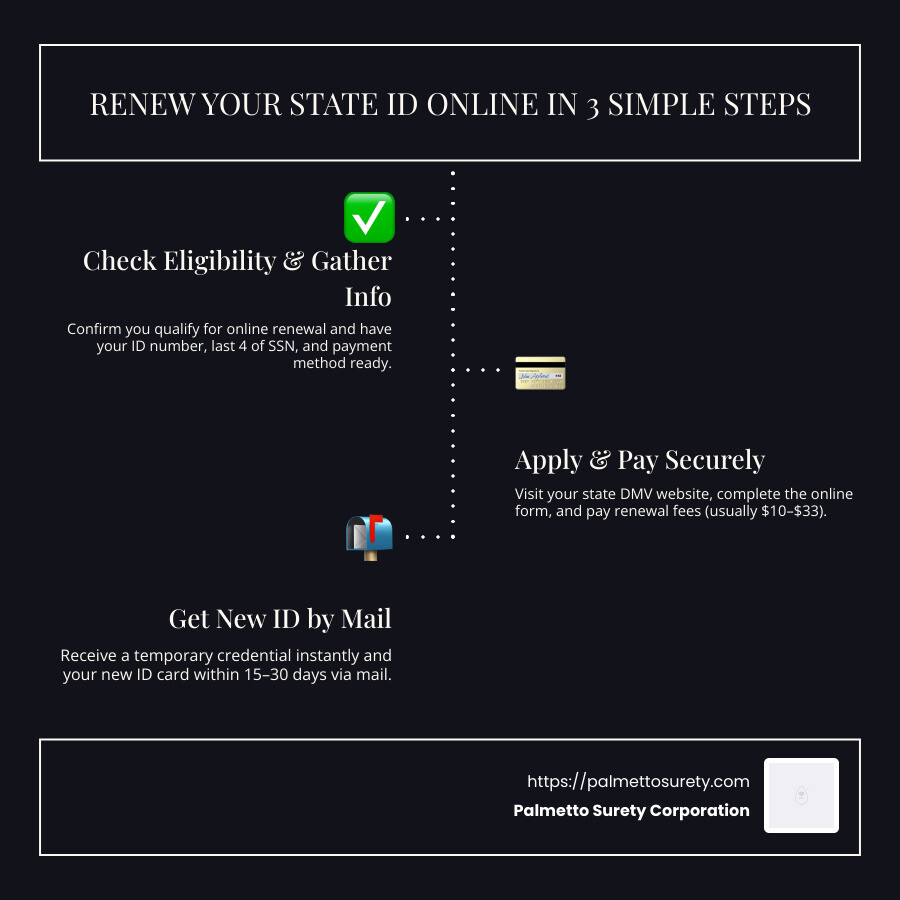
Most states now offer a straightforward online renewal process that takes just minutes to complete. Before you start, make sure you’re eligible (typically, your photo needs to be recent – within the last 12 years for most states). Then, gather your current ID number, the last four digits of your Social Security Number, and have a payment method ready.
When you’re prepared, simply visit your state’s DMV website and look for their online services section. The application process is typically very user-friendly – you’ll enter your information, pay the renewal fee (which usually ranges from $10-$33), and receive a confirmation that you can print or save as your temporary credential. Your new physical ID will arrive in your mailbox within 15-30 days.
The convenience of being able to renew id online has transformed the experience for millions of Americans. What used to take half a day can now be completed during your lunch break or while waiting for your morning coffee to brew.
As someone who’s worked extensively with state agencies on digital change projects related to credential management, I’ve seen how these online systems have evolved. At Palmetto Surety Corporation, we understand the importance of efficient, accessible government services – it’s why we’re passionate about helping clients steer these systems with ease.
If you’re interested in learning more about similar processes, check out our related articles:
– dmv renew license
– renew nc drivers license
Why online renewal is trending
The pandemic changed so many aspects of our daily lives, and government services were no exception. What began as a necessity during lockdowns has blossomed into a preferred way to handle routine credentials. According to several state DMVs, online renewals have skyrocketed by over 200% since 2020, as Americans accept the convenience of handling these tasks from home.

“We used to view online services as a nice-to-have,” shares our team at Palmetto Surety Corporation. “But now they’re essential. Most Americans expect to handle government paperwork digitally, and states have responded impressively by creating user-friendly portals that make the process smooth and secure.”
This shift is particularly noticeable in states like Michigan, where residents typically only need an in-person visit once every 12 years for a new photo and vision test. All other renewals can be handled online, by mail, or at self-service kiosks – saving countless hours and making life just a little bit easier for everyone.
The trend toward digital services isn’t just about convenience – it’s about creating a government that works for people in the way they prefer to engage. And when it comes to renewing your ID, that increasingly means doing it with a few clicks rather than spending your morning in a waiting room.
Before You Start: Eligibility, Timing, Documents & Fees
Before diving into the online renewal process, understand if you’re eligible and what you’ll need to complete the transaction successfully. While requirements vary by state, there are some common factors to consider.

Who is eligible
Not everyone can renew id online, but most states have made the process available to a broad range of residents. You’re typically eligible if you’re a U.S. citizen or legal resident with proper documentation. Most states require that your current credential isn’t expired beyond a certain timeframe – usually between 1-4 years.
“We’ve seen a dramatic increase in online renewal eligibility across states,” notes our team at Palmetto Surety. “What used to be a restrictive process has opened up to most residents.”
Your photo matters too – if your current picture was taken within the last 8-12 years, you’re usually good to go. In Michigan, for example, most folks can renew id online every other renewal cycle, meaning you only need to visit a branch once every decade or so for that new photo.
That certain situations might prevent online renewal. If you’ve recently moved, have a suspended license, hold a CDL with special endorsements like hazmat, or are registered as a sex offender in some states, you’ll likely need to visit in person.
When you can apply
Timing your renew id online application just right can save you headaches down the road. Most states offer a generous window for renewal:
Before your ID expires, you can typically start the renewal process up to 6 months early. Some states are even more flexible – Indiana allows renewals up to 24 months before expiration! This early bird approach means you’ll never be caught with an expired ID.
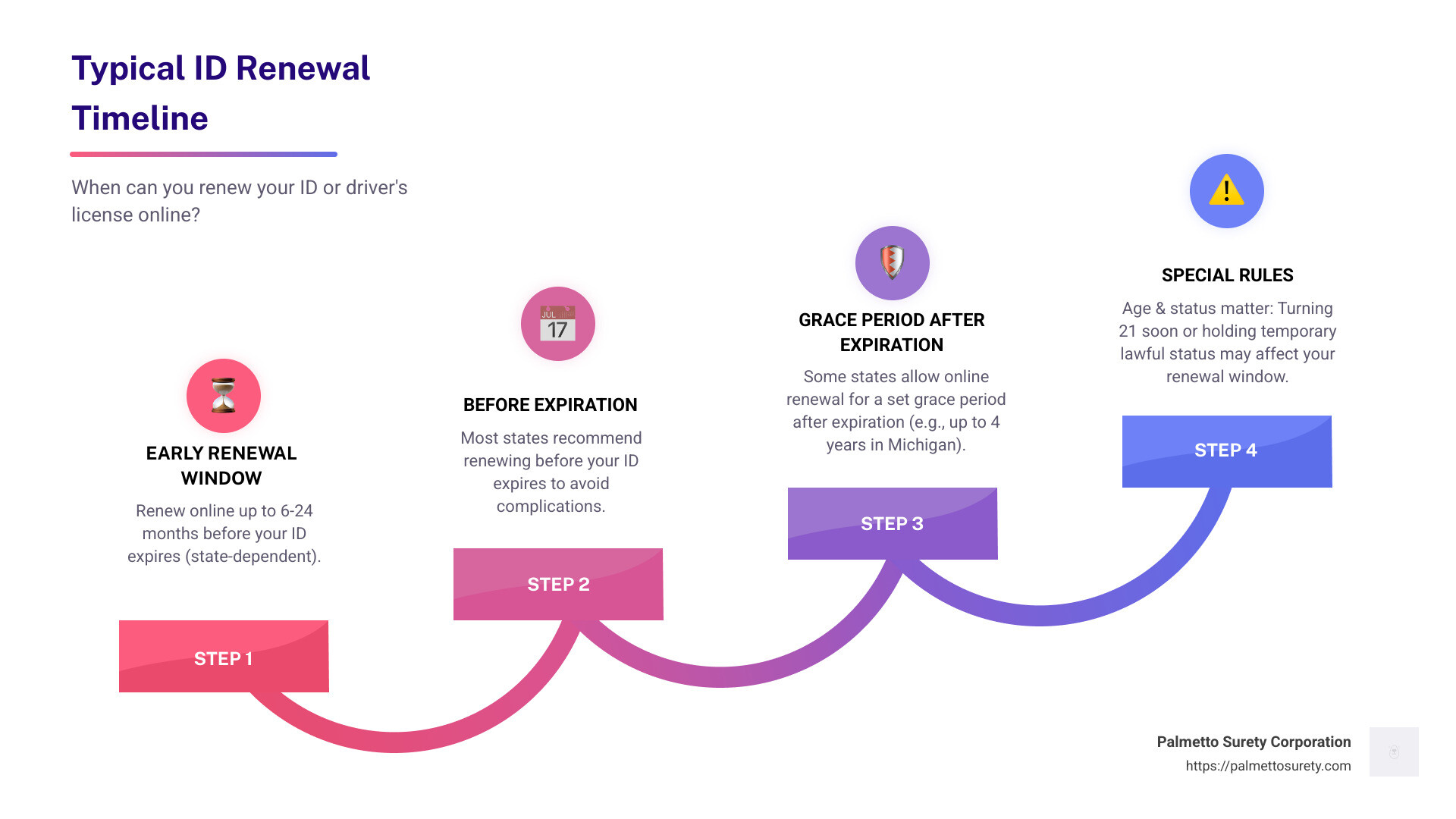
After expiration, there’s usually a grace period where you can still renew id online without additional testing. Michigan is particularly generous, allowing online renewals up to 4 years after expiration (though your wallet might feel the pinch of late fees).
If you’re approaching a milestone birthday, pay attention! Those turning 21 soon should check their state’s rules. In Michigan, renewing within 40 days before your 21st birthday gets you a card without that pesky “UNDER 21” designation.
For our friends with temporary lawful status, the window might be narrower. Iowa, for instance, only allows foreign nationals to renew up to 30 days before expiration.
As our Iowa research confirmed, “You may renew your driver’s license 180 days before its expiration date, and your license is valid for driving for an additional 60 days after the expiration date.” That’s a nice cushion on both ends!
Documents & information checklist
When you sit down to renew id online, having everything ready makes the process smooth as butter. You’ll typically need your current ID or driver’s license number – it’s usually right on the front of your card.
For identity verification, have the last four digits of your Social Security Number handy. You’ll also need your date of birth and make sure the current address on file with the DMV is accurate.
A valid email address is essential for receiving your confirmation and tracking information. And don’t forget a payment method – most states accept major credit/debit cards or electronic checks.
Some states send a renewal notice with specific information or codes you’ll need during the process. And if your state requires a vision test, you might need to upload results or confirm you’ve had one recently.
Texas keeps it simple – you’ll just need your driver’s license or ID number, date of birth, audit/DD number, and those last four SSN digits to log into their renewal system. The whole process can take less than five minutes when you’re prepared!
Typical fees & how to pay
Let’s talk money – what will it cost to renew id online? The answer varies widely depending on where you live and what type of ID you need.
For a standard ID card, expect to pay between $10-$16 in most states. Driver’s licenses typically run a bit more, usually $18-$33. If you’re opting for an improved or improved ID that works for border crossing, prices jump to the $30-$45 range.
Commercial drivers, get your wallets ready – CDL renewals often cost between $97-$105. And if you’re late to renew, expect to pay extra. Late fees typically add $6-$25 to your total, depending on your state.
Michigan residents pay $18 for a standard license renewal, while an improved license costs $38. Wait too long, and those prices jump to $25 and $45 respectively.
Payment is straightforward in most states. You can use major credit cards (Visa, MasterCard, Find, American Express), debit cards, or electronic checks pulled directly from your bank account.
Be aware that some states tack on convenience fees for online transactions. In Michigan, using a self-service station adds a $4.25 service fee to each transaction. Small price to pay for avoiding the DMV line, if you ask me!
These fees go toward maintaining secure identification systems that protect your identity and ensure compliance with federal standards – an area where our team at Palmetto Surety has extensive experience working with government agencies.
renew id online: Step-by-Step Process, Delivery & Tracking
Ready to get started? Now that you’ve checked your eligibility and gathered your documents, let’s walk through exactly how to renew id online from the comfort of your home.

renew id online in 5 minutes
The beauty of online renewal is how quick and painless it can be. Most people complete the entire process in under 5 minutes when they have everything ready. Here’s what to expect:
First, visit your state’s official DMV or Secretary of State website. Look for sections with names like “Online Services” or “License Renewal.” Be careful to use only official government sites—third-party websites often charge unnecessary fees for services you can get directly from the state.
Many states require you to create a user account first. This is actually helpful for future transactions, as your information will be saved securely. If you already have an account from a previous visit, simply log in with your username and password.
Once you’re logged in, select the renewal option that matches your needs—whether that’s for a standard ID, driver’s license, or improved credential. The system will typically verify your eligibility automatically based on your record.
Next comes the information verification step. You’ll need to confirm that your personal details are correct, including your address. This is your chance to make sure everything is up to date. If you’ve moved recently, some states require you to update your address separately before attempting to renew id online.
Most states will ask you a few eligibility questions. For driver’s licenses, these might include questions about your vision or medical conditions. Some states trust you to self-certify that your vision meets requirements, while others might require you to upload a recent vision test form.
After reviewing all your information (double-check everything!), you’ll proceed to payment. Most states accept all major credit and debit cards, and some also allow electronic checks. The renewal fee will vary based on your state and the type of ID you’re renewing.
Once payment is processed, you’ll receive a confirmation screen with your receipt information. Many states also provide a printable temporary credential that you can use until your permanent card arrives in the mail. In Virginia, if your license is expiring within 15 days, this temporary receipt extends your driving privileges for up to 30 days—perfect for that awkward waiting period.
The entire process is designed to be straightforward, but if you run into any issues, most state DMV websites offer live chat support or a customer service number you can call for immediate assistance.
Track your new card after renewal
After clicking “submit” on your renewal, the waiting game begins. Most states mail new IDs within 15-30 days, but wouldn’t it be nice to know exactly where yours is in the process? Thankfully, most states now offer tracking tools.
If you’ve completed your renew id online process in New York, for example, you can log back into your DMV account and select “View Credential Mail Status” to see if your card is still being processed, has been mailed, or was perhaps returned to the DMV for some reason.
Many states also send email updates about your application status. These might include confirmation that your application was received, notification that your card has been printed, and sometimes even delivery updates. Make sure the email address you provide during renewal is one you check regularly.
According to data we’ve gathered at Palmetto Surety, delivery times can vary significantly by state:
– Iowa residents typically receive their new cards within 30 days in a plain white envelope
– Virginia advises allowing at least 15 days before contacting the DMV
– Michigan generally delivers new IDs within 2-3 weeks
If your card hasn’t arrived after the expected timeframe (typically 30-60 days), don’t panic. First, check the online status tool if your state offers one. If that doesn’t help, contact your DMV’s customer service line. Many states offer free replacements if you don’t receive your card within a specific timeframe, so be sure to ask about this option if your ID seems lost in the mail.
Update address or organ-donor status during checkout
The renew id online process isn’t just for renewal—it’s also a convenient time to update certain information on your record. Most states allow you to make several important changes during the renewal process.
Thinking about moving soon? Some states let you update your address right in the renewal workflow. Others, like Michigan, require you to verify or change your address online before starting the renewal process. This small difference in timing can be important, so check your state’s specific requirements before beginning.
The renewal process is also the perfect time to register as an organ donor if you haven’t already. This simple checkbox can potentially save lives, and your donor status will be printed directly on your physical ID. If you’re already registered but wish to opt out, you can typically make this change during renewal as well.
Many states have integrated voter registration into their renew id online systems too. This “Motor Voter” integration means you can register to vote or update your voter information without filling out separate forms. It’s a small convenience that helps boost civic participation.
Some forward-thinking states like Texas have even added emergency contact information updates to their renewal process. This information isn’t printed on your ID but is stored in secure databases that law enforcement can access in emergencies—potentially life-saving if you’re ever in an accident.
While these updates are convenient, keep in mind that major changes like name changes or gender marker updates typically require an in-person visit with supporting documentation. The online system is designed for simpler updates that don’t require additional verification.
Ready to get started with your online renewal? For Illinois residents, you can access the service directly through the Illinois Secretary of State portal.
Special Cases, Limitations & Alternative Renewal Methods
While online renewal is convenient for many, certain situations require alternative approaches. Let’s explore special cases and other renewal methods available.
When you cannot renew id online
There are several common reasons why you might not be eligible to renew id online:
-
New photo requirement: If you’re due for a new photo (typically every 8-12 years), you’ll need to visit in person.
-
REAL ID upgrade: If you want to upgrade from a standard ID to a REAL ID-compliant credential, you’ll need to visit in person with required documentation.
-
Name or gender marker changes: These require in-person verification with supporting documents.
-
Expired beyond the grace period: If your ID has been expired for too long (often 1-4 years), you’ll need to apply in person.
-
Commercial Driver’s License (CDL) with certain endorsements: Many states require in-person renewal for CDLs, especially with hazmat endorsements.
-
Medical conditions or restrictions: Some states require in-person evaluation for certain medical conditions.
-
SSN verification failure: If the system cannot verify your Social Security Number, you’ll need to visit an office.
According to Michigan’s DMV, common reasons for online ineligibility include “needing a new photo, SSN verification failure, recent address change, canceled or expired license over four years, or special restrictions such as sex offender registry or CDL hazmat endorsement.”
Options if online isn’t possible
If you can’t renew online, several alternatives are available:
Mail Renewal:
– Many states offer mail-in renewal options
– You’ll typically receive a renewal notice with instructions
– Complete the form, include payment, and mail it back
– In Ohio, “Out-of-state renewal packets must be postmarked within 180 days of expiration.”
Self-Service Kiosks:
– Available in many states at DMV offices, libraries, or grocery stores
– Offer many of the same services as online renewal but with a physical interface
– Usually require your current ID and a credit/debit card
– In Michigan, “A $4.25 service fee is charged for each item transacted at a self-service station.”
In-Person Office Visit:
– Required for certain situations (REAL ID, name changes, etc.)
– Many offices now offer appointment scheduling to reduce wait times
– Bring all required documentation and payment methods
– Some states have expanded office hours or dedicated times for renewals
Temporary Extensions:
– If you’re temporarily out of state, some states offer extensions
– Military personnel often have special provisions
– In Iowa, “Military personnel can request an operating-privileges extension valid until six months after separation, and dependents get up to five years from expiration.”
At Palmetto Surety Corporation, we’ve helped many clients steer these alternative renewal methods, particularly when they’re facing tight deadlines for credential-dependent transactions. Our experience shows that planning ahead is crucial—if you know you’ll need to visit in person, scheduling an appointment can save hours of waiting time.
Frequently Asked Questions about renew id online
Is it safe to renew id online?
Yes, it’s absolutely safe to renew id online through your state’s official DMV website. I know many people worry about sharing personal information online, but state agencies take security very seriously.
When you renew id online, your information is protected by multiple layers of security. States use the same encryption technology that banks use, so your data is scrambled during transmission. Most DMV portals also require multi-factor authentication—meaning you’ll need more than just a password to access your account.
“We’ve worked with numerous state agencies on their digital security protocols,” notes our team at Palmetto Surety Corporation. “These systems undergo rigorous testing and regular security audits to protect your personal information.”
To ensure you’re on a legitimate site when you renew id online, always look for “https://” and a lock icon in your browser’s address bar. Access the renewal portal directly through your state’s official DMV website, not through search engines or email links. And be wary of any third-party sites charging “convenience fees” to connect you to DMV services—these are rarely necessary and could be scams.
How long until I receive my renewed ID?
After you renew id online, the waiting game begins—but it’s not usually a long one. Most people receive their renewed ID within 15-30 calendar days from submission.
The process typically works like this: your renewal application is processed within 1-5 business days, and then your new card spends another 10-25 days in the mail. Different states have different timelines:
In Iowa, your new ID arrives “in a plain white envelope within 30 days of being processed.” New York residents can expect their cards “within two to four weeks after renewal,” while Virginia asks you to “allow at least 15 days for license delivery.”
Don’t worry about being without identification during this waiting period. When you renew id online, you’ll receive a printable temporary credential immediately after completing your renewal. This digital document is legally valid for driving and identification in most situations for 30-90 days, giving plenty of breathing room for your permanent card to arrive.
One helpful tip from our experience: in Virginia, if there are 15 days or fewer remaining on your current license, printing the online receipt extends its validity for up to 30 days—a nice buffer if you’re cutting it close to expiration.
What if my new ID never arrives?
It happens to the best of us—you renew id online, wait patiently, and your ID never shows up. Don’t panic! There’s a straightforward process to resolve this issue.
First, check your renewal status online. Most states provide tracking tools through their DMV websites. In New York, for example, you can log into your DMV account and look for “View Credential Mail Status” to see exactly where your ID is in the process.
If the status shows your ID was mailed weeks ago, it’s time to contact your state’s DMV customer service. Have your confirmation number and personal information ready when you call. Many states offer free replacements if you don’t receive your card within the expected timeframe.
“In Louisiana, if you don’t receive your credential within 30 days, you can visit a field office within 60 days of application to get a replacement at no charge,” according to our research.
One common issue worth checking: verify that your address is correct in the DMV system. In many states, the postal service will not forward DMV mail, even if you have a mail forwarding order in place.
Here’s an insider tip we’ve learned through our work at Palmetto Surety: state IDs often arrive in very plain, nondescript envelopes that can easily be mistaken for junk mail. Iowa specifically mentions that “your new driver’s license or ID card will arrive in a plain white envelope,” so check all your mail carefully during the expected delivery period before assuming it’s lost.
If all else fails, you may need to visit a DMV office in person. While this defeats the purpose of choosing to renew id online, it’s sometimes the fastest way to resolve delivery issues and get your new ID in hand.
Conclusion
The journey to renew id online has truly transformed how we interact with government services. What started as a convenient option has become an essential service that saves millions of Americans from spending hours in DMV waiting rooms.
Throughout this guide, we’ve explored how most states now offer user-friendly online renewal systems that can be completed in just minutes from the comfort of your home. While requirements vary from state to state, the process follows a familiar pattern that most of us can steer with ease:
- Check your eligibility first (saving yourself potential headaches)
- Gather your information (ID number, SSN, payment method)
- Visit your state’s official DMV website
- Complete the application carefully
- Pay your fee and download any temporary documents
- Wait for your permanent ID to arrive in that plain white envelope
For those situations where online renewal isn’t possible – perhaps you need a new photo, have a name change, or need a REAL ID upgrade – alternatives like mail-in renewal, self-service kiosks, and in-person visits ensure you can keep your identification current no matter your circumstances.
At Palmetto Surety Corporation, we see how important valid, up-to-date identification is for many life situations, especially those requiring surety bonds. Our 20+ years of experience working with government compliance and documentation requirements has taught us that planning ahead is absolutely essential – renew id online early, keep your address current, and always stick to official government websites for your transactions.
The digital change of ID renewal represents one of the most successful modernization efforts in government services in recent years. Not only does it save citizens time, but it also streamlines operations and reduces costs for state agencies. It’s a rare win-win in bureaucracy!
Whether you’re in Georgia, Florida, Louisiana, Mississippi, South Carolina, Tennessee, or Texas, our team at Palmetto Surety is here to help with all your surety bond needs while providing friendly guidance on related government processes. We understand that navigating these systems can sometimes feel overwhelming, but with the right information and a little planning, you can avoid the stress and enjoy the convenience of modern digital services.
For more information about our surety solutions and how we can assist with your compliance needs, visit our website or contact one of our offices throughout the Southeast. We’re real people ready to help with real solutions – no automated phone menus or chatbots here!


