


DMV Renew License: 5 Essential Steps for Hassle-Free Success
Simplify Your DMV License Renewal Process
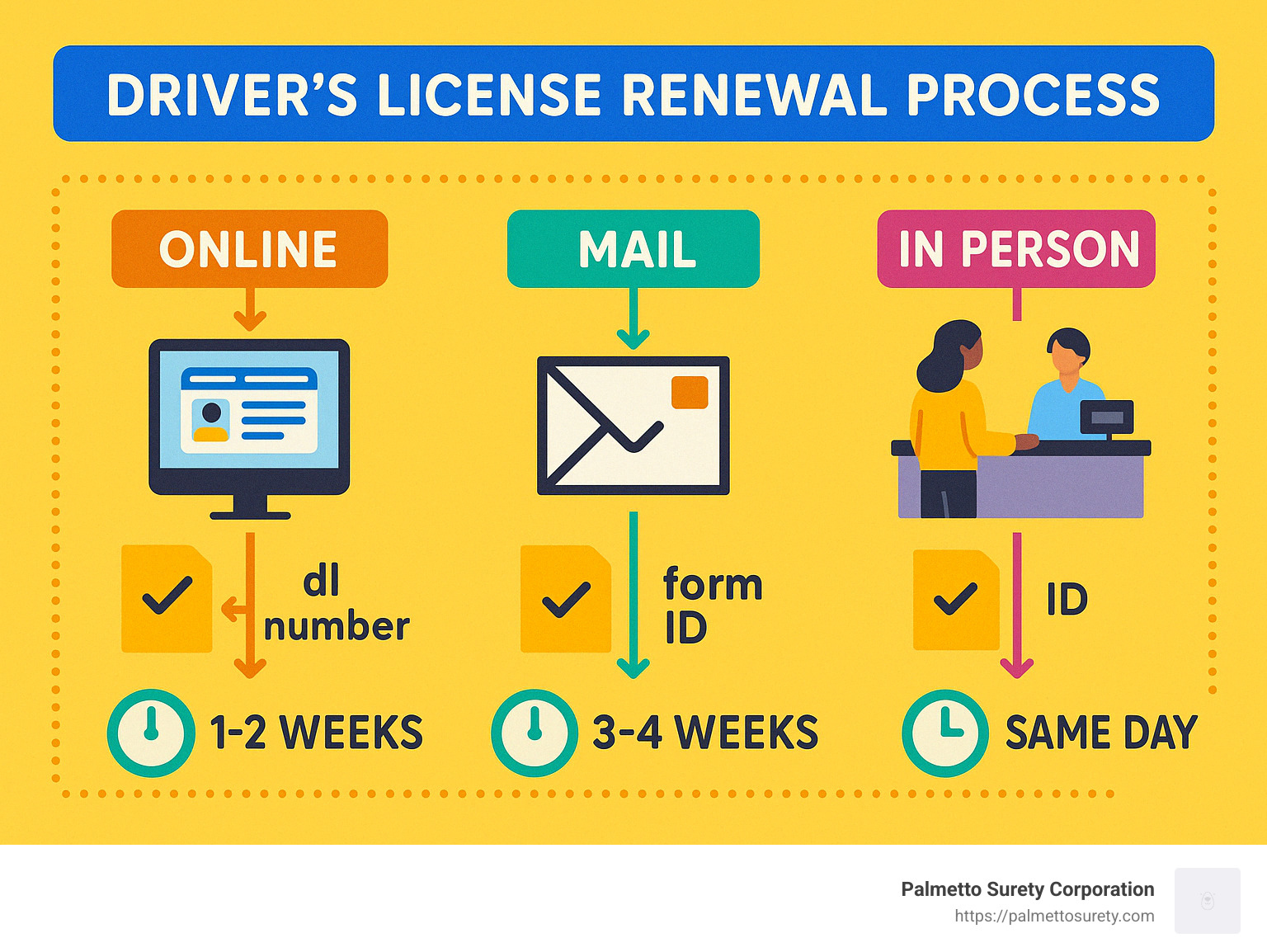
If you need to dmv renew license, here’s a quick overview of the main renewal methods:
| Renewal Method | Typical Eligibility | Processing Time | Special Notes |
|---|---|---|---|
| Online | Most drivers with current photo and no major changes | 2-4 weeks | Not available for all states/situations |
| In Person | All eligible drivers | Same day (temporary) + 2-4 weeks for permanent | Required for REAL ID upgrades |
| By Mail | Varies by state; often available for simple renewals | 2-4 weeks | Good option for out-of-state residents |
Renewing your driver’s license is a necessary task that everyone must complete periodically to maintain legal driving privileges. Most states allow you to dmv renew license anywhere from 6 months to 1 year before your expiration date, giving you plenty of time to complete the process. Failing to renew on time can result in fines, penalties, and even the need to retake driving tests if your license has been expired for too long.
The renewal process varies slightly from state to state, but generally follows similar steps regardless of location. Understanding when and how to renew can save you significant time and hassle.
I’m Haiko de Poel Jr, and through my work with Palmetto Surety Corporation, I’ve guided numerous clients through various licensing processes including dmv renew license procedures that impact their business operations and compliance requirements. My experience has shown that knowing the right renewal path can save you hours of frustration.
Understanding When to Renew Your Driver’s License
Let’s face it—no one gets excited about a trip to the DMV. But knowing when to renew your driver’s license can save you from headaches, fines, and that dreaded feeling of seeing flashing lights in your rearview mirror with an expired license in your wallet.
Most DMVs aren’t out to catch you by surprise. They typically send renewal notices about 60-90 days before your expiration date, giving you plenty of time to plan your renewal strategy.


Renewal Timeframes Across States
Did you know that many states let you renew your license months before it expires? This is one of those rare opportunities where procrastination doesn’t pay off!
If you’re in California, you can dmv renew license up to 6 months before that expiration date. Florida residents get even more breathing room—up to 18 months for driver licenses and 12 months for ID cards. Georgia drivers have a 150-day window before expiration, while Virginia allows renewal as early as a full year ahead.
New York offers perhaps the most flexible timeline, with renewal possible up to 1 year before and even 2 years after expiration. As their DMV website notes: “Before You Renew: You can renew up to 1 year before and 2 years after your license expires.” But don’t be fooled—this generous post-expiration period is definitely not the norm across the country.
Consequences of Expired Licenses
Driving with an expired license isn’t just a minor oversight—it’s actually illegal and can lead to some serious consequences that go well beyond a simple traffic ticket.
The financial hit alone should be enough to mark your calendar. Fines typically range from $25 to $300, depending on how long you’ve been driving with an expired license. In New York, for example, if your license has been expired for 60 days or less, you’re looking at a penalty of $25 to $40 plus surcharges. Let that expiration stretch beyond 60 days, and those penalties jump to $75 to $300 plus surcharges.
But the costs don’t stop there. In some places, your vehicle might be towed on the spot, leaving you stranded and facing impoundment fees. Your insurance company might also refuse to cover accidents if they find you were driving with an expired license.
Perhaps most inconvenient of all—if your license has been expired for too long (usually more than 1-2 years), you might find yourself back in driver’s ed, retaking knowledge and road tests as if you were a brand-new driver.
Renewal Reminders
The days of relying solely on paper renewal notices are largely behind us. Most states now offer multiple ways to stay on top of your renewal dates:
Many DMVs now send email notifications when your renewal date approaches. You can also sign up for text message alerts in many states. Most state DMVs now offer online accounts where you can check your license status and expiration date anytime. Some states have even developed mobile apps that send push notifications about upcoming renewals.
For example, Virginia’s DMV sends renewal reminders 90 days before license expiration, and drivers can easily sign up for electronic reminders to stay ahead of important deadlines.
At Palmetto Surety Corporation, we’ve seen how expired licenses can complicate other important matters like obtaining surety bonds or handling other legal requirements. A current, valid license is often the foundation for many other important transactions in your life—one more reason to mark those renewal dates in your calendar!
Eligibility Criteria for DMV Renew License
When it’s time to dmv renew license, knowing if you qualify for different renewal options can save you precious time and prevent frustration. Not everyone can renew online, and some drivers must visit the DMV in person due to specific circumstances.
General Eligibility Requirements
Before you begin the renewal process, make sure you meet the basic requirements. Most states won’t let you renew if your license is currently suspended or revoked—this is a universal rule across America. You’ll also hit a roadblock if you have unpaid traffic tickets or outstanding fines lingering in the system.
Your personal information needs to be current too. If you’ve moved or changed your name since your last renewal, you’ll need to update these details first. Vision requirements vary by state, but most require you to pass a basic screening to ensure you can see well enough to drive safely. And naturally, any medical conditions that might affect your driving ability will need to be disclosed and evaluated.
“We often see clients who don’t realize their outstanding tickets make them ineligible for renewal,” says one DMV representative in South Carolina. “It’s always best to clear those up first before attempting to renew.”
Online Renewal Eligibility
The convenience of online renewal is wonderful—when you qualify for it. The rules tend to be stricter for digital renewals than in-person visits:
Age restrictions often apply, with many states requiring drivers under 18 or over 70 to visit in person. This ensures proper evaluation of younger drivers and seniors who may need additional testing.
Previous renewal method can affect your options too. Some states operate on an alternating system—if you renewed online last time, you might need to show up in person this cycle.
Vision testing requirements might send you to a physical DMV location if you’re due for a new screening. Similarly, if it’s time for a new photo (typically every 8-12 years), you’ll need to smile for the camera in person.
License type matters significantly—Commercial Driver’s License (CDL) holders typically can’t use the online systems and must renew in person due to additional federal requirements.
In New Jersey, for example, online renewal provides immediate results and convenience, but CDL holders and people with soon-to-expire visas must visit a Licensing Center to complete their renewal.
Special Cases
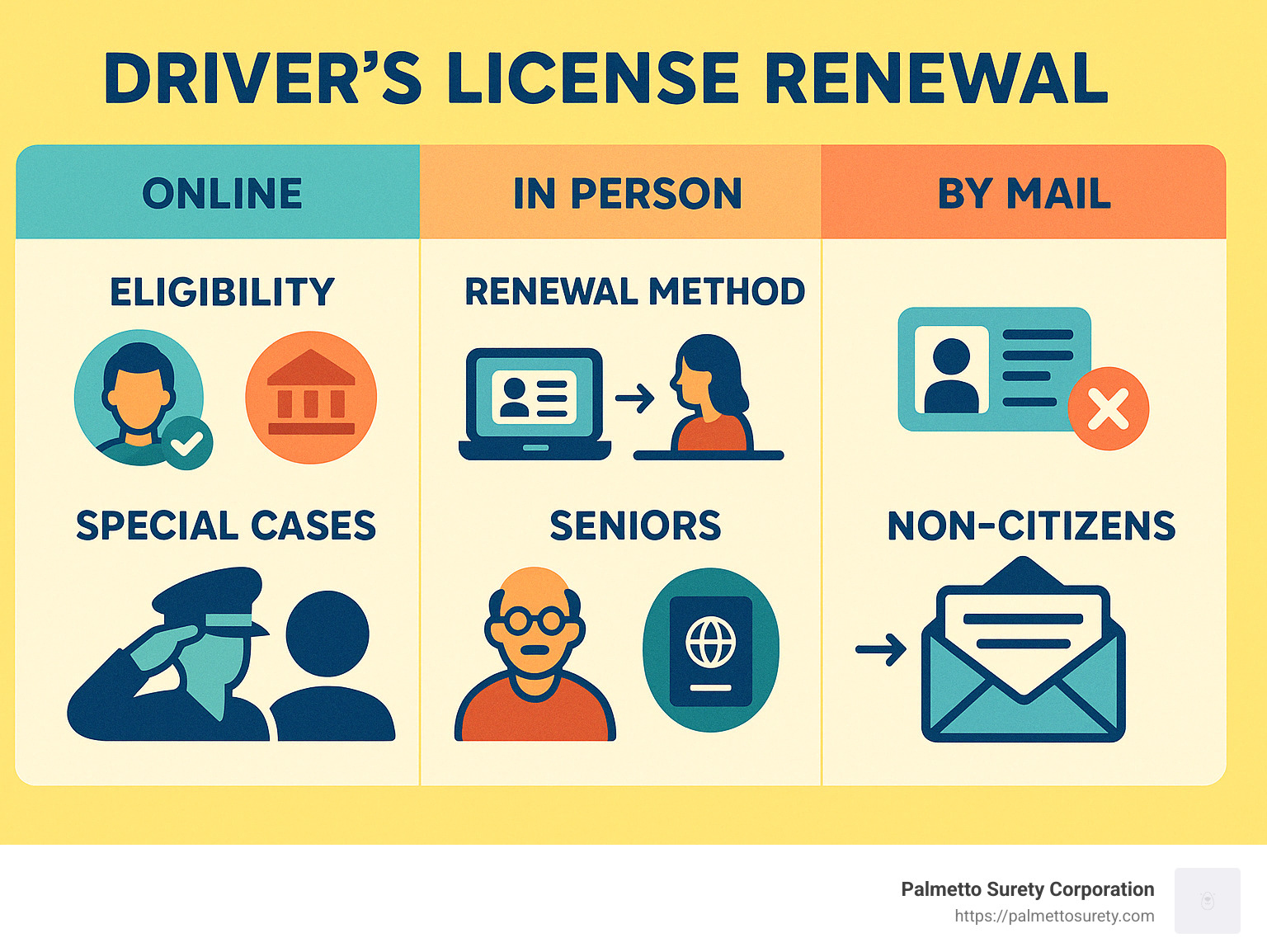
Life circumstances create exceptions to standard renewal rules. If you’re serving in the military, you’ll find most states offer generous extensions while you’re on active duty. Military personnel stationed outside their home state can typically renew by mail, and many states waive certain fees as a thank-you for your service.
Senior drivers face more frequent renewal requirements in many states. If you’re over 65 or 70 (depending on where you live), you’ll likely need to renew in person so the DMV can conduct appropriate vision and sometimes cognitive assessments. These extra precautions help ensure road safety for everyone.
Non-U.S. citizens with temporary visas or international student status need to follow special procedures that align with their immigration documentation. Your license typically can’t be valid longer than your authorized stay in the country.
The REAL ID requirements add another layer to consider during renewal. If you’re planning to upgrade to a REAL ID-compliant license (which you’ll need by May 7, 2025, for domestic air travel), you’ll need to appear in person with additional documentation regardless of your normal renewal eligibility.
Understanding these eligibility criteria before you begin the dmv renew license process can prevent wasted trips and ensure you gather all necessary documents for a smooth renewal experience.
How to DMV Renew License: Methods Explained
There are typically three main ways to dmv renew license: online, in person, or by mail. Each method has its own process, advantages, and limitations.

DMV Renew License Online
Online renewal is like finding a fast lane through the DMV—convenient, quick, and perfect for busy schedules. Here’s how to steer this digital highway:
Step 1: Check Your Eligibility
Before you fire up your computer, make sure you qualify for online renewal. Most states have similar requirements, though specifics vary. Generally, you need to have a license that isn’t expired (or is within the grace period), you’re not making any major changes to your information, and you’re due for online renewal if your state alternates between online and in-person methods.
I recently helped a client who was frustrated after attempting an online renewal only to find he needed a new photo. A quick eligibility check could have saved him the hassle!
Step 2: Locate Your State’s DMV Website
Always stick to official government websites ending in “.gov” to avoid scams. A simple search for “[Your State] DMV” usually does the trick. These official sites not only protect your personal information but also ensure you’re getting accurate renewal instructions.
Step 3: Create or Log Into Your Account
Most state DMVs now require an online account for renewals. You’ll typically need your current license number, date of birth, and the last four digits of your Social Security Number to get started. The account setup is usually straightforward, though it might feel like a lot of verification steps—trust me, this security is there for your protection.
Step 4: Complete the Renewal Application
The online form walks you through verifying your information and answering questions about your driving status. It’s usually painless and takes about 10-15 minutes. Some states might ask about medical conditions or vision changes, so answer honestly—these questions are for your safety and others on the road.
Step 5: Pay the Renewal Fee
Renewal fees vary widely by state. For example, Connecticut charges $72 for a six-year license, while California asks for $45 for non-commercial licenses. Most states accept all major credit and debit cards, though be prepared for a small processing fee for the convenience of renewing online.
Step 6: Print Your Temporary License
After completing your renewal, you’ll usually be able to print a temporary license that’s valid until your permanent one arrives in the mail—typically within 2-4 weeks. As the California DMV advises, “If you renewed your DL/ID card and have not received it after 60 days, visit Driver’s License & ID Card Status on the DMV website.” Keep that temporary license handy while driving!
For the latest information on REAL ID requirements that may affect your license renewal, visit the Transportation Security Administration’s REAL ID page.
Renewing Your License In Person at the DMV
While online renewal is convenient, sometimes an in-person visit is necessary or even preferred. The face-to-face experience ensures everything is handled correctly, especially for special situations.
When to Renew in Person
You’ll need to visit your local DMV if you’re applying for a REAL ID, changing personal information, need a new photo, or if your license has been expired for a while. Seniors typically need to renew in person too, as many states require more frequent vision testing for drivers over 70.
Step 1: Schedule an Appointment
The days of spending your entire morning waiting at the DMV are (mostly) behind us. Most offices now offer appointment scheduling online or by phone. I always recommend making an appointment—it can turn a potentially hours-long wait into a 15-minute process.
Step 2: Gather Required Documents
Before heading to the DMV, make sure you have your current license, proof of identity if required, proof of residency (usually two documents), and payment for the renewal fee. If you’re upgrading to a REAL ID, you’ll need additional documentation, which we’ll cover in detail later.
Step 3: Complete the Process at the DMV
The in-person renewal process is straightforward but more time-consuming than online renewal. You’ll check in, complete a renewal application, take a vision test, have your photo taken, and pay the renewal fee. You’ll receive a temporary license while your permanent one is being processed and mailed.

Renewing Your Driver’s License by Mail
Mail renewal is the least common option, but it’s a lifesaver for those who qualify—especially folks temporarily living out of state or those unable to visit a DMV office due to medical reasons.
Eligibility for Mail Renewal
Mail renewal is typically available if you received a renewal notice stating you’re eligible, if you’re temporarily out of state, or if you have a medical condition preventing an in-person visit. Your license also can’t be expired beyond the grace period, which varies by state.
Step-by-Step Mail Renewal Process
The mail renewal process begins with completing the renewal form that came with your notice (or downloading one from your state’s DMV website). Depending on your state, you might need to include a vision statement from an optometrist, proof of out-of-state residence, or military orders if you’re active duty.
Payment for mail renewals is typically by check or money order—never send cash through the mail. Once everything is ready, simply mail your application package to the address on your renewal notice or the state DMV website.
Virginia, for example, makes this process particularly straightforward for eligible drivers. You simply complete and sign the mailed renewal reminder and send it with your payment to the DMV. Within a few weeks, your new license arrives in your mailbox—no DMV visit required!
At Palmetto Surety Corporation, we understand the importance of keeping your licenses and credentials current. While we specialize in surety bonds rather than driver’s licenses, the principle remains the same—staying on top of renewals keeps you legally compliant and avoids unnecessary complications down the road.
Upgrading to a REAL ID During License Renewal
The REAL ID Act represents one of the most significant changes to driver’s license requirements in recent memory. Starting May 7, 2025, you’ll need a REAL ID-compliant license or another acceptable form of identification to board domestic flights or enter certain federal facilities. This deadline might seem far away, but planning ahead can save you significant hassle later.
What is a REAL ID?
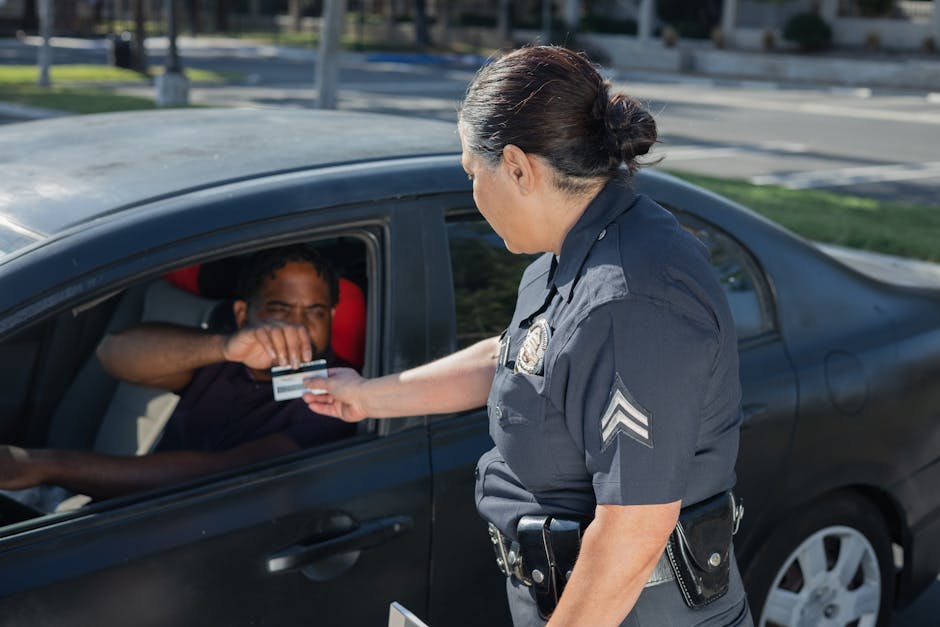
You can easily spot a REAL ID-compliant license by looking for a star in the upper right corner. This little star carries big significance – it shows that your license meets federal security standards and that the state has thoroughly verified your identity, legal status, Social Security number, and where you live. Think of it as your license getting a security upgrade.
When I explain this to clients at Palmetto Surety Corporation, I often describe REAL ID as your “airport access card” – because that’s what it’s primarily designed for. Without it (or a passport), airport security will eventually turn you away from domestic flights.
Documents Needed for REAL ID
Preparing for your REAL ID upgrade requires a bit more documentation than a standard dmv renew license process. The verification process is intentionally thorough, so gather these items before your appointment:
Your identity needs verification through either a birth certificate or passport. For your Social Security number, bring your Social Security card, a W-2 form, or even a recent pay stub with your full SSN displayed. To prove where you live, you’ll need two separate documents like utility bills, bank statements, or mortgage paperwork with your name and address. And if you’ve changed your name through marriage, divorce, or court order, bring documentation showing your name change history.
“Beginning May 7, 2025, REAL ID will be required for domestic flights,” the Virginia DMV reminds residents, highlighting why this upgrade matters for anyone who travels by air.
Process for Upgrading During Renewal
Unlike standard license renewals, REAL ID upgrades require face-to-face verification. The good news? You can combine this with your regular dmv renew license appointment if you plan ahead. Here’s how the process typically works:
First, schedule an in-person appointment at your local DMV. This step is non-negotiable – REAL ID verification cannot happen online or through the mail. When appointment day arrives, bring all your original documents (leave the photocopies at home). You’ll complete the application process, which includes taking a fresh photo – so dress accordingly! Finally, be prepared to pay the fee, which often includes both your standard renewal cost plus a REAL ID upgrade charge that varies by state.
The entire process typically takes 15-30 minutes once you’re at the counter, though wait times vary widely depending on your location and appointment availability.
Benefits of Upgrading Now
While May 2025 might seem distant, there are compelling reasons to handle your REAL ID upgrade during your current dmv renew license cycle rather than waiting:
Beat the rush! As the deadline approaches, DMV offices nationwide will face overwhelming demand. Upgrading early means shorter wait times and less stress. You’ll also gain immediate compliance for air travel and federal facility access – no need to remember to bring a passport for domestic flights. Perhaps most practically, combining your renewal and REAL ID upgrade into one DMV visit potentially saves you hours of waiting in line later.
I’ve seen through our work at Palmetto Surety how procrastination on licensing requirements can create unnecessary complications. When it comes to REAL ID compliance, a little planning now prevents significant headaches later.
If you decide not to get a REAL ID, your standard license will still be valid for driving – you’ll just need alternative identification like a passport for flying and entering federal buildings after the deadline.
Special Circumstances in License Renewal
Life doesn’t always follow a straight path, and neither does the license renewal process. Whether your license has expired, you’re serving in the military, or you’ve reached your golden years, special situations require special handling. Let’s look at how to steer these unique circumstances.
Renewing an Expired or Suspended License
We’ve all been there – life gets busy, and suddenly you realize your license expired last month. Don’t panic, but do act quickly.
Expired Licenses
The clock starts ticking the moment your license expires, and the consequences get more serious with time:
Recently expired licenses (typically under 60 days) usually just need normal renewal plus a late fee. Consider this your grace period – the DMV understands that people sometimes miss deadlines.
Moderately expired licenses (60 days to 1 year) often come with higher fees and additional requirements. You might need to provide extra documentation or complete additional forms.
Long-expired licenses (over 1 year) can be much more troublesome. In Virginia, for example, if your license has been expired for more than a year, you’ll need to start almost from scratch – vision screening, knowledge exam, and yes, even the road skills test. It’s like being 16 again, minus the acne.
New Jersey is even stricter: “If your license is expired more than three (3) years, you will have to start over as a first-time driver,” according to their DMV. That’s a sobering thought!
Suspended Licenses
A suspended license is different from an expired one – you can’t simply dmv renew license in this situation. Instead, you need to:
- Address whatever caused the suspension first (unpaid tickets, DUI requirements, etc.)
- Pay all reinstatement fees (which can be substantial)
- Provide proof of insurance (often an SR-22 form)
- Only then can you proceed with normal renewal
In my work at Palmetto Surety Corporation, I’ve helped many clients who needed surety bonds as part of their license reinstatement, especially those with business-related suspensions. The process can be complex, but having the right guidance makes all the difference.
Lost or Stolen Licenses
If your wallet goes missing just before your license expires, you have two choices:
Get a replacement license with the same expiration date (cheaper but temporary)
Renew early and start a fresh license term (more expensive but avoids a second DMV visit)
If your renewal date is more than six months away, a replacement makes sense. Otherwise, early renewal is usually more convenient.
License Renewal for Military Personnel
Our service members face unique challenges when it comes to license renewal, which is why most states offer special accommodations.
Military Extensions
If you’re serving our country, your license won’t expire while you’re on active duty. Most states provide automatic extensions that last until 30-90 days after your discharge. Some states are particularly generous – Virginia, for instance, offers extensions up to six years for military personnel stationed outside the U.S.
To claim these extensions, you’ll need to provide documentation of your military status. This flexibility recognizes the practical challenges of maintaining stateside administrative details while serving elsewhere.
Fee Waivers
Many states also say “thank you for your service” by waiving renewal fees for active-duty military members. The policies vary:
Some states only waive fees for those deployed to combat zones, while others extend this benefit to all active-duty personnel. Either way, you’ll need to provide documentation like your military ID or deployment orders.
Out-of-State Renewal Options
Being stationed across the country or overseas doesn’t mean you have to fly home just to dmv renew license. Military members have several options:
Mail renewal is available to military personnel in most states, regardless of the normal eligibility rules.
Online renewal options exist in many states specifically for service members.
On-base services are available at some larger installations, bringing DMV services directly to where you are.

License Renewal for Senior Drivers
With age comes wisdom, but also additional requirements when it comes to license renewal. These extra steps help ensure everyone’s safety on the road.
Age-Based Requirements
As we get older, states implement additional safeguards in the renewal process:
More frequent renewals become the norm. While younger drivers might renew every 8 years, seniors often need to renew every 2-4 years. For example, Florida licenses are valid for eight years for adults 18-65, but only five years for those 66 and older.
In-person visits are typically required. The convenience of online renewal is often not available to senior drivers.
Vision tests become mandatory at each renewal, ensuring that drivers can clearly see road signs and potential hazards.
Medical evaluations may be required in some states, with doctors certifying fitness to drive.
Knowledge tests might be periodically required to ensure drivers stay current with changing traffic laws.
Vision Requirements
Good vision is essential for safe driving, and the standards are strictly enforced for senior drivers:
Most states require 20/40 vision with or without correction. If your vision falls below this standard, you might still qualify for a restricted license limiting when and where you can drive – for example, daytime driving only or within a certain radius of your home.
These vision tests almost always must be done in person, which is why online renewal isn’t typically available for seniors.
Renewal Process for Seniors
If you’re a senior driver (usually defined as 65+ or 70+, depending on your state), here’s what to expect:
Schedule an appointment at your local DMV office and bring your current license, proof of identity, and any required medical forms. Be prepared for a vision test and possibly a knowledge test. Then pay your renewal fee – though there’s good news here, as some states offer discounted fees for seniors. Connecticut, for instance, offers a two-year renewal option for drivers 65 and older at just $24, compared to $72 for a standard six-year license.
While these additional requirements might seem burdensome, they’re designed with safety in mind – helping to ensure that all drivers, regardless of age, can safely steer our roadways.
Frequently Asked Questions about DMV License Renewal
Can I renew my driver’s license online if it’s expired?
That dreaded moment when you realize your license has expired happens to the best of us. The good news? You might still be able to handle it from your couch.
Most states offer a grace period for online renewal after expiration – typically around 60 days. After that, you’ll likely need to make that trip to the DMV office. The rules vary quite a bit depending on where you live:
In California, you can still renew online shortly after expiration, saving yourself a trip to the DMV. New York is surprisingly lenient, allowing renewal up to 2 years after expiration (though don’t get too comfortable – driving with that expired license is still illegal and can get you in trouble).
Florida takes an interesting approach with no late fees for renewing an expired license, but if you’re caught driving with it expired, expect a citation that will cost you far more than renewing on time would have.
Here’s where it gets serious: if your license has been gathering dust for too long (usually 1-3 years), many states will treat you almost like a new driver. You might need to retake written tests, vision tests, or even road tests. In extreme cases, you could be starting from square one in the licensing process.
The bottom line: Don’t wait. The longer your license is expired, the more complicated and expensive renewal becomes.
What documents do I need to renew my driver’s license?
Preparing for your dmv renew license appointment? Having the right documents ready can make all the difference between a quick visit and a frustrating waste of time.
For standard renewals, the requirements are usually straightforward. You’ll need your current driver’s license (even if expired), a completed renewal application form, and payment for the renewal fee. Many states accept credit cards, but it’s always smart to check payment options beforehand.
In-person renewals often require more documentation. Be prepared to show proof of identity (like your birth certificate or passport), verification of your Social Security Number, and evidence that you actually live where you claim (utility bills and bank statements work well here). Most DMV offices can perform your vision test on-site, so no need to make a separate doctor’s appointment unless you have specific vision concerns.
If you’re upgrading to a REAL ID during your renewal, the documentation requirements are more extensive. You’ll need to bring everything mentioned in the REAL ID section above – proof of identity, Social Security Number, two proofs of residency, and name change documentation if applicable.
As the New York DMV helpfully points out: “Please note: You may have different mailing and residential addresses.” This is an important reminder to make sure all your address information is current before renewal, especially if you’ve moved recently.
How long does it take to receive my renewed license?
Patience is a virtue when waiting for your new license to arrive, but knowing the typical timeline can ease your mind.
When you renew in person, most states provide a temporary paper license on the spot. These temporary licenses are usually valid for 30-60 days, giving the DMV time to process your permanent card. This temporary license is a legal driving document, so you can hit the road without worry while waiting for the real thing.
For those who renew online or by mail, the waiting game is a bit longer since you won’t get that temporary card. Most states process and mail permanent licenses within 2-4 weeks after your application is approved. During busy seasons (like summer) or holiday periods, delays can occur.
Some states have experienced longer wait times due to production issues with their contractors. North Carolina, for example, has had periods where license production was significantly delayed due to vendor problems.
The California DMV sets realistic expectations, noting that “renewed driver’s license/ID cards are typically received in two to four weeks by mail.” This timeline is fairly consistent across most states.
If the waiting period has stretched beyond what’s normal (typically 60 days), it’s time to be proactive. Most state DMVs now offer online status checking tools where you can verify that your license is being processed. If the online system doesn’t provide answers, a phone call to your local DMV office is your next best step.
At Palmetto Surety Corporation, we understand the importance of having proper documentation, especially when it comes to licensing requirements that affect your business operations. While we specialize in surety bonds rather than driver’s licenses, we know that timely processing of all government documentation is essential to keeping your life and business running smoothly.
Conclusion
Navigating your dmv renew license journey doesn’t have to feel like a trip through a bureaucratic maze. With a little preparation and the right information, you can handle this necessary task with minimal stress and maximum efficiency.
Think of license renewal as regular maintenance for your driving privileges – just like changing your car’s oil keeps it running smoothly, keeping your license current ensures you can legally hit the road whenever you need to.

As you plan your renewal, remember these friendly tips:
Check your eligibility early to determine if you can renew online, by mail, or need to visit in person. Not everyone qualifies for the convenient options, so knowing your status saves time and frustration. If you’re over 70, have vision changes, or need a REAL ID upgrade, an in-person visit is likely in your future.
Don’t wait until the last minute to dmv renew license. Most states offer a generous window before expiration – take advantage of it! Renewing early helps you avoid those uncomfortable moments of realizing your license expired last week while you’re being pulled over for a minor traffic violation. Trust me, that’s a conversation no one wants to have.
Consider upgrading to REAL ID during your renewal if you haven’t already. The May 7, 2025 deadline might seem distant, but we all know how quickly time passes. Save yourself a separate trip to the DMV by combining your renewal with this important upgrade, especially if you travel by air or visit federal facilities.
If you’re in a special circumstance – perhaps you’re military personnel stationed out of state, a senior driver, or dealing with an expired license – give yourself extra time to understand the specific requirements. These situations have their own rules and often require additional documentation or steps.
At Palmetto Surety Corporation, we understand the importance of proper documentation and compliance. While our primary focus is providing surety bonds for industries ranging from construction to healthcare, we recognize that valid driver’s licenses are essential for many of our clients’ business operations.
For those of you in specialized industries requiring both licensing and bonding, we’re here to help with the bonding portion of your compliance needs. Our team brings over 20 years of experience in the commercial surety business, and we pride ourselves on approving most bond applications within hours – getting you back to business quickly.
Staying current with your license renewal isn’t just about avoiding tickets or fines – it’s about maintaining your independence and mobility. In today’s world, few of us can afford to be without driving privileges, even temporarily.
For more information about surety bonds and DMV licensing requirements that might affect your business, visit Palmetto Surety Corporation. We’re here to help you steer the road ahead, whatever your journey entails.


