


North Carolina mechanical license: Top Guide in 2024
Understanding the North Carolina Mechanical License
A North Carolina mechanical license is essential for a successful career in skilled trades such as HVAC, plumbing, and electrical work within the state. Whether you’re starting your own business or advancing your career in these industries, understanding the license requirements is crucial. Here’s a quick overview to help you get started:
- License Types: There are various classifications, like Limited, Intermediate, and Unlimited.
- Examinations: You’ll need to pass both a Business and Law Exam and a trade-specific exam.
- Training Hours: You’ll need significant on-the-job experience, which varies by trade.
For anyone interested in pursuing work in North Carolina’s thriving mechanical industries, knowing the ins and outs of the licensing process is essential. Not only does it ensure compliance, but it also guarantees the standard of expertise expected by clients and companies alike. This article will walk you through what you need to know to obtain your North Carolina mechanical license—from the requirements and application process to renewal procedures and continuing education mandates.
I’m Haiko de Poel Jr., an experienced professional in marketing and strategic growth, currently aiding companies in digital change. By leveraging my comprehensive understanding of processes like obtaining a North Carolina mechanical license, I aim to empower individuals and businesses to meet regulatory requirements efficiently.
Requirements for Obtaining a North Carolina Mechanical License
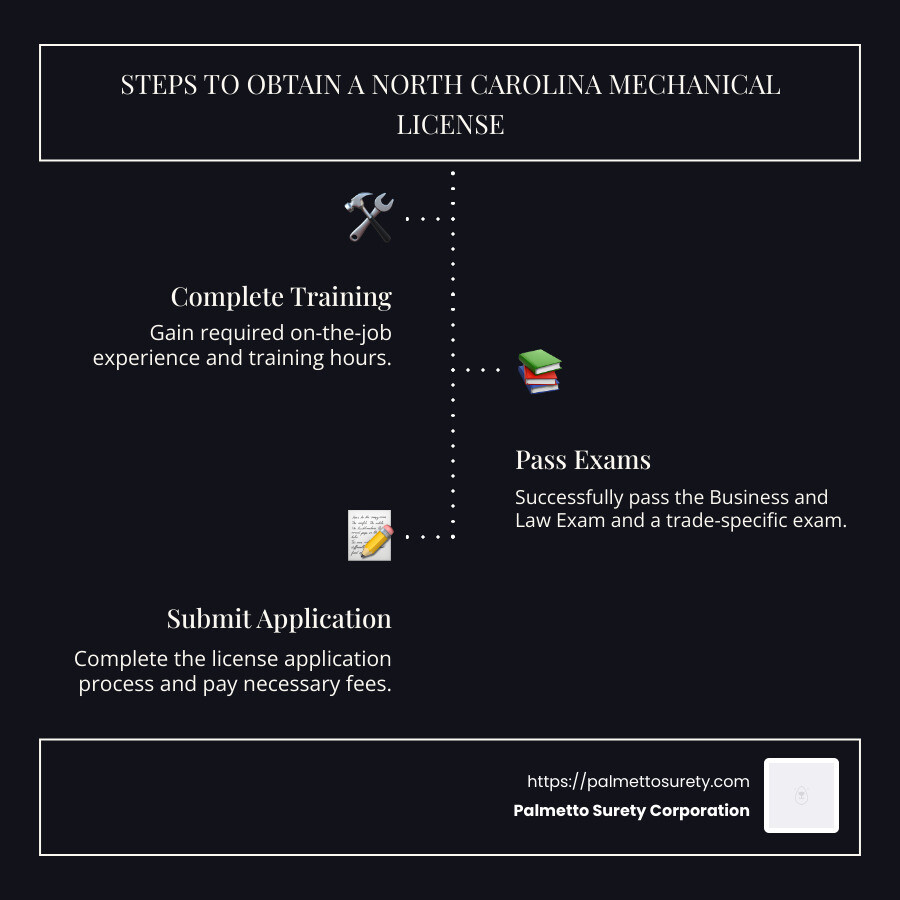
To get a North Carolina mechanical license, you need the right mix of on-site training, exams, and application steps. Let’s break it down.
On-Site Training Requirements
Before you can sit for any exams, you need hands-on experience. This experience ensures you’re ready for the real-world challenges you’ll face in the field.
-
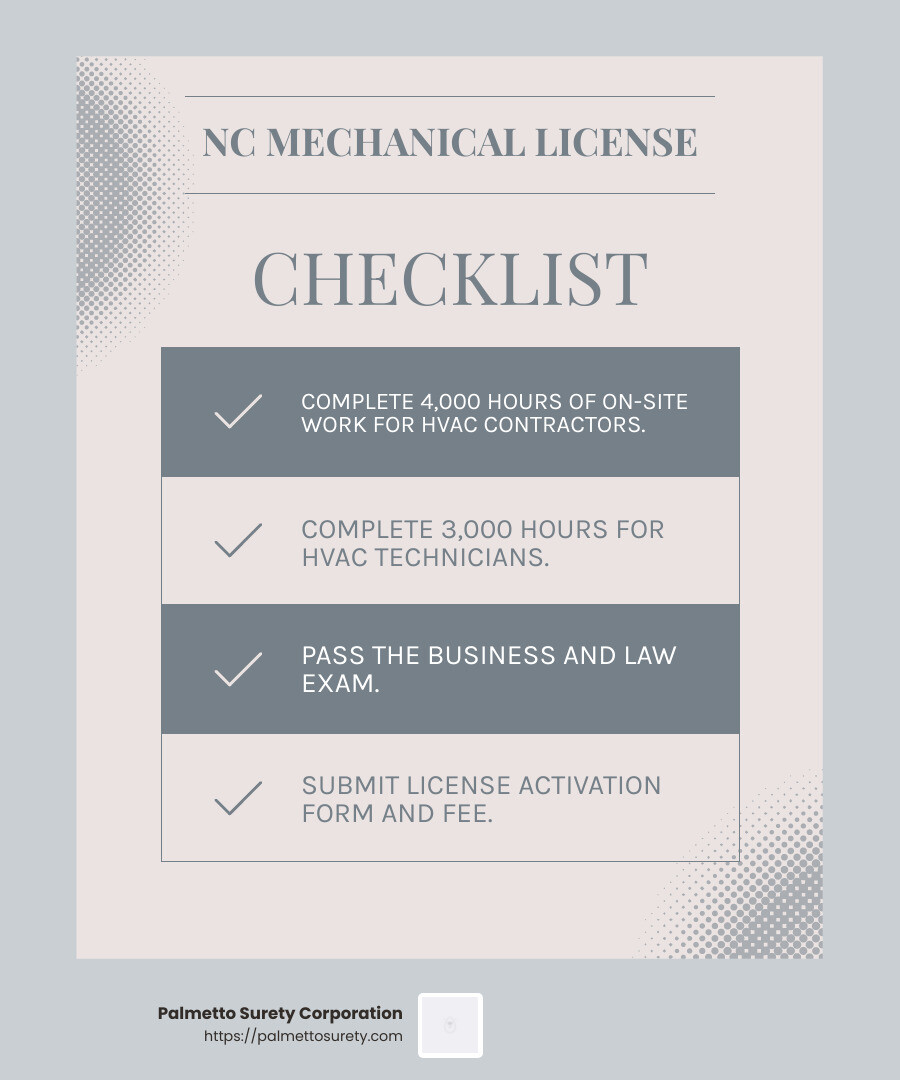
HVAC Contractors: You must complete 4,000 hours of on-site full-time work. This includes installation, maintenance, service, or repair of HVAC systems. The good news? Up to half of these hours can come from academic or technical training.
-
HVAC Technicians: The requirement is slightly less, at 3,000 hours of on-site experience. Again, half of this can be substituted with related training.
For both roles, this experience must be gained under the supervision of a licensed contractor. It’s not just about putting in the hours; it’s about gaining valuable skills and insights.

Examination Requirements
Once you’ve met the training requirements, it’s time to tackle the exams. These are crucial to proving your knowledge and competence.
-
Business and Law Exam: This is a must for all applicants. It covers essential business practices and legal regulations you need to know.
-
Trade-Specific Exams: Depending on your focus, you’ll need to pass a relevant trade exam. For example, HVAC professionals might take the Heating Group 3 Exam. These exams test your technical knowledge and problem-solving skills.
-
Application Process: After passing your exams, the next step is submitting your application. You’ll need to fill out the Licensing Activation form and pay the associated fee. This step finalizes your entry into the licensed world of North Carolina’s mechanical trades.
By meeting these requirements, you’re setting yourself up for a successful career in North Carolina’s mechanical industries. Whether you’re aiming to be a contractor or a technician, the right preparation and dedication can make it happen.
Types of Mechanical Licenses in North Carolina
In North Carolina, mechanical licenses are categorized into three main types: Limited, Intermediate, and Unlimited. Each license type has specific scopes and limitations, primarily concerning project value limits and, in some cases, voltage limits.
Limited License
The Limited License is ideal for those starting in the field or working on smaller projects. This license permits you to engage in electrical contracting projects with a value not exceeding $60,000. Additionally, the equipment or installation must not be rated over 600 volts. This restriction makes it suitable for smaller residential or light commercial projects.
Intermediate License
For those looking to take on larger projects, the Intermediate License offers more flexibility. It increases the project value limit to $150,000, allowing licensees to handle more substantial and complex projects. However, it still imposes restrictions compared to the Unlimited License, making it a middle ground for growing contractors.
Unlimited License
The Unlimited License provides the most extensive scope for contractors. With no project value limit, this license allows you to work on any size project, regardless of its value. This includes large-scale commercial and industrial projects. Holding an Unlimited License signifies a high level of expertise and experience, opening up a wide range of opportunities in the mechanical contracting field.
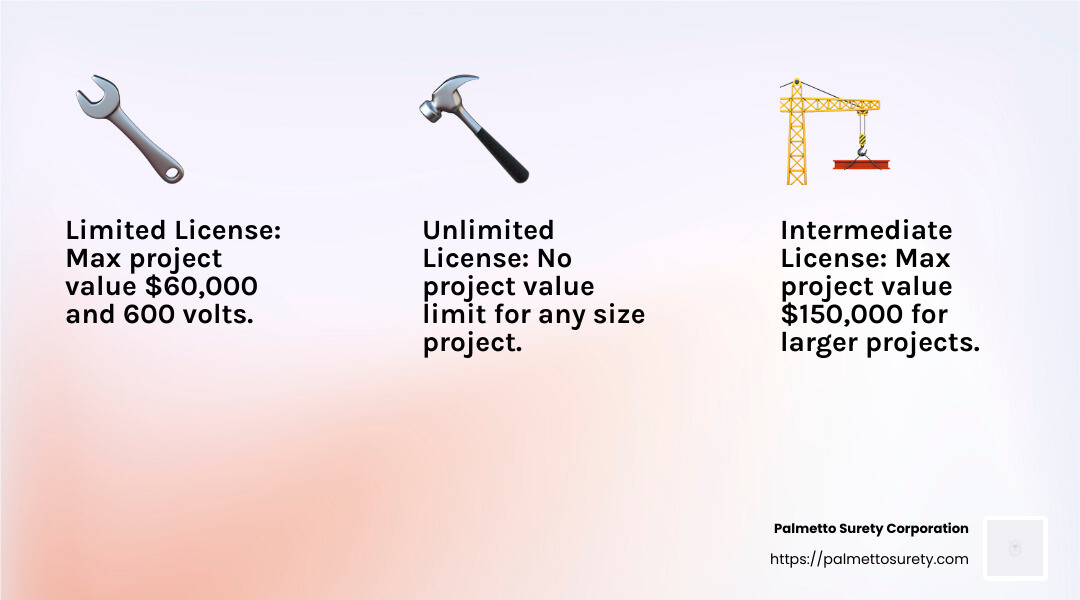
These classifications ensure that contractors work within their capabilities and experience levels, maintaining safety and quality standards across projects. Choosing the right license depends on your current skills, experience, and the types of projects you aim to undertake.
Application and Renewal Process
Navigating the North Carolina mechanical license application and renewal process can seem daunting, but breaking it down into simple steps makes it manageable. Here’s what you need to know:
Application Steps
-
Examination: Before applying, you must pass the required examinations. This includes both the Business and Law Exam and trade-specific exams, such as the Heating Group 3 Exam. Once your application is approved, you’ll receive notification of exam eligibility and can schedule your exam with PSI Exams Online.
-
License Application: After passing the exams, complete the New License Application. Make sure to include all necessary details, such as the “Qualified Individual Information,” which requires your name, signature, date of birth, and SSN.
-
Fee Submission: Submit your application along with the applicable license fee. The fees vary depending on the license type: $100 for a Limited License, $150 for an Intermediate License, and $200 for an Unlimited License. Ensure all payments are made by check or money order to the “State Board of Examiners.”
-
Background Check: Obtain a nationwide criminal record report from CastleBranch.com and attach a paper copy to your application. A past offense may not necessarily disqualify you, as the Board considers various factors.
-
License Activation: Once you pass the exams and submit the necessary documents, you will need to complete and submit the Licensing Activation form to officially receive your license.
Renewal Process
-
Expiration Date: All licenses expire one year from the date of issuance. It’s crucial to keep track of your expiration date to avoid lapses in your licensing.
-
Renewal Notices: Approximately 60 days before your license expires, you’ll receive a renewal notice. If you have provided an email address, the notice will be sent via email; otherwise, a paper form will be mailed to you.
-
Administrative Fees: Renewals submitted after the expiration date incur an additional $25 administrative fee. To avoid this, ensure you renew your license promptly.
-
Renewal Submission: Complete the renewal form and submit it along with the renewal fee. Keeping your contact information updated with the Board ensures you receive all notices and updates.
These steps ensure a smooth process for obtaining and maintaining your North Carolina mechanical license, allowing you to focus on your professional growth and project opportunities.
Continuing Education Requirements
Continuing education is a vital component for maintaining professional licenses in North Carolina. It ensures that license holders stay updated with the latest industry practices, codes, and technologies. Here’s what you need to know about the continuing education requirements for electrical and general contractor licenses in North Carolina.
Electrical License Continuing Education
For those holding an electrical license, continuing education is mandatory before each renewal. The state requires a specific number of hours to be completed annually, ensuring that electricians remain knowledgeable about current standards and practices.
-
Required Hours: Electricians must complete a set number of continuing education hours each year. While the exact number can vary, it is important to check the latest requirements from the state board.
-
Online and Classroom Options: To accommodate different learning preferences and schedules, half of the required hours can be completed online. The remaining hours must be attended in a traditional classroom setting. This blend of online and in-person learning provides flexibility while ensuring comprehensive education.
General Contractor Continuing Education
General contractors in North Carolina are also required to complete continuing education annually. This helps them stay informed about changes in construction codes, safety regulations, and industry trends.
-
Annual Hours: General contractors need to complete 8 hours of continuing education each year. These hours are crucial for staying compliant and competitive in the construction industry.
-
Course Content: The courses cover a range of topics relevant to general contracting, including updates on building codes, safety practices, and new construction technologies. This ensures that contractors are well-equipped to handle both residential and commercial projects effectively.
Continuing education not only fulfills regulatory requirements but also improves professional skills and knowledge. By staying current, license holders can deliver high-quality services and maintain a competitive edge in their respective fields.
Frequently Asked Questions about North Carolina Mechanical License
How do I get my mechanical license in NC?
To obtain a North Carolina mechanical license, you need to follow a structured process that includes gaining experience, completing training hours, and passing exams. Here’s a quick guide:
-
Experience and Training: Accumulate the necessary work experience. For HVAC technicians, this means 3,000 hours, while HVAC contractors require 4,000 hours of on-site training. This experience can be gained through apprenticeships or entry-level positions.
-
Examinations: You will need to pass both the Business and Law Exam and trade-specific exams. For those focusing on HVAC, the Heating Group 3 Exam is essential.
-
Application Process: After completing the required training and exams, submit your application along with the necessary fees to the appropriate state board. Ensure all documentation is accurate and complete to avoid delays.
Is it hard to get HVAC license in NC?
Obtaining an HVAC license in North Carolina can be challenging due to the stringent requirements, but with dedication, it’s achievable.
-
Timeframe: Expect to spend several years gaining the required experience and completing training. An apprenticeship typically lasts four to five years.
-
Training and Exams: The training involves both hands-on and classroom learning. Exams are rigorous and cover a wide range of topics, including technical skills and business knowledge.
While the process requires commitment, the career benefits, including job security and opportunities for advancement, make it worthwhile.
Does North Carolina have reciprocity for HVAC licenses?
North Carolina does not have reciprocity agreements for HVAC licenses with other states. This means that if you hold an HVAC license from another state, you will still need to meet North Carolina’s specific requirements and pass their examinations to work legally in the state.
However, there is an exception for certain licensed South Carolina contractors. If you hold a Heating Group 1 Class II or Heating Group 3 Class II license from South Carolina and are in good standing, you may qualify for a technical exam waiver. You will still need to pass the North Carolina Business and Law exam.
Understanding these requirements ensures that you are fully prepared to meet North Carolina’s standards and operate legally within the state.
Conclusion
Navigating the process of obtaining a North Carolina mechanical license can be a complex journey, but it’s a necessary step for anyone aiming to legally perform mechanical work in the state. Whether you’re looking to work as an HVAC technician or contractor, understanding the licensing requirements is crucial.
At Palmetto Surety Corporation, we specialize in offering surety bonds that can support your business operations, including those in the construction and mechanical sectors. Our extensive experience of over 20 years in the industry allows us to provide quick and efficient service, often approving applications within hours. This speed and reliability can be particularly beneficial when you’re in the process of securing your mechanical license and need bonding solutions.
Based in Charleston, SC, we pride ourselves on delivering exceptional customer service across the southeastern United States. Our commitment to ethical business practices and our vast network of agents ensure that we can meet your surety bond needs effectively.
Whether you’re just starting your journey or need ongoing support, consider us as your partner in achieving your business goals. For more information on how we can assist you, visit our Palmetto Surety Corporation service page.
By choosing Palmetto Surety Corporation, you’re not just getting a bond provider; you’re gaining a reliable ally dedicated to helping you succeed in the North Carolina mechanical industry.


