


Florida Statute of Limitations on Performance Bond: Top 3 Facts
The Florida statute of limitations on performance bond is central to understanding your legal rights and obligations if you’re involved in construction or any operation requiring these bonds. This crucial period determines how long you have to make a claim if something goes wrong with a project.
Quick Answer:
– Statute of Limitations Duration: Five years
– Starts: When the bond-principal defaults or breaches terms
In construction, performance bonds play a pivotal role. Essentially, these are agreements that help ensure a contractor completes their work according to the agreed contract terms. Failing to meet these standards can have significant legal implications for all parties involved, especially when statutes of limitations come into play. In Florida, the period to file a claim related to these issues is five years, starting when the default occurs or the terms are breached.
Such rules make understanding and complying with the statute of limitations essential. Knowing when your clock starts ticking can mean the difference between a successful claim and a missed opportunity.
With over two decades of experience in marketing and digital change, I, Haiko de Poel Jr., have extensively worked on rebranding and strategic positioning for companies like Palmetto Surety Corporation. This article will offer insight into the Florida statute of limitations on performance bonds, drawn from both detailed research and industry experience.
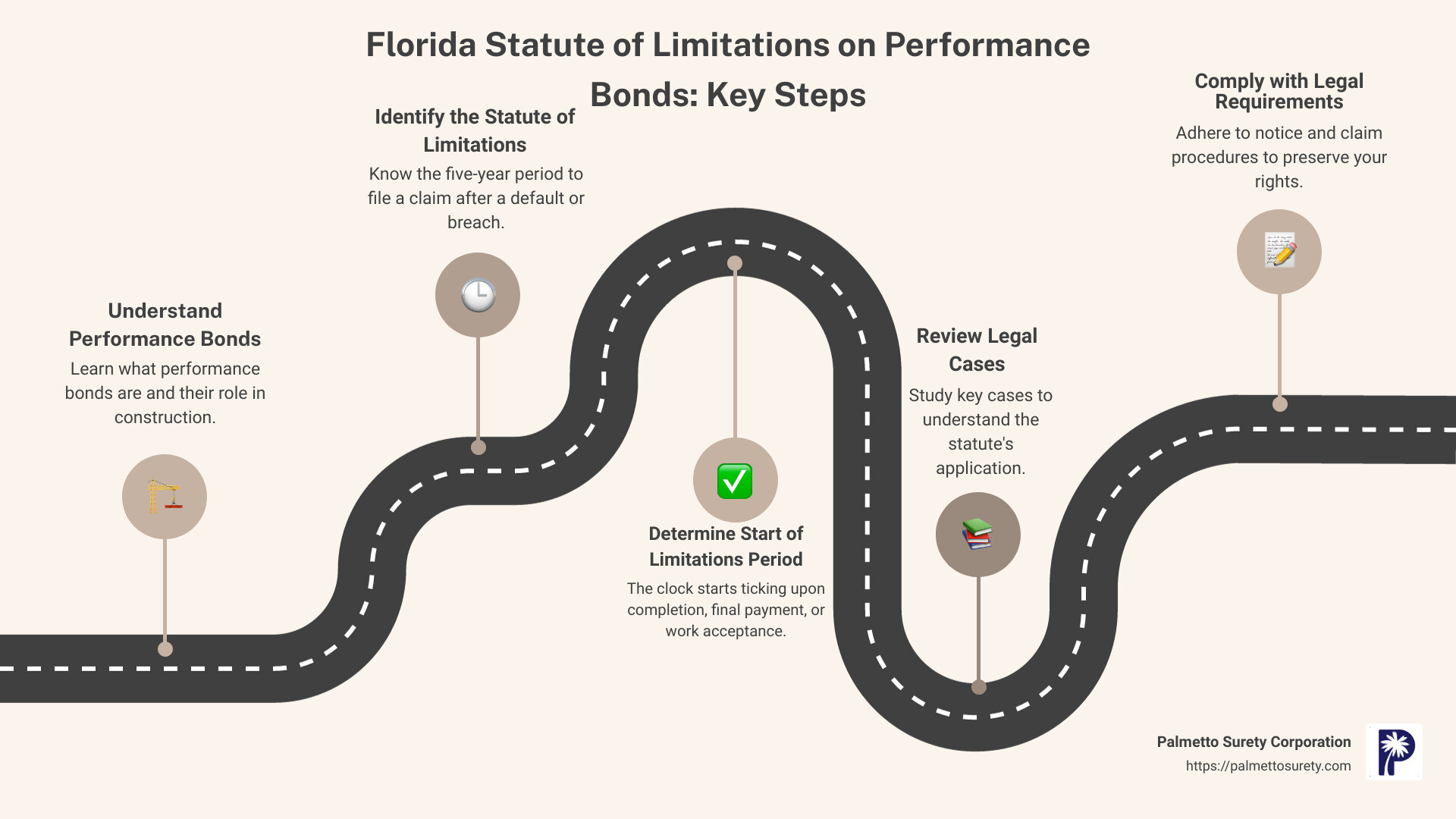
Transitioning into a deeper dive, we will explore the nuances and specifics of performance bonds, their definitions, purposes, and implications within the construction industry.
Florida statute of limitations on performance bond glossary:
– florida statute performance bonds
– performance bond florida
– performance bonds florida
Understanding Performance Bonds
What is a Performance Bond?
A performance bond is a type of surety bond issued by an insurance company or a bank to guarantee the completion of a project by a contractor. It acts as a financial safety net for the project owner (the obligee) if the contractor (the principal) fails to fulfill the terms of the contract.

Purpose of Performance Bonds
Performance bonds are vital in the construction industry. They assure the project owner that the contractor will complete the project according to the agreed specifications and timelines. If the contractor defaults, the surety (the insurance company or bank) steps in to cover the losses or ensures the project is completed by another contractor.
Key Players in Performance Bonds
- Principal: The contractor who takes on the construction project and is responsible for fulfilling the contract terms.
- Obligee: The project owner or entity requiring the bond, often a government agency or private developer.
- Surety: The insurance company or bank that issues the bond and guarantees the contractor’s performance.
How Performance Bonds Work
When a contractor is awarded a project, they may be required to obtain a performance bond. This bond is a legal agreement involving three parties:
- The Principal: Agrees to complete the project as per the contract.
- The Obligee: Receives assurance that the project will be completed.
- The Surety: Guarantees the contractor’s performance and steps in if the contractor defaults.
Importance in the Construction Industry
Performance bonds are critical in the construction industry for several reasons:
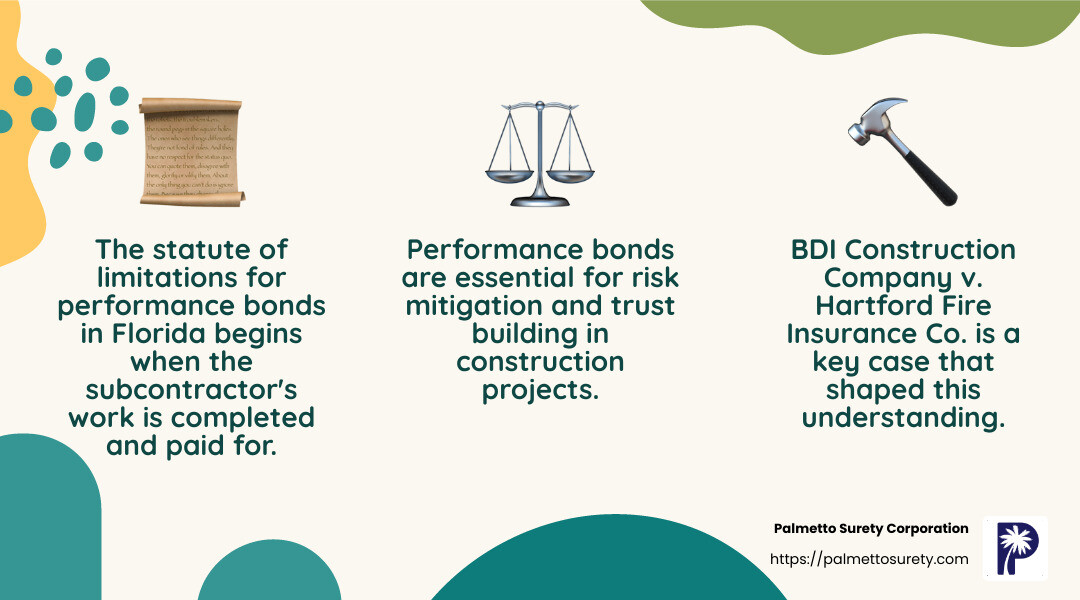
- Risk Mitigation: They provide financial protection to project owners against contractor default.
- Compliance: Many government and large-scale private projects require performance bonds as part of the bidding process.
- Trust Building: They improve trust between project owners and contractors by ensuring financial backing for project completion.
Real-World Example: BDI Construction Case
In the case of BDI Construction Company v. Hartford Fire Insurance Co. (995 So. 2d 576), the court ruled that the statute of limitations for claims under a performance bond starts when the subcontractor’s work is completed and paid for. This emphasizes the importance of understanding when the clock starts ticking for filing a claim.
Conclusion
Understanding performance bonds and their role in the construction industry is crucial for contractors, project owners, and surety companies. These bonds not only provide financial security but also ensure that projects are completed as agreed. In the next section, we will dig into the specifics of the Florida statute of limitations on performance bonds, including when the statute of limitations begins and key legal cases that have shaped this area of law.
Florida Statute of Limitations on Performance Bonds
When Does the Statute of Limitations Begin?
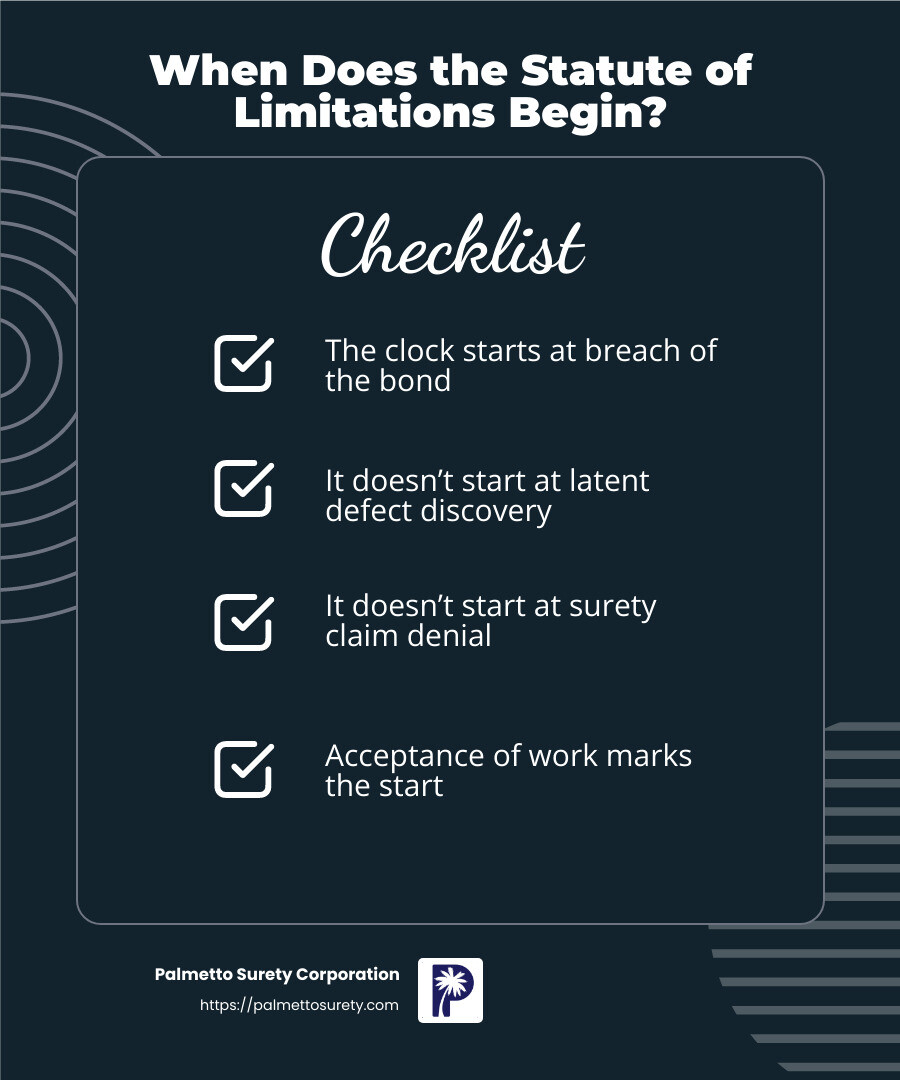
In Florida, the statute of limitations for claims against performance bonds is five years. But when does this clock start ticking? The countdown begins at the moment of the breach of the bond, which is when the bond-principal (the contractor) defaults. This is based on the same statute of limitations that governs written contracts and obligations.
Key Points to Remember:
- The statute of limitations does not start when a latent defect is finded.
- It does not commence when the surety denies the claim.
- The clock starts ticking when the obligee (the project owner) accepts the work, marking the completion of the project.
In the case of BDI Construction Company v. Hartford Fire Insurance Co., the court clarified that the statute of limitations begins when the subcontractor’s work is completed and paid for. This interpretation is essential for contractors and project owners to avoid missing the deadline for filing a claim.
Key Legal Cases
Several key legal cases have shaped the understanding of the statute of limitations on performance bonds in Florida:
Federal Insurance Co. v. Southwest Florida Retirement Center, Inc.
In this 1998 case, the Florida Supreme Court ruled that the five-year statute of limitations for performance bonds begins upon the default of the bond-principal. This case highlighted that the statute starts when the obligee accepts the work, not when defects are finded later.
Lexicon Ins. Co. v. City of Cape Coral, Florida
In 2017, the Second District Court of Appeal reinforced this principle. Here, a developer stopped construction in 2007, and the City of Cape Coral filed a claim against the surety bonds in 2012. The court ruled that the five-year statute of limitations had expired because the clock started when the developer ceased work in 2007. The court’s decision emphasized that the statute of limitations is tied to the contractor’s default, not the surety’s denial of the claim.
BDI Construction Company v. Hartford Fire Insurance Co.
In this 2008 case, the Third District Court of Appeal clarified that for subcontractors, the statute of limitations starts when the subcontractor’s work is completed and paid for. BDI Construction argued that the clock should start when the entire project was completed and accepted by the owner. However, the court disagreed, stating that the statute of limitations for subcontractors begins when their specific work is done and paid for.
These cases illustrate the importance of understanding when the statute of limitations begins for performance bonds in Florida. Knowing the exact start date can prevent losing the right to file a claim due to expired legal time limits.
In the next section, we will explore the legal requirements and obligations associated with performance bonds, ensuring you are well-prepared to steer this complex field.
Legal Requirements and Obligations
Notice and Claim Procedures
When dealing with performance bonds in Florida, there are specific procedures and timelines that claimants must follow to protect their rights.
Notice to Contractor: If you are a claimant not in direct contract (not in privity) with the contractor, you must provide a notice of your intent to look to the bond for protection. This notice must be given before starting work or within 90 days after beginning to supply labor or materials.
Notice of Nonpayment: If you haven’t been paid, you must deliver a written notice of nonpayment to both the contractor and the surety. This notice can be sent anytime during the work but no sooner than 45 days after you start providing labor or materials and no later than 90 days after your final contribution to the project.
Written Statement of Account: Ensure that all notices are detailed and accurate. Missteps in this paperwork can jeopardize your claim.
Actions and Deadlines
365-Day Rule: Claimants, regardless of their relationship with the contractor, must file an action against the contractor or the surety within 365 days after completing their work or delivering their materials. This is a crucial deadline—missing it can bar you from recovering any money.
Final Acceptance: For claims involving retainage, the 365-day countdown starts after the final acceptance of the contract work by the Department of Transportation (DOT).
Attorney Fees: If you win a claim against a performance bond, you are entitled to recover reasonable attorney fees for both trial and appeal. This incentivizes timely and accurate claims and ensures that claimants can seek justice without bearing exorbitant legal costs.
Surety Bond Requirements
Contract Price: The surety bond must cover the total awarded contract price. For multiyear maintenance contracts, the DOT may allow incremental annual contract bonds that cumulatively meet the full contract price.
Waiver Conditions: The DOT can waive all or part of the surety bond requirement under certain conditions, such as if the contract price is $250,000 or less and the project is deemed noncritical.
Incremental Annual Contract Bonds: For phased design-build contracts, the DOT might permit multiple performance and payment bonds in succession, aligning with each phase of the contract.
Department of Transportation: All bonds must be payable to the DOT and conditioned for the prompt, faithful, and efficient performance of the contract.
Understanding these legal requirements and obligations is essential for contractors, subcontractors, and anyone involved in Florida’s construction industry. Proper adherence to notice procedures and deadlines ensures that your rights are preserved and your claims are valid.
In the next section, we will dig into the implications for contractors and subcontractors, highlighting how defaults, damages, and other factors can impact your projects and financial health.
Implications for Contractors and Subcontractors
Default
When a contractor or subcontractor defaults on a project, it means they have failed to fulfill their obligations as outlined in the contract. This can trigger a performance bond claim. Default situations can arise from various issues, such as poor workmanship, delays, or abandoning the project.
If a default occurs, the surety (the company that issued the performance bond) steps in to either complete the project or compensate the obligee (the party that benefits from the bond). This helps ensure that the project gets done, even if the original contractor cannot finish it.
Liquidated Damages
Liquidated damages are pre-determined amounts specified in the contract, payable by the contractor if they fail to meet deadlines or performance standards. These damages are meant to cover the losses the obligee suffers due to delays or subpar work.
For example, if a school construction project is delayed, the school board might incur additional costs for temporary classrooms. Liquidated damages help cover these unexpected expenses. Contractors should be aware of these potential costs and ensure they meet all contractual obligations to avoid them.
Incentive Payments
On the flip side, some contracts include incentive payments for early completion or exceptional performance. These payments are designed to motivate contractors to finish the work ahead of schedule or exceed quality standards.
For instance, the Florida Department of Transportation (DOT) might offer incentives for completing a highway project early, reducing traffic disruptions and benefiting public safety. These incentives can be substantial, making it worthwhile for contractors to invest in efficient project management and high-quality work.
Additional Damages
Additional damages refer to any costs incurred by the obligee due to the contractor’s failure to complete the project on time or according to specifications. These can include things like extra inspection costs, legal fees, or costs to hire another contractor to fix defects.
In the case of BDI Construction Company v. Hartford Fire Insurance Co., the court’s ruling emphasized that the statute of limitations for claims against subcontractors under performance bonds starts when the work is completed and paid for. This highlights the importance of timely and thorough project completion to avoid incurring additional damages.
Public Health and Safety
Performance bonds also play a crucial role in protecting public health and safety. For public projects like schools, hospitals, or highways, timely and quality completion is vital. Delays or substandard work can pose serious risks to the community.
For example, a delayed hospital project can affect patient care, and a poorly constructed highway can lead to accidents. Performance bonds ensure that contractors are held accountable, promoting safer and more reliable public infrastructure.
Understanding these implications helps contractors and subcontractors steer their legal and financial responsibilities effectively. In the next section, we will address frequently asked questions about Florida’s performance bond statute of limitations, providing additional clarity on this important topic.
Frequently Asked Questions about Florida’s Performance Bond Statute of Limitations
What is the statute of limitations for performance bonds in Florida?
In Florida, the statute of limitations for claims against a performance bond is five years. This time limit is based on the same statute of limitations that governs written contracts or obligations. According to Fla. Stat. s. 95.11(2)(b), you have five years from the date of the bond-principal’s default to file a claim.
When does the statute of limitations start for a performance bond claim?
The statute of limitations begins when the bond-principal defaults, not when the surety denies the claim. This crucial detail was underscored in cases like Federal Insurance Co. v. Southwest Florida Retirement Center, Inc. and Lexicon Ins. Co. v. City of Cape Coral, Florida. For completed projects, the five-year period starts when the obligee (beneficiary of the bond) accepts the work. This means that the clock starts ticking as soon as the work is accepted, regardless of when any defects are finded later.
What are the notice requirements for claimants?
Claimants must adhere to specific notice requirements to preserve their rights under the bond. For example, if you are not in direct contract (not in privity) with the contractor, you need to serve a written demand for a statement of account. This statement should include details like the nature of the work, materials furnished, amounts paid, and amounts due. Failure to provide this information within 60 days after the demand can deprive you of your rights under the bond. However, if the demand is not served correctly, this failure does not affect your rights.
In the case of multiple demands where no new information is available, you are not required to furnish a repeated statement. The Florida Statutes outline these procedures, ensuring that claimants follow the correct steps to maintain their claims.
Understanding these FAQs can help you steer the complexities of performance bond claims in Florida. For more detailed scenarios and legal advice, always consult with a professional.
Conclusion
Navigating the complexities of performance bonds and their statute of limitations in Florida can be daunting. However, understanding the key points and acting promptly can make a significant difference.
Summary
The Florida statute of limitations on performance bonds is five years. This period begins when the bond-principal defaults, not when the surety denies the claim. Key legal cases like BDI Construction Company v. Hartford Fire Insurance Co. have clarified that the clock starts ticking as soon as the work is accepted, regardless of when defects are finded.
Importance of Timely Action
Timely action is crucial. Missing the five-year window can result in losing your right to claim against the performance bond. Ensure you understand the notice requirements and deadlines to preserve your rights. For instance, if you are not directly contracted with the contractor, you must serve a written demand for a statement of account within 60 days.
Palmetto Surety Corporation
At Palmetto Surety Corporation, we understand the importance of protecting your interests. With over twenty years of experience in surety bonds, we offer exemplary customer support and cutting-edge technology to make the process as seamless as possible. Whether you need a performance bond, payment bond, or any other type of surety bond, we are here to assist you every step of the way.
Legal Advice
While this article provides a comprehensive overview, consult with legal counsel for specific situations. Legal professionals can offer custom advice to ensure your rights are preserved and that you meet all necessary requirements.
Preserving Rights
To preserve your rights under a performance bond, always adhere to notice and claim procedures. Understand the deadlines and ensure all documentation is accurate and timely. By doing so, you can avoid the pitfalls of missing the statute of limitations and ensure that your claims are valid.
For more information or to discuss your specific needs, don’t hesitate to contact us at Palmetto Surety Corporation. We’re here to help you steer the complexities of performance bonds in Florida.


