Introduction
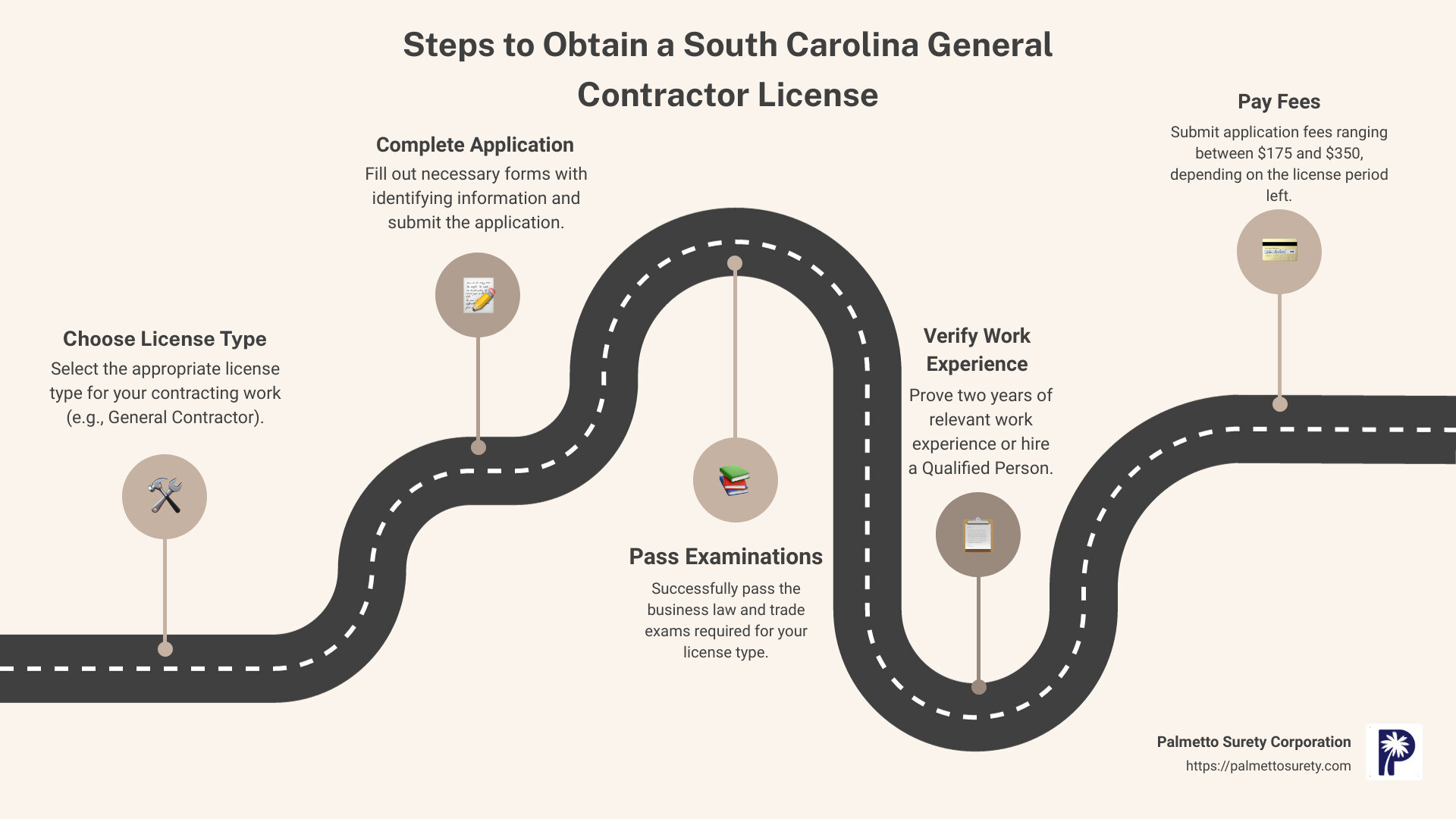
To become a contractor in South Carolina, you’ll need to obtain the proper South Carolina general contractor license. The South Carolina Contractor Licensing Board (SCCLB) oversees the licensing process, making sure contractors meet strict requirements to ensure public safety and welfare. Here’s a quick rundown of what you need:
- License Types: General contractor for projects over $5,000, including residential jobs.
- Application: Fill out necessary forms with identifying information.
- Examinations: Pass business law and trade exams.
- Work Experience: Prove two years of relevant experience or hire a Qualified Person.
- Fees: Application fees between $175 and $350, depending on the license period left.
Once you understand these essentials, the process becomes manageable and sets you on the path to a successful contracting business in South Carolina.
Understanding South Carolina Contractor Licensing Requirements
General Information
The South Carolina Contractor’s Licensing Board (SCCLB) ensures that businesses and individuals performing contract work are qualified and adhere to standards that protect the public’s health, safety, and welfare. They regulate various types of construction work, ensuring that only licensed professionals undertake significant projects.
Purpose
The primary goal of the SCCLB is to safeguard the public by regulating contractors. This means only qualified individuals, who have demonstrated their knowledge and skills through examinations and experience, can legally perform construction work. This helps maintain high standards and prevent subpar workmanship that could endanger residents.
Health and Safety
Contractors must follow strict guidelines to ensure their work does not compromise the health and safety of the public. By enforcing these regulations, the SCCLB aims to prevent accidents, structural failures, and other hazards that can arise from poor construction practices.
Public Welfare
The SCCLB also focuses on the public’s welfare by ensuring contractors are financially responsible and adhere to ethical business practices. This includes requiring contractors to have insurance and surety bonds, which provide financial protection to clients if a contractor fails to meet their obligations.
Licensure Information
To perform construction work legally in South Carolina, contractors must obtain the appropriate license. The type of license required depends on the nature and scope of the work:
- General Contractor License: Required for commercial projects over $10,000.
- Mechanical Contractor License: Required for specific trades like plumbing, HVAC, and electrical work.
- Residential Builder License: Needed for those focusing solely on residential construction, excluding swimming pools.
Residential Construction
If you plan to work exclusively on residential construction (excluding residential swimming pools), you’ll need to contact the Residential Builders Commission at (803) 896-4696 for specific licensing requirements and guidance.

Non-Regulated Work
Certain types of work do not require a specific contractor’s license. However, if any part of the work falls under regulated activities and the total cost exceeds $10,000, a General or Mechanical Contractor license may be needed. Examples of non-regulated work include:
- Painting
- Flooring installation
- Landscaping
License Exemptions
Some projects and activities are exempt from licensing requirements. For instance:
- Work costing less than $5,000
- Certain types of minor repairs and maintenance
Understanding these exemptions can help you determine whether you need a license for your specific projects. Always refer to the SC Code ann. §40-11-410 for detailed regulations and recent law changes.
By meeting the licensing requirements, contractors can ensure they operate legally and uphold the standards set to protect the public. This not only enhances credibility but also opens up opportunities for larger projects and higher earnings.
Next, we’ll delve into the specific steps you need to take to obtain your General Contractor License in South Carolina.
Steps to Obtain Your General Contractor License in South Carolina
If you’re ready to become a licensed general contractor in South Carolina, follow these straightforward steps to get your South Carolina General Contractor License:
Examination Information
To start, you’ll need to pass several exams. The exams cover business and law, as well as trade-specific knowledge. These exams are administered by PSI, a third-party contractor.
Licensure Applications
Once you pass the exams, fill out the licensure application. This includes providing identifying information for both the licensee and the Qualifying Person (the person with the required work experience). You’ll also need to specify your business structure and the type of license you’re applying for.
Renewals
Licenses are valid for two years. General contractor licenses expire on even years, while mechanical contractor licenses expire on odd years. The renewal fee varies based on how much time is left in the licensing period.
Board Information
The South Carolina Contractor Licensing Board (SCCLB) oversees the licensing process. They ensure all contractors meet the necessary qualifications to protect public safety and welfare.
Primary Qualifying Party
Your application must include a Primary Qualifying Party. This person needs to have at least two years of work experience within the last five years in the trade for which you’re applying.
Exam Requirements
The exams you need to take include:
- Business Management and Law Exam: Covers general business practices and legal requirements.
- Technical Examination: Focuses on trade-specific knowledge.
PSI Exams
PSI administers the exams. You can schedule your exams through their website. Make sure to study the provided materials and practice exams to increase your chances of passing on the first try.
Technical Examination
This exam tests your knowledge in your specific trade, such as building construction, electrical work, or plumbing. The content varies depending on the type of work you plan to perform.
Exam Waiver
In some cases, you may qualify for an exam waiver. This usually applies if you have a license in another state with similar requirements or have experience in your trade.
MASC Certification
The Municipal Association of South Carolina (MASC) certification may be required for some types of work. Check with the SCCLB for specific requirements.
Business Management and Law Exam
This is a mandatory exam for all applicants. It ensures you understand the legal and business aspects of running a contracting business.
Work Experience Requirement
You must provide proof of at least two years of work experience within the last five years. This experience does not have to be your own; it can be from a Qualified Person employed by your business.
Once you have completed these steps, you’ll be well on your way to obtaining your South Carolina General Contractor License. Next, we’ll explore the different types of contractor licenses available in South Carolina.
Types of Contractor Licenses in South Carolina
South Carolina offers several types of contractor licenses, each tailored to specific kinds of work. Here’s a breakdown of the main categories:
General Contractor
A General Contractor license is required for anyone looking to work on commercial and industrial projects valued at over $5,000. This license also allows you to take on residential jobs. General contractor licenses come with various classifications, such as:
- Building Construction: Includes interior renovation, structural framing, and more.
- Highway: Covers asphalt paving, bridges, and grading.
- Public Utilities: Includes water and sewer lines, pipelines, and plants.
Mechanical Contractor
A Mechanical Contractor license is for those specializing in trades like heating, air conditioning, plumbing, and electrical work. These licenses cover fewer specialties compared to general contractor licenses but are crucial for specific mechanical services.
Residential Home Builders
If your focus is on building or remodeling residential properties, you’ll need a Residential Home Builders license. This license is specifically for contractors working on single-family homes, townhouses, and similar structures.
Residential Specialty Contractors
Residential Specialty Contractors are those who specialize in specific areas of residential construction, such as roofing, masonry, or interior renovations. This license is more focused, allowing contractors to concentrate on their area of expertise.
License Classifications and Specialty Classifications
Each type of contractor license in South Carolina comes with its own set of classifications and specialty classifications. These classifications help define the scope of work you are legally allowed to perform. For example:
- General Roofing and Specialty Roofing are classifications under the General Contractor license.
- Heating and Air Conditioning fall under the Mechanical Contractor license.
Group Limit
When applying for a general or mechanical contractor license, you must choose a Group Limit. This determines whether you need to submit financial statements or secure a bond. Here’s a quick overview:
- Lower Tiers: Require less stringent financial statements or lower bond amounts.
- Higher Tiers: Require more detailed financial statements or higher bond amounts.
Financial Statement Requirements
Depending on your chosen group limit, you may need to submit financial statements. These statements help prove that your business is financially stable and capable of handling large projects.
Bond Requirements
For some licenses, especially those with higher group limits, you may need to secure a bond. Bonds act as a financial guarantee that you will complete your projects as agreed. They protect clients and ensure that contractors meet their obligations.
Understanding the different types of contractor licenses in South Carolina is crucial for choosing the right one for your business. Up next, we’ll discuss how to prepare for the contractor’s exam to ensure you pass with flying colors.
Preparing for the Contractor’s Exam
Getting ready for the South Carolina contractor’s exam is a critical step in securing your general contractor license. Here’s how you can prepare effectively:
Contractor Training Center
The Contractor Training Center is a valuable resource for aspiring contractors. They offer comprehensive training programs designed to equip you with the knowledge and skills needed to pass the exam. Their experienced team provides guidance and support throughout the process, ensuring you’re well-prepared.
Exam Prep Tools
To succeed, you’ll need a variety of exam prep tools. The Contractor Training Center provides:
- Study Guides and Books: Essential reading materials that cover all topics on the exam.
- Practice Exams: Simulated tests to help you get familiar with the exam format and types of questions.
- Online Resources: Access to digital content and interactive tools for flexible learning.
Resources and Books
Having the right resources and books is crucial. The Contractor Training Center offers a curated list of books that are specifically tailored to the South Carolina contractor’s exam. These books cover everything from building codes to business management.
Assistance
Don’t hesitate to seek assistance. The Contractor Training Center’s team is there to help you understand complex topics and provide tips for studying effectively. Whether you need one-on-one tutoring or group study sessions, they can accommodate your needs.
Credibility
Passing the contractor’s exam and obtaining your license significantly boosts your credibility. Clients are more likely to trust and hire a licensed contractor over an unlicensed handyman. This trust is essential for building a successful business.
Higher Earning Potential
A licensed contractor generally commands higher fees. With a license, you can take on larger projects that unlicensed contractors cannot. This not only increases your earning potential but also opens up more opportunities for growth and expansion in your business.
Preparing for the contractor’s exam might seem daunting, but with the right tools and support, you can achieve your goal. Next, we’ll discuss the penalties for unlicensed contracting and why it’s crucial to get your license.
Penalties for Unlicensed Contracting
Working as an unlicensed contractor in South Carolina carries serious consequences. Let’s break down the key penalties and why obtaining a South Carolina general contractor license is crucial.
Fines
If you’re caught working without the proper license, the fines can be hefty. For a first offense, you could face penalties of up to $250. While this may seem manageable, it’s just the beginning. Repeat offenders face even stiffer penalties, potentially bringing your case before the South Carolina Contractors Licensing Board.
Board Actions
The Board takes unlicensed contracting seriously. A second offense can lead to severe actions, including the possibility of having your case reviewed by the Licensing Board. This could result in further fines, legal actions, and even a permanent ban from obtaining a license in the future.
Lien Rights
One of the most significant drawbacks of unlicensed contracting is the loss of lien rights. In South Carolina, unlicensed contractors have no right to file a lien against a property, even if they have met every contract requirement and delivered quality work. This means if a client refuses to pay, you have no legal avenue to claim your money.
Importance of Licensure
Obtaining your South Carolina general contractor license isn’t just about avoiding penalties. It’s about building a reputable and successful business. A license:
- Ensures Credibility: Clients are more likely to trust and hire a licensed contractor.
- Increases Earning Potential: Licensed contractors can take on larger, more lucrative projects.
- Legal Protection: It offers legal avenues like lien rights to protect your business interests.

In summary, the risks of unlicensed contracting far outweigh any short-term gains. Next, we’ll dive into the different types of contractor licenses available in South Carolina and what you need to know about each one.
Conclusion
Getting your South Carolina general contractor license is a critical step to building a reputable and profitable contracting business in the state. Following the outlined steps ensures you meet all regulatory requirements and sets you up for long-term success.
At Palmetto Surety Corporation, we understand the complexities involved in obtaining and maintaining your contractor license. We are committed to helping you navigate these challenges with ease. Our expertise in surety bonds and our dedication to customer support make us a trusted partner in your licensing journey.
Why Choose Palmetto Surety Corporation?
- Exemplary Customer Support: We provide quick, reliable, and transparent communication to ensure you get the support you need.
- Cutting-Edge Technology: Our technology simplifies the process of purchasing, printing, and managing your surety bonds.
- Expertise: With over twenty years in the industry, we offer personalized services and solutions tailored to your specific needs.
For more information on how we can assist you with your surety bond requirements, visit our Surety Bonds page.
Taking the step to become a licensed contractor in South Carolina is a decision that will pay off in credibility, legal protection, and financial opportunities. Let Palmetto Surety Corporation be your partner in this journey, providing the support and expertise you need to thrive.