


Introduction
Do contractors have to be licensed in South Carolina? The short answer is: Yes.
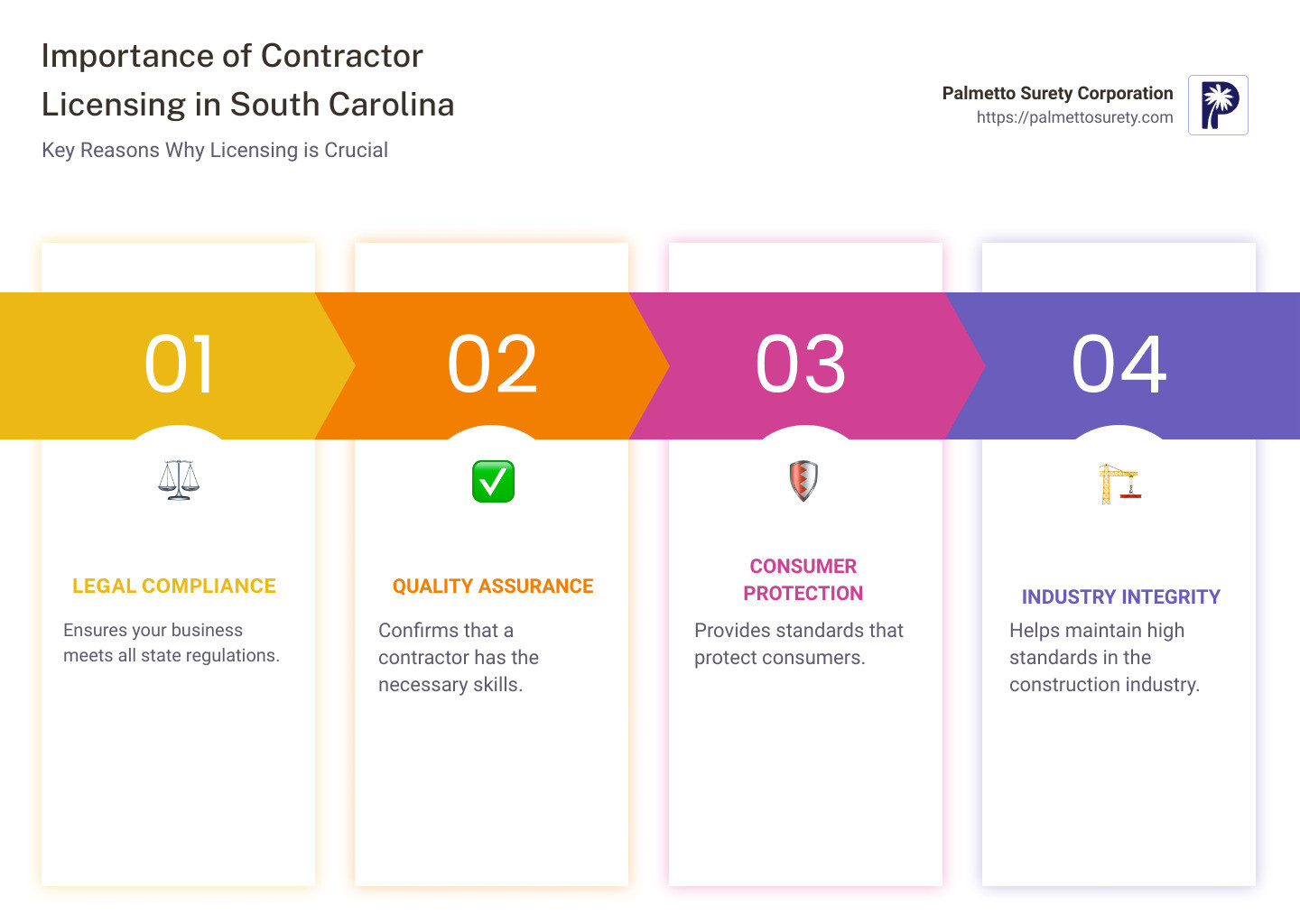
If you’re planning to start a construction business in South Carolina, it’s important to know that contractors must be licensed. This ensures your business is legally compliant and capable of delivering quality work.
Why is Licensing Important?
Licensing isn’t just red tape; it’s about protecting both contractors and consumers. A South Carolina contractor license confirms that a contractor has the necessary skills, experience, and financial stability to perform the job. It also provides accountability and standards that help maintain the integrity of the construction industry in the state.
Key Points:
- Required for All Major Projects: Both commercial and residential projects need licensed contractors.
- State Authorities: Licenses are issued by the South Carolina Contractor’s Licensing Board (SCCLB) and the Residential Builders Commission (SCRBC).
- Types of Licenses: General contractor, mechanical contractor, residential builder, and specialty contractor.
Following these guidelines ensures a smooth start and a reputable standing in your construction career.
Types of Contractor Licenses in South Carolina
In South Carolina, contractors must be licensed to work legally. The state offers several types of contractor licenses, each suited to different kinds of work. Here’s a breakdown:
General Contractor
A general contractor license is required for anyone performing commercial construction projects valued over $5,000. This license covers a broad range of activities, including:
- Commercial construction
- Industrial projects
- Large-scale residential projects
General contractors must pass the PSI business management and law exam and a technical exam relevant to their trade. They also need to submit a financial statement and proof of experience.
Mechanical Contractor
A mechanical contractor license is necessary for those working on mechanical systems in both commercial and residential settings. This includes:

- HVAC systems
- Plumbing
- Electrical systems
Like general contractors, mechanical contractors must pass both a business management and law exam and a technical exam. They also need to provide a financial statement and relevant work experience.
Residential Builder
A residential builder license is required for constructing or significantly altering residential buildings. This license is overseen by the Residential Builders Commission (SCRBC). Residential builders need to:
- Pass a state exam
- Provide proof of experience
- Submit a surety bond
The surety bond amount is $15,000 for residential builders. This ensures that the builder will adhere to state regulations and complete projects as agreed.
Specialty Contractor
Specialty contractors focus on specific trades and may need either a license or registration, depending on the trade. The SCRBC oversees these licenses, which include:
- Plumbing
- Electrical
- HVAC
There are 13 different specialty classifications. Four of these (building, plumbing, electrical, and HVAC) require a license, while the other nine need a registration. Specialty contractors must:
- Pass a relevant exam (for the four licensed trades)
- Provide letters of reference
- Submit proof of experience
For example, a licensed residential specialty contractor must post a $10,000 surety bond, while a registered one needs a $5,000 bond.
Understanding these different license types is crucial for anyone planning to work as a contractor in South Carolina. Each license has specific requirements and covers different scopes of work, ensuring that contractors are qualified and projects are completed to high standards.
Next, we’ll dive into the detailed requirements for obtaining these licenses in South Carolina.
Licensing Requirements for South Carolina Contractors
To legally work as a contractor in South Carolina, you need to meet several important requirements. Here’s what you need to know:
Business Entity Registration
Before you can apply for a contractor license, you must register your business entity with the South Carolina Secretary of State. This step ensures your business is legally recognized in the state.
Tax Registration
You also need to register for taxes with the South Carolina Department of Revenue. This step is essential for meeting state tax obligations and operating legally.
Proof of Experience
For most contractor licenses, you must prove your relevant experience. This can involve providing certifications, letters of reference, and other documentation that showcases your work history. The exact requirements can vary based on the type of license you are applying for.
State Exam
Most contractor licenses require you to pass a state examination.
- For general and mechanical licenses, you must complete the exam with PSI before you apply.
- For residential contractors and certain specialty licenses (building, plumbing, electrical, and HVAC), you need to pass the exam after your initial application is approved.
Application Process
To apply for a contractor license, you need to complete and submit the appropriate application forms:
- General and Mechanical Contractor License Application
- Residential Builder and Specialty Contractor License Applications (different forms per license type)
Once your application is complete, mail it along with the necessary documents and fees to:
South Carolina Department of Labor, Licensing and Regulation
P.O. Box 11329
Columbia, S.C. 29211
Surety Bond
Depending on your license type, you may need to post a surety bond. For example:
- Residential Builder: $15,000 surety bond
- Licensed Residential Specialty Contractor: $10,000 surety bond
- Registered Residential Specialty Contractor: $5,000 surety bond
Insurance Requirements
Adequate insurance is crucial for protecting your business. Depending on the work you do, you might need:
- Workers’ Compensation Insurance: Required for businesses with four or more employees.
- Commercial Auto Insurance: Necessary if you use vehicles for business purposes.
- General Liability Insurance: Required in some cities like Charleston, which mandates $1,000,000 per occurrence and $2,000,000 in aggregate.
- Professional Liability Insurance: Also required in Charleston, with a minimum of $1,000,000 per claim.
Meeting these requirements ensures that your business is compliant with South Carolina laws, protecting both your business and your clients.
Next, we’ll explore how to apply for a contractor license in South Carolina.
How to Apply for a Contractor License in South Carolina
Applying for a contractor license in South Carolina involves several steps. Here’s a simplified guide to help you navigate the process:
Application Forms
First, you need to obtain the correct application form based on the type of license you are applying for:
- General and Mechanical Contractor License Application: This is for those involved in commercial, industrial, and residential projects.
- Residential Builder and Specialty Contractor License Applications: Different forms are available for each specific classification.
You can find these forms on the South Carolina Department of Labor, Licensing and Regulation (SCLLR) website.
Required Documents
To complete your application, you must gather several important documents:
- Proof of Experience: Certifications and letters of reference that showcase your relevant experience.
- State Exam Certificate: Proof that you have passed the required state examination.
- Business Registration: Proof of registration with the South Carolina Secretary of State.
- Tax Registration: Proof of tax registration with the South Carolina Department of Revenue.
- Driver’s License or State-Issued ID: A copy of your driver’s license, state-issued photo ID, or passport.
- Social Security Card: A copy of your social security card.
- Background Check: A background check from the South Carolina Law Enforcement Division (SLED).
Financial Statement
You must submit a financial statement showing that you meet the net worth or working capital requirements for your license group. This is crucial to demonstrate that your business is financially stable.
Surety Bond
A surety bond is essential for your application:
- Amount: The bond amount varies based on your license type. For example, a residential builder needs a $15,000 bond.
- Conditions: The bond must list the State of South Carolina as the obligee and be continuous in form.
- Provider: You can obtain a surety bond from providers like Palmetto Surety Corporation.
Insurance Requirements
Adequate insurance coverage is necessary to protect your business:
- Workers’ Compensation Insurance: Required for businesses with four or more employees.
- Commercial Auto Insurance: Needed if you use vehicles for business purposes.
- General Liability Insurance: Required in some cities like Charleston, which mandates $1,000,000 per occurrence and $2,000,000 in aggregate.
- Professional Liability Insurance: Also required in Charleston, with a minimum of $1,000,000 per claim.
Submission
Once you have gathered all the required documents, you can submit your application:
- Mailing Address: Send your completed application to:
South Carolina Department of Labor, Licensing and Regulation
P.O. Box 11329
Columbia, S.C. 29211
Ensure all documents are complete and accurate to avoid delays in processing.
Next, let’s delve into the penalties for unlicensed contracting in South Carolina.
Penalties for Unlicensed Contracting in South Carolina
Operating as a contractor without the required license in South Carolina can lead to serious consequences. Understanding these penalties is crucial to avoid legal and financial troubles.
Fines
South Carolina imposes fines for unlicensed contracting to ensure compliance and protect consumers. For a first offense, contractors can face fines of up to $250. However, the penalties escalate significantly for repeat offenders. A second offense will bring the case before the South Carolina Contractors Licensing Board, potentially leading to more severe repercussions.
Legal Consequences
Beyond fines, unlicensed contractors may face legal consequences that can impact their business operations. The South Carolina Contractors Licensing Board has the authority to take legal action against unlicensed contractors. This can include:
- Cease and Desist Orders: The Board can issue orders to stop all work immediately.
- Court Proceedings: Severe cases may result in court proceedings, which can lead to additional fines and potential jail time.
Lien Rights
One of the most significant legal disadvantages for unlicensed contractors in South Carolina is the loss of lien rights. In the event of non-payment, licensed contractors have the right to file a lien against the property they worked on. This legal tool helps ensure they get paid for their services.
However, unlicensed contractors do not have lien rights in South Carolina. This means that even if they complete the work perfectly and meet all contractual obligations, they cannot file a lien to secure payment. This can leave unlicensed contractors vulnerable to financial losses.
Case Study: The Importance of Licensing
Consider the case of John, a contractor who took on a residential roofing project without the proper license. Despite completing the project on time and to the client’s satisfaction, John was not paid. When he attempted to file a lien, he discovered he had no legal standing. Not only did he lose out on the payment, but he also faced fines and legal action from the state.
Summary
The penalties for unlicensed contracting in South Carolina are stringent. They include fines, legal consequences, and the loss of lien rights. For contractors, obtaining the proper license is not just a legal requirement but a crucial step to protect their business interests.
Next, we’ll explore the process of renewing your contractor license and the reciprocity agreements that can make licensing easier if you are already licensed in another state.
Renewal and Reciprocity of Contractor Licenses
License Expiration
In South Carolina, general contractor licenses expire on October 31 of every even-numbered year. It’s crucial to keep track of this date to ensure your license remains active. An expired license can halt your business operations and lead to penalties if you continue working without renewal.
Renewal Process
Renewing your contractor license in South Carolina is straightforward but requires timely action. Here are the steps:
- Complete the Renewal Application: You will need to fill out the renewal form provided by the South Carolina Department of Labor, Licensing, and Regulation (SCLLR).
- Pay the Renewal Fee: The renewal fee for a general contractor license is $135. Make sure to submit this payment along with your application.
- Submit Required Documents: Depending on your license type, you may need to provide updated financial statements, proof of insurance, and other documents.
- Mail the Application: Send your completed application and documents to:
South Carolina Department of Labor, Licensing and Regulation
P.O. Box 11329
Columbia, S.C. 29211
Reciprocity Agreements
If you’re already licensed in another state, South Carolina offers reciprocity agreements that can simplify the licensing process. Here’s how it works:
- Technical Exam Waiver: If you’ve passed a technical exam in another state with a reciprocity agreement, you may not need to retake the exam in South Carolina. Instead, you can provide a letter of verification or an examination waiver from the other state’s licensing board.
- Business Management and Law Exam: Even with reciprocity, you must pass the PSI business management and law exam specific to South Carolina requirements.
Reciprocity agreements can save you time and allow you to expand your business across state lines more efficiently.
Next, we’ll address some frequently asked questions about contractor licensing in South Carolina.
Frequently Asked Questions about Contractor Licensing in South Carolina
What types of work require a contractor license in South Carolina?
In South Carolina, you need a contractor license for various types of construction work. This includes:
- General contractors: Required for commercial, industrial, and large-scale residential projects.
- Mechanical contractors: Needed for specialized trades such as HVAC, plumbing, and electrical work.
- Residential builders: Required for constructing or remodeling residential buildings.
- Specialty contractors: Includes specific trades like masonry, roofing, and interior renovation.
Some specialty classifications only require registration instead of a full license. For instance, out of 13 specialty classifications, 9 only need registration while the rest require a license.
How can I verify a contractor’s license in South Carolina?
Verifying a contractor’s license in South Carolina is straightforward:
- Visit the South Carolina Department of Labor, Licensing and Regulation (SCLLR) website: They have an online portal where you can search for licensed contractors.
- Search by name or license number: Enter the contractor’s name or license number to verify their status.
- Check for any disciplinary actions: The portal also shows if there are any actions taken against the contractor.
This ensures that the contractor you’re hiring is legally compliant and qualified for the job.
What are the insurance requirements for contractors in South Carolina?
Contractors in South Carolina must have specific insurance coverages to protect their business and clients:
- Workers’ Compensation Insurance: Required for businesses with four or more employees. It covers medical bills and lost wages for work-related injuries or illnesses.
- Commercial Auto Insurance: Necessary if you use vehicles for business purposes. Personal auto policies typically don’t cover work-related use.
- General Liability Insurance: Covers third-party injuries and property damage. For instance, Charleston requires $1,000,000 per occurrence and $2,000,000 in aggregate.
- Professional Liability Insurance: Also known as Errors & Omissions (E&O) insurance, it covers claims of negligence or mistakes. Charleston requires coverage of at least $1,000,000 per claim and in aggregate.
Having the right insurance not only protects your business but is often a legal requirement, especially for larger contracts or specific jurisdictions like Charleston.

Next, we’ll cover the penalties for unlicensed contracting in South Carolina.
Conclusion
At Palmetto Surety Corporation, we understand that navigating the complexities of contractor licensing in South Carolina can be challenging. Ensuring you have the proper license is crucial for legal compliance, securing contracts, and protecting your business from potential fines and legal consequences.
We specialize in providing surety bonds, which are often a requirement for obtaining or maintaining your contractor license. Our streamlined process allows you to secure the necessary bonds quickly and efficiently, so you can focus on what you do best—running your business.
Why Choose Palmetto Surety Corporation?
Exemplary Customer Support: With over twenty years of experience, we pride ourselves on our quick, reliable, and transparent communication. Our dedicated support team is available 24/7 to assist you.
Advanced Technology: Our state-of-the-art platform enables you to purchase, print, and manage your surety bonds effortlessly, making the process hassle-free.
Expertise and Integrity: We uphold ethical business practices and aim to deliver exceptional service. Our extensive network of insurance agents and surety bond agencies ensures you get the best solutions tailored to your needs.
Ready to Get Started?
Whether you’re a general contractor, a mechanical contractor, or a residential builder, Palmetto Surety Corporation has the expertise and resources to help you meet South Carolina’s licensing requirements. Visit our Surety Bonds page to get started today.
Don’t let licensing hurdles hold you back. Secure your surety bond with us and take the next step in your contracting career with confidence.

For personalized assistance, reach out to us at (866) 372-0827. We’re here to help you every step of the way.


