


Texas bonded title cost: Easy 3-Step Guide
Understanding the Real Cost of Your Texas Bonded Title
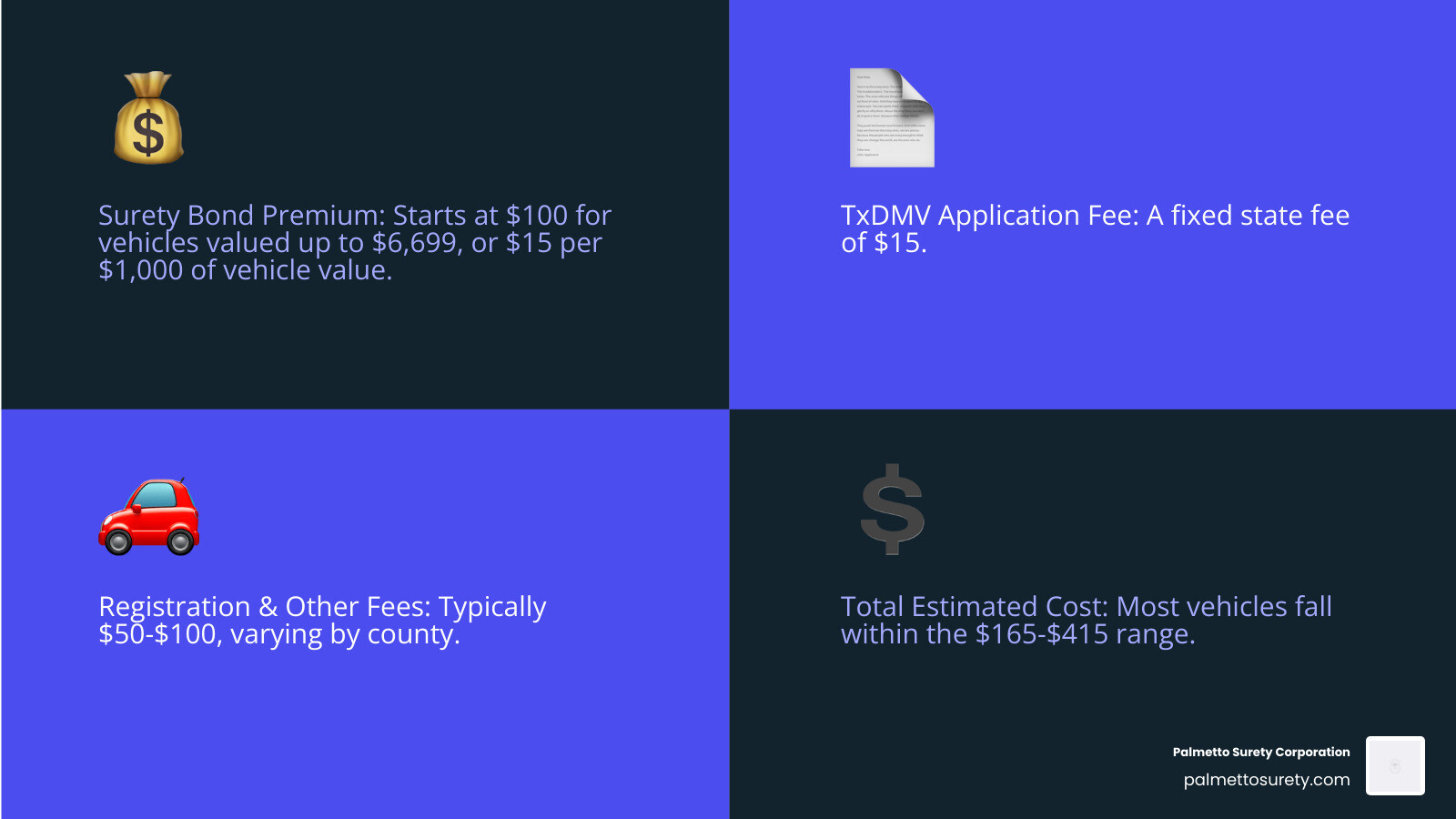
The Texas bonded title cost is actually quite manageable when you break it down into its main components. Most vehicle owners pay between $100-$300 for the surety bond itself, plus a $15 state application fee and standard registration costs.
Quick Cost Breakdown:
- Surety bond premium: $100 (vehicles valued up to $6,699) or $15 per $1,000 of vehicle value
- TxDMV application fee: $15
- Vehicle registration and other fees: Varies by county ($50-$100 typical)
- Total estimated cost: $165-$415 for most vehicles
When your vehicle’s original title is lost, damaged, or has transfer issues, a Texas bonded title becomes your path back to legal ownership. This process requires posting a surety bond equal to 1.5 times your vehicle’s value – but the actual cost you pay is just a small percentage of that bond amount.
The bond protects previous owners and lienholders while giving you a legitimate title that works exactly like a regular title. After three years with no claims against the bond, you can apply for a standard Texas title.
I’m Haiko de Poel Jr, and through my work at Palmetto Surety Corporation, I’ve helped thousands of clients steer the Texas bonded title cost and process efficiently. My experience in surety bonds and digital marketing has shown me how to break down complex processes into simple, actionable steps.
What is a Texas Bonded Title and Why Do You Need One?
Picture this: you’ve found the perfect classic truck at an estate sale, or maybe you inherited your grandfather’s old pickup. There’s just one problem – no title. Don’t panic! A Texas bonded title might be your ticket to legal ownership.
A Texas bonded title is essentially a regular vehicle title backed by a surety bond. Think of the surety bond as a financial safety net that proves you’re the rightful owner, even when the original paperwork has gone missing. It’s Texas’s way of saying, “We believe you own this vehicle, but let’s add some protection just in case.”

Here’s when you’ll likely need a bonded title:
The most common scenario is dealing with title defects. Maybe your lost title disappeared during a move, or perhaps you bought a vehicle and the seller couldn’t locate the original paperwork. Sometimes titles get damaged beyond recognition – I’ve seen titles that went through the washing machine more times than I care to count!
Incorrect transfers are another headache that bonded titles solve. Ever had a seller fill out the title wrong and then become impossible to reach? Or bought a vehicle with just a bill of sale, trusting the seller would send the title later? These situations happen more often than you’d think.
The bonded title provides financial protection for everyone involved. It protects previous owners and lienholders from potential losses if ownership questions arise later. Essentially, you’re putting your money where your mouth is when you claim ownership.
Here’s the good news: a Texas bonded title works exactly like a regular title for 3 years. You can register your vehicle, get insurance, and even sell it during this period. After three years with no claims against your bond, you can apply for a standard Texas title, and the bond requirement disappears.
This entire process is governed by Texas Transportation Code Section 501.53, which requires the 3-year duration for the surety bond. While the Texas bonded title cost might seem like an extra expense, it’s often the fastest and most straightforward path to legitimate vehicle ownership when traditional documentation isn’t available.
The beauty of this system is that it gives you legal proof of ownership while protecting everyone else’s interests – a true win-win solution.
The Complete Breakdown of Your Texas Bonded Title Cost
When you’re facing title issues with your vehicle, understanding the full picture of your Texas bonded title cost helps you budget properly and avoid surprises. The good news? It’s not just one mysterious fee – it breaks down into three clear categories that we can walk through together.
Think of it like planning a road trip – you need to know the cost of gas, tolls, and maybe a hotel. With a bonded title, you’re looking at the surety bond premium (your biggest expense), state fees, and a few extras that might pop up along the way.
The Main Expense: The Surety Bond Premium
Here’s where most of your Texas bonded title cost will go – the surety bond premium. This is what you pay to get that financial guarantee we talked about earlier. Now, don’t get confused between the bond amount and what you actually pay. The bond amount is the total coverage (usually 1.5 times your car’s value), but the premium is just a small slice of that pie.
At Palmetto Surety Corporation, we’ve structured our pricing to be as straightforward as possible. For vehicles valued up to $4,466, you’ll pay a flat $100 premium – that’s it for the entire three-year period. No monthly payments, no hidden fees.
Once your vehicle’s value pushes the bond amount above $6,699, the pricing shifts to $15 for every $1,000 of bond coverage. So if your car is worth $10,000 (requiring a $15,000 bond), you’re looking at $225. Still a one-time payment that covers you for three full years.
For higher-value vehicles requiring bonds over $25,000, our underwriters take a closer look to give you the most accurate pricing. These typically start around $375, but we’ll work with you to find the best rate.
| Vehicle Value (Approx.) | Required Bond Amount (1.5x Value) | Estimated Surety Bond Premium |
|---|---|---|
| Up to $4,466 | Up to $6,699 | $100 |
| $5,000 | $7,500 | $112.50 ($15 x 7.5) |
| $10,000 | $15,000 | $225 ($15 x 15) |
| $15,000 | $22,500 | $337.50 ($15 x 22.5) |
| $20,000 | $30,000 | Starting at $375 (Underwriter Review) |
How the Required Bond Amount is Calculated
The state of Texas doesn’t just pick a random number for your bond amount – there’s a specific formula they follow. Your bond must equal 1.5 times your vehicle’s fair market value. This might sound complicated, but the TxDMV has made it pretty straightforward.
First, they’ll try the Standard Presumptive Value (SPV) Calculator. Just plug in your VIN and odometer reading, and boom – you’ve got your vehicle’s official value. If that doesn’t work (maybe your car is too old or unique), they’ll check the NADA guide next.
For those really special cases where neither system has your vehicle, you’ll need a professional appraisal from a licensed Texas auto dealer or insurance adjuster. It’s an extra step, but it ensures you get the right valuation.
Here’s something interesting: if your vehicle is 25 years or older and appraises for less than $4,000, Texas automatically bumps the value up to $4,000 for bonding purposes. This means your minimum bond amount would be $6,000, which still falls into our $100 flat-fee category. Pretty nice deal for classic car owners!
Want to dive deeper into the process? The TxDMV has more detailed information about buying a vehicle with no title on their website.
Fixed Government Fees and Other Potential Costs
Beyond the surety bond premium, there are several other costs that round out your total Texas bonded title cost. The good news is that most of these are standard fees you’d pay for any title work.
The TxDMV charges a $15 application fee when you submit your initial paperwork. It’s non-refundable, so double-check everything before you send it in. Once you get your approval and bonded title, you’ll head to your county tax office where title transfer and registration fees typically run between $50-$100, depending on your county and vehicle type.
If your vehicle is from out-of-state or has been significantly modified, you might need a VIN inspection. You can get this done at a Texas Department of Public Safety station or through your local sheriff’s office for a small fee.
Don’t forget about sales tax – Texas will charge you 6.25% on either your purchase price or the state’s presumptive value, whichever is higher. You’ll also need proof of insurance and might run into small notary fees if certain documents need to be notarized.
The beauty of working with us at Palmetto Surety Corporation is that we help you understand all these costs upfront, so there are no surprises down the road. We’ve been helping folks steer these waters for over 20 years, and we know exactly what to expect.
Step-by-Step Guide to Getting Your Texas Bonded Title
Getting your Texas bonded title doesn’t have to be complicated. I’ve walked countless clients through this process, and when you break it down, it’s really just three straightforward steps that build on each other. Think of it like following a recipe – each step prepares you for the next one.

The entire process typically takes about two to three weeks from start to finish, though the actual time you’ll spend on paperwork is just a few hours spread across these three visits. Let’s walk through each step together.
Step 1: The Initial DMV Application
Your journey begins at the Texas Department of Motor Vehicles, where you’ll get the official word on your vehicle’s value and bond requirements. This step sets the foundation for everything that follows.
Start by completing the Texas Bonded Title Application (Form VTR-130-SOF). This form is your chance to tell your story – why you need a bonded title and what proof of ownership you have. Maybe you bought the car from a friend who lost the title, or perhaps you inherited it from a relative. Whatever your situation, be honest and thorough. You can download the Bonded Title Application (VTR-130-SOF) here.
Gather every scrap of documentation you have about the vehicle. A bill of sale is ideal, but don’t panic if it’s incomplete or has errors. Bring invoices, canceled checks, insurance documents, or even text messages about the purchase. The TxDMV has seen it all, and they’re surprisingly understanding about imperfect paperwork. You’ll also need your Texas state-approved photo ID.
Head to your nearest TxDMV Regional Service Center with your completed application and supporting documents. Bring $15 for the application fee – this is non-refundable, so double-check your paperwork before submitting. If your vehicle came from out-of-state, they might require a VIN inspection by a local sheriff, but they’ll let you know if that’s needed.
The magic happens when you receive your “Notice of Determination for a Bonded Title” letter. This official document tells you exactly how much your bond needs to be – remember, it’s 1.5 times your vehicle’s determined value. This letter is your ticket to step two, so keep it safe!
Step 2: Purchasing Your Title Surety Bond
Now comes the part where you’ll encounter the main Texas bonded title cost – purchasing your surety bond. This is where we at Palmetto Surety Corporation make the process as smooth as possible for you.
You’ll need to work with a licensed surety provider to get your Certificate of Title Surety Bond. We specialize in these exact bonds and have streamlined the process to get you bonded quickly. Many of our clients are surprised at how fast and straightforward this step actually is.
When you contact us, simply provide the bond amount from your TxDMV Notice of Determination letter. We’ll calculate your premium based on the pricing structure we discussed earlier – often just $100 for lower-value vehicles or $15 per $1,000 of coverage for higher amounts.
The best part? You can often complete this entire step online and receive your bond document within hours. We understand that you want to get your vehicle legal as quickly as possible, so we’ve designed our process to be fast and efficient. Once your payment is processed, you’ll have the official bond document you need for the final step.
Step 3: Finalizing at the County Tax Office
You’re in the home stretch! This final step brings together all your documents and gets you that bonded title you’ve been working toward.
Start by completing the Application for Texas Title and/or Registration (Form 130-U). This is your official request for the title and registration. You can download the Application for Texas Title (Form 130-U) here.
Gather your document collection: your TxDMV Notice of Determination letter, the original bond document from your surety provider, your completed Form 130-U, and proof of liability insurance. Don’t forget any supporting documents from your initial application like your bill of sale and ID. If you have a commercial vehicle or truck, you might need a certified weight certificate, and imported vehicles require import documents.
Take everything to your county tax office – not the DMV this time, but your local county office. This is where you’ll pay the remaining fees, including title transfer fees, registration fees, and sales tax. The staff there will review everything and process your final application.
Once approved, you’ll walk out with your registration sticker and license plates, knowing your vehicle is now legally titled and registered in Texas. Your physical bonded title will arrive by mail from Austin within two to three weeks. After three years with no claims against your bond, you can apply for a standard Texas title, and the whole bonded title chapter will be behind you.
The process really is that straightforward when you take it one step at a time. Most of our clients find it much less intimidating than they initially expected.
Frequently Asked Questions about Texas Bonded Titles
Getting a bonded title can feel overwhelming, especially when you’re dealing with a vehicle you can’t legally drive yet. I’ve helped thousands of Texas vehicle owners through this process, and these are the questions that come up most often. Let me put your mind at ease with some straightforward answers.
How long is a Texas bonded title valid?
Your Texas bonded title will be valid for three full years from the date it’s issued. Think of this as a waiting period where the state gives anyone who might have a claim on your vehicle the chance to speak up.
During these three years, the surety bond acts like a safety net. If someone comes forward claiming they’re the rightful owner (which rarely happens), they can make a claim against the bond. But here’s the good news: if no one makes a valid claim during this entire three-year period, you’re home free.
Once those three years are up, you can apply for a standard Texas title – no more “bonded” designation. The TxDMV will release the bond, and your vehicle will have a clean, regular title just like any other car on the road. The best part? You don’t pay any additional fees for this conversion, and the initial Texas bonded title cost covers the entire three-year term.
Can I sell a car with a bonded title?
Absolutely! A bonded title gives you full legal ownership of your vehicle, which means you can sell it, trade it, or even give it away if you want to. The bond actually makes the title more secure, not less, because it provides financial protection for everyone involved.
When you’re ready to sell, you’ll want to be upfront with potential buyers about the bonded status. Most buyers appreciate the honesty, and many don’t even see it as a concern once you explain what it means. You can tell them that the bond protects them too – it’s essentially a guarantee that you have clear ownership.
The bonded title transfers to the new owner just like a regular title would. They’ll get the same legal protections, and after the three-year period ends, they can apply for a standard title. It’s really that simple.
Are there ways to lower the Texas bonded title cost?
While you can’t change the state-mandated fees or dramatically alter the bond premium structure, there are definitely smart ways to keep your Texas bonded title cost as low as possible.
Getting an accurate vehicle valuation is your biggest opportunity to save money. Since the bond amount is 1.5 times your vehicle’s value, even a small reduction in the assessed value can meaningfully lower your premium. If you think the TxDMV’s valuation is too high, consider getting a professional appraisal from a licensed Texas auto dealer or insurance adjuster.
Shopping around for your surety bond can also help, though most reputable providers offer similar rates. What matters more is finding a company that can process your bond quickly and correctly the first time. At Palmetto Surety Corporation, we pride ourselves on approving most applications within hours, which helps you avoid costly delays.
Accuracy is everything when it comes to paperwork. I can’t stress this enough – double-check every form before you submit it. One small mistake can mean starting over, paying duplicate fees, or missing deadlines. Take your time with the forms, and don’t hesitate to ask questions if something isn’t clear.
Timing matters too. Your surety bond must be filed with the county tax office within 30 days of being issued, or you’ll need to purchase a new one. Plan your steps accordingly, and try to complete the entire process within a few weeks once you start.
The key is being prepared and informed. When you know exactly what to expect, you can budget accurately and avoid those surprise costs that can really add up.
Conclusion: Get Your Texas Title Bond with Confidence
Getting your Texas bonded title doesn’t have to feel overwhelming. As we’ve walked through together, the Texas bonded title cost breaks down into manageable pieces – typically between $165-$415 for most vehicles. That’s a small price to pay for peace of mind and legal ownership of your vehicle.
The beauty of this process is its predictability. You know exactly what you’re getting into: a surety bond premium based on your vehicle’s value, a $15 state application fee, and your standard registration costs. No hidden surprises, no complicated formulas to decode.
What makes this journey even smoother is having the right partner by your side. At Palmetto Surety Corporation, we’ve been helping folks steer these waters for over 20 years. We understand that when you need a bonded title, you’re often dealing with a frustrating situation – maybe you’ve lost your title, inherited a vehicle without proper paperwork, or bought from someone who couldn’t provide clean documentation.
That’s exactly why we’ve streamlined our process to approve most applications within hours. We know you want to get back on the road, not spend weeks waiting for paperwork to crawl through bureaucratic channels. Our team in Charleston has seen every type of bonded title situation you can imagine, and we’re genuinely excited to help you resolve yours quickly and affordably.
Your bonded title will work just like any regular title for the next three years. You can register your vehicle, get insurance, and even sell it if you need to. After those three years pass without any claims, you’ll have a standard Texas title – clean and clear.
Ready to take the next step? We’re here to make your Texas bonded title cost as reasonable as possible while getting you the fast, reliable service you deserve.


