


NC insurance license extension: 2025 Pro Guide
Understanding NC Insurance License Validity and Renewal Requirements
Navigating NC insurance license extension requirements can feel overwhelming, especially when you’re unsure whether your license needs active renewal or simply continuing education compliance. The good news is that many North Carolina insurance licenses are actually perpetual, meaning they don’t expire unless surrendered, canceled, or revoked.
Quick Answer for NC Insurance License Extensions:
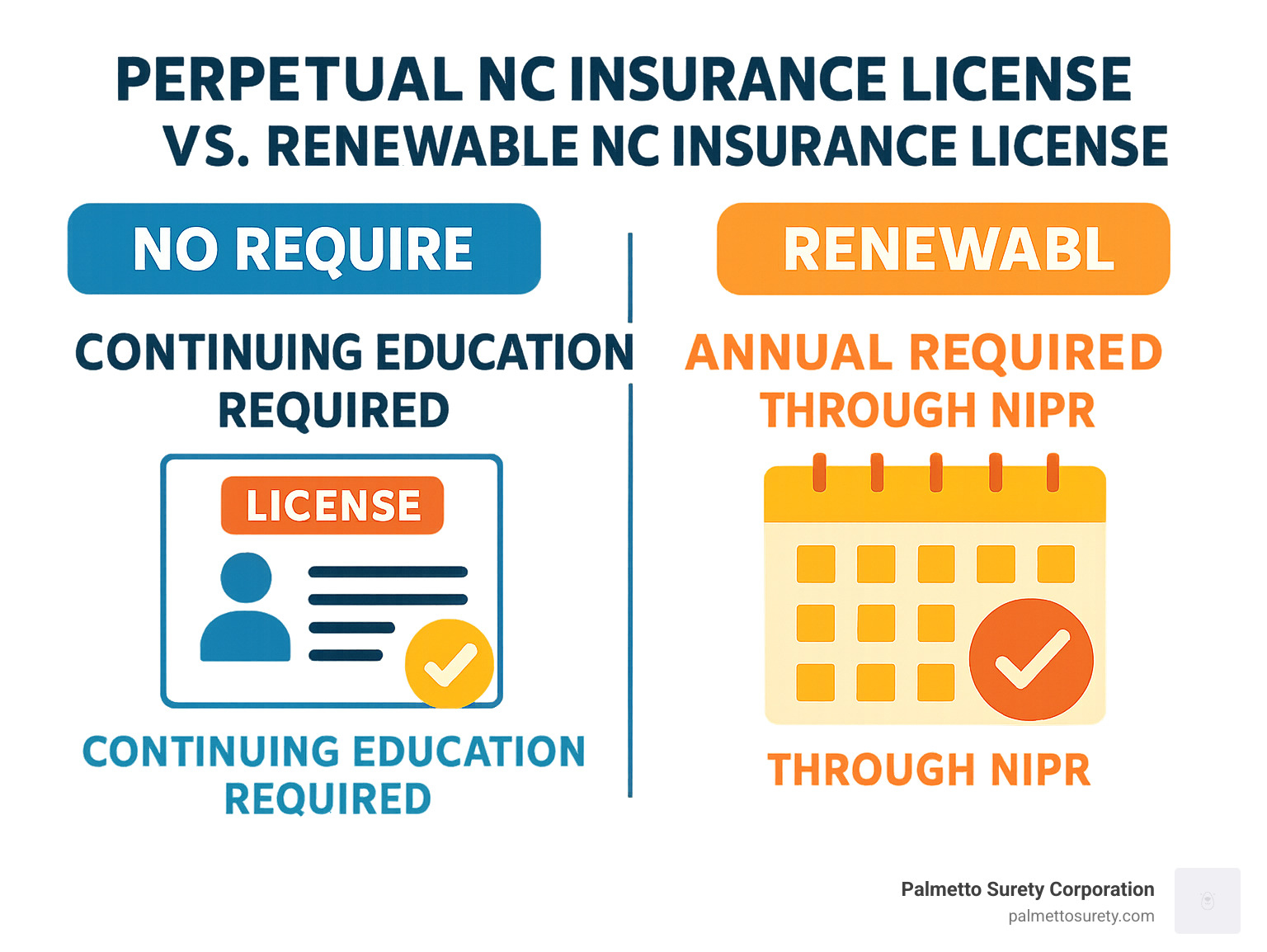
- Perpetual Licenses (Life, Accident & Health, Property, Casualty, Personal Lines, Variable Life & Variable Annuity, Medicare Supplement/Long-Term Care): No renewal application needed – just complete 24 CE hours every 2 years by your birth month
- Renewable Licenses (Adjusters, Surplus Lines, Bail Bondsmen, Business Entities): Active annual renewal required through NIPR
- 30-Day Extensions: Available for $75 if requested between 30 days before and on your CE compliance date
- Reinstatement: Expired licenses can be reinstated within 4 months for $75 if CE requirements are completed
The key difference lies in understanding whether you hold a perpetual license that requires only continuing education compliance, or a renewable license that demands both CE completion and an active renewal application. North Carolina allows excess CE hours to carry over to the next period, and licensees receive courtesy reminders approximately 120 and 45 days before their compliance dates.
Most confusion stems from the fact that North Carolina stopped issuing new Broker licenses in July 2022, while maintaining different renewal schedules for various license types. Some renew on April 1st, others on September 1st, and perpetual licenses simply require biennial CE completion.
I’m Haiko de Poel Jr., and through my work with surety bonds and insurance licensing at companies like Palmetto Surety Corporation, I’ve helped countless professionals steer NC insurance license extension processes and compliance requirements. My experience in the insurance industry has shown me that proactive license management prevents costly lapses and ensures uninterrupted business operations.
Understanding Your License Type: Perpetual vs. Renewable
The first step in managing your North Carolina insurance license is understanding what type you actually hold. This isn’t just insurance industry jargon – it makes a real difference in what you need to do to stay compliant.


Here’s the good news: most North Carolina insurance producers hold perpetual licenses. These licenses for Life, Accident & Health, Property, Casualty, Personal Lines, Medicare Supplement/Long-Term Care, and Variable Life & Variable Annuity don’t actually expire. They stay valid until you surrender them, the Department of Insurance cancels them, or they’re revoked due to disciplinary action.
Think of perpetual licenses like a gym membership that never expires – as long as you keep up with your continuing education requirements, you’re good to go. No renewal applications, no annual fees, just stay current with your CE hours.
However, some license types do require active renewal. Adjusters, Surplus Lines producers, Viatical Settlement Brokers, Bail Bondsmen, and various Business Entities all need regular renewal applications to stay active.
There’s one important change to note: North Carolina stopped issuing new Broker licenses on July 7, 2022. If you already have one, it may still be valid, but no new ones are being issued.
Not sure which type you have? You can easily view your license status online through the State Based Systems portal to check your current status and license type.
Perpetual License Maintenance
If you hold a perpetual license, your life is relatively simple. No renewal application means no annual paperwork headaches or renewal fees. Your license stays valid as long as you complete your biennial CE requirements – that’s 24 hours of continuing education every two years, due by your birth month.
The beauty of perpetual licenses is their simplicity. Complete your CE on time, and your license validity continues uninterrupted. Miss your CE deadline, and that’s when you might need an NC insurance license extension to get back on track.
Licenses Requiring Active Renewal
For those with renewable licenses, staying compliant requires more active management. These licenses operate on specific annual renewal periods with actual deadlines and fees.
Most business entities and many individual licenses follow April 1 renewals. The renewal window typically opens 60 days before March 31st and stays open through May 30th. Surplus Lines licenses march to a different drummer, with September 1 renewals and an application window running from July 2nd through October 30th.
Renewal fees vary significantly by license type. Adjusters and Motor Vehicle Damage Appraisers pay $109, while Surplus Lines producers pay $84. Viatical Settlement Brokers face the highest fee at $534.
The primary platform for most renewals is the NIPR portal, which streamlines the process for both residents and non-residents. You can renew your license through NIPR to handle most renewal applications efficiently.
The key difference between perpetual and renewable licenses isn’t just administrative – it’s about planning. Perpetual license holders focus on CE compliance, while renewable license holders must juggle both CE requirements and renewal deadlines.
Core Compliance: North Carolina Continuing Education (CE) Requirements
Whether your license is perpetual or requires active renewal, continuing education (CE) forms the backbone of maintaining your professional standing in North Carolina. Think of it as your professional insurance policy – it keeps you current with industry trends, regulations, and best practices that protect both you and your clients.

Here’s what every resident insurance producer and adjuster needs to know: you must complete 24 total hours of CE every 2 years. This breaks down into 3 hours of Ethics training and 21 general hours covering any approved insurance-related topics relevant to your lines of authority. It’s straightforward, but the timing is what trips up many professionals.
Your CE compliance date isn’t random – it’s tied directly to your birth month and follows a biennial cycle. If you were born in an odd-numbered year, your compliance occurs in odd-numbered years. Born in an even-numbered year? You’ll comply in even-numbered years. This system spreads out the compliance dates throughout the year, preventing everyone from scrambling at once.
North Carolina offers a helpful feature that many states don’t: excess credit carry-over. Complete 30 hours instead of 24? Those extra 6 hours roll over to your next compliance period. However, there’s an important caveat – excess ethics or flood credits convert to general credits when they carry over. This means you still need to complete your required ethics and flood hours fresh in each new period. Also, you can’t repeat the same course for credit within a single renewal period.
Staying on top of your progress is crucial, and that’s where regular monitoring comes in. We strongly recommend checking your CE transcript frequently through the official portal. You can Check your CE transcript on Sircon to track your completed hours and ensure you’re on track. If you don’t meet these requirements by your compliance date, your license expires – and that’s when you might need an NC insurance license extension.
Product-Specific CE Training
Beyond the standard CE requirements, North Carolina recognizes that certain insurance products are complex enough to warrant specialized training. These additional requirements ensure that producers are properly equipped to serve clients in these specialized areas.
Annuity Best Interest training represents one of the most recent additions to North Carolina’s CE landscape. If you were licensed before January 1, 2023, you had until June 30, 2023, to complete a 1-hour updated course. For those licensed on or after January 1, 2023, a one-time 4-hour Annuity Best Interest Certification Training is required before you can sell annuities. The good news? North Carolina recognizes NAIC Annuity Best Interest training completed in other states, so you won’t need to duplicate your efforts.
Long-Term Care Partnership (LTCP) products require their own specialized knowledge base. To sell these products, you’ll need to complete an initial 8-hour LTCP Certification Training. Once you’ve completed this initial requirement, you’ll need 4 hours of LTCP training every two years to maintain your authorization.
Flood Insurance (NFIP) training is mandatory for anyone dealing with property risks. All Adjusters, Property/Casualty producers, and Personal Lines producers must complete 3 hours of NFIP Flood Insurance Certification Training. This requirement kicks in during your first compliance period and then repeats every other compliance period – essentially every four years. Given North Carolina’s coastal geography and weather patterns, this training provides essential knowledge for protecting clients.
Non-Resident CE Rules
If you’re a non-resident producer licensed in North Carolina, you’ll find the CE requirements refreshingly simple – there generally aren’t any specific North Carolina CE requirements for you. Instead, North Carolina follows a home state reciprocity approach that makes compliance much more manageable.
The Department of Insurance monitors your license status in your home state through the National Producer Database (PDB). As long as your home state license remains in good standing, your North Carolina non-resident license automatically extends. However, if your resident state license falls out of good standing, North Carolina will cancel your non-resident license. This system creates a seamless compliance process that prevents duplicate requirements across states.
Non-resident adjusters face slightly different rules depending on how they qualified for their North Carolina license. If you qualified through your residence state or by passing an adjuster examination in another state, you’re covered under the same reciprocity rules as producers – just keep your qualifying state license in good standing.
However, if you qualified for your North Carolina license by taking the North Carolina adjuster examination specifically, you’ll need to meet the same CE requirements as resident adjusters: 24 hours biennially, including the mandatory ethics and flood training. This distinction ensures that all adjusters working in North Carolina have appropriate continuing education, regardless of their residency status.
The NC Insurance License Extension and Reinstatement Process
Let’s be honest – life doesn’t always cooperate with our professional deadlines. Maybe you’ve been swamped with client work, dealing with family obligations, or simply lost track of time. Whatever the reason, if you’re staring down a CE compliance deadline and feeling the pressure, you’re not alone.
When you fail to complete your CE requirements by your compliance date, your license expires. This isn’t just a technicality – it means you legally cannot conduct insurance business until you get back into compliance. The clock starts ticking immediately, and you have exactly 4 months (120 days) to complete your CE hours and get reinstated.
Here’s where things get serious: if you don’t act within that 4-month window, your license becomes inactive. Once that happens, you’re looking at starting over from scratch – completing pre-licensing education and retaking the state exam for each line of authority you want to maintain. Trust me, nobody wants to go through that process again.

How to Request a 30-Day NC Insurance License Extension
The good news is that North Carolina offers a safety net for those who see the deadline approaching but need a little breathing room. You can request a 30-day extension to complete your CE requirements, giving you that extra month to get everything squared away.
The timing matters here. You can request this NC insurance license extension starting 30 days before your compliance date and up until the last day of your compliance period. Miss that window, and you’re out of luck – once your license expires, the extension option disappears.
The $75 extension fee is a small price to pay for peace of mind. The entire process happens online through the Sircon portal, which makes it pretty straightforward. Steer to the Sircon website, click on ‘Services,’ then select ‘CE Exemption or Extension Request.’ You’ll enter your email, check the box indicating you’re applying for a continuing education extension, and pay the fee.
After your extension is approved, you can verify your extension status by checking your license on the NAIC’s SOLAR system. Your license should show up as ‘Extended,’ confirming you have that extra month to complete your requirements.
Securing a CE Exemption or Reinstating an Expired License
Sometimes circumstances truly beyond your control interfere with your ability to complete CE requirements. North Carolina recognizes this and offers exemptions (or waivers) in specific situations, primarily for medical reasons or active military service.
If you’re dealing with a serious health issue or deployed with the military, you can submit a waiver request form along with proper documentation – like a doctor’s note or military orders. Send these materials to [email protected] or through the mail. If approved, you’ll receive written confirmation that you’re waived from all CE requirements for that period, including the mandatory ethics and flood hours.
For those whose licenses have already expired, the 4-month reinstatement period is your lifeline. You’ll need to complete all your required CE hours and pay a $75 reinstatement fee. The reinstatement process is handled online, typically through the Sircon Compliance Express portal.
The key is acting quickly once you realize you’ve missed your deadline. Every day that passes during that 4-month window brings you closer to having to start the entire licensing process over again. For detailed step-by-step guidance on getting your license reinstated, you can find Information on the reinstatement process through the official channels.
Staying proactive about your license compliance isn’t just about avoiding fees and paperwork – it’s about maintaining your ability to serve your clients and keep your business running smoothly.
Administrative How-To’s for NC Licensees
Managing your North Carolina insurance license involves more than just meeting CE requirements and renewal deadlines. There are several day-to-day administrative tasks that every licensee needs to handle efficiently. The good news is that most of these can be completed online through user-friendly portals.
The three main platforms you’ll work with are NIPR (National Insurance Producer Registry), NC DOI Agent Services, and Pearson VUE. Each serves a specific purpose in your license management journey, and getting familiar with them will save you time and headaches down the road.
Printing, Updating, and Canceling Your License
Once your license is active, you’ll often need to print your license online for various business purposes. This is easily done through the North Carolina Department of Insurance’s License Manager Service, which provides official copies whenever you need them.
Keeping your contact information current isn’t just good practice—it’s actually required by law. Life changes happen, and when they do, you need to report them promptly. You can update contact information and report legal name changes electronically through NIPR, making the process straightforward and efficient.
For individual licensees, name changes are handled directly through the NIPR portal. If you’re managing a business entity, the process is similar, but there’s an important distinction: changing your FEIN (Federal Employer Identification Number) isn’t considered a simple name change. Instead, you’ll need to submit a completely new application for the new entity.
Business entities have additional reporting requirements when it comes to personnel changes. Any changes to Owners, Officers, Partners, or Directors require written notification on company letterhead to the Agent Services Division. This notification must include names, NPNs or SSNs, and clear instructions about who’s leaving and who’s joining. Changes to affiliations or Designated Responsible Licensed Persons (DRLPs) can be reported electronically through NIPR.
Sometimes you might need to cancel or surrender a license or remove a specific line of authority. The process requires returning your physical license along with a signed written request. If you can’t locate your physical license (it happens to the best of us), a signed statement requesting cancellation will work. This statement needs to include your name, complete social security number, and specify which licenses you want to cancel.
It’s worth noting that the Agent Services Division will accept third-party license cancellations, but only for company-sponsored licenses. For most administrative tasks, we recommend using the comprehensive portal where you can Manage your license details via NIPR.
Scheduling Exams and Understanding Score Validity
Whether you’re a new applicant entering the insurance field or an experienced professional who needs to retake an exam, scheduling an examination is handled through Pearson VUE. You can reach them directly at 1-800-274-0668 to set up your test date and location.
Understanding exam score validity is crucial for planning your licensing timeline. The NC Department of Insurance honors test scores for up to one year after the exam date, which gives you plenty of flexibility in completing your application process.
However, there’s an important caveat if you’re required to complete pre-licensing education. In this case, you must pass your examination within 90 days of completing your education OR within 5 examination attempts during that 90-day window—whichever comes first. This timeline is designed to ensure that your education is fresh when you take the exam, but it also means you need to plan carefully to avoid having to repeat your pre-licensing coursework.
This timing consideration is particularly important if you’re pursuing multiple lines of authority or if you’re balancing exam preparation with other professional responsibilities. Missing this window doesn’t just mean scheduling another exam—it means starting the entire pre-licensing education process over again.
Specific Renewal Rules: Adjusters, Bail Bondsmen, and Business Entities
While we’ve covered the general rules, some license types have unique fees and renewal cycles that deserve special attention. Understanding these nuances can help you avoid surprises when it comes time to renew.
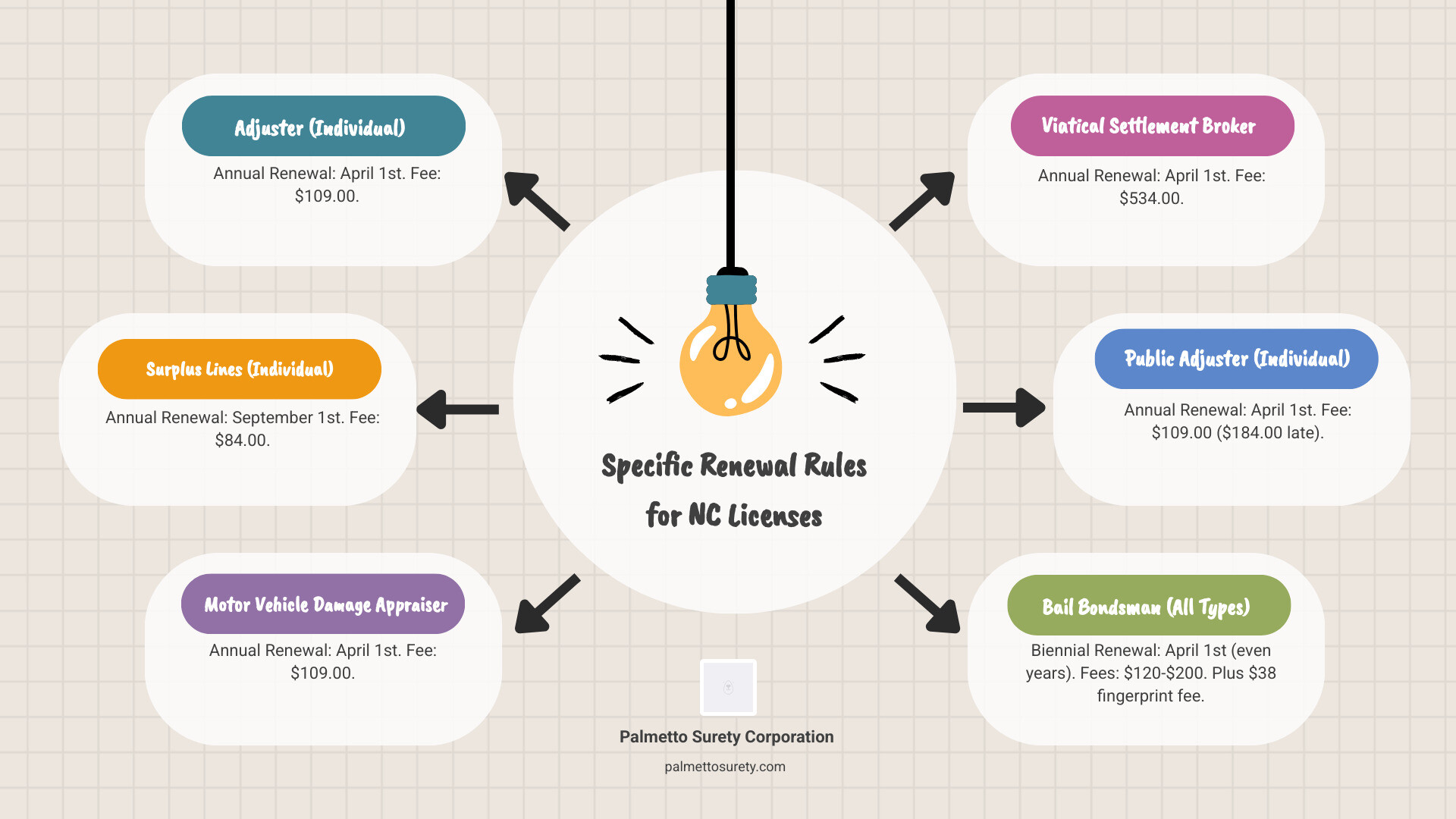
Adjuster licenses renew annually on April 1st with a $109 renewal fee. This applies to both individual adjusters and Motor Vehicle Damage Appraisers. Public Adjusters pay the same $109 fee but have an additional $184 late renewal fee if they miss the deadline.
Surplus Lines licenses follow a different schedule, renewing annually on September 1st with an $84 renewal fee. This lower fee makes it one of the more affordable renewal options in North Carolina.
The Viatical Settlement Broker license carries the highest renewal cost at $534, renewing annually on April 1st. This significant fee reflects the specialized nature and regulatory oversight required for this type of license.
Business entities like Corporations, Partnerships, and Public Adjuster Business Entities typically renew annually on April 1st through NIPR. These entities must ensure their Designated Responsible Licensed Person (DRLP) information stays current and is properly reported through the NIPR system.
Non-Insurance Business Entities (NIBE) such as collection agencies, motor clubs, and premium finance companies operate on their own timeline. They renew annually from early April through June 30th using the North Carolina License Management System (NCLMS).
Bail Bondsman License Renewal
Bail Bondsman licenses in North Carolina follow their own unique rhythm. Professional and Surety Bail Bondsman licenses carry a $200 renewal fee, while Bail Bond Runner licenses cost $120 to renew. All bail bondsman licenses renew biennially on April 1st of even-numbered years, giving you a generous renewal window that extends through June 30th.
Here’s where it gets interesting: bail bondsmen face an additional $38 fingerprint fee that applies every other renewal period. This requirement helps maintain the integrity and security standards expected in the bail bond industry.
Another key requirement is the affidavit submission, typically uploaded to the NIPR Attachment Warehouse. This paperwork ensures you’re maintaining compliance with all state regulations and professional standards.
For complete details and to stay fully compliant, we strongly recommend checking the Additional Bail Bondsman renewal requirements directly on the NC DOI website. The bail bond industry has specific regulations that can change, so staying informed through official channels is crucial.
Non-Resident Broker Bonds
Although North Carolina stopped issuing new Broker licenses in July 2022, existing non-resident brokers still have ongoing requirements to maintain. The most significant of these is the North Carolina Non-Resident Brokers Insurance Bond in the amount of $15,000.
This bond serves as a financial safety net, ensuring that brokers maintain their responsibility to clients and comply with state regulations. Think of it as the state’s way of saying, “We trust you, but let’s have some backup just in case.”
To maintain a valid broker license in North Carolina (for those grandfathered in before the July 2022 cutoff), you must also hold a valid agent’s license. The bonding process typically involves a straightforward online application and working with a licensed surety provider.
If you need help securing your NC insurance license extension or obtaining the required surety bond, working with an experienced surety company can streamline the process and ensure you meet all requirements on time.
Conclusion
Managing your NC insurance license extension and renewal requirements doesn’t need to keep you up at night. Once you understand the system, staying compliant becomes second nature.
The most important thing to remember is knowing your license type. If you hold a perpetual license for Life, Accident & Health, Property, Casualty, or Personal Lines, you’re in luck – no renewal applications needed. Just stay on top of your continuing education. For those with renewable licenses like Adjusters or Surplus Lines, you’ll need to juggle both CE completion and active renewal through NIPR.
Meeting your CE deadlines is non-negotiable. Those 24 biennial hours, including your 3 mandatory ethics hours, need to be completed by your birth month. Don’t forget about product-specific training if you’re selling annuities, long-term care, or flood insurance – these requirements can sneak up on you.
Life happens, and sometimes deadlines approach faster than expected. That’s where the 30-day NC insurance license extension becomes your safety net. For just $75, you can buy yourself crucial time through the Sircon portal. Just remember – request it before your license expires, not after.
Proactive license management pays dividends. Keep your contact information current through NIPR, know where to print your license when needed, and understand the reinstatement process. It’s much easier to prevent problems than fix them after the fact.
At Palmetto Surety Corporation, we’ve spent over 20 years helping insurance professionals steer the complexities of licensing and bonding requirements. We understand that your license is your livelihood, and maintaining compliance is crucial to your success.
Whether you need a non-resident broker bond or you’re looking to expand your services, we’re here to support your professional journey. Our team in Charleston has built relationships throughout the southeastern United States, and we pride ourselves on approving most applications within hours.
Ready to take the next step in your insurance career? Become a partner agent with us.


