


Bail Bonds Payment Plans: Easy 2025 Relief
Why Bail Bonds Payment Plans Matter for Families in Crisis
Bail Bonds Payment Plans provide a financial lifeline when families face the overwhelming cost of securing a loved one’s release from jail. When an arrest occurs, the financial burden can be crushing. Bail often runs into thousands of dollars, and even the 10% premium for a bail bond can be out of reach for many families. This is where payment plans become essential. Instead of paying $5,000 upfront for a $50,000 bail bond, you might pay $500 down and finance the rest, making justice accessible for working families.
Quick Answer – Bail Bonds Payment Plans:
- Down Payment: Typically 10-20% of the bail bond premium
- Payment Schedule: Weekly, bi-weekly, or monthly installments
- Duration: Cannot exceed the length of the defendant’s case
- Requirements: Employment verification, co-signer often needed
- Credit: Many agencies accept bad credit or offer no-credit-check options
- Premium: Non-refundable service fee, usually 10% of total bail amount
The process works through licensed bail bond agents who assess your financial situation and ability to make regular payments. Many agencies offer flexible terms, accept co-signers, and don’t require perfect credit scores.
I’m Haiko de Poel Jr., and through my work with Palmetto Surety Corporation and other companies in the bail bond industry, I’ve helped countless families use Bail Bonds Payment Plans to secure quick releases. My experience has shown me the practical challenges families face and the solutions that work best in real-world situations.
What Are Bail Bond Payment Plans and How Do They Work?
When a judge sets bail at $25,000, most families don’t have that kind of money available. A bail bond helps, but even the typical 10% premium ($2,500) can be a struggle to pay at once.
Bail Bonds Payment Plans solve this problem. Instead of paying the full premium immediately, you can work with a bail bond agent to spread the cost over manageable monthly payments. Think of it as financing a major expense, but this one brings your family member home.
When you contact a company like Palmetto Surety Corporation, we post the full bail amount with the court. In return, you pay us a non-refundable premium—usually 10% of the total bail. A payment plan simply lets you pay this premium through installment agreements rather than all at once.

This arrangement provides immediate financial relief when you need it most. Our network of licensed agents specializes in these bail surety bonds, making the legal process more manageable when crisis hits.

The Step-by-Step Process
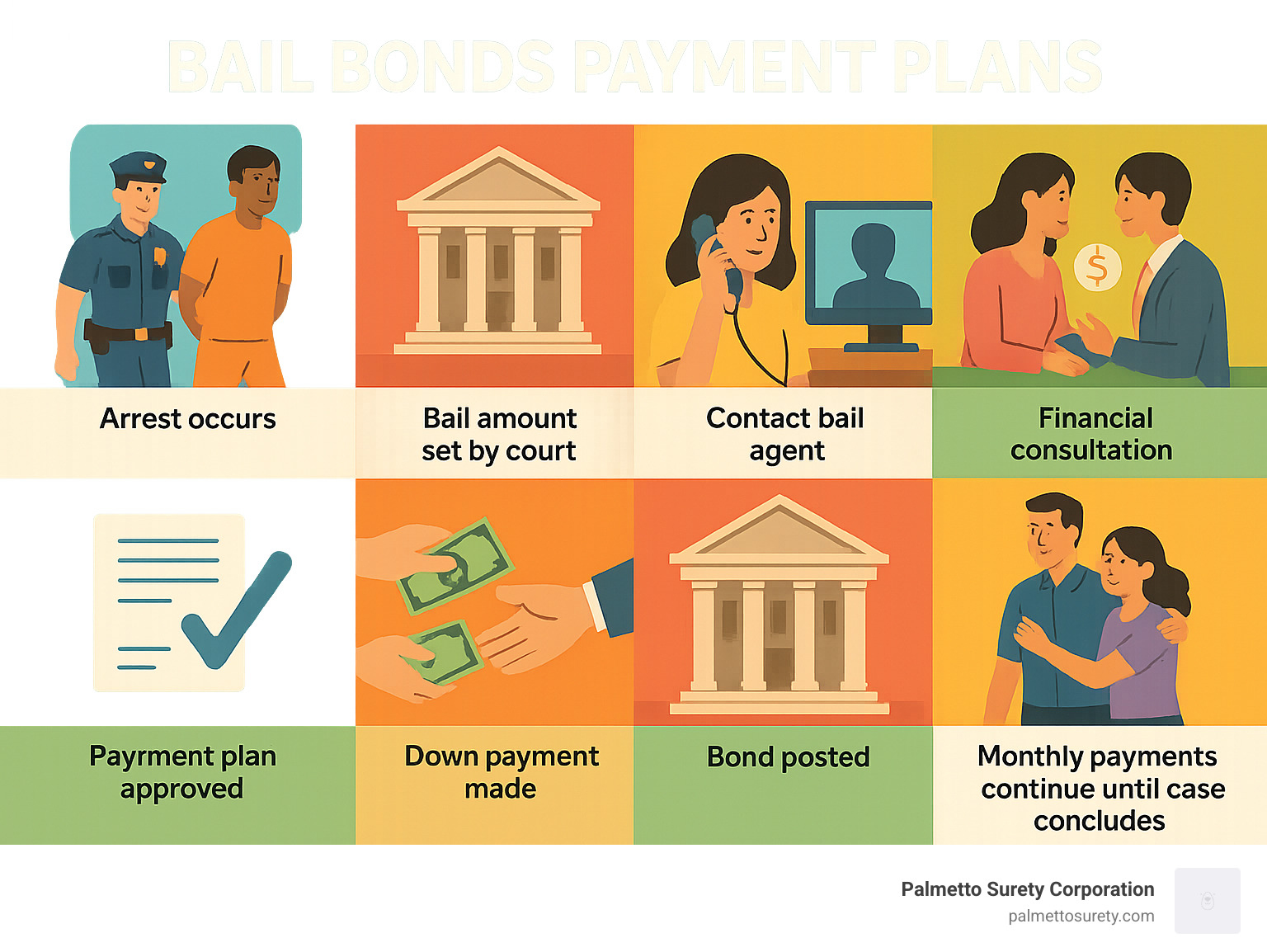
Getting someone out of jail with a payment plan is straightforward. Here’s how it works:
- Initial Consultation: This happens quickly, usually over the phone. We’ll ask for basic information about the case and your financial situation to see how we can help.
- Eligibility Assessment: We review your employment, residency, and whether you have a co-signer. A steady job often matters more than a perfect credit score.
- Down Payment: Once approved, you’ll make a down payment, typically 10-20% of the premium. For a $2,500 premium, that might be $250-$500 to get started.
- Contract Signing: You’ll sign a legal agreement outlining the payment schedule and terms. It’s important to read this carefully.
- Bond Posting: After the paperwork is complete, we post the bond with the court, and your loved one is released, often within hours.
- Regular Payments: You begin making payments according to the agreed-upon schedule (e.g., weekly, monthly) until the premium is paid in full. The plan continues until paid, regardless of the case’s outcome.
The Difference Between a Payment Plan and Paying Bail Upfront
Paying the full bail amount directly to the court is like a large, refundable deposit. You get most of it back (minus court fees) after the case is over, assuming the defendant attends all court dates.
Bail Bonds Payment Plans are different. We use our in-house financing to pay the full bail amount for you. You pay us a non-refundable service fee (the premium) for taking on this financial risk. The key benefits are that there are no third-party lenders or outside loans, and we don’t report to credit bureaus for inquiries or standard payments.
For a $20,000 bail, you could pay the court $20,000 upfront (which is returned later) or use our payment plan and pay perhaps $200 down on a $2,000 premium. The outcome is the same—your loved one is released—but our option doesn’t require you to drain your savings.
Are There Different Types of Bail Bond Payment Plans?
Yes. We offer various Bail Bonds Payment Plans because every family’s financial situation is unique. Just as there are different types of surety bonds, payment plans can be customized.
- Interest-Free Installments: Our most common option. You pay only the premium amount, divided into manageable payments.
- Low Down Payment Plans: For those with limited cash on hand, some plans require as little as 5% down to start.
- 1% Down Bonds: Available for well-qualified applicants, this could mean paying just $500 down on a $5,000 premium.
- No-Money-Down Options: These are rare and require excellent credit, stable employment, and a strong co-signer.
- Collateral-Based Plans: For larger bail amounts, you can secure the plan with assets like property or a vehicle title, which often allows for more flexible terms.
Qualifying for Bail Bonds Payment Plans
To qualify for a bail bond payment plan, our agents conduct a quick assessment to ensure the plan is realistic and to mitigate the financial risk of guaranteeing the defendant’s court appearance.
Key factors we consider include:
- Co-signer: A financially stable co-signer is often essential. They guarantee that payments will be made and that the defendant will appear in court.
- Employment Stability: A steady job history (often 12+ months) is a strong indicator of your ability to make consistent payments.
- Creditworthiness: While not always the deciding factor, your credit history (or your co-signer’s) can influence the payment plan’s terms.
- Risk Assessment: We evaluate the defendant’s arrest record, flight risk, and the severity of the charges.

Typical Requirements and Documentation
To speed up the process, have the following ready when you call:
- Government-Issued ID: A valid driver’s license, state ID, or passport for the indemnitor and any co-signers.
- Proof of Income: Recent pay stubs or a letter from your employer.
- Proof of Residency: A recent utility bill or lease agreement.
- Employment Verification: Your employer’s contact information.
- Personal References: Contact information for two or three references.
- Defendant’s Information: Full name, date of birth, charges, and jail location.
Having these documents prepared can help us approve applications within hours.
The Role of Credit History
We understand that not everyone has perfect credit. That’s why our network offers flexible options.
- Bad Credit Acceptance: We often work with individuals who have bad credit, focusing more on employment stability and ability to pay.
- No-Credit-Check Options: For some plans, especially with a higher down payment or collateral, a formal credit check may not be needed.
- Soft Credit Pulls: If a credit check is done, it’s usually a “soft pull” that won’t harm your credit score.
- Focus on Stability: A steady job and income often matter more than a high credit score.
- Co-signer Credit Score: A co-signer with good credit can help secure better terms or a lower down payment.
While credit is a factor, it’s rarely the only one. We aim to provide access to justice for people from all financial backgrounds. For more on how surety works, visit: More info on what is surety bond insurance.
Understanding the Down Payment
The down payment is the initial amount you pay to start a bail bond payment plan.
- Typical Percentage: The bail bond premium is usually 10% of the total bail for state charges (15% for federal). The down payment is typically 10-20% of this premium. For a $10,000 bail, the premium is $1,000, and a 10% down payment would be just $100.
- Low Down Payment Options: We often offer flexible options, sometimes requiring as little as 1-5% of the total bail amount as a down payment for qualified applicants.
- Non-Refundable Premium: The entire premium, including the down payment, is a non-refundable service fee. It is earned by the bail bond company for securing the defendant’s release and is not returned at the end of the case.
The down payment secures the bond and initiates the payment plan. For more on costs, see: More info on the cost of surety bonds.
Managing Your Plan: Costs, Terms, and Potential Pitfalls
A bail bond payment plan is a legal contract. Understanding the terms and diligently managing your payments are crucial to a smooth process and ensuring your loved one remains free while awaiting trial.

We understand that life happens, but communication is key. Our goal is to support you. If you need to make a payment, you can do so online or by contacting your agent: More info on how to make a payment.
Associated Fees and Payment Terms
Be aware of all costs and terms before signing:
- Late Fees: A fee (e.g., $25-$50) is typically applied if a payment is missed. Communicate with your agent before a payment is due if you foresee an issue.
- Payment Schedule: Plans are flexible, with weekly, bi-weekly, or monthly installments to match your income.
- Plan Duration: The payment plan must be completed while the defendant’s case is active.
- Early Payoff Options: Most plans can be paid off early without penalty.
- Interest-Free Plans: Many plans are interest-free, but always confirm this in your contract.
For more complex bonds, the underwriting process may have additional considerations. Learn more here: More info on large bond underwriting.
What Happens If You Miss a Payment?
Missing a payment is serious and has significant consequences:
- Bond Revocation: If you consistently miss payments, the bail bond company can revoke the bond.
- Re-arrest: Once a bond is revoked, a warrant is issued for the defendant’s arrest, and they will be returned to custody.
- Forfeiture of Collateral: Any collateral used to secure the bond can be forfeited to cover the outstanding balance.
- Co-signer Liability: The co-signer becomes legally responsible for all unpaid amounts and fees.
- Legal Action: The bail bond company may take legal action to recover the unpaid balance.
What to Do If You Have Trouble Making a Payment
If you anticipate difficulty making a payment, communicate with us proactively. Do not wait until the payment is late. Contact your bail agent immediately. We are much more willing to work with you if you are upfront about your challenges. Depending on the situation, it may be possible to renegotiate your payment schedule. Ignoring the problem will only lead to more severe consequences, including the re-arrest of the defendant. We are partners in this process and want to find a solution that works for everyone.
The Advantages and Impact of Using a Payment Plan
When an arrest turns your world upside down, a bail bond payment plan is a bridge back to normalcy. It offers the financial flexibility to get a loved one home tonight instead of leaving them in jail for weeks while you struggle to raise funds.
The quick release is critical. Time spent in jail can cost someone their job and disrupt family life. With a payment plan, we can post the bond immediately after the down payment, allowing you to manage the cost over time while your loved one prepares for their legal proceedings from home.
This approach provides genuine peace of mind. You avoid emptying your savings, selling assets, or taking out high-interest loans, protecting your long-term financial stability.

If a loved one is arrested in another state, transfer bonds can help. Learn more here: More info on transfer bonds.
The Benefits of Using a Bail Bond Payment Plan
- Affordability: A large premium becomes manageable when paid in smaller installments over time.
- Protect Your Assets: You won’t need to liquidate assets like your car or retirement funds to cover the immediate cost.
- Manageable Installments: We structure payments to align with your budget and pay schedule.
- Customized Plans: We create plans custom to your unique financial circumstances.
- Faster Jail Release: We can post the bond within hours of approval, without waiting for you to gather the full premium.
How Payment Plans Affect Collateral
Collateral provides extra security for Bail Bonds Payment Plans, especially for large bail amounts or high-risk cases. It acts as insurance for the bail bond company, allowing us to offer payment plans to more families.
Common forms of collateral include real property (like a home) or vehicle titles. Other valuable assets like jewelry or investment accounts may also be considered. Collateral is typically required only when the bail amount is very high or the financial risk is greater.
Most importantly, collateral is returned once all obligations are met. After you’ve made all payments and the defendant has fulfilled all court requirements, any collateral is released back to you. It is held as security, not taken as payment.
Frequently Asked Questions
Do I get my premium back if the case is dismissed?
No. The bail bond premium is non-refundable, regardless of the case’s outcome. Think of it as a fee for a service that has already been completed. The moment we post the bond and your loved one is released from jail, we have delivered the service you paid for. The premium is our fee for taking on the financial risk of guaranteeing the defendant’s appearance in court, and it is earned upon their release.
Are bail bond payment plans regulated?
Yes. The bail bond industry operates under strict state laws and regulations designed for consumer protection. Each state’s Department of Insurance oversees bail bond companies, setting maximum premium rates (usually 10% for state charges) and establishing guidelines. All agents must meet licensing requirements, including passing background checks and exams, ensuring you work with qualified professionals. You can find your state’s specific guidelines on its Department of Insurance website, like California’s here: State insurance department guidelines.
Can I get a payment plan for any type of charge?
In most cases, yes. Bail Bonds Payment Plans are available for a wide range of charges, from minor traffic violations and misdemeanors (like DUI or petty theft) to more serious felonies (like drug possession or fraud). Even federal charges can often qualify for a payment plan, though the premium is higher (15%).
The main exceptions are for high-risk cases. This includes charges like capital murder where bail may be denied, or cases with extremely high bail amounts that require substantial collateral. Defendants who are considered a significant flight risk or have a history of skipping court may also have difficulty qualifying for flexible payment terms. However, these situations are rare, and it’s always worth calling to discuss your specific case.
Conclusion
When a loved one is arrested, the financial burden can feel as overwhelming as the emotional stress. Bail Bonds Payment Plans provide a critical lifeline, changing an impossible upfront cost into a series of manageable payments that fit your budget.
These plans make a quick release possible, allowing your family member to return to work, be with family, and actively participate in their defense. The value of this stability is immeasurable. The key is to understand that the non-refundable premium is a service fee for securing that freedom.
At Palmetto Surety Corporation, our network of licensed agents has over 20 years of experience helping families steer these exact situations. We understand that every situation is unique, which is why we work to approve most applications within hours. We know that every moment matters.
Success with a payment plan depends on honest communication. Ask questions and contact your agent immediately if you face payment difficulties. Don’t let financial constraints keep your family separated. The right payment plan can bring your loved one home tonight.
Find a bail bond agent near you


