


General contractor license Alabama: 5 Steps to Success
Alabama’s Growing Construction Market Creates Opportunity
General contractor license Alabama requirements are the gateway to participating in one of the nation’s most dynamic and promising construction markets. Alabama’s construction sector is a powerful engine for the state’s economy, ranking 8th in business volume and boasting a robust 3.2% annual growth rate. This sustained expansion has led to a consistent increase in contractor employment, which has risen by 1.8% every year since 2014, signaling a strong and steady demand for skilled, licensed professionals.
Whether you plan to manage ground-up commercial builds, municipal infrastructure, or complex tenant improvements, licensing does more than satisfy a legal requirement—it signals to clients, lenders, and project partners that your firm has the financial stability, technical competency, and risk controls to deliver. A license also expands your access to public and private bid lists and helps you qualify for larger scopes with stricter procurement standards.
For those ready to take the next step, here’s a clear overview of what you’ll need to get started.
Quick Answer: Alabama General Contractor License Requirements
- Commercial Projects: Any commercial or public works project with a total cost of $50,000 or more requires a General Contractor License issued by the Alabama Licensing Board for General Contractors (LBGC).
- Residential Projects: For residential construction, remodeling, or repair projects exceeding $10,000 in value, a Home Builders License from the Home Builders Licensure Board (HBLB) is mandatory.
- Application Fee: The initial application fee is $300 for a General Contractor license and $350 for a Home Builders license. These fees are non-refundable.
- Financial Requirement: Applicants must demonstrate financial stability with a minimum of $10,000 in net worth and working capital, verified by a CPA.
- Exams Required: All applicants must pass the Alabama Business and Law exam. Depending on the classification sought, one or more trade-specific exams will also be required.
- Annual Renewal: To remain in good standing, all contractor licenses in Alabama must be renewed annually.
The financial incentives for becoming a licensed contractor in Alabama are significant. Alabama general contractors earn an average annual salary of $123,000, with the top 10% of earners commanding salaries upwards of $151,000. This high earning potential, coupled with Alabama’s valuable license reciprocity agreements with neighboring states like Arkansas, Louisiana, Mississippi, and Tennessee, makes obtaining a license a strategic and lucrative business decision. Reciprocity allows licensed contractors to expand their operations across state lines with a streamlined application process, opening up a much larger regional market.
If you are new to licensing in Alabama, plan your path with a simple framework:
- Set your target classifications early so you can take the correct trade exams the first time.
- Build a clean, CPA-prepared financial statement that aligns with the Board’s requirements and clearly demonstrates net worth and working capital.
- Schedule your Business and Law exam as soon as you are eligible, and reserve trade exam dates that align with board meeting deadlines so you avoid avoidable delays.
- Assemble verifiable work history and references that support your requested classification(s).
Common pitfalls include submitting financials without the appropriate CPA verification, choosing classifications that do not match your actual project experience, and missing board deadlines. Each of these can extend your timeline or require rework. A little upfront planning saves weeks.
Whether your ambition is to erect cutting-edge commercial office spaces, develop sprawling residential communities, or specialize in critical highway and infrastructure projects, understanding and meeting Alabama’s licensing requirements is the foundational first step toward legal operation, professional credibility, and sustainable business growth.

I’m Haiko de Poel Jr., and my work at Palmetto Surety Corporation is dedicated to helping contractors steer the complexities of the licensing process. A key, and often challenging, component is securing the required surety bonds. I’ve assisted hundreds of contractors in meeting the General contractor license Alabama bonding requirements, leveraging my experience in business consulting and the construction industry to simplify the process. I understand the practical problems contractors face, and my goal is to provide the swift, reliable bonding solutions you need to get licensed and get to work.
What to expect from the surety side:
- You complete a short application and provide basic financial information; larger bond amounts may require additional documentation.
- We evaluate your request quickly—Palmetto Surety is structured to approve most applications within hours.
- If the Board requires a bond as part of your application or to support your financials, we help you select the appropriate bond and deliver it fast so you can meet board deadlines.
Fast bonding support means you can keep momentum: pass your exams, submit a complete application package, and move straight into bidding season without losing weeks to paperwork.
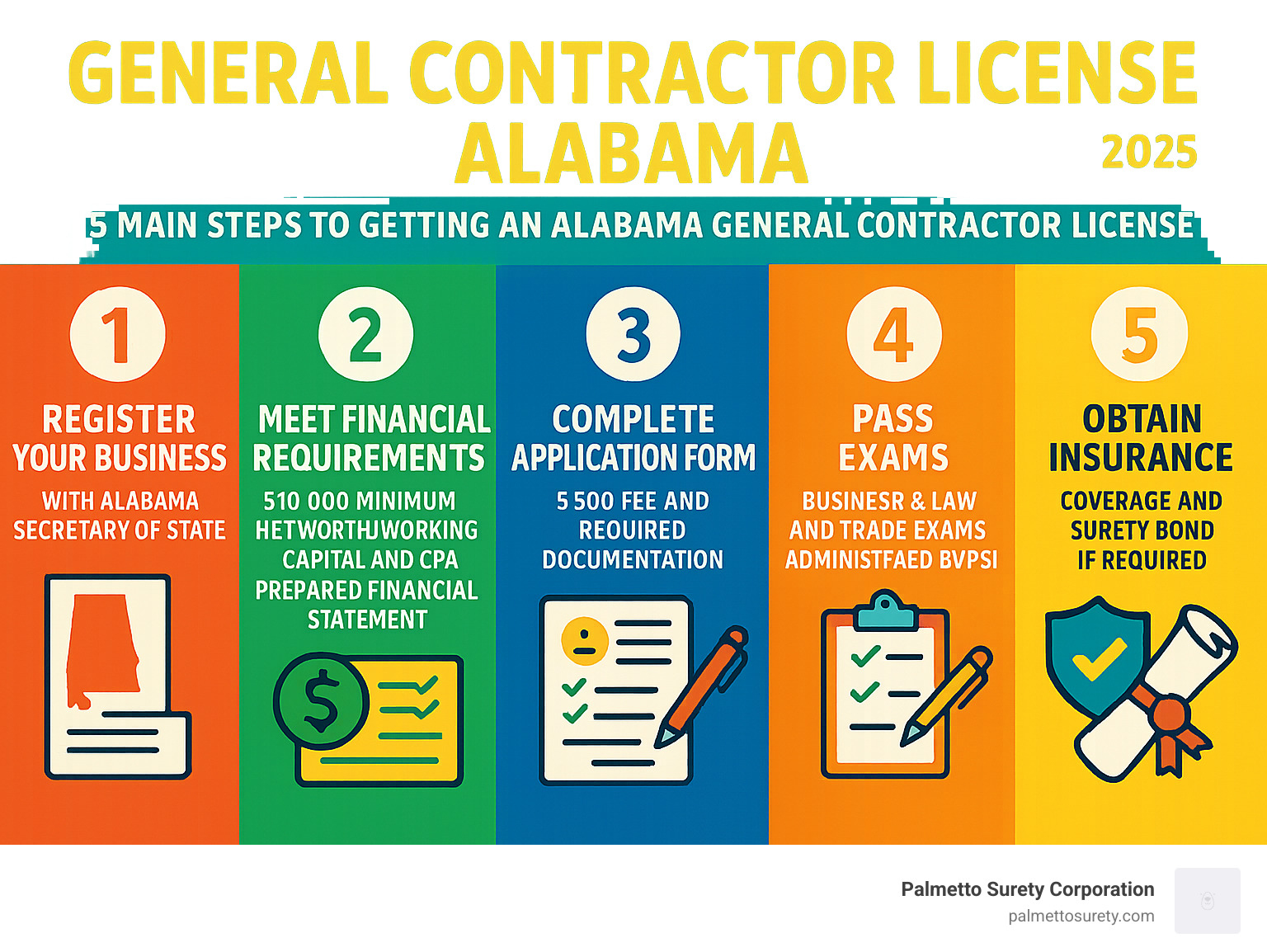
As you work through those steps, budget your time for board meeting calendars and exam availability. Many contractors find that aligning the CPA statement, application, and test dates around upcoming board meetings reduces the overall time to licensure. With an organized plan and the right partners, you can move from planning to permitting and project mobilization with confidence.
Who Needs a Contractor License in Alabama?

Alabama maintains a clear and structured approach to contractor licensing, but understand one fundamental distinction. The state operates two separate licensing boards, each with jurisdiction over different types of construction work. This separation ensures that contractors possess the specialized knowledge and qualifications necessary for their specific field, which ultimately protects consumers and upholds professional standards across the industry.
The Alabama Licensing Board for General Contractors (LBGC) is the governing body for all commercial, industrial, and public works projects. If your business involves constructing office buildings, retail centers, warehouses, manufacturing plants, or public infrastructure like roads and bridges, the LBGC is your licensing authority. A General contractor license Alabama from the LBGC is required whenever the total project cost, including labor and materials, reaches $50,000 or more. It’s worth noting a specific exception: swimming pool construction requires a license for any project valued over $5,000, a much lower threshold reflecting the specialized nature of the work.
For any work related to housing, the Home Builders Licensure Board (HBLB) is in charge. This board oversees contractors who build, remodel, repair, or improve residential structures. The licensing threshold for residential work is significantly lower; you must obtain a Home Builders License for any project exceeding $10,000. The HBLB defines residential structures as buildings that are three stories or less in height and contain no more than four individual residential units.
What about subcontractors? The state’s regulations ensure accountability down the entire project chain. Even if you are working under a properly licensed prime contractor, Alabama law requires you to obtain your own subcontractor license from the LBGC if your specific portion of the work is valued at $50,000 or more. For example, if you are an HVAC contractor hired for a new commercial building and your contract is for $75,000, you must be licensed, regardless of the prime contractor’s status.
Here is a direct comparison of the two primary licensing paths:
| Feature | General Contractor License (LBGC) | Home Builder License (HBLB) |
|---|---|---|
| Governing Board | Alabama Licensing Board for General Contractors | Home Builders Licensure Board |
| Project Types | Commercial, industrial, public works, swimming pools | Residential construction, remodeling, repairs |
| Cost Threshold | $50,000+ ($5,000+ for pools) | $10,000+ |
Understanding these differences is the first step toward ensuring full compliance with Alabama law. Both boards provide extensive resources to guide applicants. You can find detailed statutes and rules for general contractors on the LBGC’s website and review the specific regulations for home builders via the HBLB’s resources.
The bottom line is clear: if your construction work in Alabama surpasses these financial thresholds, securing the appropriate license is not optional. It is a legal requirement that protects your business, validates your professionalism, and provides peace of mind for your clients.
Practical examples to help you determine the right path:
- LBGC license scenarios: ground-up office buildings, retail shopping centers, tilt-up warehouses, medical office interiors, wastewater or utility work, roadway improvements, and most municipal or state-funded projects at or above the threshold.
- HBLB license scenarios: new single-family homes, duplexes, townhomes, and residential remodeling (kitchens, additions, major roof replacements, structural repairs) where the contract exceeds the $10,000 threshold.
- Swimming pools: commercial or residential pool construction triggers licensure with the LBGC at $5,000 or more.
Out-of-state firms planning to work in Alabama should also account for business registration steps before bidding. If you are organized in another state, you may need to register with the Alabama Secretary of State as a foreign entity and ensure your company name and structure match what will appear on your license, contracts, and insurance certificates.
Before you bid, offer, or contract for work that meets or exceeds the applicable threshold, confirm that your license classification covers the scope. Owners, construction managers, public agencies, and many private GCs will verify your license at the prequalification or bid stage; being properly licensed early removes a common obstacle to award. Subcontractors should follow the same rule of thumb—if your subcontract amount reaches the threshold, you need the appropriate subcontractor license from the LBGC.
A few additional considerations as you evaluate your needs:
- Project valuation is key. The threshold is based on the total cost of the work for which you are responsible, typically including labor and materials.
- Multi-unit residential projects can cross between boards depending on height and unit count. The HBLB definition for residential work is limited to three stories and four or fewer units.
- Limited statutory exemptions exist and are narrowly defined. If you believe an exemption could apply to your situation, review the statutes directly and contact the appropriate board for confirmation before proceeding.
Licensure is more than a compliance checkbox—it is a qualification signal that can shorten subcontract award cycles, improve client trust, and open doors to larger, more complex projects. If your board or a project owner requires a surety bond as part of prequalification, Palmetto Surety can help you source the bond quickly so you can keep your bid or contract moving without delay.


