


Bail Bondsman Pay Scale: 7 Powerful Salary Facts 2025
The Reality Behind Bail Bondsman Earnings
Understanding the bail bondsman pay scale is crucial for anyone considering this unique career path in the criminal justice system. Whether you’re exploring a career change or simply curious about how much these professionals actually earn, the numbers might surprise you.
Quick Answer: Bail Bondsman Pay Scale Overview
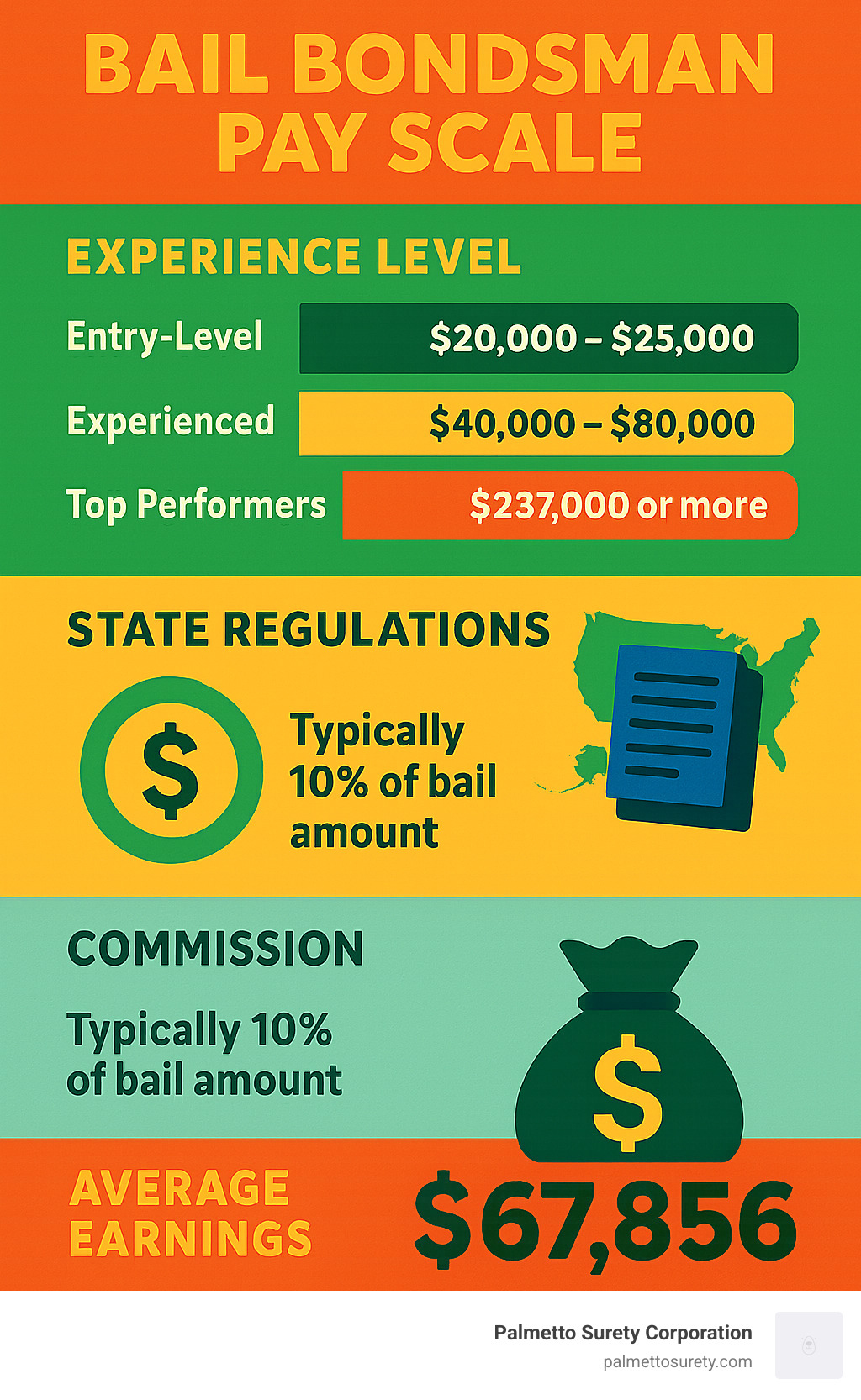
– National Average: $67,856 annually (range: $40,000-$100,000+)
– Georgia Average: $65,447 annually (range: $54,658-$96,072)
– Entry-Level: Around $20,000-$25,000 per year
– Experienced Agents: $40,000-$80,000 per year
– Top Performers: $100,000-$237,000+ annually
– Commission Rate: Typically 10% of bail amount (varies by state)
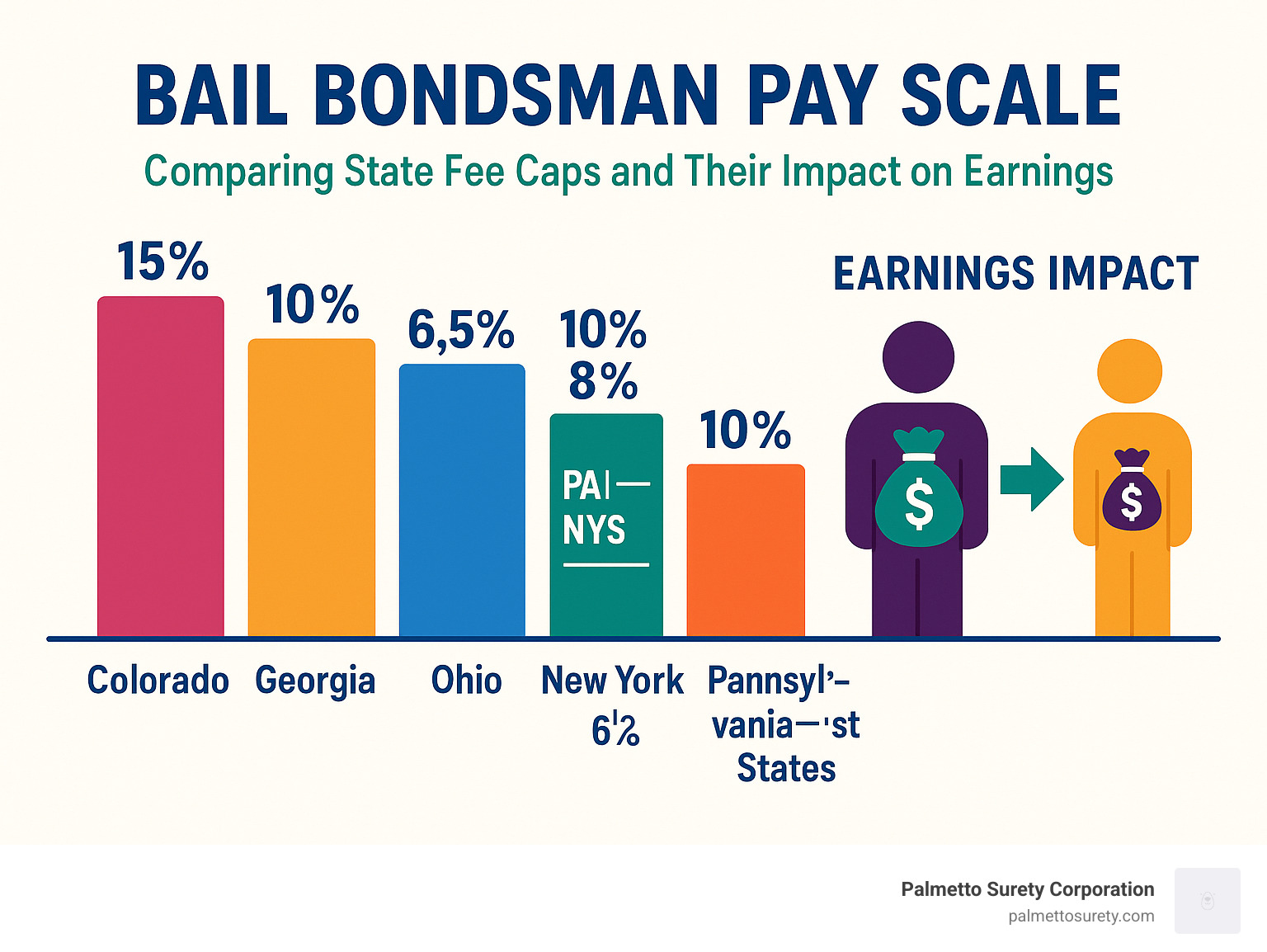
The bail bonds industry operates on a commission-based model where agents earn a percentage of each bond they write. State regulations heavily influence earning potential – for example, Colorado allows agents to charge 15% of the bail amount while Ohio caps fees at just 6.5%.
Location plays a massive role in income potential. Urban areas near busy jails typically offer higher volume and larger bail amounts, while rural agents may handle fewer cases but face less competition.
As Haiko de Poel Jr., I’ve worked extensively with bail bond professionals through my role at Palmetto Surety Corporation, helping agents understand the bail bondsman pay scale and licensing requirements across the southeastern United States.
Bail bondsman pay scale word guide:
– how do bondsman make money
– how does a bondsman work
Understanding the Bail Bondsman Business Model
Think of a bail bondsman as a financial middleman in the criminal justice system. Unlike traditional salary jobs, these professionals work as surety agents who earn their living through commissions on the bonds they write.

Here’s how it works: Someone gets arrested, and the judge sets bail at $50,000. Most families don’t have that kind of cash, so they call a bail bondsman. The bondsman posts the full $50,000 to the court and charges a non-refundable fee of around 10% – that’s $5,000 straight into the bondsman’s pocket.
This commission-based model drives the bail bondsman pay scale across the country. The more bonds you write and the larger those bonds are, the more you earn.
The catch? If that defendant skips town instead of showing up for court, the bondsman is on the hook for the entire $50,000. This is where collateral, careful screening, and sometimes bounty hunters become part of the business equation.
Scientific research on bail bond system shows that roughly half of all detainees released before trial need bondsman services.
How Bail Bondsmen Make Money
The bread and butter of any bail bondsman’s income is that 10% commission – though the exact percentage varies dramatically by state. In Colorado, agents can charge up to 15% of the bail amount, while Ohio caps fees at just 6.5%.
Beyond the basic fee structure, smart bondsmen find additional revenue streams. Payment plans with service charges help clients who can’t pay the full fee upfront. Collateral management might involve storing and tracking valuable items.
When defendants fail to appear, skip-tracing costs become both an expense and potential income source. Some bondsmen offer these investigative services to other agents.
The key to maximizing income is volume and efficiency. Experienced agents build relationships with defense attorneys, maintain 24/7 availability, and streamline their paperwork process.
Handling Failures to Appear
When someone skips their court date, the bondsman typically has 30 to 180 days to locate and return them before forfeiting the full bail amount to the court.
Fugitive recovery becomes a race against time and money. Professional bounty hunters usually charge 10-25% of the bond amount, plus expenses. A $50,000 bond could easily cost $15,000 or more to recover.
Smart bondsmen protect themselves through indemnitor liability – making co-signers responsible for the full amount if recovery efforts fail. They also require substantial collateral like property deeds or vehicle titles.
The seizure of collateral becomes the last resort when all else fails. This might mean foreclosing on someone’s home or repossessing their car to cover the forfeited bond amount.
Successful agents minimize these risks by thoroughly screening clients and building networks throughout the local criminal justice system.

Bail Bondsman Pay Scale: National to State Breakdown
Let’s explore the real numbers behind the bail bondsman pay scale. The data reveals some fascinating patterns – and significant opportunities for those willing to work smart.
Average Bail Bondsman Pay Scale in the United States
The national average for bail bondsmen sits at $67,856 annually, but this number only tells part of the story. The reality is much more nuanced, with earnings spanning from around $40,000 to well over $100,000 depending on your approach and location.
Here’s what the percentile breakdown looks like across the country:
The bottom 10% of earners make around $56,670 annually – these are typically new agents still building their client base or those working in very low-volume markets. The 25th percentile sits at $62,001, while the median earnings hit that $67,856 mark we mentioned earlier.
Things get more interesting at the top end. High-performing agents in the 75th percentile earn $84,476, while the top 10% bring in $99,608 or more. The absolute top performers? Some are pulling in over $237,000 annually – though these are typically agents with decades of experience working in major metropolitan areas.
The wide range reflects something important about this business: success isn’t guaranteed by just getting licensed. The agents earning six figures have mastered the art of building relationships, managing risk, and positioning themselves in high-volume markets.
Georgia Bail Bondsman Pay Scale in Focus
Georgia offers a particularly interesting case study for the bail bondsman pay scale. The state average of $65,447 falls just slightly below the national average, but the range from $54,658 to $96,072 shows there’s plenty of room for growth.
What makes Georgia attractive for bail bond professionals? The state has several major metropolitan areas – Atlanta, Augusta, Columbus, and Savannah – each with busy court systems and steady demand for bail services. The regulatory environment is reasonable, and Georgia’s growing population continues to drive demand.
From our experience working with agents across Georgia at Palmetto Surety Corporation, we’ve seen that location within the state matters tremendously. Agents working near the Fulton County Jail in Atlanta or the busy courts in Savannah typically handle much higher volumes than those in rural counties. The trade-off? Urban areas also mean more competition and higher overhead costs.
The sweet spot seems to be agents who understand their local market deeply – whether that’s knowing which defense attorneys refer clients or understanding the typical bail amounts for different types of cases in their jurisdiction.
State Fee Caps & Premium Limits
Here’s where things get really interesting for anyone considering this career path. State regulations directly impact your earning potential in ways that might surprise you.
| State | Maximum Fee | Additional Notes |
|---|---|---|
| Colorado | 15% (min $50) | Highest allowed rate |
| Ohio | 6.5% | Lowest cap in nation |
| Pennsylvania | 10% under $100, then 5% | Tiered system |
| New York | 10%/8%/6% tiers | Complex sliding scale |
| Georgia | 10% | Standard rate |
| Most States | 10% | Industry standard |
Consider this example: A defendant needs a $100,000 bond. In Colorado, the agent can charge up to $15,000 for their services. In Ohio, that same bond generates only $6,500. That’s more than double the income for the exact same work!
New York uses a tiered system that starts at 10% for the first $3,000 of bail, drops to 8% for the next $7,000, and then 6% for amounts above $10,000. Pennsylvania has its own unique structure with different rates for different bail amounts.
These regulatory differences explain why some states have thriving bail bond industries while others struggle to attract agents. Smart professionals often research state regulations before deciding where to establish their practice.
The 10% standard rate used by Georgia and most other states represents a middle ground – high enough to make the business profitable, but not so high that it creates political pressure for reform.
Factors That Make or Break Your Income
Success in the bail bonds industry isn’t just about getting licensed and waiting for clients. The bail bondsman pay scale varies wildly based on several key factors that can make the difference between struggling and building a six-figure business.
Your location is probably the biggest factor affecting your income. An agent working near a busy urban jail will see completely different earning potential than someone serving a small rural county. More arrests mean more potential clients, and urban areas typically see higher bail amounts.
Experience and reputation take years to build but dramatically impact your earning potential. New agents often struggle because defendants want to work with someone they trust. Building relationships with defense attorneys and court personnel creates a steady referral stream.
The size of bail amounts in your market directly affects your income since you earn a percentage of each bond. Areas with higher crime rates typically see larger bail amounts, which translates to higher fees per case.
Specialization can significantly boost your earnings. Agents who handle immigration bonds, federal cases, or appeal bonds often charge premium rates because these require specialized knowledge and involve higher risks.
Your professional network determines how much business comes your way. Successful agents maintain strong relationships with defense attorneys, who often recommend specific bondsmen to their clients.
More info about bail surety bonds provides additional context on how the surety relationship affects agent earnings and business operations.
New vs Experienced Bail Bondsmen
The bail bondsman pay scale shows a dramatic progression from entry-level to experienced professionals, with earnings often doubling or tripling as agents gain experience.
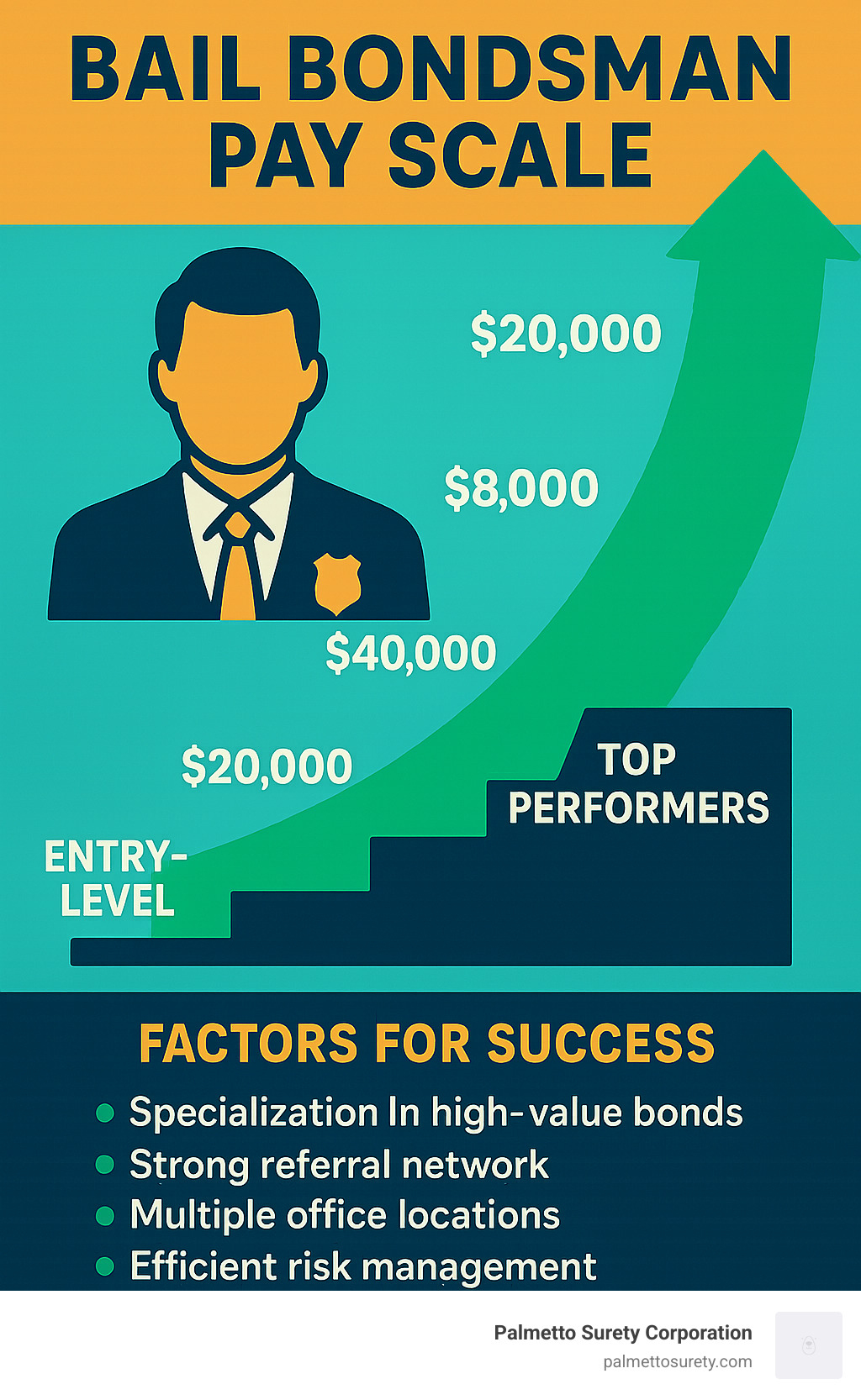
Entry-level agents typically earn around $20,000-$25,000 annually during their first two years. These new professionals often work for established agencies while learning the business, handling smaller bonds and lower-risk clients.
Mid-career agents with 3-10 years of experience usually earn $40,000-$60,000 per year. By this point, they’ve developed relationships with local attorneys and court personnel, understand risk assessment, and may have transitioned to independent operations.
Experienced specialists with over 10 years in the business often earn $80,000-$150,000 or more annually. These professionals have built strong reputations and referral networks that provide steady business. They may own agencies with multiple agents or specialize in complex bond types.
The learning curve is steep, and many new agents don’t survive their first few years. Those who do often build sustainable, profitable practices.
Urban vs Rural Pay Gaps
The difference between urban and rural markets is like comparing a busy restaurant in downtown Manhattan to a small-town diner. Both can be profitable, but the volume and earning potential are completely different.
Urban markets offer significant advantages. Cities typically see higher arrest volumes, creating more opportunities. Bail amounts tend to be larger due to more serious crimes, and there are multiple courts and jails to serve. A successful urban agent might handle 15-20 bonds monthly with average values of $25,000-$50,000.
However, urban markets come with challenges. Competition is fierce, overhead costs are higher, and the legal environment is more complex.
Rural markets offer less competition, lower overhead costs, and agents often develop closer relationships with local courts. The client base is more predictable, and word-of-mouth referrals carry more weight.
The downside is volume and bail amounts. Rural agents might process only 5-10 bonds monthly, with average values of $5,000-$15,000. Growth potential is limited by local population and crime rates.
The math clearly favors urban markets for earning potential, but rural agents can build sustainable businesses with lower stress and overhead costs.
Getting Licensed: Education, Costs & Ongoing Expenses
Getting your foot in the door as a bail bondsman requires more than just ambition—it demands a real investment in licensing, education, and startup costs. Before you can start earning on the bail bondsman pay scale, you’ll need to steer state requirements.
Most states require you to be at least 18 (sometimes 21), be a U.S. citizen or legal resident, and have a clean criminal background. You’ll also need to complete pre-licensing education ranging from 8 to 40 hours depending on your state, pass a written exam, get fingerprinted, and secure a surety bond.
The licensing process typically takes 4-8 weeks from start to finish, assuming you pass the exam on your first try.

Typical Up-Front Costs
Getting started as a bail bondsman isn’t cheap, and you’ll need to budget carefully before you can start climbing the bail bondsman pay scale.
Your education and licensing costs will run between $400-$1,650 total. This includes your pre-licensing course ($200-$800), state exam fee ($50-$200), application fee ($100-$500), and fingerprinting plus background check ($50-$150).
The surety bond requirement is where things get expensive. States typically require bonds between $5,000-$50,000, and you’ll pay an annual premium of 1-15% of that amount. That means anywhere from $50 to $7,500 yearly, depending on the bond amount and your credit score.
At Palmetto Surety Corporation, we’ve helped hundreds of new agents secure their required bonds over our 20+ years in business. Most of our new agents with decent credit pay between $500-$2,000 annually for their required bonds.
If you’re going independent right away, add business setup costs like office space ($500-$2,000 monthly), professional insurance ($1,000-$5,000 annually), and initial operating capital ($10,000-$50,000) to cover your first few bonds.
Most new agents should budget $15,000-$30,000 in total startup costs before writing their first bond.
Continuing Compliance Costs
The expenses don’t disappear once you’re licensed. Running a bail bond business involves ongoing costs that eat into your earnings throughout your career.
Annual renewals are your biggest recurring expense. Your license renewal runs $100-$500, your surety bond premium needs to be paid again ($50-$7,500 depending on requirements), and most states require continuing education ($100-$500).
Insurance costs add up quickly. Professional liability insurance runs $1,000-$3,000 annually, while errors and omissions coverage adds another $500-$2,000. These aren’t optional—they’re essential protection.
Marketing and advertising become crucial for building your client base. Successful agents typically spend $2,000-$10,000 annually on everything from Yellow Pages ads to Google advertising.
Then there are the risk management costs. Skip-tracing services cost $50-$500 per case when clients disappear. Fugitive recovery fees can run 10-25% of the bond amount. Complex forfeiture cases might require legal representation costing $1,000-$10,000 or more.
Smart agents budget 15-25% of their gross income for ongoing business expenses. This helps ensure you stay profitable even during slower periods.
Risks, Rewards & Career Outlook
The bail bonds industry presents a fascinating mix of opportunity and challenge that directly impacts the bail bondsman pay scale. Like any entrepreneurial venture, success requires understanding both the potential rewards and the very real risks involved.
The financial rewards can be substantial. Unlike traditional jobs with salary caps, your earning potential is truly unlimited based on your effort, skill, and business acumen. Many agents appreciate the flexible schedule and independence that comes with running their own practice.
The industry also offers recession resistance. Unfortunately, people get arrested during good times and bad. Crime doesn’t stop during economic downturns, which means steady demand for bail bond services. There’s also genuine satisfaction in helping people during difficult moments – reuniting families and giving defendants the chance to maintain their jobs while awaiting trial.
For successful agents, the business can become a valuable asset that generates income even when you’re not actively working. Established agencies with strong reputations can be sold or passed down to family members.
However, the risks are equally significant. The most obvious is financial liability for full bail amounts. When you post a $100,000 bond and the defendant disappears, you’re on the hook for the entire amount. This liability can destroy unprepared agents financially.
There’s also physical danger when dealing with fugitives and their associates. While most clients are cooperative, some cases involve violent offenders or desperate situations.
Legal exposure represents another serious concern. Bail bond regulations are complex and vary by jurisdiction. Violations can result in license suspension, fines, or even criminal charges. The irregular income and cash flow challenges also create stress.
Perhaps most challenging is the emotional toll of working with desperate clients and their families during crisis situations.
The industry outlook remains cautiously optimistic despite ongoing reform discussions. Some jurisdictions have eliminated cash bail for certain non-violent offenses, while others have expanded pre-trial release programs. However, the fundamental need for bail bond services persists.
Current data shows that about 460,000 people are held in pre-trial detention daily across the United States. Approximately 50% of released defendants use bail bond services, creating a substantial market. The industry handles over 30,000 fugitive recoveries annually.
Market size has remained relatively stable despite reform discussions. Wikipedia bail bondsman resources provide additional context on industry evolution.
Experience in bail bonds opens doors to several related career paths if you decide to transition. Fugitive recovery agents (bounty hunters) can earn $50,000-$80,000 annually, while private investigators average around $50,000 per year. Court services officers typically earn $40,000-$60,000 annually, and insurance investigators make $45,000-$70,000 per year.
These alternative careers often value the skills you develop in bail bonds: risk assessment, client relations, legal procedure knowledge, and crisis management.
The key to success in this industry is thorough preparation, strong financial backing, and realistic expectations. Those who succeed typically combine business acumen with genuine care for their clients, building reputations that generate steady referrals and long-term profitability.
Frequently Asked Questions about Bail Bondsman Pay
Understanding the bail bondsman pay scale often raises specific questions about how this unique industry actually works. Let me address the most common concerns I hear from people considering this career path.
What percentage of the bail amount is the standard fee?
Most bail bondsmen charge 10% of the total bail amount as their standard fee. This has become the industry norm across most states, but don’t assume it’s universal – state regulations create significant variations that directly impact your earning potential.
Colorado leads the pack by allowing agents to charge up to 15% of the bail amount, with a minimum fee of $50 even on small bonds. This means a Colorado agent writing a $10,000 bond earns $1,500, while their counterpart in most other states makes $1,000 on the same case.
On the flip side, Ohio caps fees at just 6.5%, which significantly limits earning potential. That same $10,000 bond only generates $650 in Ohio – less than half what a Colorado agent makes.
Some states get creative with tiered systems. New York starts at 10% for smaller amounts but drops to 8% on the portion between $3,000-$10,000, then down to 6% above $10,000. Pennsylvania takes a similar approach with 10% under $100, then 5% on higher amounts.
This fee is completely non-refundable regardless of what happens with the case. Whether the defendant shows up to every court date or disappears immediately, you keep that fee as compensation for the financial risk you’re taking.
Do bail bondsmen earn a salary, commission, or both?
The bail bondsman pay scale structure varies dramatically depending on whether you work independently or for an agency. Most professionals in this field work on commission-only arrangements, which explains why earnings can range so widely.
Independent agents keep 100% of the fees they generate, minus their business expenses like surety bond premiums, office rent, and marketing costs. This offers unlimited earning potential but also means no income during slow periods.
Agency employees typically earn between 25-50% of the fees on bonds they write. While this means giving up half your potential income, it also provides more stability and often includes benefits like health insurance or paid vacation time.
Some larger agencies offer hybrid arrangements with base salaries ranging from $25,000-$40,000 plus commission on bonds written. This structure helps new agents survive while building their client base and learning the business.
Entry-level positions sometimes pay hourly wages of $10-$15 while you’re training, but these are usually temporary arrangements. The real money in this business comes from building relationships and writing bonds consistently over time.
What is the earning potential for top-performing independent agents?
Here’s where the bail bondsman pay scale gets really interesting. The highest-performing independent agents regularly earn $100,000-$200,000+ annually, with some exceptional cases reaching $237,000 or more.
What separates top earners from average agents? They typically specialize in high-value bonds like federal cases, immigration holds, or appeal bonds where the stakes – and fees – are much higher. A single federal bond might generate $5,000-$15,000 in fees compared to $500-$1,500 for typical local cases.
Location matters enormously for reaching these income levels. Top performers usually work in major metropolitan areas near busy federal courts or immigration detention centers. They’ve also built strong referral networks with defense attorneys who handle serious cases requiring substantial bonds.
Multiple revenue streams help push earnings higher. Many successful agents offer fugitive recovery services, own multiple office locations, or even franchise their operations. Some expand into related services like private investigation or court consulting.
The key insight from our 20+ years at Palmetto Surety Corporation is that consistency and reputation drive the highest earnings. Agents who reliably handle complex cases without forfeitures attract the most lucrative referrals and can command premium fees for specialized services.
Conclusion
The bail bondsman pay scale tells a story of opportunity mixed with real challenges. If you’re thinking about this career, the numbers paint a picture worth considering carefully.
Starting out, you’ll likely earn around $20,000-$25,000 your first couple years while you learn the ropes and build relationships. But here’s where it gets interesting – experienced agents regularly pull in $40,000-$80,000 annually, and the real go-getters who master the business can hit $100,000-$200,000 or more.
Your location matters more than almost anything else. Working near busy urban jails means more clients and bigger bonds, while rural areas offer less competition but smaller opportunities. State rules create your earning ceiling too – Colorado agents can charge 15% while Ohio caps you at just 6.5%.
The path isn’t for everyone. You’ll need solid startup capital, stomach for financial risk, and patience to build your reputation. Some months will be feast, others famine. But for those who stick with it and develop good business sense, the bail bondsman pay scale rewards dedication.
Reform efforts keep making headlines, but people still get arrested and need help making bail. The core demand remains strong across most markets, especially in areas we serve throughout the southeastern United States.
At Palmetto Surety Corporation, we’ve watched agents build successful practices for over 20 years. What separates the winners from those who struggle? Usually it comes down to understanding the business side, managing risk smartly, and treating clients with respect during their worst moments.
The bail bonds industry offers genuine paths to financial independence, but success requires more than just showing up. Master the fundamentals, build solid relationships, and manage your risks well – that’s how agents climb the bail bondsman pay scale ladder.
Whether you’re exploring this career or looking to grow your existing practice, every successful agent started somewhere. With the right approach and support, you can build something meaningful while helping people steer difficult situations.


