


Commercial Surety Underwriting: Top 5 Key Insights 2024
Understanding Commercial Surety Underwriting
Commercial surety underwriting is the backbone of any company’s path to obtaining a surety bond. If you’re simply looking for a quick answer, here’s what you need to know about commercial surety underwriting:
- Definition: The process by which underwriters evaluate a business’s ability to meet contractual obligations.
- Importance: Ensures projects are completed and obligations are met.
- Key Factors: Character, capital, and capacity of the business.
Commercial surety underwriting involves a detailed evaluation to guarantee that businesses can fulfill their contractual duties. This process is crucial because it provides financial assurance to project owners and minimizes risks for obligees. Surety bonds are typically required for industries like construction, manufacturing, and transportation, ensuring that parties involved are protected from financial defaults.
I’m Haiko de Poel Jr., a seasoned expert in digital change and marketing, and I have spent several years specializing in branding and rebranding in the surety bond industry. My practical experience with companies like Palmetto Surety Corporation allows me to provide you with comprehensive insights into commercial surety underwriting. Now, let’s dive deeper into its definition, purpose, and why it matters for your business.
What is Commercial Surety Underwriting?
The Role of a Surety Underwriter
A surety underwriter evaluates the risk and qualifications of a business seeking a surety bond. Their primary role is to ensure that the business, known as the principal, can meet its contractual obligations. This involves a thorough review of the principal’s financial health, business history, and overall credibility.
Key Responsibilities of a Surety Underwriter:
- Evaluate Qualifications: Assess the business’s ability to complete the project or meet the contract terms.
- Risk Assessment: Determine the likelihood of the business defaulting on its obligations.
- Approval Process: Decide whether to approve the bond application and at what premium rate.
The 3 C’s of Surety Underwriting
In commercial surety underwriting, underwriters focus on three main factors: Character, Capacity, and Capital. These are often referred to as the “Three C’s.”
1. Character
Character is about the principal’s reputation and history of fulfilling obligations. Underwriters look for signs of reliability and integrity, such as:

- Credit Checks: Good credit history is crucial.
- References: Positive feedback from previous clients or partners.
- Legal Issues: Avoidance of bankruptcies, tax problems, and lawsuits.
2. Capacity
Capacity refers to the principal’s ability to complete the project. This includes:
- Experience: Relevant experience in similar projects.
- Resources: Availability of necessary tools, equipment, and manpower.
- Management Skills: Effective leadership and project management capabilities.
3. Capital
Capital is the financial strength of the business. Underwriters assess:
- Financial Statements: Strong balance sheets and income statements.
- Liquidity: Access to cash or liquid assets to handle unexpected costs.
- Debt Levels: Manageable levels of debt and financial obligations.

By focusing on these three factors, surety underwriters can make informed decisions about the risk associated with issuing a bond. This helps ensure that projects are completed successfully and that financial losses are minimized.
The Surety Underwriting Process
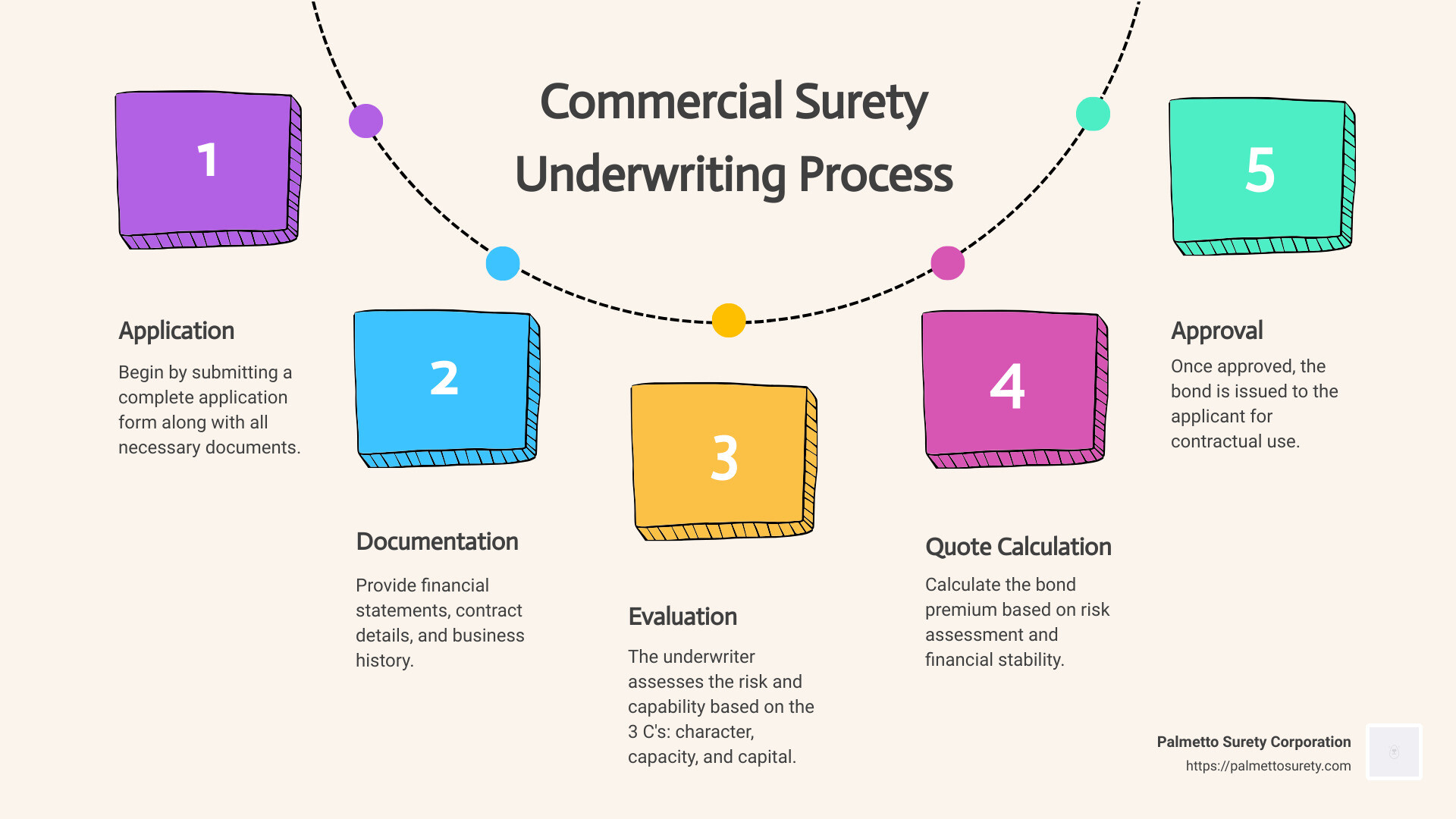
The underwriting process involves several steps:
- Submit Application: The principal submits a detailed application with all necessary documentation.
- Risk Evaluation: The underwriter reviews the application, focusing on the Three C’s.
- Quote Calculation: Based on the risk assessment, the underwriter calculates the bond premium.
This process can take anywhere from a few minutes to several weeks, depending on the complexity of the bond and the thoroughness of the application.
Understanding these elements is crucial for any business seeking a surety bond. It ensures that you are well-prepared to meet the underwriter’s requirements and secure the bond you need to move forward with your projects.
The Surety Underwriting Process
Steps in the Underwriting Process
The surety underwriting process is essential for evaluating the risk and determining the premium for a commercial surety bond. Here are the key steps involved:
- Submit Application:
-
The first step is for the principal (the business seeking the bond) to submit a detailed application. This includes providing all necessary documentation, such as financial statements, business history, and any other relevant information.
-
Risk Evaluation:
-
Once the application is submitted, the surety underwriter begins the risk evaluation process. They will assess the principal’s qualifications, focusing on the Three C’s: Character, Capacity, and Capital. This involves reviewing the principal’s credit history, financial health, and business experience.
-
Quote Calculation:
- Based on the risk evaluation, the underwriter calculates the bond premium. This is typically a percentage of the total bond amount and can range from 0.5% to 10%. The exact rate depends on the assessed risk level.
Factors Affecting Underwriting Decisions
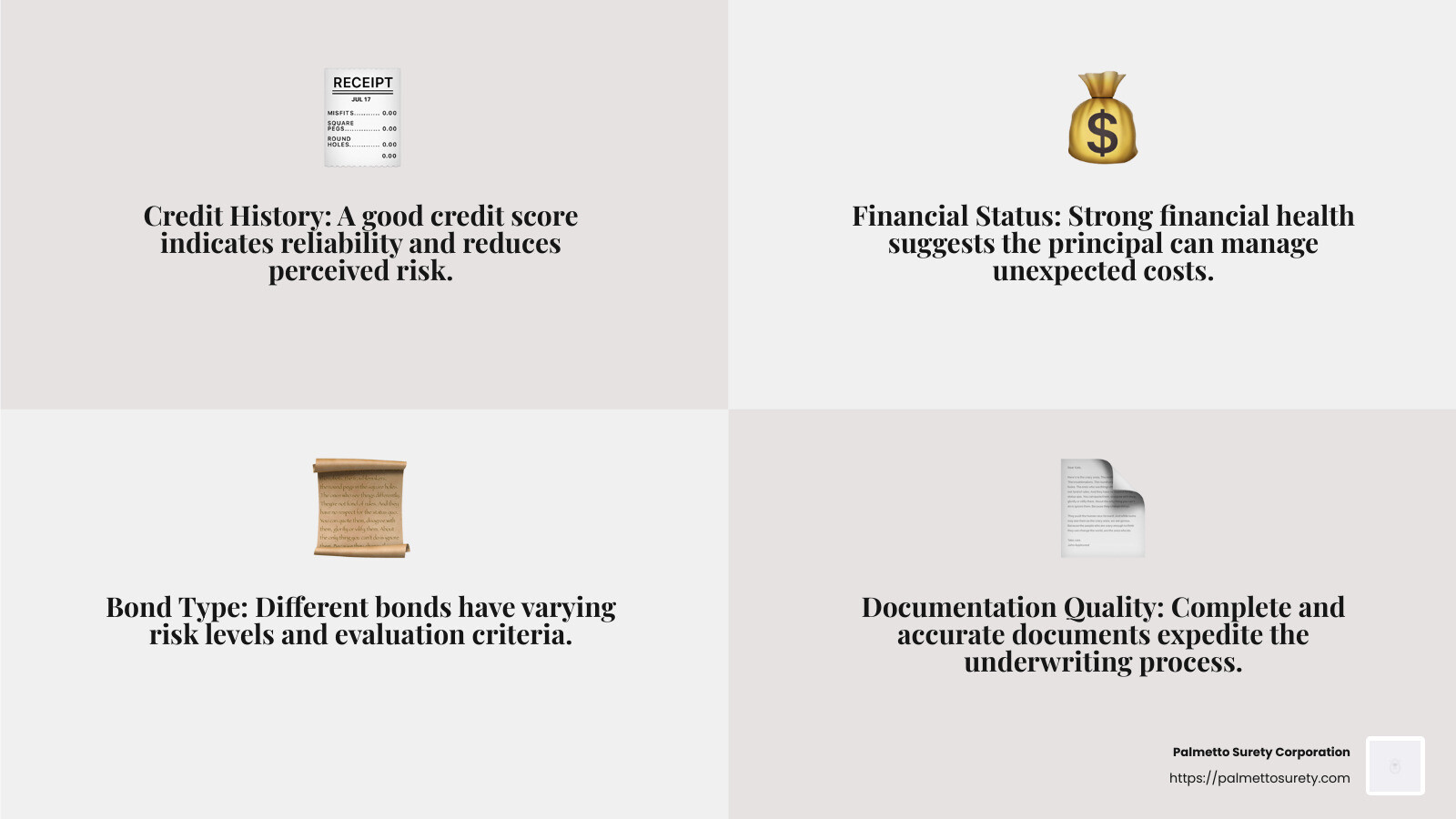
Several factors influence the surety underwriter’s decision and the final premium quote. These include:
- Credit History:
-
A principal’s credit score is a critical factor. A good credit history indicates reliability and reduces perceived risk. Conversely, a low credit score can result in higher premiums or even denial of the bond application.
-
Financial Status:
-
The financial health of the principal is thoroughly examined. Underwriters look at financial statements, liquidity, and debt levels. A strong financial position suggests that the principal can handle unexpected costs and fulfill their obligations.
-
Bond Type:
-
The type of bond also affects the underwriting process. Some bonds, like performance and payment bonds, are inherently riskier and require more extensive evaluation. Bonds with multi-year terms or substantial penalty sums also undergo stricter scrutiny.
-
Documentation Quality:
- The completeness and accuracy of the submitted documentation can significantly impact the underwriting timeline and decision. Incomplete or inaccurate information can lead to delays or denial.
Examples of How These Factors Play Out
Consider a construction company applying for a performance bond for a large project. The underwriter will:
- Evaluate Character: Check the company’s history of completing projects on time and within budget.
- Assess Capacity: Review the company’s experience with similar projects, available resources, and management skills.
- Examine Capital: Analyze the company’s financial statements to ensure they have the financial strength to handle the project.
If the company has a strong credit history, extensive experience, and robust financials, they are likely to receive a favorable premium quote quickly. However, if they have a poor credit score or insufficient documentation, the process could be delayed, or the application might be denied.
Understanding the surety underwriting process and the factors that influence it can help businesses prepare better applications and secure the bonds they need efficiently.
Types of Commercial Surety Bonds
Commercial surety bonds come in various forms, each designed to meet specific needs in different industries. Here, we’ll focus on three common types: performance bonds, payment bonds, and fiduciary bonds.
Performance Bonds
Performance bonds guarantee that a contractor will complete a project according to the contract terms. These bonds are especially crucial in the construction industry, where project delays or failures can lead to significant financial losses. According to the International Risk Management Institute, a performance bond protects the project owner by covering financial losses up to the bond limit if the contractor defaults.
Payment Bonds
Payment bonds, also known as labor and material payment bonds, ensure that contractors pay their workers, subcontractors, and suppliers. This type of bond is vital in preventing liens against the property and ensuring that all parties involved in a project are compensated. Payment bonds are typically required alongside performance bonds in construction projects.
Fiduciary Bonds
Fiduciary bonds are used in situations where an individual is responsible for managing another person’s assets. These bonds are common in the healthcare and legal industries, where guardians, executors, and trustees need to guarantee their ethical and responsible management of assets. Fiduciary bonds protect the interests of those who rely on the fiduciary’s integrity and competence.
Common Industries Using Surety Bonds
Surety bonds are essential across various industries, providing financial security and ensuring compliance with contractual obligations. Here are some industries that commonly use surety bonds:
Construction
The construction industry heavily relies on surety bonds, especially performance bonds and payment bonds. These bonds are often required for public projects to protect taxpayer money and ensure project completion. Without these bonds, contractors may not even qualify to bid on public works. According to the Construction Industries of Massachusetts, “If you can’t get a surety bond, you can’t bid on public work.”
Manufacturing
In the manufacturing sector, surety bonds are used to ensure compliance with industry regulations and contractual obligations. For example, license and permit bonds may be required for manufacturers to legally operate, ensuring they meet all regulatory standards.
Transportation
The transportation industry uses surety bonds to guarantee the performance and payment of services. Freight broker bonds and motor carrier bonds are common, ensuring that transport companies adhere to federal regulations and pay their subcontractors and suppliers.
Healthcare
In healthcare, fiduciary bonds are often required for individuals managing patient funds or estate assets. These bonds ensure that fiduciaries act in the best interest of those they serve, providing a layer of protection against misuse of funds.
Understanding the different types of commercial surety bonds and their applications in various industries can help businesses secure the right bonds for their needs. This not only ensures compliance but also builds trust with clients and stakeholders.
Next, we’ll explore the differences between surety underwriting and insurance underwriting, highlighting the unique aspects of each process.
Differences Between Surety Underwriting and Insurance Underwriting
Understanding the differences between surety underwriting and insurance underwriting is crucial for businesses seeking bonds and insurance policies. While both processes involve evaluating risk and determining premiums, they have distinct approaches and assumptions. Let’s explore the key differences.
Risk Evaluation
Insurance Underwriting
Insurance underwriters evaluate the risk of insuring a person, business, or property. They assess factors like health, lifestyle, and history to predict the likelihood of a claim. For example, health insurance underwriters might look at medical history, while auto insurance underwriters consider driving records.
Surety Underwriting
Surety underwriters focus on the risk of the principal (the bond applicant) defaulting on their obligations. They evaluate the three C’s: character, capacity, and capital. This involves reviewing credit scores, financial stability, and professional history. According to industry experts, character is often the most important factor, as it indicates the principal’s reliability and integrity.
Premium Calculation
Insurance Underwriting
Insurance premiums are calculated based on the probability of a claim being made. Insurers expect claims to occur and set premiums to cover these anticipated losses. For instance, a health insurance policy might have higher premiums for individuals with pre-existing conditions.
Surety Underwriting
Surety bond premiums are calculated based on the likelihood of the principal fulfilling their obligations without a claim being made. Sureties assume that the bond will not be used. Therefore, premiums are generally lower compared to insurance. However, factors like a low credit score or previous bond claims can increase premiums significantly.
Coverage Assumptions
Insurance Underwriting
Insurance policies are designed to cover losses from unforeseen events, such as accidents or natural disasters. The insurer expects to pay out claims and sets aside reserves for this purpose. For example, auto insurance covers damages from car accidents, regardless of fault.
Surety Underwriting
Surety bonds, on the other hand, do not cover losses in the traditional sense. Instead, they guarantee that the principal will fulfill their contractual obligations. If the principal defaults, the surety pays the obligee (the project owner) and then seeks reimbursement from the principal. This makes surety bonds more like a line of credit than insurance.
Practical Implications
Understanding these differences can help businesses better prepare for the underwriting process. For instance, maintaining good credit and having a solid financial history can significantly impact surety bond premiums. On the other hand, for insurance, focusing on risk mitigation strategies, like safe driving or healthy living, can help lower premiums.
In summary, while both surety and insurance underwriting involve risk assessment and premium calculation, they differ in their approach and assumptions. Surety underwriting focuses on the principal’s ability to fulfill obligations, while insurance underwriting prepares for potential claims. This distinction is vital for businesses navigating these financial products.
Next, we’ll address some frequently asked questions about commercial surety underwriting, providing further insights into this essential process.
Frequently Asked Questions about Commercial Surety Underwriting
What are the 5 C’s of Surety Underwriting?
In commercial surety underwriting, underwriters often evaluate the 5 C’s to assess the risk and decide whether to approve a bond application. These are:
-
Character: This is about the applicant’s integrity and reputation. Underwriters look for a history of making payments on time, personal references, and a clear legal record.
-
Capacity: This refers to the applicant’s ability to fulfill the bond obligations. Underwriters examine industry expertise, work history, education, and even the machinery or tools they use.
-
Capital: This measures the financial health of the applicant. It includes personal credit history, business financials, owned assets, and overall net worth.
-
Conditions: Conditions refer to the specific terms of the bond and the external environment affecting the bond. For example, economic conditions or industry-specific risks.
-
Collateral: Sometimes, underwriters may require collateral to secure the bond. This can be cash, property, or other assets that can be used to cover potential claims.
How Long Does the Underwriting Process Take?
The underwriting process can vary in duration depending on several factors:
-
Bond Type: Simple bonds may be underwritten in as little as 5 minutes, while more complex bonds, like performance or payment bonds, can take days or even weeks.
-
Amount: Larger bond amounts generally require more scrutiny and take longer to process.
-
Documentation: The speed of the process is also influenced by how quickly and accurately you submit the required documentation. Missing or incomplete documents can delay the process significantly.
For example, if you apply for a bond between 8 AM and 4 PM, Monday to Friday, companies often process applications the same day. However, for more complex bonds, expect a longer timeframe.
What Can Cause a Bond Application to be Denied?
Several factors can lead to the denial of a bond application:
-
Bankruptcy Declarations: A history of bankruptcy can raise red flags for underwriters.
-
Lawsuits: Being involved in ongoing or past lawsuits can indicate potential risks.
-
Tax Liens: Unresolved tax issues can be a major concern.
-
Missing Payments: A history of late or missed payments can affect your application.
-
High Volume of Debts: Too much debt can indicate financial instability.
-
License Suspensions: Suspended or revoked licenses can make you a high-risk applicant.
If your application is denied, the surety company should provide specific reasons. You can dispute the denial by providing updated information, such as cash verification, screenshots of bank accounts, or proof of paid bills.
Understanding these factors can help you better prepare for the underwriting process and increase your chances of approval.
Conclusion
In summary, commercial surety underwriting is a meticulous process that evaluates the risk and credibility of applicants seeking surety bonds. This process ensures that the principal, or the party seeking the bond, is capable of fulfilling their contractual obligations. The 5 C’s of Underwriting—character, capacity, capital, conditions, and collateral—are key factors that underwriters consider to make informed decisions.
At Palmetto Surety Corporation, we understand that navigating surety bonds can be daunting. That’s why we strive to make the process as quick and efficient as possible. With over 20 years of experience in the industry, we specialize in providing surety bonds for various sectors, including construction, manufacturing, transportation, and healthcare. Our expertise allows us to approve most applications within hours, ensuring that you get the bonds you need without unnecessary delays.
Our commitment to quick approval and efficient service sets us apart. We leverage state-of-the-art technology to simplify the underwriting process, making it hassle-free for our clients. Whether you need a performance bond, payment bond, or any other type of commercial surety bond, you can trust Palmetto Surety Corporation to deliver fast and reliable service.
For more information or to start your application, visit our website or contact us today. We’re here to help you secure the bonds you need to keep your business running smoothly.


