


State of Florida Surety Bond Requirements: Top 10 Must-Knows
Introduction
Florida’s surety bond requirements can be confusing, but they are essential for many professionals and businesses in the state. Surety bonds serve as a financial guarantee, ensuring that individuals and companies meet their contractual obligations. Here’s a brief overview of who needs surety bonds in Florida and what the requirements are:
- Construction Projects: Bonds are mandated for projects over $100,000 or any involving federal buildings.
- Contractors: Bid, performance, and payment bonds are essential.
- Licensed Professionals: Auto dealers, insurance brokers, public adjusters, and more require specific bonds.
- Specialty Bonds: Industries like agriculture, beverage distribution, and collection agencies have unique bonding requirements.
Understanding these requirements and obtaining the right bond is simplified by companies like Palmetto Surety Corporation, ensuring compliance and financial protection.
Surety Bonds – State of Florida Surety Bond Requirements
Understanding Surety Bonds in Florida
Surety bonds play a crucial role in ensuring compliance and financial protection in Florida. Let’s break down the key components and how they work.
Three-Party Agreement
A surety bond involves three parties:
- Principal: The person or business required to obtain the bond. They are responsible for fulfilling the bond’s terms and conditions.
- Obligee: The entity that requires the bond. This is often a government agency or a private entity that needs assurance the principal will adhere to specific regulations.
- Surety: The company that issues the bond, guaranteeing to the obligee that the principal will meet their obligations.
Financial Protection
Unlike regular insurance, which protects the policyholder, surety bonds protect the obligee and the public. If the principal fails to meet their obligations, the surety steps in to cover the financial loss, up to the bond’s value.
For example, if a contractor fails to complete a project, the surety company will compensate the obligee for any financial losses. However, the principal must repay the surety for any claims paid out. This ensures that the principal remains accountable for their actions.
Surety Bonds in Action
Consider a scenario where a travel agent in Florida must secure a $50,000 surety bond to offer vacation certificates. This bond ensures the agent abides by the Florida Sellers of Travel Act. If the agent fails to deliver on their promises, affected customers can file a claim against the bond.

Key Documents
When obtaining a surety bond, you’ll typically encounter:
- Bond Form: A one- or two-page document outlining the bond’s specifics, including the principal’s obligations.
- Power of Attorney Form: A document that accompanies the bond form, authorizing the surety agent to act on behalf of the surety company.
Understanding these components helps ensure compliance with Florida’s surety bond requirements and provides peace of mind for all parties involved. Next, we’ll explore the different types of surety bonds required in Florida.
Types of Surety Bonds Required in Florida
Florida mandates various types of surety bonds based on the industry and type of work. Below are the key categories:
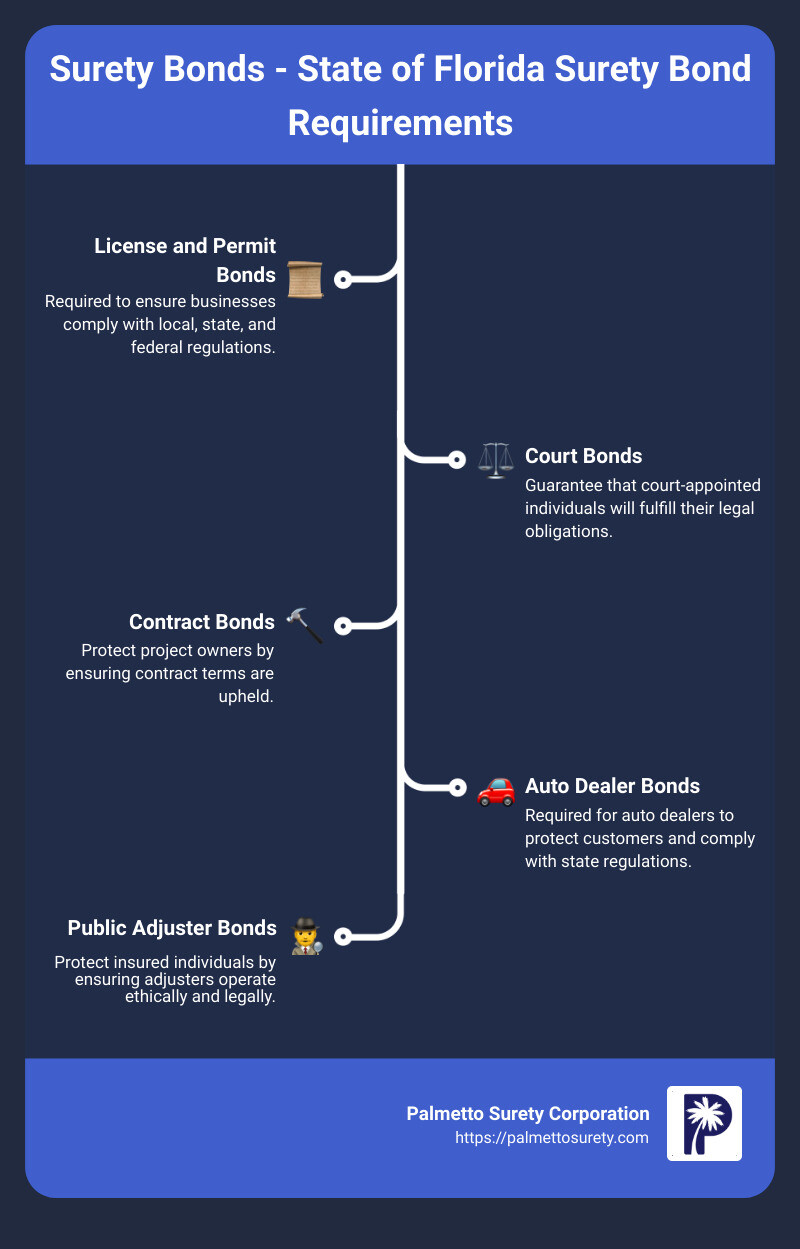
License and Permit Bonds
These bonds are required by state or local laws for specific businesses and professionals. They ensure compliance with regulations and protect the public from fraud or malpractice. For example, auto dealers must obtain a $25,000 surety bond to operate legally in Florida.
Court Bonds
Court bonds come into play during legal proceedings. There are two main types:
- Judicial Bonds: Protect against potential financial losses from court rulings.
- Probate Bonds: Required when a fiduciary is appointed to manage an estate.
Contract Bonds
Contract bonds are crucial for those bidding on or working on construction projects. They include:
- Performance Bonds: Ensure the contractor completes the project as per the contract.
- Payment Bonds: Guarantee that subcontractors, laborers, and suppliers are paid.
- Bid Bonds: Assure that the contractor will not charge more than the bid amount.
Contractor License Bonds
These bonds are necessary for contractors to get licensed in various counties and municipalities. They ensure adherence to local laws and building codes. Here are a few examples:
- Osceola Contractor’s Bond: $5,000
- Orlando Contractor’s Bond: $5,000
- Palm Beach County Contractor License Bond: $2,000
Auto Dealer Bonds
All motor vehicle dealers in Florida must post a $25,000 surety bond before receiving a dealership license. This bond ensures dealers represent vehicle conditions accurately, follow state laws, and pay taxes.
Public Adjuster Bonds
To operate as a public adjuster in Florida, you need a $50,000 surety bond. This bond ensures compliance with regulations set by the Department of Financial Services.
Yacht and Ship Broker Bonds
Individuals and businesses selling yachts or aquatic vessels need a $25,000 surety bond to get licensed. A separate $25,000 bond is required for individual yacht salespersons.
Collection Agency Bonds
Collection agencies must post a $50,000 surety bond to operate in Florida. This bond ensures adherence to the Florida Statutes and remains in effect until canceled.
Medicaid Provider Bonds
Medicaid providers are required to post surety bonds to ensure compliance with Medicaid regulations. The bond amount varies but is often set at $50,000.
Process Server Bonds
Process servers need surety bonds to guarantee their performance and adherence to legal requirements. The bond amount can vary based on the county.
Understanding these bond requirements is crucial for operating legally and ethically in Florida. Next, we’ll discuss how to obtain a surety bond in the state.
How to Obtain a Surety Bond in Florida
Getting a surety bond in Florida may seem complex, but breaking it down into steps can simplify the process. Here’s what you need to know.
Application Process
-
Identify the Type of Bond: First, determine the type of bond you need. Different professions and activities require specific surety bonds. For instance, contractors might need a contractor license bond, while auto dealers need an auto dealer bond.
-
Select a Bonding Company: Choose a reputable bonding company like Palmetto Surety Corporation. They can guide you through the process and ensure you meet all state requirements.
-
Fill Out an Application: Complete an application form. This usually includes details about your business, financial standing, and sometimes personal information.
-
Submit Required Documents: Gather and submit necessary documents. This may include business and personal financial statements, proof of work experience, and any relevant licenses or permits.
Factors Considered in Approval
Credit Score
Your credit score is a significant factor. A higher credit score can lower your bond premium. However, Palmetto Surety Corporation can often help even if you have a lower score.
Financial Standing
Your financial health matters. Companies will look at both business and personal financial statements. For high-limit bonds (e.g., over $50,000), you may need detailed financial documents prepared by a CPA.
Work Experience
Experience in your field can influence approval. For instance, contractors may need to show past projects and their outcomes. This helps demonstrate reliability and reduces perceived risk.
Palmetto Surety Corporation
Palmetto Surety Corporation offers a seamless experience:
- Expert Guidance: Their team helps you understand what bond you need and why.
- Efficient Service: They use state-of-the-art technology to simplify the application process.
- Comprehensive Support: Their 24/7 support ensures you get help whenever you need it.
By following these steps and partnering with a reliable company, you can secure the surety bond you need to operate legally in Florida.
Next, let’s look at some common bond amounts required in Florida.
Common Florida Surety Bond Amounts
Understanding the required bond amounts is crucial for compliance with state regulations. Here’s a breakdown of some common surety bond amounts in Florida:
Contractor License Bonds ($5,000 – $20,000)
Contractors in various counties and municipalities in Florida must obtain a surety bond to operate legally. These bonds ensure that contractors adhere to local laws and building codes. The required amounts vary but generally fall between $5,000 and $20,000.
Examples:
– Osceola Contractor’s Bond: $5,000
– Orlando Contractor’s Bond: $5,000
– Palm Beach County Contractor License Bond: $2,000
Auto Dealer Bonds ($25,000)
All motor vehicle dealers in Florida must post a $25,000 surety bond to receive a dealership license. This bond ensures that dealers represent vehicle conditions accurately, comply with state sales laws, and pay all applicable taxes.
Requirements:
– Approved business location
– Completed application form
– $200 fee for each main location
– $25,000 surety bond
– Lease or proof of ownership
– Pre-licensing dealer training completion certificate
– Sales tax number and federal employer identification number
Public Adjuster Bonds ($50,000)
Public adjusters need a $50,000 surety bond to obtain their license in Florida. This bond guarantees that adjusters follow all regulations in the Florida Statutes.
Collection Agency Bonds ($50,000)
Collection agencies must post a $50,000 surety bond as required by the Financial Services Commission of Florida. This bond ensures that agencies comply with state laws and ethical standards in debt collection.
Medicaid Provider Bonds ($50,000)
Medicaid providers in Florida are required to post a $50,000 surety bond. This bond ensures that providers adhere to all Medicaid regulations and billing practices.
Title Agency Bonds ($35,000)
Title agencies must secure a $35,000 surety bond to operate in Florida. This bond guarantees that the agency complies with state regulations and handles all transactions ethically.
By understanding these common bond amounts, you can ensure compliance with Florida’s surety bond requirements and operate your business legally.
Next, we’ll address some frequently asked questions about Florida surety bonds.
Frequently Asked Questions about Florida Surety Bonds
Do Florida surety bonds expire?
Yes, most surety bonds in Florida have a set term. Typical bond terms are 1, 2, or 3 years. However, some bonds are issued as continuous bonds, meaning they remain in force until canceled by the bonding company.
How much do surety bonds cost in Florida?
The cost of a surety bond is not the same as the bond amount. Instead, you pay a premium that is a percentage of the bond amount. This premium can range from 1% to 15% of the bond amount, depending on the type of bond and the risk involved.
Factors that affect the premium include:
– Type of bond: Some bonds are riskier than others.
– Credit score: Higher credit scores usually mean lower premiums.
– Financial standing and work experience: Strong financials and relevant experience can reduce the cost.
For example, a $50,000 public adjuster bond might have a premium ranging from $500 to $7,500.
Can you get a surety bond with bad credit?
Yes, it is possible to get a surety bond with bad credit. While a lower credit score might result in a higher premium, some surety companies offer flexible bonding options for those with less-than-perfect credit. Companies like Palmetto Surety Corporation can help you navigate these options and find a bond that suits your needs.
For more information on obtaining a surety bond in Florida, check out our detailed guide.
Next, we’ll conclude with some final thoughts on navigating Florida’s surety bond requirements.
Conclusion
Navigating the state of Florida surety bond requirements might seem daunting at first, but with the right guidance and resources, it becomes manageable. At Palmetto Surety Corporation, we pride ourselves on offering comprehensive support to help you through every step of the bonding process.
Our team of experts is dedicated to providing personalized service, ensuring that you get the right bond for your specific needs. Whether you’re a contractor needing a license bond, a business requiring a permit bond, or an individual seeking a court bond, we’ve got you covered.
Why choose Palmetto Surety Corporation?
-
Expertise: With over twenty years of experience in the surety bond industry, we have the knowledge and expertise to handle all types of bonds. Our team understands the nuances of Florida’s requirements and can guide you through the process smoothly.
-
Technology: Our state-of-the-art platform allows you to purchase, print, and manage your surety bonds with ease. This technology streamlines the process, saving you time and reducing hassle.
-
Support: We offer 24/7 dedicated support to ensure that you receive the best possible service at all times. Our team is always ready to assist you with any questions or concerns you may have.
-
Flexibility: We understand that not everyone has perfect credit. That’s why we offer flexible bonding options to accommodate various financial situations. Our goal is to help you get the bond you need, regardless of your credit score.
Get Started Today
Don’t let the complexities of surety bonds hold you back. Reach out to Palmetto Surety Corporation for all your bonding needs. We’re here to help you navigate the requirements and secure the bond that suits your situation.
For more information on obtaining a surety bond in Florida, visit our Surety Bonds page.

By choosing Palmetto Surety Corporation, you’re not just getting a bond; you’re gaining a trusted partner dedicated to your success. Let us help you meet Florida’s surety bond requirements with confidence and ease.


