


Construction Bond Costs 2024: Top Factors & Tips Explained
Introduction
When it comes to the construction bond cost, understanding what affects these costs is crucial for making informed decisions. Here’s what you need to know if you’re in a hurry:
Quick Overview:
- Typical Cost Range: 0.5% to 4% of the contract amount
- Factors: Contract amount, type, length, warranty, credit rating, and more
- Quotes: Often free to obtain
The construction bond cost plays a pivotal role in safeguarding investment and ensuring project completion. This financial guarantee, often a requirement for public construction projects, protects project owners from financial loss due to contractor failures. Properly navigating these costs can help avoid unexpected financial setbacks.
Palmetto Surety Corporation stands out in this space. With extensive experience since 2003, they streamline the process, offer 24/7 support, and ensure businesses meet their contractual obligations.
My name is Haiko de Poel Jr. With years in marketing strategy and digital transformation, I’ve helped companies like Palmetto Surety Corporation optimize their bonding processes for increased efficiency and reliability.
Feel free to read on for a deeper dive into construction bond costs, but the essentials are covered above.
What is a Construction Bond?
A construction bond is a type of surety bond that serves as a financial guarantee for construction projects. It ensures that contractors will fulfill their contractual obligations, protecting project owners from financial loss if the contractor fails to complete the project or meet the agreed-upon specifications.

Purpose of Construction Bonds
The primary purpose of construction bonds is to provide security to the project owner (often referred to as the obligee). By requiring a construction bond, the project owner ensures that the contractor (the principal) will:
- Complete the project as per the contract terms
- Pay for all labor and materials
- Adhere to all relevant regulations and standards
In the unfortunate event that the contractor defaults, the surety company steps in to cover the financial loss, ensuring the project can continue without significant disruption.
Types of Construction Bonds
There are three major types of construction bonds, each serving a unique purpose:
-
Bid Bonds: These bonds are submitted during the bidding process. They guarantee that if a contractor wins the bid, they will enter into the contract and provide the required performance and payment bonds. If the contractor fails to do so, the surety compensates the project owner.
-
Performance Bonds: These ensure that the contractor will complete the project according to the contract terms. If the contractor fails to perform, the surety company will either complete the project or compensate the project owner for the financial loss.
-
Payment Bonds: These bonds guarantee that the contractor will pay all subcontractors, laborers, and material suppliers. This protects the project owner from potential liens or claims if the contractor fails to make these payments.

Real-World Example
Imagine a city planning to build a new public library. They open the project for bids and require all bidding contractors to submit a bid bond. Once a contractor wins the bid, they must then provide performance and payment bonds before starting the project. This ensures the city that the library will be built on time, within budget, and that all workers and suppliers will be paid.
In summary, construction bonds are essential tools for managing risk in construction projects. They provide peace of mind to project owners and ensure that contractors adhere to their contractual obligations. Understanding these bonds is crucial for anyone involved in the construction industry.
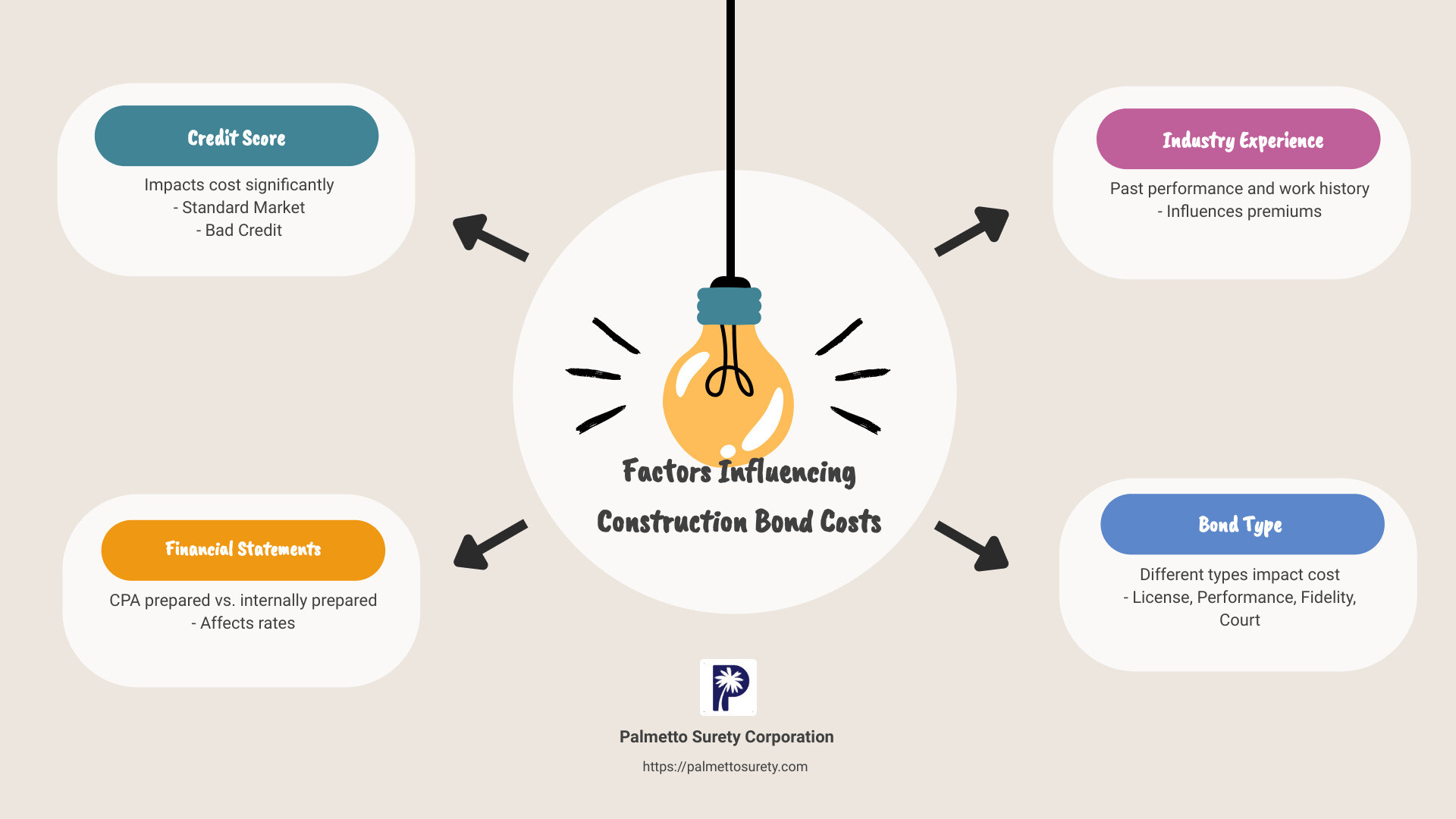
Factors Influencing Construction Bond Costs
Credit Score
Your credit score is one of the most critical factors in determining construction bond cost. Surety companies assess your credit score to gauge your financial responsibility.
- Good Credit: If your credit score is high, you’re likely to get lower bond rates, often between 0.5% and 1.5% of the contract price.
- Bad Credit: A poor credit score can push your rates up to 3% or more. This is because sureties see you as a higher risk.
Financial Statements
The type of financial statements you provide also plays a significant role in bond cost.
- CPA Prepared: Financial statements prepared by a Certified Public Accountant (CPA) are seen as more reliable. They often result in lower rates.
- Internally Prepared: If you submit internally prepared financial statements, expect higher rates. The lack of third-party verification makes these less trustworthy.
Industry Experience
Your past performance and work history can impact your bond premiums.
- Solid Track Record: Contractors with a history of completing projects successfully will generally receive lower rates.
- Limited Experience: If you’re new or have a history of incomplete projects, your rates will be higher due to perceived risk.
Bond Type
Different types of bonds have varying cost structures.
- License Bonds: These are typically cheaper and required for obtaining professional licenses.
- Performance Bonds: These protect the project owner from financial loss due to contractor failure. Rates usually range from 0.5% to 2.5%.
- Fidelity Bonds: These protect against employee dishonesty and are priced based on the number of employees and controls in place.
- Court Bonds: These include probate, appeal, and guardianship bonds. Costs vary widely based on the court requirements and the specifics of the case.
Asset Verification: Surety companies may also verify your assets to further assess risk. The more assets you have, the lower your bond cost might be.
Understanding these factors can help you better manage and potentially reduce your construction bond costs. Next, we’ll dive into how these costs are calculated, providing you with a clear picture of what to expect.
How Construction Bond Costs are Calculated
Percentage of Bond Amount
Construction bond costs are typically calculated as a percentage of the bond amount. This percentage can range from 0.5% to 3%, depending on various factors like your credit score, financial statements, and past performance. For example, if you need a bond for a $1,000,000 project, your cost could be anywhere from $5,000 to $30,000.
Risk Assessment
Surety companies conduct a risk assessment to determine your bond rate. They evaluate your financial stability, credit score, and work history. Contractors with strong financials and a good credit score usually get lower rates. Conversely, those with poor credit or financial instability may face higher rates, sometimes up to 3%.
Example Calculation
Let’s say you have a $500,000 contract and the surety company assigns you a rate of 1.5%. Here’s how the cost breaks down:
- First $100,000 @ 2.5%: $100,000 * 0.025 = $2,500
- Next $400,000 @ 1.5%: $400,000 * 0.015 = $6,000
Total Cost: $2,500 + $6,000 = $8,500
This example shows how the rate decreases as the contract value increases, resulting in a lower overall percentage.
Additional Fees
Besides the primary bond cost, there are additional fees to consider:
- Agency Fees: Some surety agencies charge a fee for their services. This can be a flat fee or a small percentage of the bond amount.
- Broker Fees: If you use a broker to obtain your bond, they may charge a fee. This is usually a percentage of the bond cost.
- Operating Costs: There might be other minor fees like overnight mailing charges or credit report fees.
For example, if your bond cost is $8,500, and your broker charges a 1% fee, you’d pay an additional $85, making the total $8,585.
Understanding these calculations and fees helps you budget more accurately for your construction projects. Next, we’ll explore the cost variations among different types of bonds.
Surety Bond Costs by Bond Type
Surety bond costs can vary significantly based on the type of bond you need. Let’s break down the costs for the most common types of surety bonds: license bonds, construction bonds, fidelity bonds, and court bonds.
License Surety Bond Costs
License bonds are often required by city or state governments to ensure businesses comply with local regulations. The cost of these bonds depends on the type of license and the specific requirements of the jurisdiction.
- City/State Requirements: Different regions have different bond requirements. For example, a contractor’s license bond in California might have different costs compared to one in Texas.
- License Type: The type of business license also affects the bond cost. Auto dealer bonds, for instance, might have different rates than contractor license bonds.
- Cost Range: Typically, license bonds range from $100 to $1,000 annually. For example, an auto dealer bond might cost around $500 per year, depending on the state and the dealer’s credit score.
Construction Bond Costs
Construction bonds include performance bonds and bid bonds, which are essential in the construction industry.
- Performance Bonds: These bonds ensure that the contractor will complete the project according to the contract terms. The cost is typically 1% to 3% of the contract value. For instance, a $500,000 project might have a performance bond cost ranging from $5,000 to $15,000.
- Bid Bonds: These bonds guarantee that the bidder will enter into the contract if awarded. They are usually less expensive and can sometimes be obtained at no cost. However, some surety companies may charge a small fee or an annual fee.
Fidelity Bond Costs
Fidelity bonds protect businesses from losses caused by dishonest employees. The cost depends on the coverage type, number of employees, and internal controls in place.
- Coverage Type: First-party fidelity bonds cover losses due to employee dishonesty, while third-party bonds protect customers from dishonest employees.
- Number of Employees: More employees generally mean higher bond costs, as the risk of fraud increases.
- Controls in Place: Companies with strong internal controls and fraud prevention measures may receive lower rates.
- Cost Range: Fidelity bonds usually cost between 1% and 3% of the coverage amount. For a $50,000 bond, the cost might range from $500 to $1,500 annually.
Court Bond Costs
Court bonds are required in various legal proceedings, such as probate, appeal, and guardianship cases.
- Probate Bonds: These bonds are required for executors or administrators of estates. The cost is generally 0.5% to 1% of the estate’s value.
- Appeal Bonds: These bonds ensure that the appellant will pay the judgment if the appeal is unsuccessful. Costs typically range from 1% to 2% of the judgment amount.
- Guardianship Bonds: These are for guardians managing the assets of minors or incapacitated individuals. The cost is usually around 0.5% to 1% of the asset value under guardianship.
Understanding the costs associated with different types of surety bonds helps you plan and budget effectively for your business needs. Next, we’ll answer some frequently asked questions about construction bond costs.
Frequently Asked Questions about Construction Bond Costs
What is the average cost of a construction bond?
The average cost of a construction bond typically ranges from 1% to 3% of the contract amount. This means if you have a $100,000 contract, your bond cost could be anywhere from $1,000 to $3,000. The exact rate depends on several factors, including your credit score, financial statements, and the type of bond required. For larger contracts, some sureties offer “tiered” rates, which can reduce the percentage cost as the contract value increases.
How does bad credit affect construction bond costs?
Bad credit can significantly impact the cost of your construction bond. Most sureties view low credit scores as a higher risk, which often results in higher premiums. If your credit is less than stellar, you might see rates as high as 10% to 15% of the bond amount. For example, on a $100,000 bond, this could mean a cost of $10,000 to $15,000. However, some surety companies specialize in high-risk bonds and can offer more competitive rates even if your credit isn’t perfect.
Can construction bond costs be reduced?
Yes, there are several ways to potentially reduce your construction bond costs:
-
Improve Your Credit Score: Paying off debts and ensuring timely payments can improve your credit score, leading to lower bond premiums.
-
Provide Strong Financial Statements: Having CPA-prepared financial statements can demonstrate financial stability and reduce perceived risk.
-
Showcase Industry Experience: A solid track record and positive past performance can make you more attractive to sureties, potentially lowering your rates.
-
Shop Around: Different sureties offer different rates. Getting multiple quotes can help you find the best deal.
-
Maintain a Good Relationship with Your Surety: Consistently fulfilling your contractual obligations and maintaining open communication can lead to better rates over time.
By focusing on these areas, you can work towards reducing the cost of your construction bonds, making your business more competitive and financially efficient.
Conclusion
Understanding construction bond costs can be complex, but we hope this guide has simplified it for you. The key factors—credit score, financial statements, industry experience, and bond type—all play a crucial role in determining your bond rate.
At Palmetto Surety Corporation, we pride ourselves on providing exemplary customer support and leveraging our 20 years of expertise to help you navigate the intricacies of construction bonds. We offer a wide range of surety bonds, from performance bonds to fidelity bonds, tailored to meet your specific needs.
Our goal is to make the bonding process as smooth and hassle-free as possible. With our cutting-edge technology, you can purchase, print, and manage your surety bonds with ease. Plus, our 24/7 dedicated support team is always here to assist you.
If you have more questions or need a quote, don’t hesitate to contact us. We’re here to help you every step of the way.
Secure your business’s future with Palmetto Surety Corporation—your trusted partner in surety bonds.

For more information and to get started, apply online for a free quote today.


