


Are Bounty Hunters Real? 7 Powerful Truths for 2025 Success
Yes, Bounty Hunters Are Real—Here’s What You Need to Know
Are bounty hunters real? Absolutely. Often called bail enforcement agents or fugitive recovery agents, these licensed professionals work for bail bond companies to bring in defendants who skip court.
Quick facts:
• 15,000-20,000 agents operate in the U.S.
• Roughly 31,500 fugitives returned to court each year (≈ 90 % recovery)
• Paid 10-20 % of the bond amount
• Legal in 46 states (not in IL, KY, OR, WI)
• Authority comes from the 1873 Supreme Court case Taylor v. Taintor
Commercial bail is almost unique to the United States, creating a multibillion-dollar industry that depends on bounty hunters. By returning fugitives, they spare taxpayers the cost of long police manhunts and keep the court calendar moving.

Technology has moved the job far beyond the cowboy myth. Modern agents rely on databases, GPS, and social-media forensics as much as surveillance in the field.
I’m Haiko de Poel Jr. of Palmetto Surety Corporation. For more than 20 years we’ve supplied the financial backing that lets licensed bail agents across the Southeast post bonds quickly—often within hours. When a defendant disappears, bounty hunters step in to protect the bond, the court, and ultimately the public.
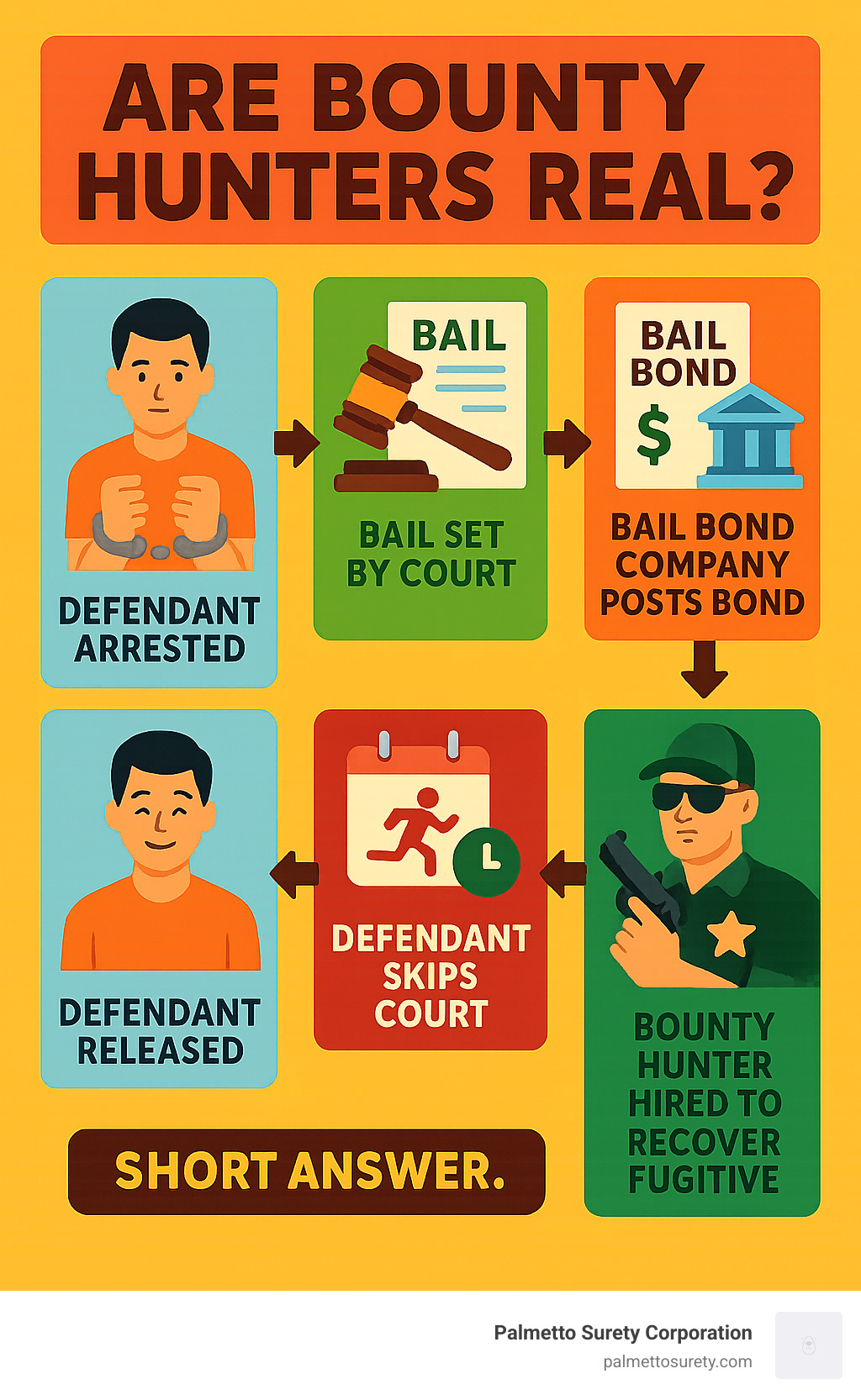
Are Bounty Hunters Real? Short Answer: Yes
Between 15,000 and 20,000 licensed bounty hunters work across America, capturing about 90 % of bail jumpers. Their legal standing is rooted in Taylor v. Taintor (1873), which lets them cross state lines and enter a fugitive’s residence without a warrant—as long as the person signed a commercial bail contract.
The National Association of Fugitive Recovery Agents sets voluntary training standards, while state laws supply the hard rules. Four states—Illinois, Kentucky, Oregon, and Wisconsin—ban commercial bail, so bounty hunting is off-limits there.
How the Law Gives Them Power
A bail contract is civil, not criminal, but it lets sureties (and their agents) take custody of a defendant who violates the agreement. Courts have upheld this private enforcement for 150 years, though states add guardrails such as ID requirements and notice to local police.
The Geographic Limits
Outside the U.S. (and parts of the Philippines) bounty hunting is generally illegal; crossing a border can turn an American agent into an accused kidnapper. High-profile cases in Mexico and Canada underscore why professionals stay within U.S. jurisdiction.
From Wanted Posters to Courtrooms: A Quick History

Bail enforcement predates the Wild West. In medieval England a friend or relative—called a surety—risked punishment if the accused skipped trial. The 1679 Habeas Corpus Act swapped personal risk for money bail, a concept the colonies later adopted.
Key milestones:
• 1789 Judiciary Act: formalized U.S. bail.
• 1793 & 1850 Fugitive Slave Acts: early (and infamous) interstate pursuit precedent.
• 1873 Taylor v. Taintor: granted sureties “dominion” over defendants.
• 1966 & 1984 Bail Reform Acts: modernized federal bail and spurred growth of commercial bonds.
Hollywood made legends of Pat Garrett and “Wanted—Dead or Alive” posters, but today’s bounty hunters work under licensing boards and insurance backing rather than frontier justice.
Inside the Job Today

Modern bounty hunters spend more time on laptops than on horseback. Daily work includes skip-tracing through databases, interviewing relatives, running surveillance, and coordinating arrests with local police when required.
| Bounty Hunter | Police Officer | |
|---|---|---|
| Governing authority | Civil contract | Criminal law |
| Warrant to enter fugitive’s home | Not needed | Usually required |
| Cross-state pursuit | Allowed | Needs extradition |
| Pay | Commission | Salary |
| Legal immunity | Limited | Qualified immunity |
Unlike officers, bounty hunters shoulder full civil liability if they use excessive force or arrest the wrong person. That incentive keeps most professionals careful and well-trained.
Economics
Agents earn 10–20 % of the bond amount. Median income hovers near $50 k, but high performers in busy markets can double that. Their 90 % success rate saves courts and taxpayers millions by avoiding forfeited bonds and lengthy police manhunts.
Interested in the Career? Requirements & Risks

First, check your state. Illinois, Kentucky, Oregon, and Wisconsin forbid bounty hunting. Elsewhere, rules vary:
- Meet minimum age (18 or 21) and background-check standards.
- Complete required training—anywhere from a weekend course to 80 hours in the classroom.
- Secure a state license and liability insurance where mandated.
- Build relationships with bail bond companies (your source of cases).
- Keep up with continuing education; laws change.
Hazards
• Physical danger: fugitives may be armed.
• Legal risk: exceed your authority and kidnapping charges await.
• Civil liability: mistaken identity or property damage can be costly.
Success demands legal knowledge, restraint, and good people skills—far more than flashy takedowns.
Frequently Asked Questions
Are bounty hunters law-enforcement officers?
No. They’re private contractors working for bail bond companies. Their powers apply only to the named defendant and stem from a civil contract, not a badge.
Is bounty hunting legal everywhere in the U.S.?
It’s legal in 46 states. Illinois, Kentucky, Oregon, and Wisconsin have eliminated commercial bail, so bounty hunting isn’t allowed there. Each of the other states sets its own licensing and operating rules.
How effective are bounty hunters?
Industry studies show about a 90 % recovery rate—far higher than typical police fugitive units—because agents are paid only when they succeed.
Conclusion
So, are bounty hunters real? Yes—and they’re essential to the U.S. commercial bail system. By returning thousands of fugitives each year, they protect court integrity and taxpayer dollars.
At Palmetto Surety Corporation we back licensed bail agents across Georgia, Florida, Louisiana, Mississippi, South Carolina, Tennessee, and Texas—approving most bonds within hours from our Charleston headquarters. When speed matters, we’re ready so that bounty hunters can be the last line of defense if a defendant vanishes.
Need surety support fast? Visit Palmetto Surety Corporation or call 833-778-7389 to learn more.


